How Microencapsulated Fragrance Systems Improve Long-Lasting Scent
Long-lasting scent is not achieved simply by adding more perfume oil. In a conventional liquid or powder formulation, the most volatile fragrance components begin to evaporate during production, storage, laundering, drying, and use. Other components can partition into surfactant micelles, dissolve into packaging materials, react with oxidizing ingredients, or remain trapped in the product phase rather than reaching the air. Microencapsulated fragrance systems address these losses by separating part of the fragrance load from the surrounding formula until a defined release event occurs.
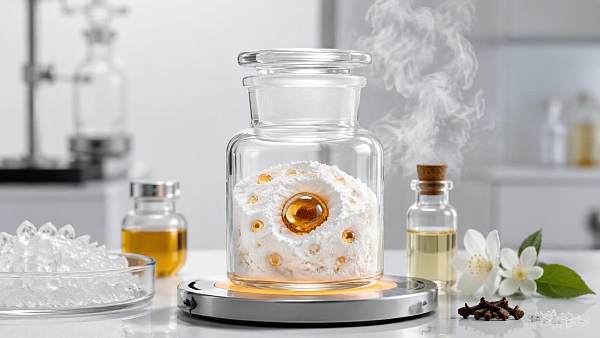
A typical system places fragrance oil inside a polymeric shell or matrix. The capsule protects the core from direct exposure to water, surfactants, heat, air, and reactive ingredients, then releases scent through friction, pressure, moisture change, shell rupture, diffusion, or gradual shell erosion. The result is not necessarily a stronger initial odor. A well-designed capsule system often shifts sensory impact toward the moment when a fabric is rubbed, a towel is handled, hair is touched, or a cleaned surface is revisited.
Retention begins with controlling fragrance loss pathways
Fragrance is a blend of materials with different vapor pressures, polarities, molecular sizes, and chemical sensitivities. A fresh citrus top note, a floral ester, a woody amber material, and a musk-like base note do not behave identically in a detergent or personal-care base. The most volatile fraction is usually the first to be lost from an unprotected fragrance composition. If the formula contains water, high surfactant levels, solvents, electrolytes, oxidants, or enzymes, the loss pattern becomes more complex.
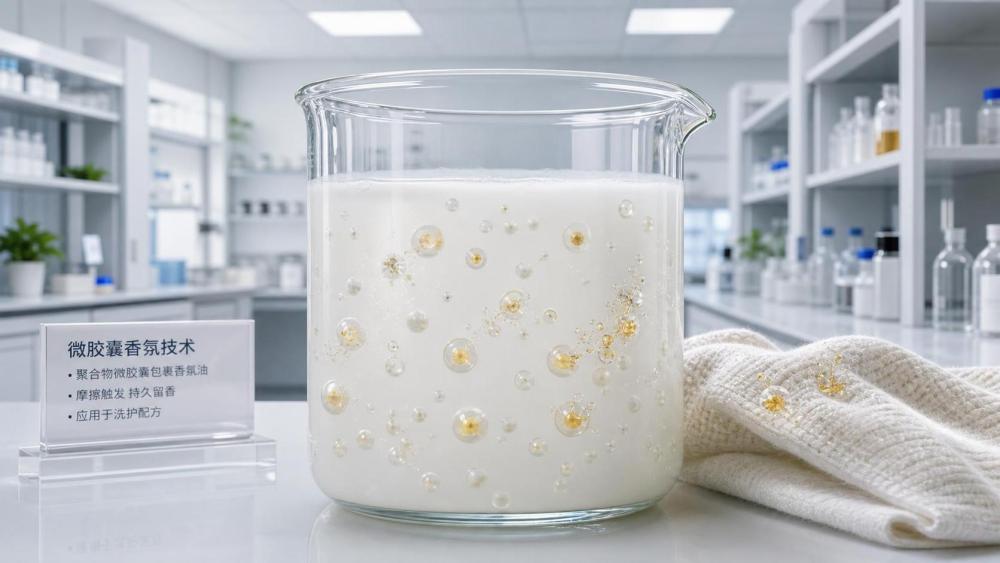
Encapsulation changes that exposure. The shell creates a physical boundary between the fragrance and the bulk formulation. This slows direct evaporation and can reduce contact with ingredients that alter the odor profile. It also limits immediate solubilization of the fragrance in the continuous phase. In a laundry product, for example, a portion of the fragrance can be carried through the wash and deposited on textile fibers as intact capsules. Later mechanical action breaks part of the deposited population and produces a renewed scent event.
This distinction matters during evaluation. A fragrance system with low headspace intensity in the package may deliver better post-use performance than a free oil fragrance with a powerful package opening. Package odor, wet-product odor, dry-fabric odor, and rub-release odor are separate sensory states. Treating them as one measurement can lead to selection of a system that performs well before use but fades quickly after application.
The capsule is a release device, not only a protective container
Shell material determines how the capsule survives processing and how it responds during use. Common shell families include aminoplast-based materials, polyurea or polyurethane structures, polysaccharide-derived systems, protein-based materials, lipid-based carriers, and other polymeric or hybrid architectures. Their suitability depends on the target product and release mechanism rather than on a simple ranking of “stronger” or “more natural.”
A rigid shell can retain fragrance effectively and withstand moderate agitation during storage. Yet excessive shell strength may reduce release on fabric or skin contact. A softer or more deformable wall may release fragrance readily under pressure but be more vulnerable to pumping, mixing, filling, or transport vibration. Matrix-style particles behave differently from hollow core-shell capsules: fragrance diffuses through a carrier network rather than being retained in a discrete liquid core. This can provide a smoother release profile, although the retained perfume level and trigger response may differ from rupture-driven capsules.
Particle size also changes both processing behavior and sensory performance. Larger capsules may be more easily ruptured by rubbing and can create a noticeable burst when deposited on a substrate. They may also be more visible, settle more readily, or feel undesirable in transparent gels and fine personal-care emulsions. Smaller capsules disperse more uniformly and are less visually apparent, but their rupture behavior and deposition efficiency should be confirmed rather than inferred from size alone.
Fragrance loading is only meaningful alongside shell integrity
High fragrance loading is attractive because it increases the amount of scent delivered per unit of capsule dispersion. It can also create a fragile system if the shell is too thin for the core volume, if the fragrance plasticizes the wall, or if the encapsulation process leaves residual free oil on particle surfaces. Surface oil produces an immediate odor boost but can blur the difference between protected and unprotected fragrance. It may also destabilize emulsions, alter viscosity, create packaging interaction, or contribute to fragrance loss during storage.
Two samples with the same nominal fragrance content may therefore perform very differently. One may contain well-formed capsules with low surface fragrance and consistent breakage behavior. The other may show comparable assay results but rely heavily on free perfume, damaged capsules, or an uneven particle population. Useful characterization separates total fragrance, encapsulated fragrance, non-encapsulated surface fraction, particle-size distribution, and retained fragrance after stress exposure.
Release triggers must match the actual use sequence
Mechanical rupture is central to many fabric-care applications. Capsules need to survive product manufacturing, dilution in the wash liquor, and rinse conditions, then deposit on the textile surface. Friction from handling or wearing the textile subsequently breaks a portion of the capsules. A capsule selected only for storage stability may remain intact after drying and give weak bloom during use. Conversely, a capsule engineered for very easy rupture can release much of its core during mixing, pumping, or product filling.
Moisture-sensitive release follows a different logic. In dry products, a water-responsive carrier may retain fragrance during storage and release it when the product contacts water. Such a system may be suitable where an initial bloom during dissolution is desired, but it is less suited to prolonged dry-fabric release after laundering. Temperature-responsive behavior can also be useful, although a thermal trigger needs to be assessed against warehouse temperatures, transportation exposure, and process heat. A release mechanism that activates during a warm manufacturing stage offers little value at the point of consumer use.
Diffusion-controlled systems are often selected when a gradual scent profile is more important than a sharp burst. The perfume migrates through the shell or carrier over time, with the rate affected by shell chemistry, wall thickness, fragrance composition, temperature, and the surrounding medium. A diffusion system can be stable in a sealed package yet release too slowly in a short-use application. The time available for sensory perception is therefore as important as the nominal release rate.
Compatibility failures often appear after a successful laboratory blend
A capsule dispersion can look acceptable immediately after addition yet fail during storage. The surrounding formula may contain surfactants that change wetting at the capsule surface, solvents that soften the shell, salts that alter dispersion behavior, or preservatives and pH-adjustment systems that influence wall stability. High-shear mixing is another frequent source of damage. A process that is suitable for dispersing pigments or thickeners may break capsules before filling.
Order of addition matters because capsules are usually best introduced after the bulk formula has reached its final viscosity, pH, and temperature range. Adding them before neutralization, prolonged homogenization, or strong recirculation exposes the capsules to conditions unrelated to their end-use environment. The correct endpoint is not simply a uniform-looking liquid. It is a uniform dispersion with enough intact capsule population to deliver the intended release profile.
Viscosity can conceal instability. In a thick product, capsules may remain suspended and visually stable while shell damage continues through chemical interaction. In a lower-viscosity liquid, sedimentation or creaming can become the immediate problem even when the capsules themselves remain intact. Density matching, rheology control, dispersant selection, and gentle mixing all influence physical stability. A settled layer does not automatically indicate capsule breakage, and a visually homogeneous product does not prove fragrance retention.
Packaging should be included in compatibility work. Free fragrance and surface oil are particularly relevant because they can be absorbed by certain plastic structures, migrate into closures, or alter label adhesion. Encapsulated fragrance reduces direct contact with the package, but no capsule system eliminates the need for filled-pack aging. The relevant observation is the combined effect on odor, capsule integrity, product appearance, leakage resistance, and package material after storage under representative conditions.
Application environment changes the definition of good performance
In powdered laundry formulations, the capsule must tolerate dry blending and avoid premature fracture under compression or abrasion. Moisture pickup during storage can affect both capsule wall properties and fragrance diffusion. In liquid detergents, surfactant-rich aqueous conditions place greater emphasis on suspension stability, shell resistance, and compatibility with enzymes, builders, and preservatives. Fabric softeners introduce their own deposition environment, where cationic systems and textile affinity can influence whether capsules remain on the fiber after rinsing.
Personal-care products add constraints around appearance, skin feel, rinse behavior, and use-stage shear. Capsules that give strong scent release on textiles may be too visible or too coarse in a clear shower product. In creams or emulsions, the capsule surface must remain compatible with the oil-water balance and processing temperature. A fragrance carrier that releases well under rubbing may be appropriate for a leave-on product only when its particle properties and formula stability meet the required sensory profile.
For hard-surface cleaners, deposition may be less predictable because the surface is rinsed, wiped, or exposed to detergency. A strong burst after wiping can be desirable, while residue, streaking, or reduced cleaning performance is not. The capsule system must therefore be evaluated alongside cleaning efficacy and surface appearance. Fragrance longevity on a porous textile cannot be used as evidence of performance on glass, sealed stone, metal, or plastic.
Reading performance data without overstating a single result
Odor panels, headspace analysis, microscopy, particle-size testing, free-oil measurement, and accelerated aging each answer different questions. Headspace methods are useful for comparing volatile release under controlled conditions, but they do not reproduce friction or fabric deposition unless the test design includes those events. Microscopy can reveal broken shells, agglomerates, and particle distribution, but it does not establish whether the remaining fragrance is perceptible. Sensory assessment identifies the user-relevant effect but requires controlled substrates, application amounts, drying conditions, and evaluation timing.
A sound comparison follows the product journey: incoming capsule dispersion, blended bulk formula, filled package, aged product, diluted or applied product, and treated substrate after use. At each point, the question changes. Before production, concern centers on lot consistency and transport stability. During blending, shear exposure and dispersion quality matter. After use, deposition, trigger response, and odor character become the relevant measures.
- Compare capsules at equal active fragrance dosage, not only equal dispersion addition level. Water content, carrier solids, and fragrance concentration can otherwise distort the result.
- Record the shear history of the blend. Pump type, recirculation time, rotor-stator mixing, and filling conditions may explain a performance change that appears to be a fragrance issue.
- Assess intact-capsule retention after storage alongside sensory performance. A sample can retain odor because of increasing free fragrance while losing the controlled-release effect.
- Use the final substrate and realistic contact sequence. A cotton swatch, skin-like surface, towel, or hard surface can produce different deposition and release behavior.
Long-lasting scent is therefore a balance among fragrance composition, shell design, particle properties, formula chemistry, production stress, and the physical event that releases the capsule. Microencapsulation works best when these variables are treated as one connected system. A capsule that survives every stress but never releases is ineffective, while a capsule that gives a dramatic first impression but breaks during manufacture does not provide durable differentiation.
Related News
 Non-ionic Surfactants & DefoamersWhat Are Octylphenol Ethoxylates and Where Are They RestrictedOctylphenol Ethoxylates explained: explore their uses, environmental risks, global restrictions, compliance challenges, and practical replacement strategies.MORE+
 Controlled-Release ThermodynamicsWhat Determines Controlled Release Fertilizer Systems PriceControlled release fertilizer systems price explained: compare coating technology, release performance, logistics, and per-hectare value for smarter purchasing decisions.MORE+
 Zero-Calorie Sweeteners & AcidulantsHow to Choose Artificial Sweeteners for Beverages That Taste BetterArtificial sweeteners for beverages: learn how to choose solutions with better taste, stability, labeling fit, and cost efficiency for successful reduced-sugar drinks.MORE+
 Zero-Calorie Sweeteners & AcidulantsHow Acidity Regulators Improve Beverage Flavor and Shelf LifeAcidity Regulators help beverage brands balance flavor, pH control, microbial stability, and shelf life. Explore practical formulation insights for safer, more consistent drinks.MORE+
 Nano-microcapsule FormulationsHow Oxidation Resistant Flavor Encapsulation Protects Taste StabilityOxidation resistant flavor encapsulation protects aroma, freshness, and taste stability. Discover how smart barriers, release control, and packaging improve shelf life.MORE+
 Microencapsulated FragrancesWater Soluble Air Freshener Fragrances That Prevent CloudinessWater soluble air freshener fragrances: learn how to prevent cloudiness with smarter fragrance selection, solubilizers, water quality, and stability testing.MORE+
 Hydrocolloids & EmulsifiersChoosing Cold Soluble Hydrocolloid Systems for Instant Beverage TextureCold soluble hydrocolloid systems for instant beverages: compare dispersion, texture, stability, process fit, and cost to select the right solution for scalable production.MORE+
 Maillard Reaction Savory FlavorsEthyl Maltol in Food Formulations for Balanced Sweet Aroma ProfilesEthyl Maltol helps food formulators create balanced sweet aroma profiles. Explore dosage control, sensory performance, quality assurance, and compliance insights.MORE+
 Targeted Bio-pesticides & APIsHow to Select Insecticide APIs for Reliable Stored Grain ProtectionInsecticide APIs for stored grain: learn how to select compliant, reliable actives for pest control, residue limits, formulation fit, and supplier quality.MORE+
 Micelle Fluidics & ChelationHow Cationic Surfactants Improve Formulation Performance and StabilityCationic Surfactants improve deposition, conditioning, anti-static control, and formulation stability. Explore compatibility, dispersion, and selection insights for better-performing products.MORE+
 Heavy-duty Industrial DegreasersWhat to Compare When Selecting a Cleaning Chemicals ManufacturerCompare a cleaning chemicals manufacturer by performance, compliance, batch consistency, technical support, and total applied cost to choose a reliable supplier.MORE+
 Targeted Bio-pesticides & APIsHow Botanical Insecticides Support Greenhouse Pest ControlBotanical insecticides for greenhouse use: learn practical IPM strategies for pest control, spray coverage, crop safety, and beneficial insect protection.MORE+
 Targeted Bio-pesticides & APIsChoosing Fungicide APIs for Stable Water Dispersible GranulesFungicide APIs for water dispersible granules: learn how particle behavior, wettability, carrier compatibility, and stability drive reliable WDG performance.MORE+
 Supercritical CO2 Essential OilsHow Mint Oils for Oral Care Improve Flavor and Fresh BreathMint oils for oral care create cooling flavor, lasting freshness, and a better daily brushing experience. Explore peppermint, spearmint, and smart product choices.MORE+
 Ultra-pure Semiconductor CleanersHow to Verify Residue Control in Semiconductor Process CleanersSemiconductor Process Cleaners: learn how to verify ionic, organic, metal, and particle residue control with risk-based qualification, rinse testing, and ongoing process monitoring.MORE+
 Controlled-Release ThermodynamicsWhen Potassium Sulfate Fertilizer 52 K2O Is the Better ChoicePotassium sulfate fertilizer 52 K2O delivers low-chloride potassium and sulfur for quality-focused crops. Explore when SOP can improve nutrient balance, crop value, and sourcing decisions.MORE+
 Non-ionic Surfactants & DefoamersAre Octylphenol Ethoxylates Still Suitable for Industrial CleanersExplore whether octylphenol ethoxylates for industrial cleaners still deliver reliable performance amid evolving regulations, wastewater demands, and safer formulation alternatives.MORE+
 Chelated Trace Element FertilizersWhat to Check Before Buying Powder Potassium Chloride FertilizerPowder potassium chloride fertilizer buying guide: compare nutrient value, chloride suitability, particle size, moisture, packaging, and delivered cost before ordering.MORE+
 Targeted Bio-pesticides & APIsHow Botanical Fungicides Protect Vegetables Without Residue RisksBotanical fungicides for vegetables help reduce residue risks while supporting effective disease control, compliance, and market-ready crop quality.MORE+
 Polymer-Coated Water Soluble NPKHow Drip Irrigation Fertilizers Improve Nutrient EfficiencyDrip Irrigation Fertilizers improve nutrient efficiency with precise root-zone feeding, smarter timing, and reduced waste. Discover practical fertigation strategies.MORE+
 Hydrocolloids & EmulsifiersWhy Spray Dried Gum Arabic Is Used to Improve Powder StabilitySpray dried gum arabic improves powder stability by protecting sensitive ingredients, supporting flow, and enhancing water dispersibility. Discover its key benefits.MORE+
 Chelated Trace Element FertilizersHow Fertigation Systems Help Vegetable Farms Reduce Water and Fertilizer WasteDiscover how fertigation systems for vegetable farming reduce water and fertilizer waste, improve root-zone delivery, and support more consistent crop quality.MORE+
 Heavy-duty Industrial DegreasersWhat to Compare When Buying Degreasing Solvents Wholesale in 2026Degreasing solvents wholesale guide for 2026: compare cleaning yield, safety, VOC status, total operating cost, specifications, and supplier reliability before buying.MORE+
 Hydrocolloids & EmulsifiersHow to Select Flavor Emulsions That Keep Juice Drinks Smooth and StableFlavor emulsions for juice drinks: learn how to select stable systems that prevent oil rings, maintain cloud, protect aroma, and support smooth shelf-life performance.MORE+
 Non-ionic Surfactants & DefoamersHow Ethoxylated Surfactants Improve Wetting and Cleaning in Textile ProcessingDiscover how ethoxylated surfactants for textile processing enhance wetting, oil removal, foam control, and rinse performance for reliable fabric quality.MORE+
 Supercritical CO2 Essential OilsWhat to Evaluate Before Choosing an Essential Oil Blends ManufacturerEssential oil blends manufacturer selection guide: evaluate quality, traceability, compliance, formula performance, and supply reliability to source with confidence.MORE+
 Hydrocolloids & EmulsifiersWhy Gellan Gum Is Used to Control Texture in Modern FoodsGellan Gum gives modern foods precise texture control, from light beverage suspension to clean gels and creamy body. Explore uses, processing factors, and formulation tips.MORE+
 Targeted Bio-pesticides & APIsHow to Select Intermediates for Stable Emulsifiable ConcentratesPesticide formulation intermediates for emulsifiable concentrate: learn how to select solvents and emulsifiers for robust solubility, dilution stability, hard-water performance, and scalable EC products.MORE+
 Zero-Calorie Sweeteners & AcidulantsKey Quality Checks for High Purity Aspartame in Food FormulationHigh purity aspartame quality checks for food formulation: evaluate assay, impurities, particle consistency, stability, documentation, and total cost.MORE+
 Herbicides & Plant Growth RegulatorsHow Plant Growth Promoters Improve Crop Uniformity and YieldPlant Growth Promoters help improve crop uniformity, root development, stress recovery, and yield potential. Learn how to choose the right product, timing, and application strategy.MORE+
 Antioxidants & Natural PreservativesHow Propionates Extend Shelf Life While Meeting Food Safety RequirementsPropionates extend shelf life by controlling mold in bakery and moisture-sensitive foods. Explore smart dosage, compliance, supplier quality, and safer distribution strategies.MORE+
 Maillard Reaction Savory FlavorsHow Concentrated Flavor Pastes Solve Batch-to-Batch Flavor VariationConcentrated flavor pastes help manufacturers reduce batch-to-batch variation with precise dosing, reliable dispersion, and stronger sensory consistency.MORE+
 Nano-microcapsule FormulationsWhat to Verify When Choosing a Cyclodextrin Inclusion Complexes ManufacturerChoose a cyclodextrin inclusion complexes manufacturer with confidence: verify complexation evidence, loading, stability, process control, and batch consistency.MORE+
 Zero-Calorie Sweeteners & AcidulantsHow Liquid Flavors for Soft Drinks Improve Taste Consistency at ScaleLiquid flavors for soft drinks help manufacturers achieve reliable taste consistency at scale through accurate dosing, controlled mixing, stability management, and sensory quality control.MORE+
 Heavy-duty Industrial DegreasersHow to Evaluate a Degreasing Surfactants Factory for Industrial CleaningDegreasing surfactants factory evaluation guide: compare cleaning performance, foam control, quality consistency, documentation, compatibility, and supply reliability.MORE+
 Zero-Calorie Sweeteners & AcidulantsWhat to Check When Choosing a Saccharin Sodium Supplier for Global OrdersChoose a reliable saccharin sodium supplier for global orders. Learn how to assess quality, documentation, packaging, export readiness, and total landed reliability.MORE+
 Non-ionic Surfactants & DefoamersHow Non Ionic Industrial Dispersants Prevent Sedimentation in Water Based FormulasNon ionic industrial dispersants help prevent sedimentation in water-based formulas. Discover practical controls for stable, redispersible industrial suspensions.MORE+
 Antioxidants & Natural PreservativesHow Oxidation Resistant Flavor Encapsulates Protect Taste During ProcessingOxidation resistant flavor encapsulates help protect delicate taste through heat, oxygen, and storage. Discover how to improve flavor retention, release, and processing consistency.MORE+
 Polymer-Coated Water Soluble NPKHow to Choose Resin Coated NPK Fertilizers for Efficient Nutrient ReleaseResin Coated NPK Fertilizers: learn how to match release duration, nutrient profiles, granule quality, and supplier reliability to your crop programme for better efficiency and lower costs.MORE+
 Microencapsulated FragrancesHow Cyclodextrin Inclusion Complexes for Fragrances Improve Scent LongevityCyclodextrin inclusion complexes for fragrances enhance scent longevity through controlled release, improved stability, and application-specific performance. Discover how to optimize lasting aroma.MORE+