How Do FDA Rules Affect Synthetic Food Preservatives for Beverages?
How Do FDA Rules Affect Synthetic Food Preservatives for Beverages?
For beverage quality control and safety teams, choosing a preservative means more than preventing spoilage—it requires confirming that its intended use meets applicable FDA requirements. FDA rules affect how synthetic food preservatives for beverages are evaluated, used, and declared on labels, with compliance depending on the substance, beverage category, and conditions of use.
The distinction between approved food additives and generally recognized as safe (GRAS) uses matters. So does a less obvious distinction: legal permission to use a preservative is not evidence that it will protect a particular beverage throughout distribution. A defensible decision needs both a regulatory basis and performance evidence from the actual formulation.
FDA evaluates the intended use, not the word “synthetic”
“Synthetic” is not a standalone FDA approval category. Under the Federal Food, Drug, and Cosmetic Act, a substance intentionally added to food generally requires an applicable food additive authorization unless its use falls within an exclusion, such as GRAS status. Whether the ingredient was synthesized or obtained from another source does not, by itself, settle its regulatory position.
For an approved food additive, the regulation establishes permitted uses and conditions. A GRAS conclusion concerns safety under specified conditions of intended use; it is not unrestricted permission to add the substance to any food at any concentration. FDA food additive provisions and GRAS regulations appear in different parts of Title 21 of the Code of Federal Regulations, including Parts 172, 182, and 184.
A supplier’s statement that an ingredient is “FDA approved” therefore needs clarification. Ask for the precise regulatory citation or documented GRAS basis, the ingredient identity covered, and the conditions that match your beverage. An FDA “no questions” response to a GRAS notice is not the same as food additive approval, and facility registration does not establish an ingredient’s permitted use.
Common preservatives do not share one regulatory limit
Two familiar preservatives illustrate why teams should read the actual provision rather than transfer a dosage from another product.
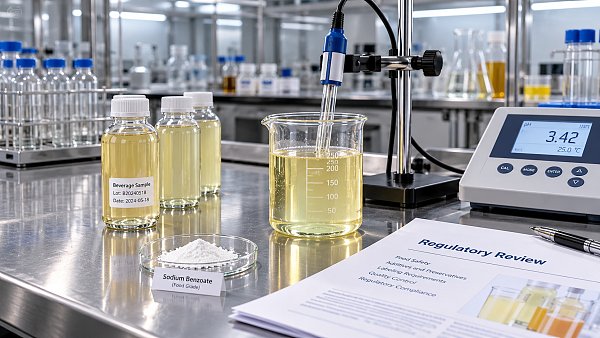
Sodium benzoate: 21 CFR 184.1733 addresses its identity, specifications, and use. The provision describes current usage resulting in a maximum level of 0.1 percent in food and affirms GRAS use under current good manufacturing practice. That wording should not be reduced to a universal instruction to formulate every beverage at 0.1 percent. Category restrictions, technical need, and the complete regulatory context still require review.
Potassium sorbate: 21 CFR 182.3640 recognizes it as safe when used in accordance with good manufacturing practice. This does not mean unlimited addition. Good manufacturing practice generally requires that the amount used not exceed what is reasonably necessary to achieve the intended technical effect.
More specialized options may have narrower permissions. Dimethyl dicarbonate, for example, is covered by 21 CFR 172.133, which specifies beverage uses and conditions. Its authorization cannot be treated as a general permission for every liquid food.
For concentration calculations, document the basis explicitly: preservative salt or acid equivalent, active ingredient or commercial preparation, and concentrate or finished beverage. These are not interchangeable. A correct weighing record can still produce a compliance error if the formulation spreadsheet uses the wrong basis.
Beverage classification comes before dose optimization
A flavored carbonated drink, refrigerated juice, dairy beverage, and shelf-stable coffee drink should not pass through the same regulatory checklist without adjustment. Applicable standards of identity may restrict ingredients, while processing requirements depend on product characteristics and the regulatory category.
Juice processors may be subject to juice HACCP requirements under 21 CFR Part 120. Shelf-stable products may require assessment under acidified food or low-acid canned food rules in Parts 114 and 113. Not every acidic beverage is an “acidified food”; definitions and exclusions matter. Carbonated beverages, for example, are excluded from the acidified-food definition in Part 114.
This classification determines what the preservative can reasonably accomplish within the safety system. Controlling spoilage yeast does not automatically satisfy a required pathogen-reduction process. Nor does adding a preservative eliminate the need for an appropriate scheduled process where one is required.
For a new beverage, establish the category, processing method, packaging system, intended storage conditions, and distribution model before selecting a preservative concentration. Otherwise, development may optimize a formula that cannot support the intended shelf-life claim or processing route.
Legal use and microbiological protection are separate questions
Benzoates and sorbates generally work better in acidic systems because the undissociated acid contributes substantially to antimicrobial activity. Their effectiveness also depends on the organisms present, initial contamination, temperature, beverage composition, and other preservation hurdles. A dose that controls one yeast in a clear soft drink may not perform similarly in a beverage containing pulp or protein.
Preservative selection should therefore connect three layers: the permitted use, the formulation’s operating range, and evidence that the combined process controls relevant hazards and spoilage organisms.
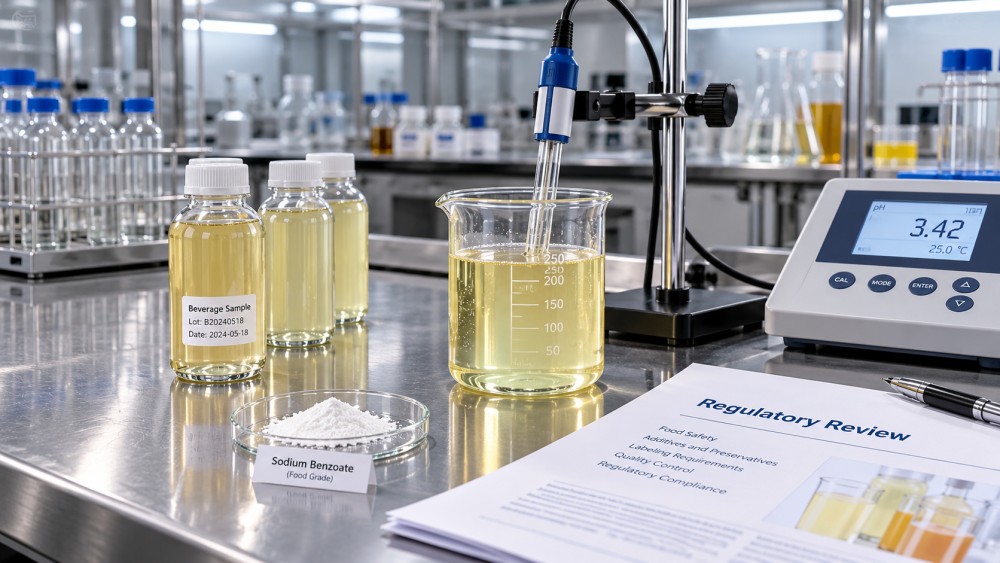
Useful validation work considers the least favorable credible conditions, not only the nominal recipe. These may include the upper pH specification, lower preservative concentration, realistic temperature exposure, and packaging conditions. Challenge studies should be designed by qualified specialists, with organisms and methods appropriate to the product. Routine finished-product testing alone cannot demonstrate that the preservation system is robust.
Where preservatives serve as preventive controls, applicable requirements under 21 CFR Part 117 may involve validation, monitoring, corrective actions, verification, and records. A preservative used only for quality purposes should not automatically be described as a validated food-safety control.
Benzoate and vitamin C need a separate compatibility review
FDA has investigated benzene formation in beverages containing benzoate salts and ascorbic acid. Under certain conditions, this combination can form benzene; heat and light can promote the reaction. Trace metals and other formulation factors can also influence it. The presence of both ingredients does not establish that a beverage is unsafe, but it does justify a documented risk assessment.
Review added vitamin C, naturally occurring ascorbic acid from juice ingredients, water quality, packaging, and expected storage exposure. Where the assessment identifies a concern, appropriate analytical testing and formulation changes should be considered. Passing a microbiological challenge study does not resolve this chemical compatibility question.
Supplier paperwork must connect to incoming-lot controls
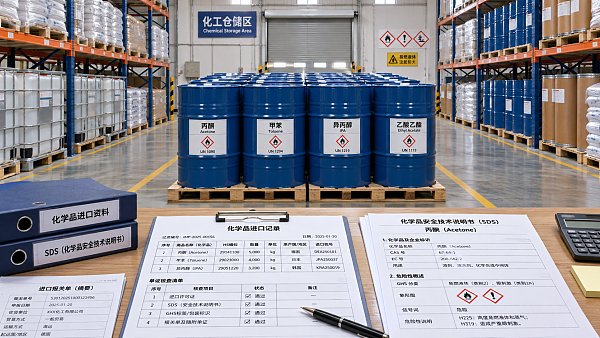
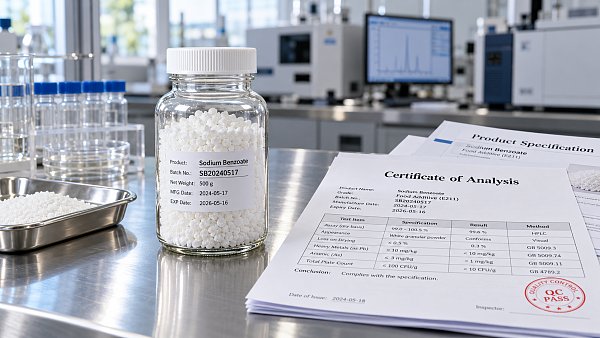
A safety data sheet supports chemical handling; it is not evidence that a material meets food-use specifications. Likewise, a certificate of analysis is useful only when its tests and acceptance criteria address the agreed specification.
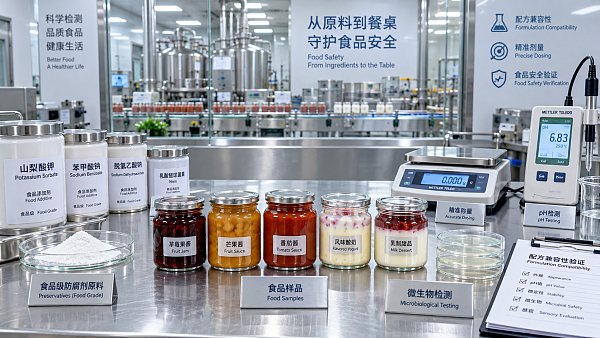
For synthetic food preservatives for beverages, a practical supplier file should establish:
- The exact chemical identity, grade, assay, and composition of any blend or carrier system.
- The regulatory basis for the intended U.S. food use, with relevant limitations.
- Specifications for identity, purity, and relevant contaminants, supported by suitable test methods.
- Lot traceability, storage conditions, shelf life, and packaging that protects the ingredient.
- Change-notification arrangements covering manufacturing site, process, composition, and specifications.
Verification should follow risk. Depending on the material and supplier history, it may include identity testing, periodic independent analysis, supplier audits, or review of manufacturing controls. Imported ingredients can also trigger Foreign Supplier Verification Program obligations, subject to applicable exemptions and modified requirements.
This is the kind of cross-functional assessment covered by Global Fine Chemicals & Agrochemical Intelligence Network (FCAS): connecting ingredient specifications, formulation behavior, safety requirements, and supply-chain documentation. The useful comparison is not simply which supplier offers higher purity, but whether the evidence supports consistent performance in the intended application.
Labeling must identify the preservative and explain its function
Under 21 CFR 101.22(j), a chemical preservative added to a food generally must be declared by its common or usual name with a separate description of its function, unless an exemption applies. Examples include “preservative,” “to retard spoilage,” or “to protect flavor.” Wording such as “potassium sorbate (preservative)” may serve this purpose when accurate for the formulation.
Do not assume a preservative can be omitted because it entered through a flavor preparation or fruit ingredient. The incidental-additive exemption depends on specific conditions, including whether the substance continues to have a technical or functional effect in the finished food. A carryover ingredient that still preserves the beverage requires careful review.
“No preservatives” claims deserve the same attention. Replacing a familiar preservative with an ingredient marketed differently does not automatically make that claim accurate. Review the ingredient’s actual function and the overall consumer impression, rather than relying on the supplier’s marketing terminology.
Build a release decision that survives a formulation change
Before commercial release, the product file should connect the regulatory citation, approved formula, dosing instructions, analytical method, validation evidence, supplier specification, and final label. Set a target concentration with enough operating margin to accommodate normal process variability without compromising effectiveness or applicable use conditions.
Then define what triggers reassessment. A new juice source may change buffering or ascorbic acid content. A packaging change may alter light exposure. A revised filling process or warmer distribution route may change microbial risk. Even when the preservative itself remains unchanged, the evidence supporting its use may no longer fit.
The next step is not to ask whether a preservative is broadly “FDA compliant.” Ask whether the current regulatory basis, supplier evidence, process controls, and label all support this specific beverage under its actual conditions of manufacture and sale. Verify the current regulatory text before final approval, particularly when changing product category, use level, or market.
Facing technical bottlenecks in manufacturing or looking for more efficient industrial solutions? Leave your details below and let the engineering experts at FCAS solve them for you.
We respect your privacy. Your information is strictly confidential.
Related News
 EPA FIFRA & FDA GRAS RegsEPA Cancels Pesticide Registrations Over Unpaid Maintenance FeesEPA pesticide registration cancellations over unpaid maintenance fees may affect procurement. Learn what buyers and suppliers should verify before the stated effective date.MORE+
 EPA FIFRA & FDA GRAS RegsEPA Issues Cancellation Order Affecting Certain Pesticide RegistrationsEPA pesticide registration cancellations may affect select products and supply chains. Learn what businesses should verify before making purchasing decisions.MORE+
 EPA FIFRA & FDA GRAS RegsEPA Reviews Glyphosate Safety, With Decision Expected in Early 2027EPA glyphosate safety review: Discover what the decision expected in early 2027 could mean for health, the environment, and businesses.MORE+
 EPA FIFRA & FDA GRAS RegsEPA Seeks Comment on Voluntary Pesticide Registration CancellationsEPA pesticide registration cancellations are open for public comment. Discover what the proposed changes could mean for product uses, compliance and supply.MORE+
 EPA FIFRA & FDA GRAS RegsEPA Lists Six Voluntary Paraquat Registration Cancellations for CommentEPA lists six voluntary paraquat registration cancellation requests for comment. Explore the potential supply impact and key deadline for buyers and suppliers.MORE+
 EPA FIFRA & FDA GRAS RegsEPA Settles with Colgate-Palmolive Over Chemical Import ReportingEPA's Colgate-Palmolive settlement highlights chemical import reporting obligations. Explore the CDR compliance lessons for importers and supply-chain teams.MORE+
 EPA FIFRA & FDA GRAS RegsEPA Exempts DMSO in Pesticide Formulations From Residue Tolerance RequirementsEPA exempts DMSO from pesticide residue tolerance requirements for specified uses. Explore the rule’s scope and what it means for formulators.MORE+
 EPA FIFRA & FDA GRAS RegsHow Do FDA Rules Affect Synthetic Food Preservatives for Beverages?Synthetic food preservatives for beverages face specific FDA requirements. Explore permitted uses, dosage, labeling, and safety validation to make smarter compliance decisions.MORE+
 EPA FIFRA & FDA GRAS RegsWhat FDA Compliance Records Should a Synthetic Food Preservatives Supplier Provide?Choosing a synthetic food preservatives supplier? Discover key FDA compliance records, batch certificates, and traceability checks to approve suppliers with confidence.MORE+
 EPA FIFRA & FDA GRAS RegsU.S. Health Aide’s Exit Raises Deregulation Hopes for Korean Food ExportersKorean food exporters eye U.S. deregulation after a health aide’s exit. Explore what uncertain ultra-processed food rules and additive policies mean for export planning.MORE+
 EPA FIFRA & FDA GRAS RegsTrump Administration Grants 202 Facilities Waivers From EPA Air Pollution RulesTrump administration EPA air pollution waivers cover 202 facilities. Explore what the Clean Air Act exemptions mean for industrial emissions and potential public health risks.MORE+
 EPA FIFRA & FDA GRAS RegsHow to Evaluate an Aroma Ingredients Manufacturer for Food UseEvaluate an aroma ingredients manufacturer for food use with practical checks on compliance, impurity controls, traceability, and batch consistency. Make confident sourcing decisions.MORE+
 EPA FIFRA & FDA GRAS RegsWhat Food Safety Documents Should an Ethyl Maltol Manufacturer Provide?Choosing an ethyl maltol manufacturer? Discover the COA, food-use compliance statements, and traceability records to request for safer sourcing and confident supplier approval.MORE+
 EPA FIFRA & FDA GRAS RegsSynthetic Food Preservatives Rules That Support Safer FormulasSynthetic Food Preservatives: learn the rules for safer formulas, compliant use levels, validated shelf life, labeling, and reliable microbial control.MORE+
 EPA FIFRA & FDA GRAS RegsButylparaben for Wet Wipes and Key Safety Compliance ConsiderationsButylparaben for wet wipes: explore regulatory compliance, preservative efficacy, skin safety, packaging risks, and supplier controls for confident product development.MORE+
 EPA FIFRA & FDA GRAS RegsWhat to Check When Using Synthetic Food Preservatives SafelySynthetic Food Preservatives: learn the essential checks for safe, compliant use—from dosage and pH to supplier control, labeling, and shelf-life validation.MORE+
 EPA FIFRA & FDA GRAS RegsWhat Certifications Do Flavor Bases Need for Food Export?What certifications do flavor bases need for food export? Explore food safety standards, market compliance, allergen documents, and export-ready paperwork.MORE+
 EPA FIFRA & FDA GRAS RegsHow Food Grade CO2 Extracts Meet Safety and Labeling RequirementsFood grade CO2 extracts: learn how source control, targeted testing, traceability, and accurate labeling support food safety compliance and confident product launches.MORE+
 EPA FIFRA & FDA GRAS RegsHow High Intensity Sweeteners for Tabletop Use Meet Labeling StandardsHigh intensity sweeteners for tabletop use: discover how accurate labeling, serving claims, ingredient lists, nutrition data, and regional rules support compliant market entry.MORE+
 EPA FIFRA & FDA GRAS RegsWhat to Check Before Choosing a Sucralose Supplier for Food ProductionChoose a reliable sucralose supplier with confidence. Explore essential checks for quality, compliance, batch consistency, traceability, packaging, and supply reliability.MORE+