How to Compare Cleaner Concentrates Wholesale by Cost per Use
A lower drum price can produce a higher cleaning bill. When comparing cleaner concentrates wholesale, start with the delivered cost of the solution at a dilution that meets your cleaning requirements. Then check how much solution, labor, and rework each product requires to complete the same task. The strongest purchasing option is the one that achieves an acceptable result at the lowest repeatable operating cost.
This comparison only works when the products serve the same purpose. A daily floor cleaner, a heavy-duty degreaser, and a cleaner with a disinfectant claim may have different operating requirements. Even two products described as general-purpose cleaners can differ in soil removal, rinsing needs, and surface compatibility. Establish those requirements before using dilution ratios to rank supplier quotes.
Define the cleaning task before calculating the price
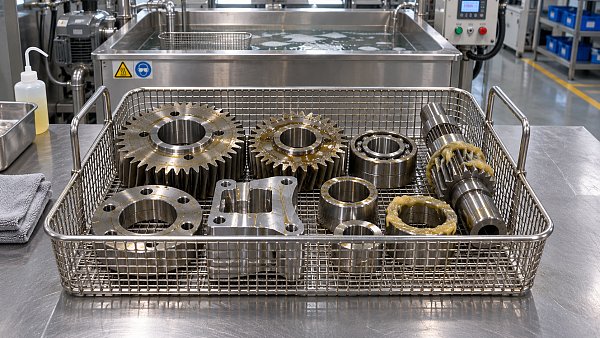
“Cost per use” needs a specific denominator. For a spray-and-wipe operation, it might mean the cost to clean a defined number of workstations. For floor maintenance, it could mean the cost per unit of floor area. For parts washing, cost per acceptable batch may be more useful than cost per tank fill.
Cost per liter of ready-to-use solution is a useful first comparison, but it does not measure the whole job. One cleaner may require more liquid to wet a surface adequately. Another may require an additional rinse or a second pass. A reusable cleaning bath may remain effective across several loads, while another needs earlier replacement. Equal solution volumes do not necessarily deliver equal cleaning output.
Before requesting comparable quotes, give suppliers a short operating specification:
- Surface and equipment: the materials being cleaned, including coatings, seals, and sensitive components.
- Soil: the type, loading, and condition of contamination, such as fresh oil, dried food residue, or embedded dirt.
- Method: manual wiping, mopping, scrubbing, spraying, immersion, or another defined process.
- Operating conditions: available water quality, temperature, contact time, and rinsing arrangements.
- Acceptance criteria: the required cleanliness, residue level, appearance, and material condition.
The acceptance criteria deserve particular attention. “Looks clean” may be sufficient for some housekeeping tasks, while a surface prepared for coating or further processing may need a more specific residue check. Agree on the endpoint with the operating team so that procurement does not buy a cheaper result that production cannot accept.
Where disinfection is required, evaluate the product against the applicable authorized label instructions, including dilution, contact time, and use conditions. A general cleaning dilution cannot substitute for those requirements.
Convert every quote into the same usable-solution basis
Start with net usable concentrate quantity and a consistent delivered cost. Include the product price and applicable inbound freight, handling, and nonrecoverable charges. Treat recoverable taxes and refundable container deposits consistently across offers. Keep recurring dispenser charges visible so they can be allocated later without being counted twice.
Check whether the quoted quantity is a volume or a mass. A price per kilogram cannot be compared directly with a price per liter without the product’s density. Likewise, a nominal container size should not replace the stated net fill.
Dilution notation is another source of error. “1:40” may be interpreted as one part concentrate plus 40 parts water, or as one part concentrate in 40 parts finished solution. Ask suppliers to express the instruction explicitly as concentrate plus water, or as a defined final concentration with its measurement basis.
For a dilution stated as one part concentrate plus a specified number of parts water:
Theoretical solution yield = concentrate volume × (1 + water parts per concentrate part)
Chemical cost per liter of solution = delivered concentrate cost ÷ theoretical solution yield
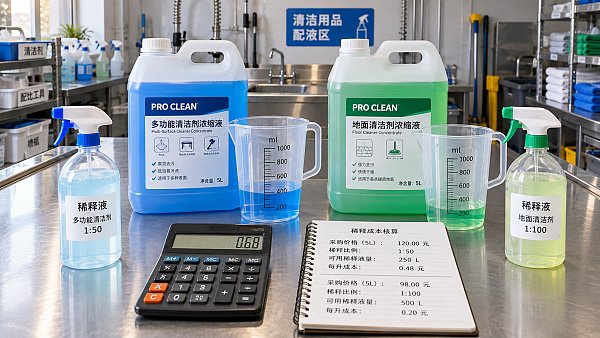
Consider an illustrative comparison using invented prices and dilution assumptions. Product A costs $120 delivered for 20 liters and is used at one part concentrate plus 39 parts water. Its theoretical yield is 800 liters, giving a chemical cost of $0.15 per liter of solution.
Product B costs $160 delivered for 20 liters and is proposed at one part concentrate plus 79 parts water. Its theoretical yield is 1,600 liters, giving a chemical cost of $0.10 per liter. Although its container price is higher, its proposed solution cost is lower.
That result depends on the proposed dilution working. If Product B needs one part concentrate plus 49 parts water to meet the same cleaning requirement, its yield falls to 1,000 liters and its chemical cost becomes $0.16 per liter. The ranking reverses before labor or waste enters the calculation.
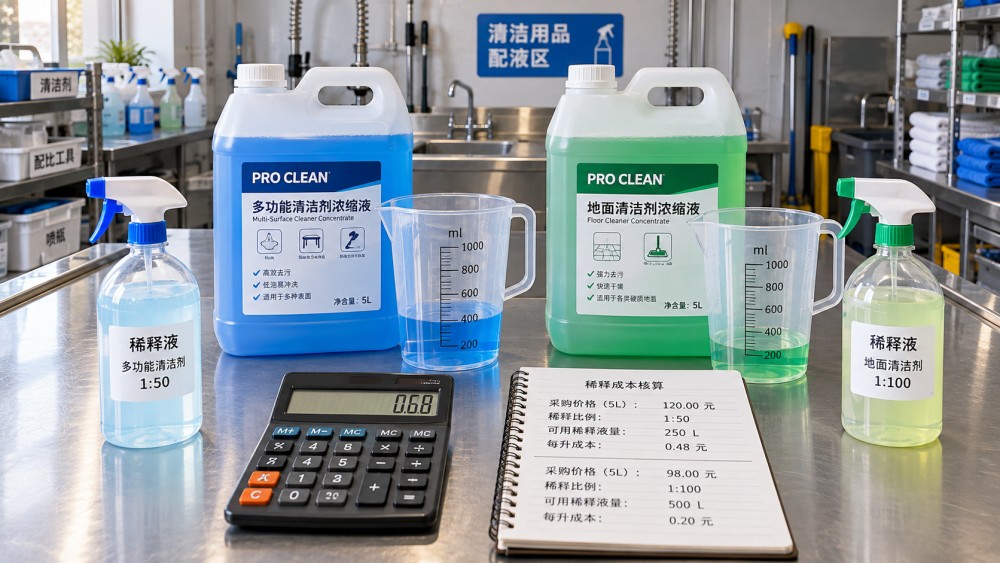
Use the supplier’s dilution recommendation for the actual task, rather than the most dilute application listed anywhere in its literature. Light maintenance cleaning and heavy soil removal may justify different concentrations. Compare each product at the concentration it needs to achieve the agreed result.
Keep theoretical yield separate from usable yield. Concentrate left in containers, solution discarded after a shift, spills, and expired stock all reduce the amount available for productive cleaning. Record losses where they occur: concentrate losses reduce available concentrate, while discarded mixed solution reduces usable solution. Applying an unexplained waste percentage to both can double-count the same loss.
Verify the dilution under your operating conditions
A supplier’s recommended dilution is a starting point for evaluation. Its suitability depends on conditions that a quotation may not describe. Water hardness, soil loading, temperature, mechanical action, and contact time can all affect whether a formulation performs adequately. Increasing concentration may help in some circumstances, but it can also increase residue or rinsing needs.
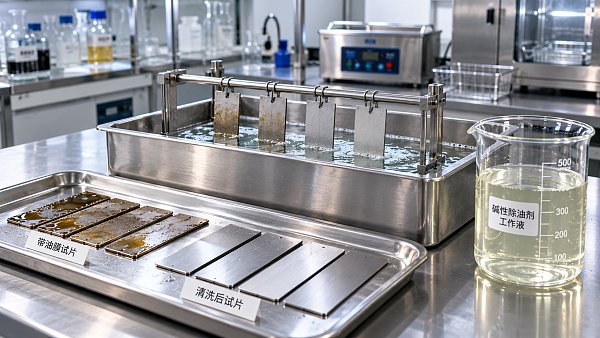
Run a controlled site trial with the shortlisted products. Use representative work, the intended equipment, and your normal water supply. Keep the cleaning endpoint consistent. If one product requires a different temperature, longer dwell time, or extra rinse, record that as part of its operating requirement.
A useful trial record captures a small set of decision-making facts:
- The actual dilution and how it was checked.
- The amount of solution consumed per accepted task, area, or batch.
- Total operator time, including preparation and rinsing.
- Whether a second pass or other corrective work was needed.
- Any residue, foaming, surface change, or equipment issue.
Check performance across realistic variation. A product that handles a lightly soiled surface may struggle with the heavier soil encountered later in the production cycle. Equally, testing only the most difficult condition can lead to unnecessary chemical consumption during routine work. Separate maintenance and heavy-duty applications if the site actually operates both.
Dosing deserves its own check because the economic comparison assumes that the specified concentration reaches the point of use. Manual pouring, unsuitable measuring containers, or a dispenser outside its intended operating conditions can change consumption. Where dosing equipment is used, verify its output under the installation conditions and at relevant outlets.
Use a concentration-checking method appropriate to the formulation. A supplier may specify titration, conductivity, refractive index, or another method. Obtain its procedure and interpretation limits; a generic reading may not provide a reliable concentration measurement for every cleaner, particularly after soil accumulates.
A more concentrated product can reduce storage and freight requirements per unit of cleaning output, but its value depends on controlled dispensing. Procurement should establish how the product will be measured, how the dispenser will be maintained, and who will check dilution after installation.
Build the cost around accepted cleaning output
Once performance is established, move from solution price to task cost. The calculation should reflect the resources that change between the options:
Cost per accepted task = total relevant operating cost ÷ number of tasks meeting the agreed cleaning standard
The relevant operating cost can include concentrate, water, labor, heating, dispensing, waste handling, and rework. Include each item once. If a repeat cleaning pass is already captured in total labor and chemical consumption, do not add those costs again under a separate rework allowance.
Labor can outweigh a modest chemical saving. A cleaner with a low solution price may require more scrubbing, longer preparation, or an additional rinse. Measure the full task cycle, including filling, application, waiting where it occupies the operator, rinsing, and equipment cleanup. Distinguish paid operator time from unattended contact time.
Solution consumption also needs direct measurement. Comparing products at an assumed equal consumption rate can conceal differences in wetting, application behavior, or repeat passes. Use the volume required to deliver an accepted result during the trial, then check whether that consumption is repeatable.
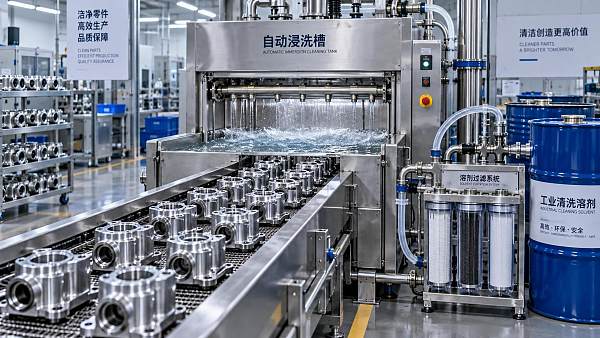
For recirculating systems and immersion tanks, evaluate bath life. Initial fill cost provides an incomplete picture when solutions can remain in service for different periods. Track accepted output between changes, concentrate top-ups, bath maintenance, and changeover labor. Define the replacement trigger so that an apparent saving does not depend on running a bath beyond acceptable performance.
Water, heating, and waste costs matter where the products change those requirements. A product that performs at a lower temperature may reduce heating demand; a product needing additional rinsing may increase water use and waste volume. Use site-specific costs and measured operating differences rather than assigning a broad environmental saving to a formulation claim.
Material compatibility belongs in the purchasing decision even when it is difficult to reduce to a precise cost. A cleaner that damages a finish, affects seals, or leaves unacceptable residue fails the application requirement. Review technical documentation and safety data alongside the trial, including handling, storage, protective equipment, and relevant disposal requirements.
Use wholesale terms to test whether the saving survives purchase
After establishing operating cost, examine the order structure. A lower unit price for a larger order only creates value if the stock can be used within its supported shelf life and stored under the required conditions. Compare expected consumption with minimum order quantity, delivery frequency, storage capacity, and working capital tied up in inventory.
Request pricing at realistic purchase volumes. Include freight differences, container return arrangements, and any product that remains inaccessible in the selected packaging. Drums, totes, and smaller containers can produce different handling costs and losses, depending on the site’s transfer equipment.
Dispensing equipment should have an explicit commercial treatment. If a supplier provides it, establish ownership, installation responsibility, maintenance coverage, and any purchase commitment or exit charge. If the buyer funds it, spread its cost over a reasonable operating period and expected usage. Evaluate proprietary connections or consumables where they affect future sourcing flexibility.
Build the final comparison around the validated dilution, measured consumption, accepted cleaning output, and realistic order quantity. Then test the uncertain assumptions. Would the preferred product still lead if consumption increased, the required concentration became stronger, or demand fell enough to leave excess inventory?
When the offers are close, the quality of the evidence becomes decisive. A saving supported by repeatable dosing and accepted cleaning results provides a firmer basis for an award than a larger saving dependent on an unproven dilution. Put the agreed dilution, application conditions, documentation, and dispensing responsibilities into the purchase specification so the quoted economics can be checked after delivery.
Facing technical bottlenecks in manufacturing or looking for more efficient industrial solutions? Leave your details below and let the engineering experts at FCAS solve them for you.
We respect your privacy. Your information is strictly confidential.
Related News
 Heavy-duty Industrial DegreasersHow Do Water Based Degreasing Surfactants Remove Industrial Grease?Water based degreasing surfactants lift industrial grease and help prevent redeposition. Learn how to select and test an effective cleaning process.MORE+
 Heavy-duty Industrial DegreasersHow to Choose Parts Wash Cleaners for Spray WashersChoose parts wash cleaners for spray washers with confidence. Compare cleaning power, material compatibility, foam control, safety, and supplier support.MORE+
 Heavy-duty Industrial DegreasersHow to Choose Industrial Metal Degreasers for Your ProcessChoose industrial metal degreasers with confidence. Compare cleaning chemistries, metal compatibility, equipment needs and trial methods for reliable results.MORE+
 Heavy-duty Industrial DegreasersChina to Continue Countervailing Duties on US-Origin n-PropanolChina extends countervailing duties on US-origin n-propanol for five years from November 6, 2026. Explore the rates and potential sourcing implications.MORE+
 Heavy-duty Industrial DegreasersHow to Choose Metal Degreasing Cleaners for Different SoilsChoose Metal Degreasing Cleaners for oils, grease, waxes and baked-on soils. Discover how to protect components, improve cleaning and avoid costly residue.MORE+
 Heavy-duty Industrial DegreasersHow to Compare Cleaner Concentrates Wholesale by Cost per UseCompare cleaner concentrates wholesale by true cost per use—not drum price. Learn how dilution, labor, and waste affect savings so you can choose the best-value supplier.MORE+
 Heavy-duty Industrial DegreasersShrieve Chemical Acquires Alabama-Based RSG to Expand US Southeast ReachShrieve Chemical acquires Alabama-based RSG to expand its US Southeast reach. Explore what the deal could mean for specialty chemical supply and regional customer service.MORE+
 Heavy-duty Industrial DegreasersWhich Quality Checks Matter When Sourcing Alkaline Degreasers?Evaluating an alkaline degreasers manufacturer? Discover key quality checks for cleaning performance, material compatibility, and batch consistency to source confidently and cut costs.MORE+
 Heavy-duty Industrial DegreasersHow to Choose Metal Cleaning Chemicals for Pretreatment Before CoatingChoose metal cleaning chemicals for pretreatment that match your substrate, soils, and coating line. Learn how to validate performance, reduce defects, and lower cost per accepted part.MORE+
 Heavy-duty Industrial DegreasersHow to Select Parts Wash Cleaners for Automotive ComponentsParts wash cleaners for automotive components: learn how to match chemistry, materials, rinsing, safety, and waste controls for reliable cleaning results.MORE+
 Heavy-duty Industrial DegreasersHow to Qualify a Solvent Degreasers Manufacturer for Industrial CleaningQualify a solvent degreasers manufacturer with proven batch control, safety documentation, compatibility testing, and process-specific cleaning performance.MORE+
 Heavy-duty Industrial DegreasersHow Zeolite Detergent Builders Improve Cleaning at Lower DosageZeolite detergent builders help improve hardness control, protect surfactant efficiency, and support effective cleaning at lower detergent dosage. Explore key formulation factors and testing insights.MORE+
 Heavy-duty Industrial DegreasersHow Fast Drying Degreasing Solvents Reduce Cleaning Cycle TimesFast drying degreasing solvents cut cleaning cycle times by improving evaporation, reducing residue risks, and enabling faster production handoffs. Learn how to choose the right solution.MORE+
 Heavy-duty Industrial DegreasersSelecting Degreasing Surfactants for Hard Surface CleanersDegreasing surfactants for hard surface cleaners: learn how to match soil, foam, rinseability, and material compatibility for reliable cleaning performance.MORE+
 Heavy-duty Industrial DegreasersHow Degreasing Surfactants Improve Performance in Heavy-Duty CleaningDegreasing Surfactants improve heavy-duty cleaning by lifting oils, controlling redeposition, and supporting cleaner rinses. Explore practical selection and process tips.MORE+
 Heavy-duty Industrial DegreasersHow to Evaluate an Industrial Cleaning Auxiliaries ManufacturerEvaluate an industrial cleaning auxiliaries manufacturer by performance, batch consistency, documentation, technical support, and supply reliability.MORE+
 Heavy-duty Industrial DegreasersWhat to Compare When Selecting a Cleaning Chemicals ManufacturerCompare a cleaning chemicals manufacturer by performance, compliance, batch consistency, technical support, and total applied cost to choose a reliable supplier.MORE+
 Heavy-duty Industrial DegreasersWhat to Compare When Buying Degreasing Solvents Wholesale in 2026Degreasing solvents wholesale guide for 2026: compare cleaning yield, safety, VOC status, total operating cost, specifications, and supplier reliability before buying.MORE+
 Heavy-duty Industrial DegreasersHow to Evaluate a Degreasing Surfactants Factory for Industrial CleaningDegreasing surfactants factory evaluation guide: compare cleaning performance, foam control, quality consistency, documentation, compatibility, and supply reliability.MORE+
 Heavy-duty Industrial DegreasersHow to Choose Parts Wash Cleaners for Automotive Components Without DamageParts wash cleaners for automotive components: learn how to remove oils and residues while protecting metals, plastics, seals, coatings, and downstream assembly performance.MORE+
 Heavy-duty Industrial DegreasersWhat to Check Before Choosing a Metal Degreasers SupplierChoose a reliable metal degreasers supplier with confidence. Learn what to assess in performance, compatibility, corrosion control, SDS, and support.MORE+
 Heavy-duty Industrial DegreasersHow to Evaluate a Solvent Degreasers Manufacturer Before OrderingSolvent degreasers manufacturer evaluation guide: assess cleaning performance, batch consistency, compliance, packaging, and supply reliability before ordering.MORE+
 Heavy-duty Industrial DegreasersHow to Evaluate a Metal Degreasers Manufacturer for Reliable SupplyMetal degreasers manufacturer evaluation guide: compare formulation control, material compatibility, compliance, supply reliability, and total cost to choose a dependable industrial cleaning partner.MORE+
 Heavy-duty Industrial DegreasersHow to Evaluate Degreasing Solvents Bulk Price Without Hidden Cost SurprisesDegreasing solvents bulk price is only part of the real cost. Learn how to compare purity, logistics, compliance, and supplier reliability to avoid hidden expenses and buy with confidence.MORE+
 Heavy-duty Industrial DegreasersHow Caustic Free Alkaline Degreasers Improve Safety and CleaningCaustic free alkaline degreasers improve safety while delivering reliable grease removal. Learn how they reduce handling risks, protect surfaces, and support cleaner, more consistent industrial processes.MORE+
 Heavy-duty Industrial DegreasersHow Acidic Metal Cleaning Chemicals Reduce Rework and Maintenance CostsAcidic metal cleaning chemicals help cut rework and maintenance costs by removing oxides, scale, and residues more effectively, improving process stability and reducing downstream defects.MORE+