How Do Microencapsulated Flavors Improve Snack Seasoning Stability?
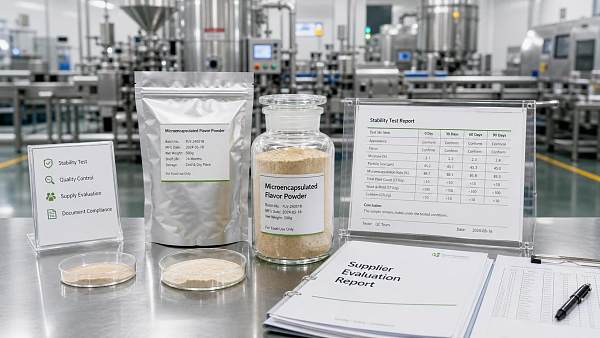
A snack seasoning can smell correct at blending yet lose its citrus lift, roasted notes, or spice freshness during distribution. Microencapsulated flavors improve stability by embedding aroma compounds in a protective matrix or surrounding them with a barrier that slows evaporation, oxygen exposure, and contact with incompatible ingredients. The benefit is better flavor retention before consumption, provided the encapsulate survives processing and releases its contents during eating.
Microencapsulated flavors for snack seasonings are therefore not automatically more stable than liquid flavors or flavors adsorbed onto a carrier. Performance depends on exposed surface flavor, wall composition, moisture uptake, particle integrity, and packaging. A useful evaluation separates three questions: does the powder protect the aroma, does it remain evenly distributed on the snack, and does the consumer still perceive the intended flavor?
Start by identifying what is actually becoming unstable
“Flavor fade” can describe several different failures. Volatile compounds may escape without undergoing chemical change. Oxidation can instead transform aroma molecules, reducing freshness or generating undesirable notes. Meanwhile, segregation or poor adhesion may make individual pieces taste inconsistent even when the total flavor content remains acceptable.
Encapsulation addresses these mechanisms differently. A barrier can reduce molecular mobility and slow oxygen access, but it cannot correct inadequate seasoning coverage. It may reduce the exposure of a sensitive flavor oil, yet it will not stop rancidity developing in the snack’s frying oil. Distinguishing the source prevents an expensive ingredient change from masking the real problem.
The protective barrier is usually a matrix, not a sealed shell
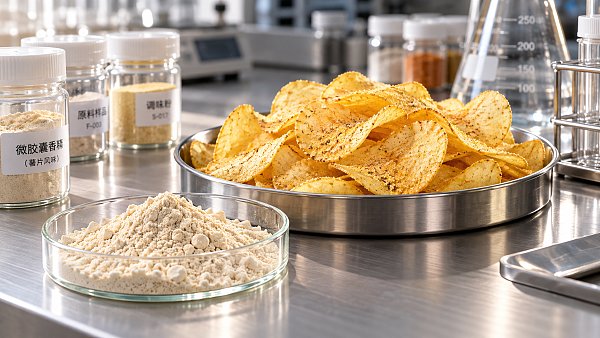
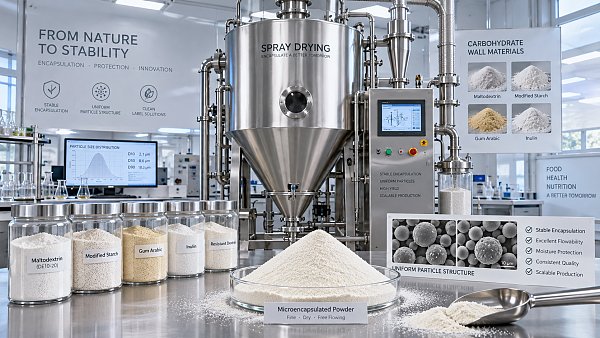
Many commercial flavor powders are spray-dried emulsions. Flavor oil droplets are dispersed in a wall-forming solution and dried into particles containing multiple droplets. These particles are not necessarily hollow capsules with a single core. Their performance depends on emulsion quality, drying conditions, matrix structure, and how much flavor remains exposed at the surface.
In a sufficiently dry carbohydrate matrix, molecular mobility can be low. This slows the movement of aroma compounds and can restrict oxygen transport. Keeping reactive ingredients physically separated may also reduce some unwanted interactions during dry storage. Neither effect is absolute: pores, cracks, exposed oil, and environmental moisture create routes through which protection can be lost.
Total flavor loading and encapsulation efficiency answer different questions. Loading describes how much flavor the powder contains. Encapsulation efficiency commonly compares total flavor or oil with the fraction classified as surface or unencapsulated material. Suppliers may use different extraction procedures, so percentages are not directly comparable unless the methods and calculation basis match.
A highly loaded powder may reduce the required dosage but offer less protection if more oil is exposed. Conversely, low surface oil does not prove that the aroma profile survived manufacture. Volatile components may already have been selectively lost during drying, leaving a technically well-encapsulated but sensorially incomplete flavor.
Match wall chemistry to storage conditions and eating behavior
Wall materials determine both storage protection and release. Maltodextrin often contributes matrix formation and powder handling, but generally needs an effective emulsifier when encapsulating flavor oils. Gum arabic and suitable modified starches can support emulsion formation and stabilization. Their performance depends on grade, formulation, and processing rather than ingredient name alone.
Protein-containing walls can provide useful interfacial properties, but introduce allergen, labeling, and compatibility considerations. Lipid-based barriers may resist moisture differently from carbohydrate matrices and can support temperature-dependent release. They also require attention to fat melting behavior, oxidation susceptibility, and mouthfeel. A lipid coating that performs well in storage may leave flavor insufficiently available during a short eating period.
Humidity can change the barrier after manufacture
Water plasticizes many amorphous carbohydrate matrices, lowering their glass-transition temperature and increasing molecular mobility. Under unfavorable temperature and humidity conditions, this can accelerate aroma migration, promote stickiness, and contribute to caking. The relevant condition is the powder’s physical state during storage, not simply its moisture content at dispatch.
Measure water activity as well as moisture content, and examine moisture sorption behavior where humidity sensitivity is a concern. Water can migrate between the snack and its seasoning inside a sealed pack. Opening and resealing bulk seasoning containers can also expose the powder to repeated humidity cycles before application.
Release must occur where flavor is needed
On a dry snack, useful protection often lasts until saliva hydrates the matrix and chewing disrupts the particles. Release that is too rapid during storage defeats the purpose; release that is too slow during eating suppresses aroma impact. Particle size, wall solubility, fat coating, and the location of particles within the seasoning layer all influence this balance.
Evaluate both immediate impact and flavor development during chewing. A lower dry-powder headspace aroma can indicate successful retention rather than weak flavor, but only a consumption-relevant sensory assessment can establish whether that retained aroma becomes available.
Where the seasoning line can undo the protection
Post-frying or post-baking application generally avoids the most severe cooking exposure, but the snack may still be hot when seasoned. Residual heat can increase aroma loss and soften some encapsulation systems. Record actual product temperature at application and the time before cooling and packaging; equipment setpoints alone do not describe the exposure.
Mechanical handling also matters. Milling an encapsulated ingredient after manufacture can expose internal flavor. Conveying, blending, and tumbling may generate fines or damage fragile particles. Where breakage is suspected, compare particle-size distribution, surface oil, and aroma retention before and after the relevant operation.
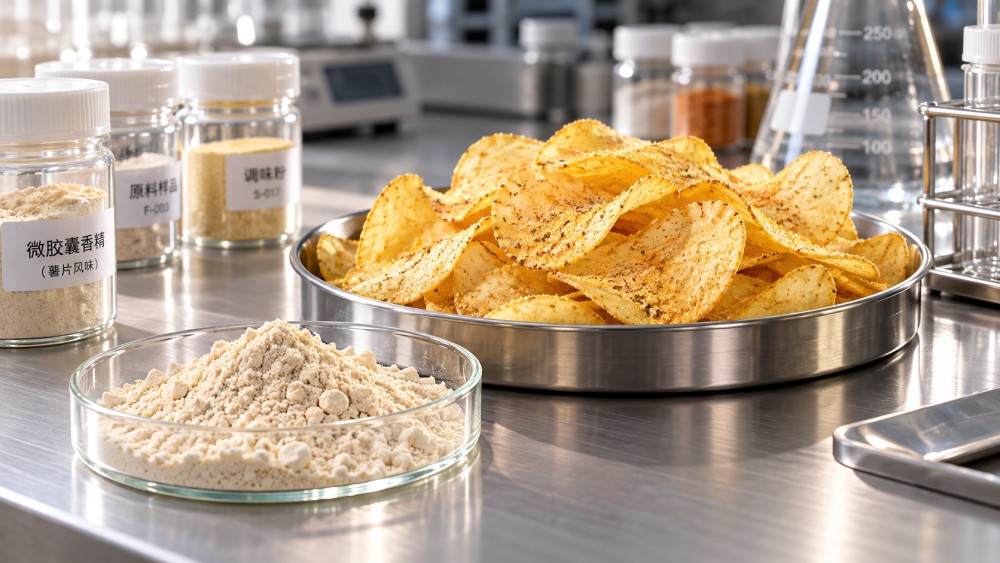
Adhesion introduces a separate trade-off. Added oil can help retain seasoning on the snack, but may wet particles or draw flavor components into the external fat phase. A carrier that works in a dry seasoning jar may behave differently on an oily chip. Testing the finished snack is essential because the surrounding fat, salt, acids, and powders alter the local environment.
- Check size and density compatibility: large differences between encapsulated flavor particles and the seasoning base can encourage segregation.
- Compare deposition, not just blend uniformity: a homogeneous mixer sample does not guarantee uniform seasoning after conveying and tumbling.
- Inspect fines and dust: they may indicate attrition and can change both retention and dosing consistency.
- Check holding conditions: extended residence in warm, humid hoppers can undermine a powder that performed well in sealed laboratory storage.
Build a stability study that distinguishes protection from dilution
Comparing equal masses of an encapsulated powder and a liquid flavor is usually misleading because their active flavor contents differ. Start with a documented flavor-equivalent basis, then confirm that fresh samples deliver a suitably comparable sensory profile. If initial profiles differ materially, report that difference rather than attributing every later sensory gap to stability.
- Define the failure endpoint. Specify whether rejection is driven by loss of a characteristic note, development of off-notes, uneven delivery, caking, or a combination. Establish acceptance criteria before examining results.
- Include relevant controls. Compare the proposed encapsulate with the current flavor system and, where useful, an unencapsulated carrier-based version. An unflavored snack control helps identify deterioration originating in the substrate.
- Use the intended process and pack. Reproduce seasoning temperature, oil addition, mixing sequence, and packaging atmosphere. Include representative handling rather than testing only freshly prepared powder.
- Sample across storage. Use intervals that can reveal the onset and progression of failure. Include independent batches so formulation effects are not confused with batch variability.
- Combine sensory and analytical evidence. Track the defining aroma notes, relevant chemical markers, physical condition, and application uniformity rather than relying on one retention percentage.
Gas chromatography can track selected volatile compounds, but marker selection should reflect the flavor’s sensory character and degradation pathways. Headspace measurements describe the compounds available under the measurement conditions; they are not automatically equivalent to total retained flavor. Extraction-based measurements answer a different question and should use a consistent, validated recovery procedure.
Oxidation measurements also require interpretation. Peroxide value can support assessment of lipid oxidation, but it is not a universal indicator of flavor stability and may not track later-stage deterioration. Pair appropriate chemical measurements with blinded sensory evaluation of the finished snack, including aroma during eating.
Accelerated storage can screen formulations, but elevated temperature or humidity may change the failure mechanism by softening the matrix or altering the fat phase. Do not extrapolate directly to shelf life unless the relationship is supported. Real-time storage in the intended packaging remains necessary to confirm performance.
What supplier specifications and standards should establish
There is no single universal specification that proves a microencapsulated flavor will stabilize every snack seasoning. A useful technical package should identify the carrier system, declared flavor loading, measurement basis for encapsulation efficiency, particle-size distribution, moisture, water activity, storage conditions, and recommended application limits. Batch documentation should make these properties traceable.
Request stability evidence with enough context to interpret it: test substrate, packaging, storage conditions, analytical method, sensory protocol, and acceptance criteria. Results from powder stored in a sealed laboratory container do not demonstrate equivalent performance on a porous, oil-coated snack.
Food-use suitability must cover the flavor and wall materials in the intended market and application. Confirm applicable additive permissions, use conditions, allergen declarations, labeling requirements, and microbiological specifications. Encapsulation is not a microbial kill step, and a dry powder specification does not replace finished-product food safety controls.
Deciding whether the encapsulate solves the problem
Adoption is justified when the finished snack retains its defining flavor through the required storage period, without unacceptable changes in release, adhesion, texture, or labeling. Compare cost at the effective application rate, including any additional powder needed to match sensory impact, rather than comparing ingredient prices alone.
When powder retention improves but snack performance does not, investigate migration into surface oil, packaging losses, application damage, and substrate oxidation before increasing dosage. When chemical retention is good but sensory impact is weak, revisit release behavior. These two outcomes require different corrections: the first points toward exposure or compatibility, while the second suggests that protection is persisting too effectively into consumption.
Facing technical bottlenecks in manufacturing or looking for more efficient industrial solutions? Leave your details below and let the engineering experts at FCAS solve them for you.
We respect your privacy. Your information is strictly confidential.
Related News
 Nano-microcapsule FormulationsIndexBox Releases 2026–2035 Global Controlled-Release Pesticide Formulation OutlookControlled-release pesticide formulations could grow 5.8% annually through 2035, according to IndexBox. Explore the forecast, key drivers and implications for buyers.MORE+
 Nano-microcapsule FormulationsWhat Affects the Cost of Microencapsulated Flavors Wholesale?Microencapsulated flavors wholesale pricing depends on formulation, processing, volume and quality. Learn how to compare suppliers and lower your cost in use.MORE+
 Nano-microcapsule FormulationsHow to Use Microcapsule Slurries for Household ProductsDiscover how to use microcapsule slurries for household products, from compatibility and gentle mixing to stability testing and fragrance performance.MORE+
 Nano-microcapsule FormulationsHow to Choose a Capsule Suspension Pesticides SupplierChoose a capsule suspension pesticides supplier with confidence. Compare formulation quality, regulatory documentation, delivery reliability and total costs.MORE+
 Nano-microcapsule FormulationsHow to Choose Seed Coating Agents for Better Seed CoverageChoose Seed Coating Agents with confidence. Learn how to assess coverage, dust-off, compatibility, drying, and germination for reliable results.MORE+
 Nano-microcapsule FormulationsHow Flavor Encapsulates for Bakery Fillings Retain FlavorDiscover how flavor encapsulates for bakery fillings protect aroma, support shelf-life stability, and help you choose the right carrier for your formulation.MORE+
 Nano-microcapsule FormulationsHow Can You Prevent Microcapsule Slurries From Settling in Storage?Keep Microcapsule Slurries stable in storage. Discover how temperature control, gentle agitation, and uniformity checks help reduce settling and protect capsule integrity.MORE+
 Nano-microcapsule FormulationsHow Do Microencapsulated Flavors Improve Snack Seasoning Stability?Explore how microencapsulated flavors for snack seasonings help preserve aroma and slow flavor loss. Learn to select and test systems for lasting freshness and better snack performance.MORE+
 Nano-microcapsule FormulationsHow to Use Food Grade Cyclodextrin Inclusion Complexes in BeveragesExplore food grade cyclodextrin inclusion complexes for beverages. Learn how to select, dose, and test them for flavor retention, stability, and smarter formulation decisions.MORE+
 Nano-microcapsule FormulationsHow Can High Solids Microcapsule Slurries Stay Stable in Storage?Keep high solids microcapsule slurries stable in storage. Learn how to control settling, protect capsule integrity, and optimize mixing for reliable pumping and consistent dosing.MORE+
 Nano-microcapsule FormulationsHow Spray Drying Wall Materials Affect Stability and EncapsulationSpray drying wall materials determine powder stability, encapsulation efficiency, moisture resistance, and release. Learn how to select the right matrix for reliable performance.MORE+
 Nano-microcapsule FormulationsHow Encapsulated Flavors Protect Taste During Processing and StorageEncapsulated Flavors protect taste from heat, oxygen, moisture, and storage loss. Explore smarter release, carrier selection, and processing strategies.MORE+
 Nano-microcapsule FormulationsHow Food Grade Cyclodextrin Complexes Protect Sensitive FlavorsFood grade cyclodextrin inclusion complexes help protect sensitive flavors from oxidation, evaporation, and processing loss while supporting controlled release and consistent sensory quality.MORE+
 Nano-microcapsule FormulationsChoosing Fragrance Preparations That Perform Well in Personal WashFragrance preparations for personal wash: learn how to select options that protect clarity, stability, foam, scent performance, and packaging compatibility.MORE+
 Nano-microcapsule FormulationsHow to Select Spray Drying Wall Materials for Better StabilitySpray drying wall materials: learn how to select the right matrix for improved stability, moisture resistance, encapsulation, release performance, and cost-efficient scale-up.MORE+
 Nano-microcapsule FormulationsFood Grade Cyclodextrin Inclusion Complexes for Stable Flavor DeliveryFood grade cyclodextrin inclusion complexes help protect volatile flavors, improve handling, and support controlled release for reliable food formulation performance.MORE+
 Nano-microcapsule FormulationsHow Oxidation Resistant Flavor Encapsulation Protects Taste StabilityOxidation resistant flavor encapsulation protects aroma, freshness, and taste stability. Discover how smart barriers, release control, and packaging improve shelf life.MORE+
 Nano-microcapsule FormulationsWhat to Verify When Choosing a Cyclodextrin Inclusion Complexes ManufacturerChoose a cyclodextrin inclusion complexes manufacturer with confidence: verify complexation evidence, loading, stability, process control, and batch consistency.MORE+
 Nano-microcapsule FormulationsWhat to Look for in a Reliable Flavor Encapsulates ManufacturerFlavor encapsulates manufacturer selection starts with application fit. Learn how to compare stability, release, documentation, and supply reliability before you buy.MORE+
 Nano-microcapsule FormulationsHow Pesticide Formulation Intermediates Improve Suspoemulsion StabilityPesticide formulation intermediates for suspoemulsion can make or break product stability. Learn how dispersants, emulsifiers, and co-stabilizers reduce separation, caking, and storage failure.MORE+