Which Quality Documents Should a Liquid Sorbitol Supplier Provide?
A delivery of liquid sorbitol can arrive with intact seals and still be unsuitable for release: the certificate may describe a different grade, the reported assay may use an unclear calculation basis, or the supplier may be unable to trace the material to its manufacturing site. These gaps can hold up production and leave quality and safety teams without defensible acceptance evidence.
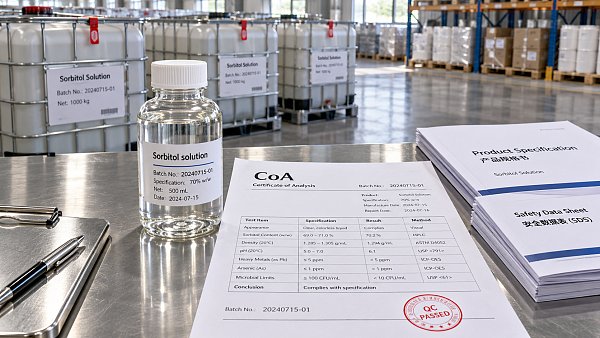
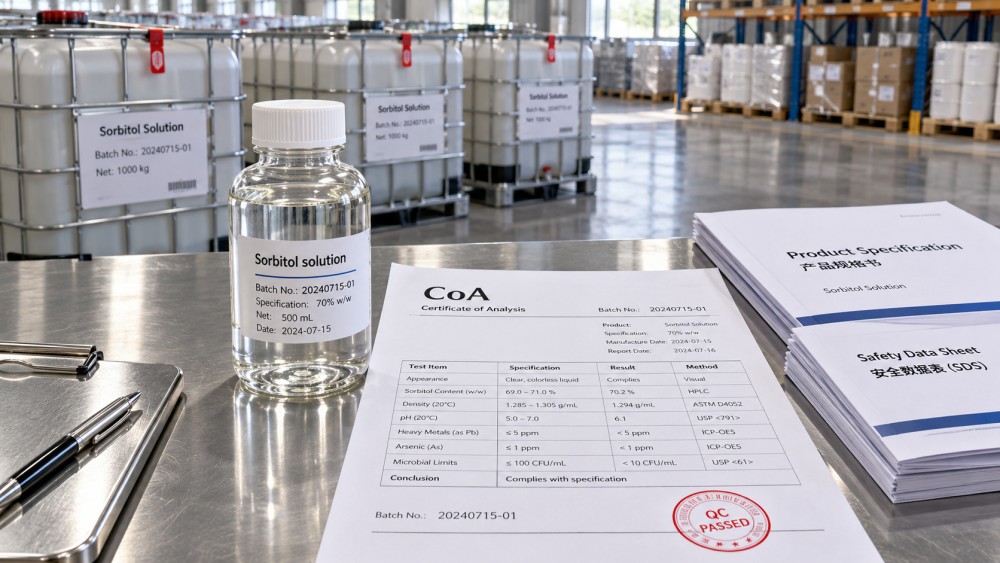
A liquid sorbitol supplier should provide an agreed product specification, a batch-specific Certificate of Analysis (CoA), a current Safety Data Sheet (SDS), and records linking each shipment to its manufacturer and production lot. Storage, shelf-life, and packaging information should accompany that core package. Food, pharmaceutical, cosmetic, or industrial applications may require additional compliance evidence; those documents must match the actual grade, manufacturing site, and destination market.
Start with the exact grade, not the supplier’s document list
Before requesting certificates, define what you intend to purchase. “Liquid sorbitol” is not a complete purchasing specification. Commercial products can differ in solids content, sorbitol content, accompanying polyols, and crystallization behavior. A non-crystallizing grade may have a different composition from a grade selected for high sorbitol content, even when both carry similar commercial descriptions.
Ask the supplier to identify the product code, manufacturer, manufacturing site, intended grade, and composition basis. Clarify whether a stated percentage means sorbitol in the solution, sorbitol on a dry basis, or total solids. These are not interchangeable. A result that appears acceptable on paper may represent a different formulation input once water and other components are accounted for.
The document package should then be assessed against that defined material. A pharmaceutical compliance statement cannot compensate for an unsuitable composition, and a food safety certificate does not establish that a particular lot meets your agreed analytical limits.
The core documents and the decisions they support
Read the CoA against the specification, line by line
A useful CoA identifies the material, grade or product code, batch number, reporting organization, and issue date. Manufacturing date and expiry or retest information should be available on the certificate or through linked records. Authorization may be electronic; the important point is that the document is controlled and its origin can be verified.
The specification defines acceptance; the CoA reports batch conformity. Keep those functions separate. A technical data sheet describing appearance, viscosity, and typical concentration is useful for preliminary selection, but it is not a substitute for agreed release limits.
Confirm what each result actually measures
Depending on the grade and application, relevant parameters may include identity, sorbitol assay, dry matter or water content, related polyols, reducing sugars, pH, color, and specified inorganic or organic impurities. Microbiological limits may also be necessary. Do not impose one universal test panel: choose parameters from the applicable standard, formulation requirements, and material risk assessment.
- Assay basis: distinguish as-supplied results from dry-basis results, and sorbitol assay from total solids.
- Units: confirm that percentages, mass concentrations, and trace-impurity results use the units required by the specification.
- Test conditions: density, viscosity, refractive index, and pH may depend on temperature, dilution, or preparation method.
- Methods: identify the compendial, recognized standard, or controlled internal method used. Where methods differ, establish comparability before comparing results.
Refractive index or density may help monitor concentration, but neither alone proves chemical identity or impurity control. Similarly, a clear, colorless appearance does not establish microbiological suitability.
Separate tested results from declarations
For quantitative attributes that drive acceptance, request numerical results where appropriate. “Complies” may be reasonable for certain identity or qualitative tests, but it provides little visibility into variation for a critical numerical parameter.
Ask which attributes are tested on every batch and which are covered by periodic testing, process controls, or other justified verification. Reduced testing is not automatically unacceptable, but it should be transparent and supported by an approved control strategy. A supplier should not present an untested attribute as though a batch measurement was performed.
When critical methods are internal, request enough information to assess suitability, including detection or quantitation capability where relevant. The full proprietary procedure may require a confidentiality agreement; its absence should not leave the buyer unable to judge whether the method can detect the impurity of concern.
Use the SDS for safety decisions—not product release
The SDS should match the supplied solution and be appropriate for the jurisdiction where it will be used. Check the product identifier, supplier details, revision information, composition description, and emergency contact arrangements. There is no universal SDS expiry period; review whether the version reflects current product and regulatory information rather than rejecting it solely because of its age.
Compare its handling and storage guidance with warehouse practice. Even where a sorbitol solution is not classified as hazardous, spilled material can create slippery surfaces. Heating and transfer operations may introduce thermal exposure risks. Site procedures should address the actual conditions of unloading, pumping, cleaning, and waste handling.
Also reconcile transport information with shipping documents. Do not infer dangerous-goods status from the chemical name alone. Conversely, an SDS classification does not establish food suitability, pharmaceutical compliance, or conformity with the purchasing specification.
Add application-specific evidence where it changes approval
Food use: verify product compliance and site controls separately
Request a statement identifying the food-grade material and the applicable requirements for the destination market. Where compliance with a named food additive or purity standard is claimed, obtain the exact reference and applicable version. A broad “food grade” declaration without scope is weak evidence.
Relevant supporting documents may include a food safety management certificate, allergen statement, source and GMO information, and contaminant-control evidence. Halal or kosher documentation is needed only when required by the customer or product claim. For each certificate, verify the legal entity, site address, scope, validity, and whether the activity covered includes manufacture or only storage and distribution.
Declarations should explain their scope. For example, an allergen statement should distinguish intentional ingredients from potential cross-contact. A certificate demonstrates aspects of a management system or certification scheme; it does not replace batch acceptance testing.
Pharmaceutical use: require the exact claimed standard
Where sorbitol solution is purchased as a pharmaceutical excipient, request compliance with the applicable pharmacopoeial monograph and a clear statement of the material type. Similar names do not guarantee equivalent monograph composition or testing requirements.
Discuss controls for potentially harmful contaminants, including ethylene glycol and diethylene glycol where relevant to applicable requirements and the supply-chain risk assessment. Establish which tests are performed, by whom, and at what frequency. Supplier documentation does not remove a receiving manufacturer’s testing and qualification obligations.
Excipient qualification may also require manufacturing-control information, audit evidence, change notification commitments, and distribution-chain oversight. Do not assume a food safety certificate satisfies pharmaceutical excipient requirements.
Cosmetic and industrial applications
For cosmetics, request the identity and composition information needed for ingredient labeling and safety assessment, together with relevant impurity and microbiological controls. Industrial users may place greater emphasis on concentration consistency, color, ionic impurities, or compatibility with a downstream formulation. Select evidence around the application’s failure modes rather than automatically requesting every available certificate.
Make the paperwork follow the physical shipment
A distributor may legitimately issue its own CoA, but the original manufacturing lot must remain traceable. Ask whether the material is resold unchanged, repacked, diluted, blended, or otherwise processed. Each activity changes what records and controls are needed.
For repacked material, verify the relationship between original and new batch references, packaging suitability, filling controls, and any assigned shelf life. For bulk deliveries, request cleaning and previous-cargo information where justified by the transport risk assessment, plus seal and compartment identification. A packaging statement alone cannot establish tanker cleanliness.
At receipt, connect the purchase order and approved product code to the delivery note, container labels, batch numbers, and CoA. Mixed-lot deliveries need corresponding documentation for every lot. Resolve differences before sampling or release, rather than assuming a matching commercial name proves equivalence.
Resolve shelf-life and change-control gaps before approval
Request written storage conditions covering temperature, container closure, and any handling restrictions. Clarify whether the stated period is an expiry date or a retest interval, and whether it applies only to unopened original packaging. After-opening controls should reflect contamination risks and actual use; an unopened shelf life should not automatically be applied to a repeatedly accessed tank.
Crystallization or viscosity changes can complicate transfer and sampling. Obtain grade-specific guidance on permitted warming, mixing, and recovery procedures. Do not assume heating is acceptable without defined limits or that restored appearance proves continued conformity.
The supplier agreement should also require notification of changes affecting material quality: manufacturing site, process, feedstock source, specification, analytical methods, packaging, or distribution arrangements. Define the notice and approval process rather than relying on a general promise to supply “equivalent” material.
Decide whether a gap needs clarification or blocks release
Use document review to assign a clear disposition, not simply a completed-file status:
- Clarify: resolve administrative discrepancies, such as a renamed product code, through controlled written confirmation linking the records.
- Qualify conditionally: where permitted by the quality system, address a defined evidence gap with justified incoming testing, restricted use, or a time-bound corrective action.
- Hold: quarantine material when identity, lot linkage, critical conformity, or application suitability remains unresolved. Conditional supplier approval is not permission to release a nonconforming batch.
A liquid sorbitol supplier should be able to explain not only which documents it supplies, but also who controls them, what they cover, and how they connect to the delivered material. When that connection fails—especially for identity, critical impurities, or manufacturing traceability—keep the shipment on hold until verifiable evidence closes the gap.
Facing technical bottlenecks in manufacturing or looking for more efficient industrial solutions? Leave your details below and let the engineering experts at FCAS solve them for you.
We respect your privacy. Your information is strictly confidential.
Related News
 Zero-Calorie Sweeteners & AcidulantsHow to Choose Plant Based Natural Sweeteners for BeveragesChoose plant based natural sweeteners for beverages with confidence. Compare stevia, monk fruit and blends for taste, processing, labeling and cost.MORE+
 Zero-Calorie Sweeteners & AcidulantsChina’s New Food Labeling Standard to Prohibit “Zero Addition” ClaimsChina’s new food labeling standard targets “zero addition” and “no added” claims. Discover what the change means for food brands and ingredient suppliers.MORE+
 Zero-Calorie Sweeteners & AcidulantsHow to Use High Sweetness Sucralose in Reduced-Sugar DrinksDiscover how to use high sweetness sucralose in reduced-sugar drinks, with practical tips for balancing taste, mouthfeel, stability, and compliance.MORE+
 Zero-Calorie Sweeteners & AcidulantsChoosing High Intensity Sweeteners for Tabletop UseHigh intensity sweeteners for tabletop use: compare taste, formats, stability and compliance to create a consistent product consumers will enjoy.MORE+
 Zero-Calorie Sweeteners & AcidulantsHow to Evaluate a Maltitol Manufacturer for Consistent QualityEvaluate a maltitol manufacturer with confidence. Discover how to assess batch consistency, food safety, traceability, and trial performance before you buy.MORE+
 Zero-Calorie Sweeteners & AcidulantsChattogram Customs Seizes 4.2 Tonnes of Banned SweetenerChattogram Customs seized 4.2 tonnes of banned sodium cyclamate. Explore what the seizure means for sweetener sourcing and food compliance in Bangladesh.MORE+
 Zero-Calorie Sweeteners & AcidulantsHow to Evaluate a Crystalline Polyols ManufacturerChoosing a crystalline polyols manufacturer? Learn how to compare quality, production performance, documentation, and delivered costs with confidence.MORE+
 Zero-Calorie Sweeteners & AcidulantsHow to Evaluate a Sucralose Supplier Before Placing a Bulk OrderEvaluate a sucralose supplier with confidence. Learn how to verify quality, compliance, traceability, delivery reliability, and total costs before placing a bulk order.MORE+
 Zero-Calorie Sweeteners & AcidulantsHow to Choose Low Calorie Bulk Sweeteners for Reduced-Sugar FoodsChoose low calorie bulk sweeteners with confidence. Compare options for taste, texture, shelf life, and compliance to create better reduced-sugar foods.MORE+
 Zero-Calorie Sweeteners & AcidulantsWhich Quality Documents Should a Liquid Sorbitol Supplier Provide?Choosing a liquid sorbitol supplier? Learn which quality documents to request, how to verify CoAs and traceability, and what gaps should block release before you buy.MORE+
 Zero-Calorie Sweeteners & AcidulantsWhat Should You Check Before Choosing an Acidulants Supplier?Choosing an acidulants supplier? Learn how to verify specifications, batch quality, compliance, and delivery reliability to reduce risks and compare true usable costs.MORE+
 Zero-Calorie Sweeteners & AcidulantsHow Can You Reduce Bitterness When Using Natural Stevia Powder?Reduce bitterness in natural stevia sweetener powder with smarter dosing, glycoside selection, and sweetener blends. Discover practical tips for cleaner sweetness and a better finish.MORE+
 Zero-Calorie Sweeteners & AcidulantsHow Food Grade Stevia Sweetener Affects Taste and Label ClaimsFood grade stevia sweetener: learn how glycoside profiles, taste control, processing stability, and label claims shape successful lower-sugar products.MORE+
 Zero-Calorie Sweeteners & AcidulantsHow to Choose a Natural Sweeteners Supplier for Clean-Label ProductsNatural sweeteners supplier selection guide for clean-label products: compare formulation fit, traceability, documentation, and supply reliability.MORE+
 Zero-Calorie Sweeteners & AcidulantsWhat Drives Zero Calorie Sweeteners Bulk Price in 2026Zero calorie sweeteners bulk price in 2026: compare specifications, dosage, quality, freight, and supply risk to make smarter sourcing decisions.MORE+
 Zero-Calorie Sweeteners & AcidulantsHow to Choose Zero Calorie Sweeteners for Sugar Free ProductsZero calorie sweeteners for sugar free products: compare taste, stability, labeling, and cost to choose the right system for beverages, bakery, and functional foods.MORE+
 Zero-Calorie Sweeteners & AcidulantsChoosing Sucralose for Dairy Products Without Compromising TasteSucralose for dairy products: learn how to protect clean sweetness, optimize sensory performance, verify quality, and source reliably for reduced-sugar dairy.MORE+
 Zero-Calorie Sweeteners & AcidulantsHow to Choose Artificial Sweeteners for Beverages That Taste BetterArtificial sweeteners for beverages: learn how to choose solutions with better taste, stability, labeling fit, and cost efficiency for successful reduced-sugar drinks.MORE+
 Zero-Calorie Sweeteners & AcidulantsHow Acidity Regulators Improve Beverage Flavor and Shelf LifeAcidity Regulators help beverage brands balance flavor, pH control, microbial stability, and shelf life. Explore practical formulation insights for safer, more consistent drinks.MORE+
 Zero-Calorie Sweeteners & AcidulantsKey Quality Checks for High Purity Aspartame in Food FormulationHigh purity aspartame quality checks for food formulation: evaluate assay, impurities, particle consistency, stability, documentation, and total cost.MORE+
 Zero-Calorie Sweeteners & AcidulantsHow Liquid Flavors for Soft Drinks Improve Taste Consistency at ScaleLiquid flavors for soft drinks help manufacturers achieve reliable taste consistency at scale through accurate dosing, controlled mixing, stability management, and sensory quality control.MORE+
 Zero-Calorie Sweeteners & AcidulantsWhat to Check When Choosing a Saccharin Sodium Supplier for Global OrdersChoose a reliable saccharin sodium supplier for global orders. Learn how to assess quality, documentation, packaging, export readiness, and total landed reliability.MORE+
 Zero-Calorie Sweeteners & AcidulantsAre High Intensity Sweeteners for Tabletop Use Right for Your ProductExplore high intensity sweeteners for tabletop use: compare taste, carriers, serving cost, stability, packaging, and compliance to build a successful product.MORE+
 Zero-Calorie Sweeteners & AcidulantsSaccharin Sodium Selection Factors for Zero-Calorie FormulasSaccharin Sodium selection factors for zero-calorie formulas: optimize taste, purity, solubility, compliance, and batch consistency for reliable production.MORE+
 Zero-Calorie Sweeteners & AcidulantsHow High Purity Aspartame Supports Consistent Zero-Calorie FormulasHigh purity aspartame supports consistent zero-calorie formulas with reliable sweetness, process stability, traceability, and quality control across every batch.MORE+
 Zero-Calorie Sweeteners & AcidulantsHow Acesulfame Potassium for Soft Drinks Affects Taste and CostAcesulfame potassium for soft drinks can improve sweetness efficiency and lower formulation cost, but only with the right blend, taste control, and sourcing strategy. Learn what drives the best ROI.MORE+