How Does Cocamidopropyl Betaine Affect Foam and Skin Mildness?
Cocamidopropyl Betaine can make a cleansing formula produce creamier, more persistent foam while helping reduce the irritation potential of some anionic surfactant systems. These benefits depend on the blend: adding CAPB does not automatically make a cleanser mild, and a larger foam volume does not necessarily mean better cleaning.
The useful question is how CAPB changes performance at the concentration, dilution, and contact time of actual use. Surfactant ratio, pH, electrolyte content, fragrance, and raw material impurities can all shift the result. A sound assessment therefore connects foam measurements with skin compatibility testing and supplier specifications.
How Cocamidopropyl Betaine changes the surfactant system
Cocamidopropyl Betaine, commonly shortened to CAPB, is an amphoteric surfactant made from fatty acid feedstocks. Commercial material contains a distribution of related molecules rather than a single uniform compound. Its head group contains a permanent positive charge and a carboxyl group whose charge depends on pH. Under typical cleansing conditions, it is predominantly zwitterionic, carrying both positive and negative charges.
Surfactants collect at interfaces and, above suitable concentrations, form aggregates called micelles. When CAPB is combined with an anionic surfactant such as sodium laureth sulfate, the ingredients can form mixed micelles. Interactions between their head groups alter aggregation and the behavior of the blend at air–water and skin–water interfaces.
These changes help explain why the blend can behave differently from either ingredient alone. CAPB may improve foam texture and influence viscosity while reducing some interactions between anionic surfactants and skin components. The outcome depends on the identities and proportions of the surfactants; mixed micelle formation alone does not establish mildness.
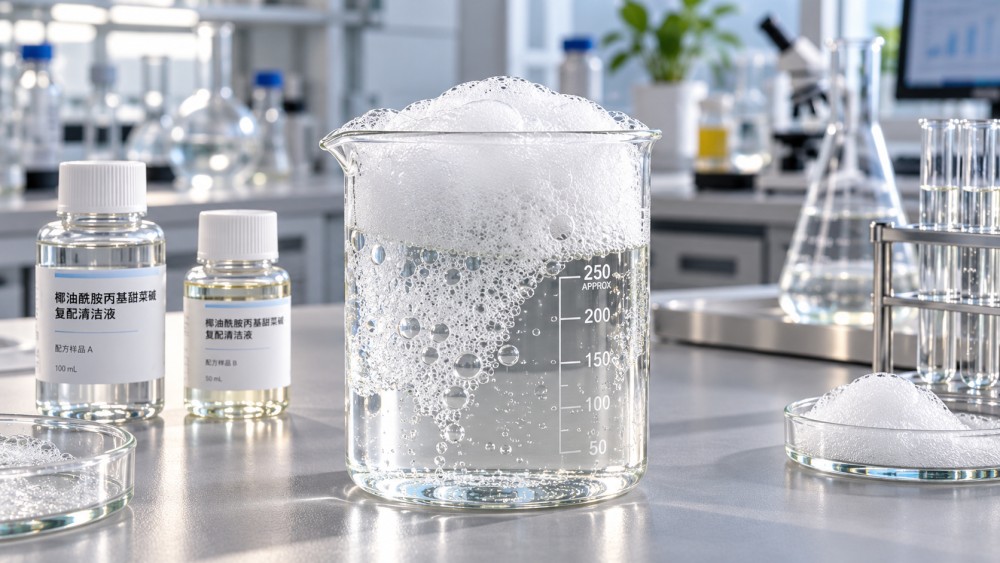
It is also useful to separate what happens inside the liquid from what happens around a bubble. Micelles influence surfactant availability and soil handling, while the surfactant film surrounding each bubble helps determine whether foam drains, coarsens, or collapses.
Better foam involves more than initial height
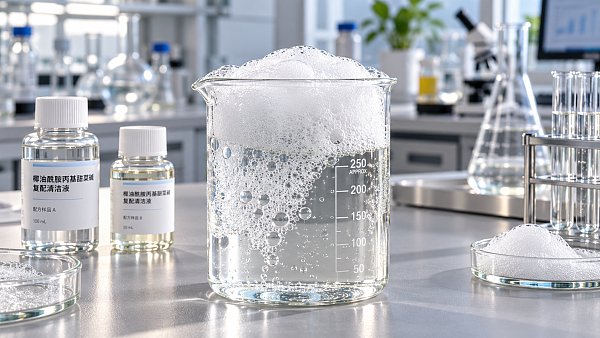
CAPB often works well as a co-surfactant in shampoos, hand washes, and body cleansers because it can support lather formation and foam persistence. Depending on the base formula, the noticeable improvement may be a denser texture, smaller bubbles, or better retention of lather during washing rather than a dramatic increase in initial volume.
Foam forms when surfactants stabilize newly created air–water interfaces. It breaks down as liquid drains from bubble films, gas moves between bubbles, and films rupture. CAPB can change the composition and mechanical behavior of these films. A favorable blend can resist collapse more effectively, but the same improvement should not be assumed across different anionic systems.
Oil and soil make this distinction particularly important. A formula that foams strongly in clean water may lose lather quickly when exposed to sebum, food grease, or oily fragrance components. Foam testing without a relevant soil load can therefore overstate the benefit users will experience.
Foam remains a performance attribute, not a direct measure of detergency. A rich lather can improve spreading and user acceptance, but soil removal must be measured separately. Persistent foam may also be undesirable in automated cleaning equipment, where it can interfere with circulation or rinsing.
Why CAPB can improve skin mildness
Anionic surfactants can interact with skin proteins and remove components of the skin barrier. In suitable blends, CAPB changes surfactant aggregation and can reduce the availability or activity of species that interact strongly with skin. This provides a practical basis for using it to moderate the irritation potential of an anionic cleanser.
The mechanism is more complex than simply making micelles larger. Aggregate composition, exchange between micelles and the surrounding water, and interactions with proteins all matter. A measurement of micelle size or free surfactant concentration can support a formulation explanation, but neither predicts the complete skin response by itself.
Exposure also changes the result. A cleanser is diluted during washing and further diluted during rinsing, so its aggregation behavior evolves throughout use. Testing only the concentrated product can miss conditions relevant to skin contact. Repeated washing, water temperature, contact time, and existing barrier damage further influence tolerance.
Higher viscosity can create a misleading impression of mildness. A thick, creamy cleanser may feel comfortable during application while still causing dryness after repeated use. Conversely, a thin formula can have good skin compatibility. Sensory richness and biological mildness require separate evidence.
Irritation and allergy need different judgments
Irritation arises from direct effects on tissue and depends strongly on exposure. Allergic contact dermatitis involves an immune response in a sensitized person. Reducing the irritation potential of a surfactant blend does not establish that it will be suitable for someone with a relevant contact allergy.
CAPB-related contact allergy assessments often focus on residual manufacturing substances, particularly dimethylaminopropylamine, or DMAPA, and amidoamine intermediates. Their control matters because a grade can perform well in foam testing while remaining unsuitable for a particular skin compatibility target.
A reaction to a finished cleanser cannot be assigned to CAPB from the ingredient list alone. Fragrance, preservatives, other surfactants, and exposure conditions also need consideration. For product development, impurity control and evaluation of the complete formula address different parts of this problem.
The formulation variables that can change the result
Surfactant ratio should be calculated on active matter. Commercial CAPB is commonly supplied as an aqueous solution, and different grades can have different active concentrations. Comparing equal weights of supplied materials may therefore compare different amounts of surfactant. Total solids are not necessarily equivalent to surfactant active matter because dissolved salts also contribute to solids.
Replacing part of an anionic surfactant with CAPB at constant total active matter helps show how blend composition affects performance. Adding CAPB while leaving the anionic level unchanged answers a different question: it changes both composition and total surfactant concentration. Either approach can be useful, but the resulting claims should reflect the experiment.
pH affects the complete system. CAPB becomes more cationic under sufficiently acidic conditions, which can alter its interactions with other ingredients. Within a practical formulation range, pH also affects preservatives, thickeners, skin feel, and stability. A mildly acidic pH may suit a product brief, but it does not establish mildness independently of surfactant composition and exposure.
Salt can change viscosity and foam behavior. Electrolytes may encourage micellar growth and thicken certain anionic–CAPB blends. Beyond a formulation-dependent point, additional salt can reduce viscosity or cause instability. Salt already present in the CAPB raw material must be included when interpreting this response.
Fragrance, oils, and conditioning ingredients can shift the balance. They can alter micelles, affect clarity, suppress lather, or change deposition and rinsing. A successful surfactant base should therefore be evaluated again after the full additive package is included. Water hardness and temperature should also reflect the intended application.
What to request when comparing CAPB grades
A shared ingredient name does not make two commercial grades interchangeable. Differences in active content, electrolyte level, fatty chain distribution, and residual impurities can affect processing, viscosity, odor, and skin compatibility.
Useful supplier documentation should address the following points:
- Active matter and its analytical basis: enough information to formulate and compare costs at equivalent surfactant content.
- Residual DMAPA and amidoamine: specifications supported by defined analytical methods and reporting limits suitable for the intended application.
- Sodium chloride and pH: values reported under stated test conditions so their contribution to formulation behavior is interpretable.
- Preservation and microbiological quality: information relevant to handling and using an aqueous raw material.
- Batch consistency: certificates of analysis and meaningful acceptance ranges, including appearance, color, and odor where relevant.
A “low impurity” description is less useful than a numerical specification with a clear method. Likewise, “not detected” means little without the method’s reporting limit. There is no single impurity specification that proves every finished cleanser will be non-irritating or suitable for every user.
Procurement comparisons should include the cost of achieving the finished formulation target. A cheaper grade may require adjustments to thickening, fragrance, or processing. A premium grade provides value when its documented quality addresses an identified formulation or compatibility requirement.
Build a test plan that separates foam gains from mildness gains
Begin with a relevant reference formula and a small series of blends spanning the proposed anionic-to-CAPB ratios. Keep total surfactant active matter constant for the main comparison. Control pH, water quality, temperature, and processing, and record the electrolyte contribution from each raw material.
Decide whether the experiment is screening surfactant interactions or comparing finished products. For an interaction study, avoid uncontrolled differences in additives. For finished product comparisons, bring samples within the intended viscosity range and document the adjustments. Otherwise, changes in dispensing and air incorporation can distort foam comparisons.
- Screen physical performance. Evaluate foam formation, persistence, texture, and rinsing at representative dilutions, both with and without relevant soil.
- Measure cleansing separately. Check whether the blend removes the intended soil without unacceptable residue or excessive stripping.
- Use appropriate mildness screening. Protein interaction or validated reconstructed tissue methods can help compare candidates, but they measure different endpoints and do not establish absence of allergy.
- Evaluate finished product tolerance. Where suitable for the product and claims, use a professionally designed human compatibility study reflecting realistic exposure.
- Repeat critical checks after stability testing. Track pH, viscosity, appearance, odor, and foam so the selected balance survives storage.
Test methods should follow the product category and intended claim. A standardized foam method can improve reproducibility, but its agitation and dilution may differ from handwashing or shampooing. Pairing a controlled laboratory method with an application-based assessment makes the results more useful. Eye compatibility also requires its own assessment when relevant; skin mildness does not establish eye mildness.
Select the blend that meets the required combination of lather, cleansing, rinsing, tolerance, and stability. If increasing CAPB improves foam texture but gives no meaningful compatibility benefit, there may be little reason to continue increasing it. If impurities or another ingredient limit tolerance, adjusting the surfactant ratio alone will not resolve the issue. The next formulation decision should follow the measured constraint.
Facing technical bottlenecks in manufacturing or looking for more efficient industrial solutions? Leave your details below and let the engineering experts at FCAS solve them for you.
We respect your privacy. Your information is strictly confidential.
Related News
 Micelle Fluidics & ChelationHow Venturi Fertigation Systems Control Fertilizer InjectionDiscover how venturi fertigation systems control fertilizer injection, and learn how pressure, sizing, and calibration affect dosing accuracy.MORE+
 Micelle Fluidics & ChelationHow to Use Cocamidopropyl Betaine for Hand Soap FormulasDiscover how to use cocamidopropyl betaine for hand soap, balance surfactants, adjust pH and viscosity, and troubleshoot common formulation issues.MORE+
 Micelle Fluidics & ChelationHow to Evaluate an Industrial Dispersants ManufacturerEvaluate an industrial dispersants manufacturer with confidence. Learn how to assess formulation performance, batch consistency, quality controls and supply risk.MORE+
 Micelle Fluidics & ChelationHow Cationic Surfactants Affect Emulsion StabilityCationic Surfactants can improve emulsion stability—but formulation matters. Discover key risks, compatibility checks, and practical troubleshooting tips.MORE+
 Micelle Fluidics & ChelationHow Eco Friendly Detergent Builders Perform in Hard WaterExplore how eco friendly detergent builders tackle hard water, compare citrate, zeolite and chelants, and find the right approach for cleaner results.MORE+
 Micelle Fluidics & ChelationHow Does Cocamidopropyl Betaine Affect Foam and Skin Mildness?Discover how Cocamidopropyl Betaine can enhance foam and support skin mildness. Explore formulation tips, impurity controls, and testing strategies for better cleansers.MORE+
 Micelle Fluidics & ChelationWhich Detergent Builders for Hard Water Prevent Mineral Buildup?Compare detergent builders for hard water, including MGDA, GLDA, citrate and zeolites. Discover how to prevent mineral buildup, reduce residue and choose the right formulation.MORE+
 Micelle Fluidics & ChelationHow Anionic Industrial Dispersants Improve Coating StabilityAnionic industrial dispersants improve coating stability, pigment wetting, viscosity control, gloss, and storage performance. Learn how to select and test the right solution.MORE+
 Micelle Fluidics & ChelationWhat Are Cationic Surfactants and Where Are They Commonly Used?Cationic Surfactants deliver powerful surface affinity for disinfection, fabric softening, hair conditioning, antistatic control, and industrial treatments. Explore key uses and selection factors.MORE+
 Micelle Fluidics & ChelationHow Cationic Surfactants Improve Formulation Performance and StabilityCationic Surfactants improve deposition, conditioning, anti-static control, and formulation stability. Explore compatibility, dispersion, and selection insights for better-performing products.MORE+
 Micelle Fluidics & ChelationIndustrial Dispersants for Pigments and Fillers: How to Improve Stability and FlowIndustrial Dispersants help improve pigment and filler stability, boost flow, and reduce defects in production. Discover how the right choice can cut rework and improve results.MORE+