Choose potassium chloride fertilizer for bulk blending by matching particle size, handling durability, and moisture behavior to your actual formulation and distribution conditions.
Potash content and purchase price matter, but neither predicts whether a finished blend will remain uniform through conveying, transport, storage, and field spreading.
For technical evaluators, the strongest qualification combines documented specifications, representative sampling, comparative laboratory measurements, and a plant trial using the intended companion fertilizers.
Begin by confirming chloride suitability for the intended crop and application. Then evaluate physical compatibility, storage performance, and delivered cost per usable nutrient unit.
Which Potassium Chloride Grade Should You Evaluate First?
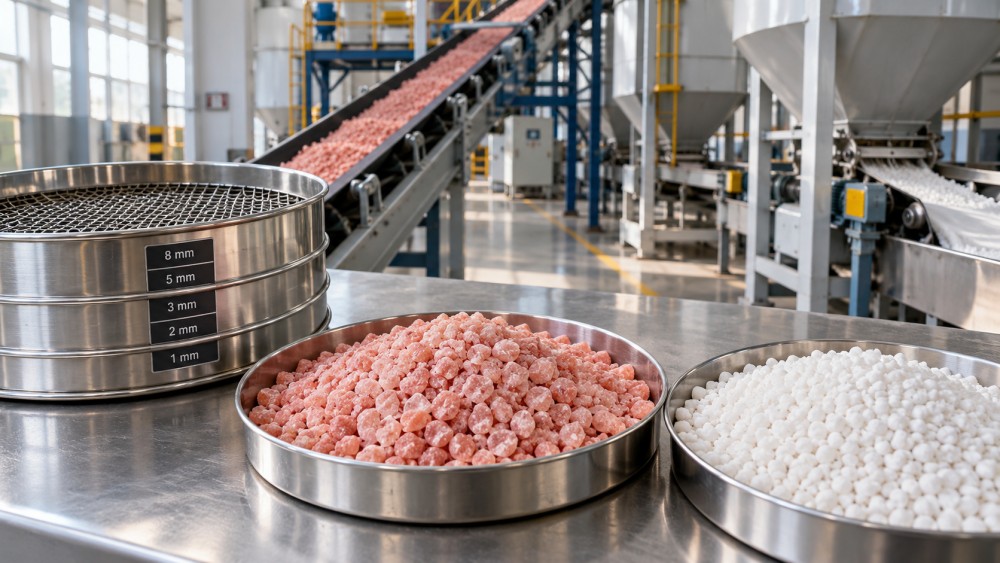
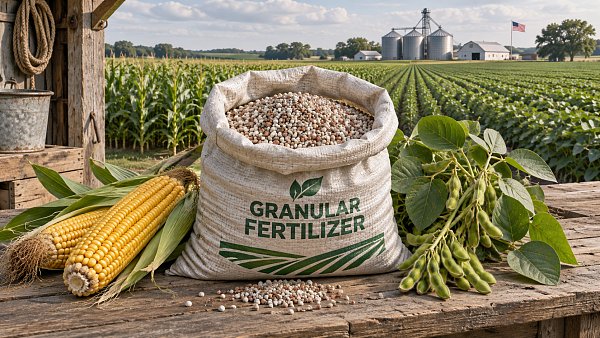
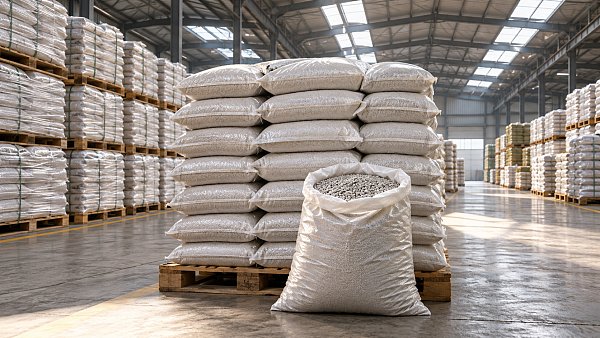
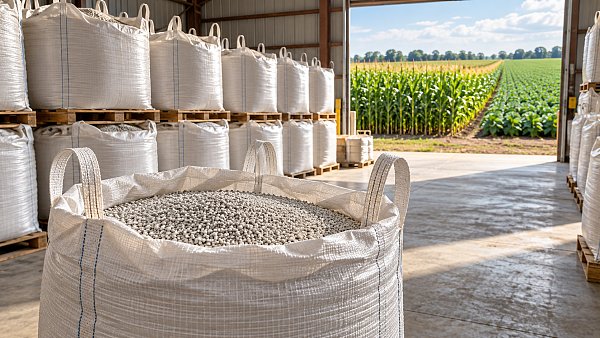
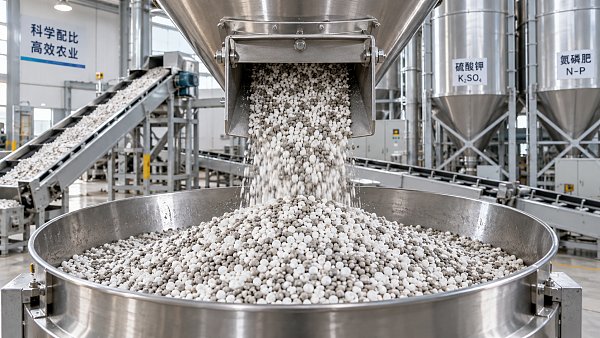
Granular potassium chloride, commonly called granular muriate of potash or granular MOP, is usually the starting point for conventional dry fertilizer bulk blending.
Standard or fine grades may contain suitable potassium concentrations, yet their smaller particles can segregate from larger nitrogen and phosphate granules during handling.
Do not qualify material by its commercial grade name alone. Terms such as granular, coarse, and premium do not guarantee identical specifications across suppliers.
Request the actual sieve distribution, nutrient guarantee, moisture specification, and production route. Compacted and crystallized products can differ in shape, abrasion behavior, and handling performance.
Many commercial fertilizer grades declare around 60–62% potassium expressed as K₂O equivalent. Confirm the guaranteed analysis and reporting basis for each offered product.
K₂O equivalent is a nutrient reporting convention; potassium chloride does not contain potassium oxide as its fertilizer ingredient. Avoid confusing K₂O percentage with KCl purity.
Will Its Particle Distribution Match Your Other Ingredients?
Particle size compatibility usually deserves the greatest attention because a chemically correct blend can still deliver uneven nutrient proportions after segregation during routine handling.
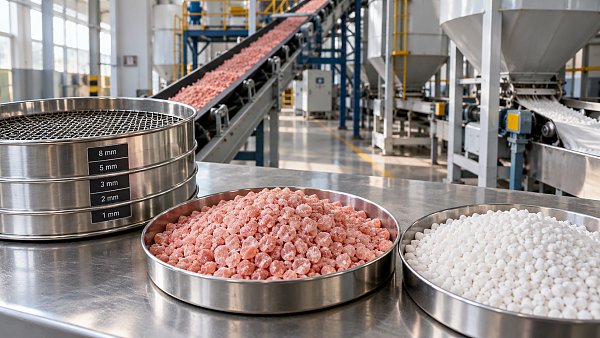
Compare the complete sieve curves of potassium chloride and every major companion material. A similar average size can conceal substantially different fine and coarse fractions.
Request cumulative sieve results using agreed apertures and methods. Measure incoming material against the same procedure so supplier data and receiving results remain comparable.
For example, a proposed 2–4 mm purchasing range needs more detail: define the required proportion inside that range and allowable fines and oversize.
That range is illustrative, not a universal specification. The appropriate limits depend on companion granules, equipment, transfer heights, transport conditions, and intended spreading system.
Where available, size guide number and uniformity index help screen candidates. Confirm their calculation conventions, and retain the underlying sieve data for technical comparison.
Size matching alone cannot eliminate segregation. Differences in particle density, shape, and surface texture can alter movement through hoppers, conveyors, truck loading, and spreaders.
Pay particular attention to blends containing lower-density urea. Similar sieve profiles improve compatibility, but actual handling trials must establish whether nutrient uniformity remains acceptable.
Which Specifications Belong in the Purchase Agreement?
A useful specification links every important property to a test method, sampling procedure, acceptance limit, and agreed response when a delivery falls outside requirements.
Specify whether nutrient values apply on an as-received or dry basis. Differences in reporting can distort both formulation calculations and comparisons between supplier quotations.
Request recent results from multiple production lots. One compliant sample establishes initial suitability but gives limited evidence about the consistency of future commercial deliveries.
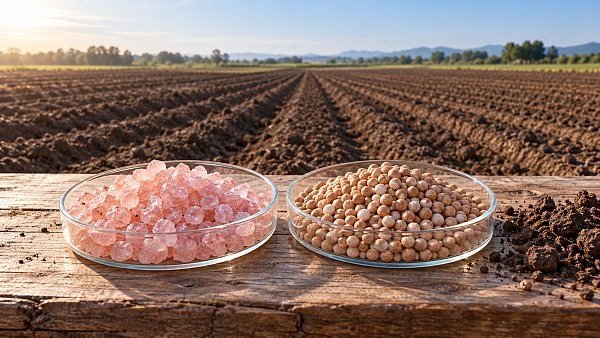
Color is not a dependable acceptance criterion. Red and white potassium chloride can both be suitable; measured composition and physical performance should guide selection.
Will the Granules Survive Your Handling System?
Granules that arrive within specification may generate fines after repeated transfers. Evaluate durability under the handling conditions between unloading and the final application point.
Single-granule crushing strength provides useful information, but it does not fully describe resistance to rubbing, impact, or breakage during repeated conveyor and elevator passes.
Request an abrasion or attrition assessment alongside crushing strength. Compare products using equivalent methods and particle fractions, since different procedures can produce misleading rankings.
During trials, measure the increase in fines between receipt and final discharge. Record transfer counts, drop heights, equipment settings, and throughput for meaningful comparisons.
Dust reduces saleable recovery, burdens collection systems, and can change nutrient distribution. Include collected dust, screening losses, and housekeeping time in the material evaluation.
Ask about dust suppressants and anticaking treatments. Confirm their suitability for your formulation, handling equipment, labeling obligations, and downstream use before approving treated material.
How Should You Assess Moisture, Caking, and Compatibility?
A low incoming moisture result is useful, but it cannot independently predict storage stability. Humidity, temperature cycling, storage pressure, and residence time also matter.
Fertilizer mixtures can begin absorbing moisture at a lower relative humidity than individual ingredients. This makes testing the complete formulation essential for storage decisions.
Avoid adopting one moisture maximum for every product and climate. Establish limits using supplier evidence, local warehouse conditions, packaging arrangements, and observed plant performance.
Run storage trials with the intended potassium chloride, actual companion fertilizers, and representative blend ratios. Include expected storage duration, humidity exposure, and stacking pressure.
Assess flow after storage, lump formation, cake strength, and recovery during discharge. Define whether normal equipment can restore flow without excessive crushing or screening.
Compatibility assessment should also cover reaction hazards and applicable restrictions, particularly for formulations containing ammonium nitrate. Use formulation-specific guidance and relevant local requirements.
Do not interpret a dry, free-flowing laboratory sample as proof of long-term compatibility. Extend qualification when commercial blends will experience prolonged or humid storage.
When Does Chloride Make Potassium Chloride Unsuitable?
Potassium chloride is widely used because it supplies concentrated potassium economically. Its suitability still depends on crop tolerance, soil conditions, irrigation water, and placement.
Certain crops and quality-focused production systems require careful chloride management. Tobacco and some potato programs are common examples where alternative potassium sources warrant evaluation.
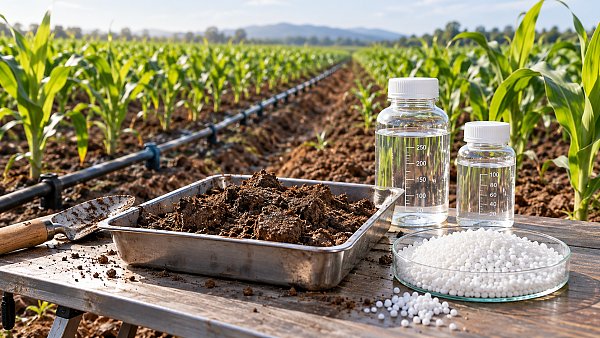
Evaluate the chloride load from the complete fertilizer program and irrigation water. Soil drainage, rainfall, and leaching conditions influence whether chloride accumulates around roots.
Placement matters because concentrated fertilizer salts near seeds or roots can cause injury. Confirm application rate, placement distance, and crop-specific recommendations with qualified agronomic guidance.
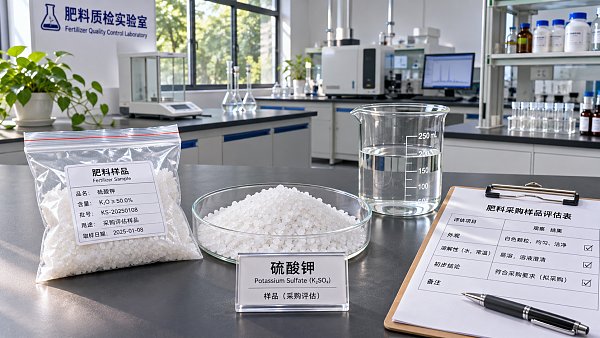
Where chloride restrictions or sulfur requirements justify another source, assess potassium sulfate. Recheck particle compatibility and economics because substitution changes more than nutrient chemistry.
What Should a Practical Qualification Trial Include?
Use staged qualification to avoid committing a full production campaign to an unproven grade. Begin with representative samples and progress to realistic handling trials.
- Collect increments across the lot or moving stream using an agreed sampling plan. Prepare a representative composite and retain a sealed reference sample.
- Verify nutrient analysis, moisture, sieve distribution, and handling durability against the proposed specification. Investigate material differences from the supplier’s certificate of analysis.
- Produce a pilot blend using the intended recipe, equipment settings, and mixing time. Include minor ingredients where their distribution affects the finished guarantee.
- Sample the blend across discharge and after representative transfers. Analyze nutrient variation using a predefined sampling design and agreed performance criteria.
- Store a representative quantity under expected conditions, then reassess flow, caking, fines, and nutrient uniformity before approving routine commercial use.
For blend uniformity, use nutrient assays or a validated component measurement method. Sieve results alone cannot demonstrate that potassium remains evenly distributed throughout a load.
A coefficient of variation can help summarize results, but interpret it alongside average concentration, sampling uncertainty, analytical precision, and the intended regulatory or operational limits.
No single mixing time or universal uniformity threshold suits every plant. Establish acceptance criteria before testing, based on product guarantees and customer application requirements.
If spreading performance is critical, add a spreader evaluation. A uniform blend at factory discharge does not automatically produce uniform nutrient distribution across the field.
How Do You Compare Suppliers Beyond Price per Tonne?
Compare potassium chloride fertilizer for bulk blending on delivered nutrient cost, then adjust for measurable differences in recovery, throughput, storage performance, and technical support.
For a material priced at $360 per tonne with 60% K₂O equivalent, the unadjusted nutrient cost is $600 per tonne of K₂O equivalent.
Apply the same calculation to competing quotations using consistent delivery terms and nutrient reporting bases. Then include documented screening losses, dust losses, and rework costs.
A lower-priced grade may cost more in operation if it slows unloading, requires additional screening, or increases rejected product. Quantify these effects during trials.
Check supply reliability alongside physical quality: production capacity, shipment protection, transit exposure, lot traceability, complaint handling, and notification of changes in source or treatment.
Request a technical data sheet, current safety data sheet, lot-specific certificate of analysis, and applicable compliance documentation. Confirm destination-market requirements before contracting supply.
Make Approval Conditional on Demonstrated Performance
Approve a potassium chloride grade when it meets agronomic requirements, matches companion materials sufficiently, survives expected handling, and maintains acceptable blend quality through storage.
Convert successful trial results into written purchasing and receiving criteria. Include agreed test methods, sampling responsibilities, retained samples, and procedures for investigating nonconforming deliveries.
Requalify material after meaningful changes in source, particle distribution, conditioning treatment, or production route. Also review performance when formulations, equipment, or storage conditions change.
The best choice balances nutrient value with consistent physical performance. A documented qualification process gives technical teams a defensible basis for reliable purchasing decisions.