How Do Herbicide APIs for Formulation Affect Final Product Stability?
Two herbicide active ingredients can meet the same assay specification and still produce formulations with different storage stability. Differences in impurity profile, solid form, moisture content, particle size, and solubility can change how the active ingredient behaves during manufacturing and storage. The consequences may include chemical degradation, crystal growth, hard sediment, or precipitation that appears only after temperature cycling.
For technical evaluators, selecting herbicide APIs for formulation therefore requires more than comparing purity certificates. A material is suitable when its chemical and physical characteristics remain compatible with the intended formulation, manufacturing process, packaging, and storage conditions. A higher assay may offer little advantage if the material introduces an uncontrolled crystal form or shifts the formulation outside its stable pH range.
Separate active ingredient loss from physical instability
Final product stability has two connected dimensions. Chemical stability concerns whether the active ingredient retains its identity and concentration without unacceptable degradation or impurity formation. Physical stability concerns whether the product remains homogeneous, pourable, dispersible, and usable through its claimed shelf life. Either dimension can fail independently.
A suspension concentrate may retain its active content while developing sediment that cannot be redispersed adequately. A soluble concentrate may remain clear while the active ingredient gradually degrades. Appearance alone cannot establish chemical stability, and a satisfactory assay cannot establish physical stability.
This distinction affects the investigation. When active content falls, the evaluator should examine degradation products, analytical recovery, and sampling representativeness. When sediment or crystals appear, particle size, solid form, solubility changes, and the formulation’s dispersing system become immediate priorities. Some failures involve both: chemical changes may alter pH or generate poorly soluble products, while physical separation can create misleading assay results if samples are not representative.
The same active ingredient also presents different risks in different formulation types. In an aqueous suspension concentrate, particle surfaces and limited dissolution govern much of the physical behavior. In an emulsifiable concentrate, solvent capacity and dilution behavior are central. In a soluble concentrate containing an active ingredient salt, pH, counterion, ionic strength, and temperature may control whether the active remains dissolved.
Which incoming material properties change the stability risk?
Impurities and moisture can influence more than assay
An assay result compresses a complex material into a single number. Two lots with similar active content may contain different residual solvents, inorganic salts, synthesis by-products, or trace metals. Where chemically relevant, these components can promote degradation, shift pH, change ionic strength, or interfere with surfactant performance.
The effect depends on the active ingredient and formulation. An acidic or alkaline impurity may matter greatly when the active is unstable outside a narrow pH range. Trace metals may matter where a degradation pathway is metal-catalyzed. Residual electrolyte can affect dispersant adsorption or the behavior of a thickening system. These are mechanisms to investigate, rather than reasons to impose the same impurity limits on every herbicide.
Moisture deserves similar treatment. Water entering through the technical material can affect water-sensitive chemistry, encourage caking in dry products, or alter a solvent-based formulation. The significance depends on total water in the finished product and the active ingredient’s sensitivity. A moisture result should therefore be interpreted against the formulation’s water budget and processing conditions.
Supplier evaluation should establish which impurities are identified, which are controlled, and how their levels vary between batches. Safety- or registration-relevant impurities also require separate attention; a stable formulation does not establish that an impurity profile is acceptable for regulatory purposes.
Solid form and particle size govern suspension behavior
For an active ingredient present as solid particles, crystal form can affect solubility, dissolution rate, milling behavior, and transformation during storage. Polymorphs, hydrates, solvates, and amorphous material may behave differently even when a routine chemical assay gives the same result. Not every active exhibits all these forms, but known solid-state variability should be addressed explicitly.
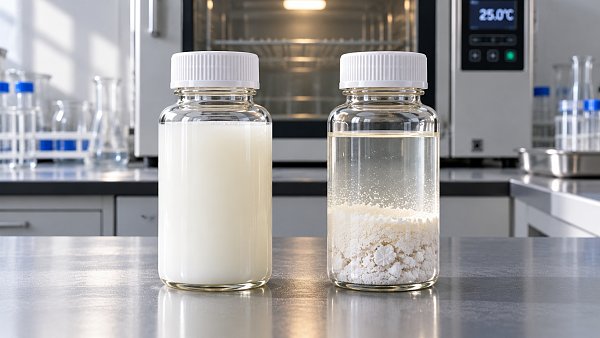
A form that dissolves more readily may convert to a less soluble form during storage. Dissolved material can then deposit on existing particles or form new crystals. In some systems, this causes particle growth, altered viscosity, or sediment that becomes difficult to redisperse. Changing the dispersant may provide limited benefit if the underlying problem is an uncontrolled solid-state transformation.
Particle size also involves trade-offs. Reducing size can improve suspension behavior and application consistency, but increases surface area and the demand placed on wetting and dispersing agents. Very fine material may increase viscosity or contribute to dissolution and recrystallization. Coarse particles and agglomerates may settle, obstruct filters, or disperse incompletely.
A single median particle-size value cannot describe these risks adequately. Distribution width, the coarse fraction, particle shape, and agglomeration behavior can all matter. Incoming technical material should also be distinguished from the particles present after milling: the process may reduce size while changing crystal condition or exposing new surfaces.
Solubility must be measured in the formulation environment
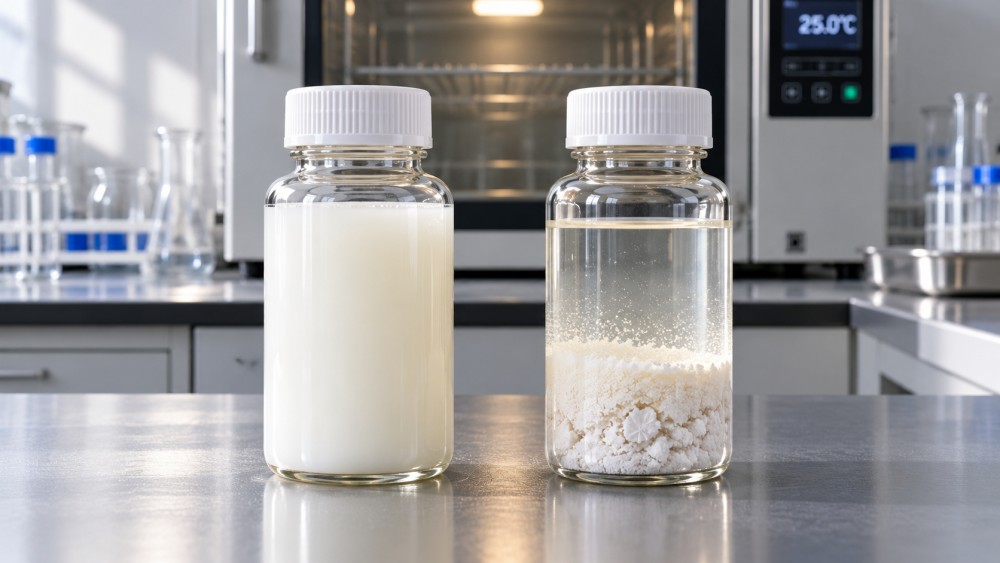
A published water-solubility value is a starting point. The relevant question is how much active dissolves in the actual solvent mixture at the formulation’s pH, ionic strength, and temperature. Co-solvents and surfactants may increase apparent solubility enough to influence crystal growth, even when most of the active remains suspended.
For ionizable herbicides, pH and salt form can have a strong effect on solubility. A formulation that stays clear at manufacture may precipitate after cooling or after a pH shift. Different salts also differ in molecular weight and active-equivalent content, so comparisons must use a consistent basis. Equal mass additions of different salts do not necessarily deliver equal amounts of the herbicidal moiety.
Increasing solubility does not automatically improve stability. It may help a soluble concentrate remain homogeneous, yet increase the amount of active exposed to solution-phase degradation. In a suspension, temperature-dependent dissolution followed by recrystallization can progressively change particle size. Solubility and chemical stability must be evaluated together.
Why a satisfactory raw material can fail in a finished formulation
Stability emerges from the interaction between the active ingredient and the complete formulation. A technical material that works in one surfactant package may behave differently in another. Dispersants must adsorb effectively onto particle surfaces, solvents must retain adequate solvency during storage, and rheology modifiers must function at the product’s pH and electrolyte concentration.
In suspension concentrates, changing the API supplier can change surface properties enough to alter dispersant demand. A formula may initially look acceptable but develop flocculation, excessive viscosity, or compact sediment during aging. Adding more dispersant without investigating the cause can create other problems, including changes in foam or interactions with the thickener.
For emulsifiable concentrates, complete dissolution at room temperature provides limited reassurance about cold storage. A reduction in solvent capacity can cause crystallization, especially near the intended loading limit. After dilution, the emulsifier system must also maintain acceptable behavior in the relevant water conditions. Concentrate storage stability and dilution performance are separate assessments.
Manufacturing conditions can amplify differences between technical materials. Milling energy, processing temperature, addition sequence, and hold time may influence particle surfaces, dissolution, and degradation. A laboratory batch made with short processing times may not reproduce the thermal or mechanical exposure of commercial production.
Packaging adds another interaction. Depending on the system, moisture transfer, solvent loss, or contact with container and closure materials can change the product during storage. Development samples kept only in laboratory glass cannot establish performance in the intended commercial pack.
These interactions explain why changing an API source requires a defined comparison. Matching the existing assay specification provides an entry criterion, but the comparison should also address the material properties that support the established formulation’s stability.
Build a stability assessment that can explain a failure
An effective assessment connects incoming material attributes to measurable finished-product behavior. Begin with the intended formulation type, active loading, packaging, and distribution conditions. Identify the plausible failure mechanisms, then choose measurements that would detect them. A broad test list has limited value if it cannot distinguish degradation from precipitation or reversible settling from permanent aggregation.
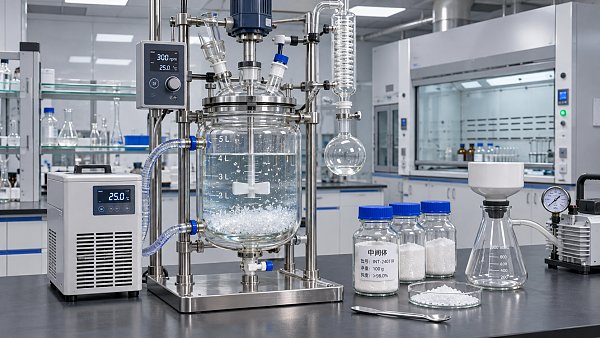
The supplier data package should support this reasoning. Beyond identity and assay, useful information may include impurity profiles, water content, residual solvents, particle-size distribution, and solid-form characterization where relevant. Multi-batch data help establish variability. A single favorable sample cannot show whether a formulation will tolerate routine production differences.
Finished-product assessment should connect several kinds of evidence:
- Chemical integrity: active content and relevant degradation products, measured using methods capable of distinguishing the active ingredient from likely interferents.
- Physical behavior: formulation-specific properties such as particle-size distribution, sedimentation, redispersibility, viscosity, crystallization, phase separation, or emulsion behavior.
- Conditions that influence stability: pH, water content, or other relevant variables tracked alongside the observed failure.
- Usability after storage: dilution, dispersion, suspensibility, or wet-sieve performance, selected according to the formulation and its application requirements.
Use applicable product specifications and recognized pesticide test methods, such as relevant CIPAC methods, to select procedures and acceptance criteria. Method choice must fit the formulation type and regulatory context. A method that measures suspensibility does not establish chemical shelf life, and a storage test does not replace assessment of dilution behavior.
Accelerated storage can reveal weaknesses and compare candidate materials, but its interpretation requires care. Elevated temperature may introduce degradation or phase behavior that does not dominate under normal storage. Conversely, a warm-storage test can miss cold-induced precipitation. Low-temperature exposure and temperature cycling may be needed where those conditions represent credible distribution risks.
A satisfactory accelerated result alone does not justify an arbitrary shelf-life claim. Real-time storage in the intended packaging provides evidence under the proposed storage conditions. Test duration, temperatures, and acceptance criteria should follow the applicable requirements and the product’s known behavior.
When a result fails, preserve the distinction between cause and symptom. Enlarged particles suggest examining dissolution, recrystallization, aggregation, and solid-form change. Falling assay with rising degradation products points toward chemical instability. An apparent assay loss without corresponding degradants should trigger checks on sampling, extraction, and analytical recovery before reformulating.
The practical qualification decision is whether the candidate material remains within the formulation’s demonstrated operating window. That window includes impurity levels, moisture, solid form, particle characteristics, and processing conditions that the finished product can tolerate. Where a supplier change moves a critical attribute outside that window, targeted formulation and stability work is needed before scale-up. Once those relationships are understood, incoming specifications can control the properties that actually determine shelf life and usable performance.
Facing technical bottlenecks in manufacturing or looking for more efficient industrial solutions? Leave your details below and let the engineering experts at FCAS solve them for you.
We respect your privacy. Your information is strictly confidential.
Related News
 Herbicides & Plant Growth RegulatorsChina Pesticide Retail Prices Diverge as Lambda-Cyhalothrin and Glyphosate Lead GainsChina pesticide retail prices diverge as lambda-cyhalothrin and glyphosate lead gains. Explore the implications for buyers, suppliers and procurement.MORE+
 Herbicides & Plant Growth RegulatorsHow to Apply Powder Single Superphosphate for Better Root GrowthDiscover how to apply powder single superphosphate for better root growth, with practical guidance on soil testing, fertilizer rates, safe placement, and application.MORE+
 Herbicides & Plant Growth RegulatorsEnvironmental Groups Urge EPA to Release Paraquat Litigation MaterialsParaquat litigation materials are at the center of a push for EPA disclosure. Explore what environmental groups are requesting and why it matters for the herbicide review.MORE+
 Herbicides & Plant Growth RegulatorsHow to Choose a Reliable Herbicide APIs ManufacturerChoose a reliable herbicide APIs manufacturer with confidence. Discover how to assess quality, compliance, delivered costs and supply reliability.MORE+
 Herbicides & Plant Growth RegulatorsEU Pesticide Reduction Stalls as Binding Targets Are ScrappedEU pesticide reduction is stalling as binding targets are scrapped. Discover what the uncertainty means for sourcing, compliance and supply-chain planning.MORE+
 Herbicides & Plant Growth RegulatorsNAFDAC Seizes Banned Farm Chemicals Worth 200 Million Naira in KanoNAFDAC seizes banned farm chemicals worth 200 million naira in Kano. Discover what the action means for pesticide suppliers, buyers and storage operators.MORE+
 Herbicides & Plant Growth RegulatorsHow Do Herbicide Intermediates Affect Production Yield?Discover how Herbicide Intermediates influence production yield, from impurity control to product recovery, and learn how to evaluate suppliers with confidence.MORE+
 Herbicides & Plant Growth RegulatorsHow to Choose Crop Protection Chemicals for Effective Weed ControlChoose Crop Protection Chemicals with confidence. Discover how to match herbicides to weeds, crop stages, field conditions, and resistance risks for effective control.MORE+
 Herbicides & Plant Growth RegulatorsBayer Launches First Group 12 Pre-Emergence Herbicide Convintro in the USBayer's Convintro brings a Group 12 pre-emergence herbicide option to US corn and soybean growers. Explore its potential role and key purchasing considerations.MORE+
 Herbicides & Plant Growth RegulatorsCalifornia Report Shows Continued Decline in High-Risk Pesticide UseCalifornia pesticide use reportedly declined 28% for carcinogen-classified products. Explore what this could mean for suppliers, buyers and market access.MORE+
 Herbicides & Plant Growth RegulatorsHow to Choose Adjuvant Systems for Herbicide FormulationsChoose Adjuvant Systems that improve herbicide performance without sacrificing crop safety or stability. Explore practical selection and testing strategies.MORE+
 Herbicides & Plant Growth RegulatorsHow to Choose Adjuvant Systems for HerbicidesChoose adjuvant systems for herbicides with confidence. Explore label requirements, compatibility, crop safety, and field testing to make better-informed decisions.MORE+
 Herbicides & Plant Growth RegulatorsReport Forecasts Global Agrochemical Market to Reach $387.7 Billion by 2031Global agrochemical market could reach $387.7 billion by 2031. Explore how technology, regulation and agricultural drones may shape industry decisions.MORE+
 Herbicides & Plant Growth RegulatorsWisconsin DNR Board to Vote on Drafting New Pesticide RulesWisconsin DNR pesticide rules are up for a drafting vote. See what the decision could mean for farmers, suppliers and future compliance.MORE+
 Herbicides & Plant Growth RegulatorsHow Do Herbicide APIs for Formulation Affect Final Product Stability?Discover how herbicide APIs for formulation affect product stability. Learn which impurities, particle properties, and tests matter to reduce storage failures and qualify reliable suppliers.MORE+
 Herbicides & Plant Growth RegulatorsHow Do You Choose Spray Adjuvant Systems for Herbicide Applications?Choose spray adjuvant systems with confidence. Compare surfactants, oils, and water conditioners, check label requirements, and learn how to avoid costly herbicide application mistakes.MORE+
 Herbicides & Plant Growth RegulatorsHow Can Plant Growth Regulators Control Excessive Shoot Growth?Plant Growth Regulators help control excessive shoot growth. Discover how crop-specific selection, timing, and application can improve canopy management without over-suppressing plants.MORE+
 Herbicides & Plant Growth RegulatorsCanadian Coalition Calls for Removal of Bill C-31 Pesticide ProvisionBill C-31 faces calls from a Canadian coalition to remove Section 13 over pesticide oversight concerns. Explore the debate and potential implications for farmers and suppliers.MORE+
 Herbicides & Plant Growth RegulatorsUS EPA Approves Three Controversial New Pesticide Active IngredientsExplore reported US EPA approvals of epyrifenacil, diflufenican and trifludimoxazin. Understand PFAS concerns and discover key checks for pesticide buyers and agricultural suppliers.MORE+
 Herbicides & Plant Growth RegulatorsEnvironmental Groups Sue EPA to Seek Atrazine Water Quality StandardsAtrazine water quality standards are at the center of a reported EPA lawsuit. Explore potential impacts on growers and suppliers, plus practical steps to prepare for possible regulatory changes.MORE+
 Herbicides & Plant Growth RegulatorsUsing Insect Growth Regulators to Protect Stored Grain from InfestationsInsect growth regulators for stored grain: learn how lifecycle control, precise application, sanitation, and residue planning help safeguard quality and market access.MORE+
 Herbicides & Plant Growth RegulatorsSelecting Benzyl Alcohol for Stable Agrochemical FormulationsBenzyl alcohol for agrochemical formulations: discover how to improve solubility, emulsion stability, storage performance, compliance, and supplier qualification.MORE+
 Herbicides & Plant Growth RegulatorsWhat to Verify Before Choosing a Suspoemulsion Pesticides SupplierChoose a reliable suspoemulsion pesticides supplier with confidence. Verify formulation stability, dilution performance, documentation, packaging, batch control, and supply reliability.MORE+
 Herbicides & Plant Growth RegulatorsHow to Assess Quality Risks at a Pesticide Formulation Intermediates FactoryPesticide formulation intermediates factory assessment guide: identify quality risks in raw materials, processes, testing, traceability, and storage.MORE+
 Herbicides & Plant Growth RegulatorsSoluble Concentrates Explained for Reliable Field ApplicationsSoluble Concentrates explained: improve mixing, calibration, water quality, compatibility, and spray coverage for more reliable field applications.MORE+
 Herbicides & Plant Growth RegulatorsHow to Test Wetting Agents for Crop Protection FormulationsHow to test industrial wetting agents for crop protection use? Explore practical checks for leaf coverage, foam, stability, sprayability, and crop safety to select the right formulation additive.MORE+
 Herbicides & Plant Growth RegulatorsWhat Does Water-Dispersible Granules Mean in Crop Protection Formulations?Water dispersible granules meaning explained: discover how WDG crop protection formulations disperse in water, improve handling, and support reliable spray performance.MORE+
 Herbicides & Plant Growth RegulatorsHow Plant Growth Promoters Improve Crop Uniformity and YieldPlant Growth Promoters help improve crop uniformity, root development, stress recovery, and yield potential. Learn how to choose the right product, timing, and application strategy.MORE+
 Herbicides & Plant Growth RegulatorsAre Bioherbicides Ready to Replace Conventional Weed Control in 2026Bioherbicides are gaining ground in 2026, but can they replace conventional weed control? Explore where they truly perform, what limits adoption, and which markets offer the biggest opportunity.MORE+
 Herbicides & Plant Growth RegulatorsHow to Compare Herbicides for Cost, Control, and Crop SafetyHerbicides comparison made practical: learn how to assess true cost per hectare, weed control reliability, crop safety, resistance risk, and supplier quality before you buy.MORE+