How Do You Choose Flavor Emulsions for Beverages With Low Sugar?
Choose flavor emulsions for low-sugar beverages by their performance in the finished drink, not by the taste of the concentrate or its price per kilogram. A suitable option must deliver the intended flavor at an acceptable dose, remain physically stable through processing and storage, and meet the labeling requirements of every destination market.
Reducing sugar changes more than sweetness. It can expose acidity and bitterness, reduce body, and alter aroma perception. It may also change the viscosity and density of the beverage, affecting how dispersed oil droplets behave. An emulsion that performs well in a full-sugar reference is therefore a starting candidate, not an automatically qualified replacement.
Define the beverage before comparing emulsions
A useful supplier brief describes the actual beverage matrix. “Low-sugar citrus drink” leaves too many variables unresolved: a carbonated lemon beverage sweetened with stevia presents a different challenge from a still orange drink containing residual sugar, juice solids, and minerals.
The brief should specify the sugar level and sweetener system, target pH and titratable acidity, juice content, mineral additions, carbonation, appearance, processing conditions, packaging, and intended shelf life. Include the expected storage and distribution temperatures. These details determine whether an emulsion is technically appropriate and whether a supplier’s supporting data are relevant.
Appearance deserves an early decision. An opaque flavor emulsion can suit a cloudy fruit beverage but conflict with a clear sparkling drink. A flavor emulsion also differs from a cloud emulsion: the former delivers flavor, while the latter primarily creates visual opacity. Some products combine both functions, but flavor strength and cloud intensity do not necessarily change in the same proportion.
If the beverage must be transparent, ask whether a soluble flavor system or a suitably designed fine-droplet system is more appropriate. Do not accept “water-dispersible” as evidence that an ingredient will produce a clear drink.
Separate sweetness balance from flavor strength
A reduced-sugar formulation can make the same citrus emulsion taste sharper, thinner, or more peel-like. Increasing the dose may intensify those characteristics without restoring the rounded profile previously supplied by sugar. It can also add unnecessary oil load, cloud, and cost.
The first sensory question is therefore not “Which sample has the strongest aroma?” It is “Which sample produces the intended drinking experience with this sweetener and acid system?”
Evaluate candidates at their proposed use rates in a common beverage base. Assess initial aroma, fruit identity, acidity balance, bitterness, mouthfeel, and aftertaste. For high-intensity sweeteners, pay particular attention to the timing of sweetness and lingering notes: an attractive first sip does not establish an acceptable finish.
Sweet-associated aromas can support perceived sweetness, but they do not replace sugar’s contribution to body or guarantee that a sweetener’s off-notes will disappear. Likewise, a flavor emulsion should not be expected to correct every texture problem. Where body is inadequate, adjusting the beverage base may be more effective than increasing flavor dosage.
Use a recognizable product target and blind-coded samples. Compare candidates both at supplier-recommended doses and, where practical, at approximately matched flavor intensity. Otherwise, a more concentrated sample can appear superior simply because it is stronger. Repeat assessment after the intended production process and during storage, rather than approving the freshly mixed drink alone.
Judge the emulsifier system by compatibility, not ingredient reputation
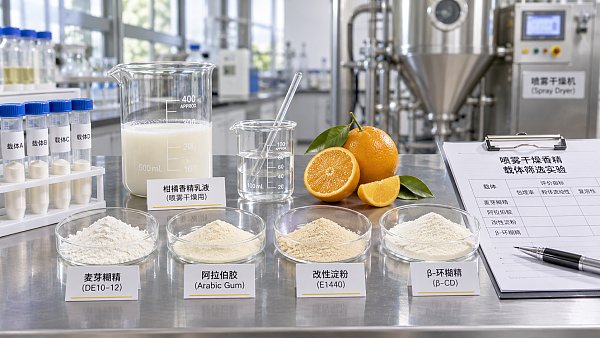
Beverage flavor emulsions disperse oil-based flavor materials in water using an interfacial stabilizing system. Gum arabic and emulsifying modified starches are established options; other hydrocolloids, proteins, or permitted surfactants can be appropriate in particular formulations. The ingredient name alone does not establish performance.
Low sugar can make physical stability more demanding if the reformulation reduces continuous-phase viscosity or changes the density difference between the beverage and oil droplets. Droplet size, oil composition, interfacial protection, and the surrounding liquid all matter. A statement such as “small particle size” is insufficient without the distribution, measurement method, and evidence from the diluted beverage.
Smaller droplets can reduce gravitational separation, but size alone does not control every failure mechanism. Certain flavor oils can undergo droplet growth through molecular transfer between droplets, known as Ostwald ripening. The oil-phase design must address this where relevant; a smaller initial measurement does not prove long-term stability.
Ask suppliers to explain why their system suits the specified pH, mineral content, and process. A technical explanation linked to application data is more useful than a general claim of “excellent stability.”
Require stability evidence from the diluted, processed beverage
Concentrate stability and beverage stability are separate qualifications. Dilution changes the environment around the droplets, while acids, salts, juice components, and processing can create interactions absent from the supplied emulsion.
Useful evidence identifies the test beverage composition, emulsion dose, preparation method, processing conditions, package, storage conditions, and evaluation period. A photograph of an unidentified bottle or a certificate confirming concentrate shelf life does not establish suitability for the finished drink.
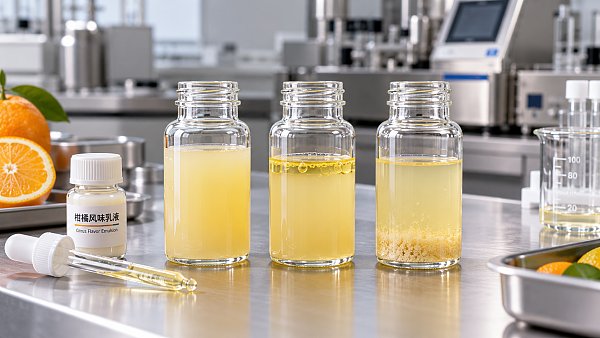
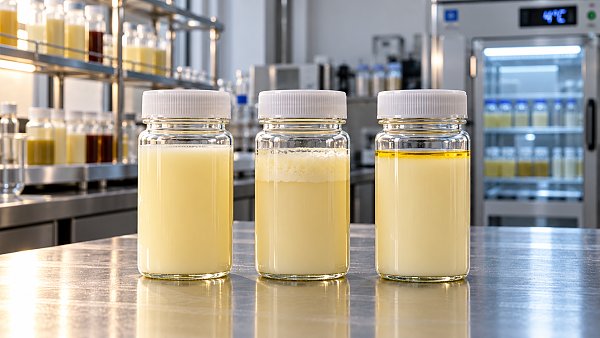
During application trials, distinguish the visible failure modes:
- Creaming: droplets accumulate toward the top, potentially creating uneven flavor or cloud.
- Ringing or oiling-off: an oily deposit or ring forms at the surface or package wall.
- Flocculation or coalescence: droplets cluster or merge, changing their distribution and appearance.
- Sediment: material settles, potentially involving juice solids, minerals, or ingredient interactions rather than the emulsion alone.
- Flavor deterioration: aroma fades or off-notes develop despite acceptable visual appearance.
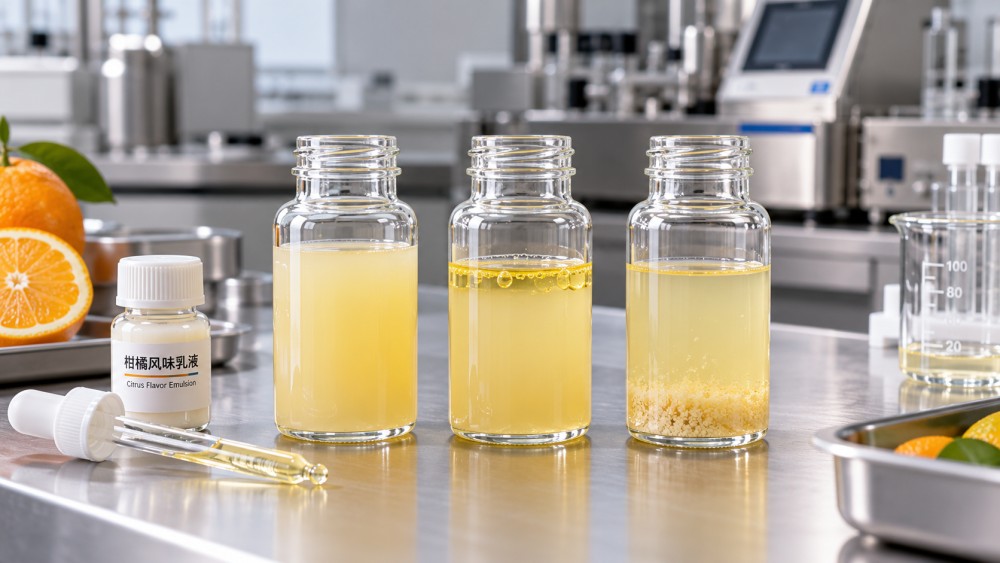
Agree acceptance criteria before testing. These might include no visible oil ring, acceptable cloud uniformity, defined limits on instrumental changes, and sensory approval against a retained reference. There is no universal droplet-size or turbidity limit suitable for every beverage; criteria should reflect the intended appearance and product specification.
Accelerated storage can help screen candidates, but it does not automatically establish ambient shelf life. Elevated temperatures may change the dominant deterioration mechanism. Centrifugation can reveal separation tendencies, but it is not a substitute for real-time storage in the intended package.
Physical stability also does not demonstrate microbiological safety. Reducing sugar can change water activity, depending on the starting formulation and the extent of reduction. The beverage’s preservation and process validation must be assessed separately from emulsion performance.
Match trials to the production line and package
A successful laboratory blend can fail when ingredient addition, mixing energy, heat exposure, or filling conditions change. Establish whether the supplied product is a ready-to-use emulsion or requires further processing. Do not assume that additional homogenization is necessary—or that it will improve an already engineered system.
Trial conditions should reproduce the actual sequence of addition, dilution temperature, agitation, and hold times. Where concentrated acid or mineral solutions are added, examine whether local exposure before full mixing destabilizes the emulsion. If the drink receives thermal treatment, assess it after the relevant time–temperature profile rather than relying on an unspecified “heat-stable” claim.
Carbonated drinks should be evaluated after carbonation and under realistic serving conditions. Carbonation changes aroma release and sensory sharpness, so approval of a still base is incomplete. Packaging also matters: oxygen exposure, light transmission, headspace, and interactions with packaging materials can affect flavor retention or oxidation.
Validate the intended container, closure, and fill conditions. A clear glass laboratory bottle cannot establish performance in every commercial package. For distribution routes involving substantial temperature variation, include relevant shipping exposure in the validation plan rather than extrapolating from controlled room-temperature storage alone.
Compare cost at the accepted dose—and check what comes with it
Price per kilogram is meaningful only alongside dosage and performance. The direct emulsion cost per 1,000 liters equals its delivered price per kilogram multiplied by the kilograms required for that volume.
As a hypothetical comparison, an emulsion priced at $12/kg and dosed at 1 kg per 1,000 liters costs $12 per 1,000 liters. An alternative priced at $9/kg but requiring 1.6 kg costs $14.40. This comparison is valid only if both deliver acceptable sensory quality, appearance, and stability.
Include any formulation consequences. A lower-priced candidate may require separate cloud adjustment, additional stabilization, or more complicated handling. Conversely, a concentrated option may reduce transport and storage requirements but demand greater dosing accuracy. Compare total formulation cost under practical operating conditions, not nominal ingredient strength.
Obtain enough composition information to assess carriers, preservatives, antioxidants, emulsifiers, colors, and any density-adjusting ingredients. Flavor preparations can introduce sugars or other carbohydrates through their carriers. Calculate their contribution at the finished-beverage dose when assessing nutrition declarations and sugar-related claims. “Low sugar,” “sugar-free,” and “no added sugar” are different claims with market-specific conditions.
Regulatory suitability must cover the finished use, not merely the sale of the concentrate. An ingredient permitted in one market or food category may face different restrictions elsewhere. Natural-flavor positioning also requires review of the complete preparation and the applicable labeling rules; it cannot be inferred from the origin of the main flavor oil.
Make approval transferable from sample to commercial supply
Before committing to commercial quantities, connect the approved sample to a defined specification. Relevant documents include the technical specification, ingredient and allergen statements, safety data where applicable, storage instructions, shelf-life information, and a representative certificate of analysis. Market-specific regulatory declarations should identify their scope rather than offer an unsupported statement of worldwide compliance.
For an emulsion, useful release controls may include appearance, sensory identity, pH, viscosity, density, microbiological limits, and an appropriate measure of droplet distribution or stability. Not every attribute needs to appear on every certificate, but the supplier should explain how critical performance characteristics are controlled between batches.
Clarify whether the evaluated sample represents routine commercial manufacture. Where practical, assess more than one production lot. Agree on notification requirements for changes to flavor-oil sourcing, emulsifier grade, carrier composition, manufacturing site, or process: any of these may affect performance even when the product name remains unchanged.
Delivery terms should preserve the conditions under which the ingredient was qualified. Confirm minimum order quantities, lead times, pack sizes, transport temperature requirements, and remaining shelf life on arrival. An alternative source is not interchangeable until it has passed the same beverage-level qualification.
The strongest selection is the emulsion that meets the flavor target at a validated dose, remains acceptable after processing and storage, carries usable market-specific documentation, and can be supplied consistently. When no candidate meets all of those conditions, revisiting the sweetener, acid balance, appearance target, or process is more defensible than approving an unsuitable emulsion on price.
Facing technical bottlenecks in manufacturing or looking for more efficient industrial solutions? Leave your details below and let the engineering experts at FCAS solve them for you.
We respect your privacy. Your information is strictly confidential.
Related News
 Hydrocolloids & EmulsifiersHow Does Agar Work as a Gelling Agent in Food?Discover how agar transforms liquids into firm gels, what affects texture and setting, and how to troubleshoot common problems in food formulations.MORE+
 Hydrocolloids & EmulsifiersHow Do Hydrocolloid Gums Improve Texture and Stability in Foods?Discover how hydrocolloid gums improve food texture and stability, and learn how to choose the right gum for your formulation.MORE+
 Hydrocolloids & EmulsifiersHow to Use Hydrocolloid Stabilizer Blends for SaucesDiscover how to use hydrocolloid stabilizer blends for sauces to improve texture, prevent separation, and achieve consistent results from trial to production.MORE+
 Hydrocolloids & EmulsifiersWhat to Look for in a Konjac Gum ManufacturerChoosing a konjac gum manufacturer? Learn how to assess quality, consistency, food safety, pricing, and supply reliability before you buy.MORE+
 Hydrocolloids & EmulsifiersHow to Choose Flavor Carriers for Spray Dried FlavorsChoose flavor carriers for spray dried flavors with confidence. Compare maltodextrin, gum arabic and modified starch for retention, stability and release.MORE+
 Hydrocolloids & EmulsifiersHow to Use Tara Gum for Dessert Toppings With Better StabilityDiscover how to use tara gum for dessert toppings to improve texture and stability, with practical hydration, formulation, and testing tips.MORE+
 Hydrocolloids & EmulsifiersHow Seaweed Extract Hydrocolloids Improve Food TextureSeaweed Extract Hydrocolloids improve food texture and stability. Discover how alginate, carrageenan, and agar perform in real formulations.MORE+
 Hydrocolloids & EmulsifiersWhat to Check Before Buying Carboxymethyl Cellulose WholesaleBuying carboxymethyl cellulose wholesale? Learn how to compare grades, supplier documents, performance and delivered costs before placing your order.MORE+
 Hydrocolloids & EmulsifiersHow Cocamidopropyl Betaine Improves Foam in Bath ProductsDiscover how cocamidopropyl betaine for bath products can enhance foam, support a creamy lather, and help formulators improve bath and shower products.MORE+
 Hydrocolloids & EmulsifiersHow Does Low DE Maltodextrin Affect Texture in Powdered Drinks?Discover how low de maltodextrin adds body to powdered drinks with minimal sweetness. Learn how to select grades, improve mixing, and fine-tune texture for a better drinking experience.MORE+
 Hydrocolloids & EmulsifiersHow Do You Choose Flavor Emulsions for Beverages With Low Sugar?Choose flavor emulsions for beverages with low sugar. Learn how to balance taste, validate stability, compare cost per dose, and meet labeling requirements for a confident selection.MORE+
 Hydrocolloids & EmulsifiersNutrition Experts Urge White House to Define Ultra-Processed FoodsUltra-processed foods face a push for an official White House definition. Explore what the proposed criteria could mean for ingredient suppliers and food product development.MORE+
 Hydrocolloids & EmulsifiersHow Can Flavor Emulsions for Beverages Stay Stable During Storage?Keep flavor emulsions for beverages stable during storage. Discover practical ways to control droplet size, prevent oil rings, protect aroma, and validate shelf life.MORE+
 Hydrocolloids & EmulsifiersHow Does Locust Bean Gum Compare With Guar Gum as a Thickener?Compare locust bean gum thickener with guar gum for hydration, texture, stability, and cost. Discover which option fits your process and delivers better product performance.MORE+
 Hydrocolloids & EmulsifiersHow Can You Verify Quality at a Microcrystalline Cellulose Factory?Verify quality at a microcrystalline cellulose factory with practical audit tips on traceability, testing, and batch consistency. Explore the guide to make confident sourcing decisions.MORE+
 Hydrocolloids & EmulsifiersHow Do Clean Label Stabilizer Blends Prevent Separation in Drinks?Discover how clean label stabilizer blends help reduce drink separation while preserving texture. Learn how to choose and validate the right blend for your beverage.MORE+
 Hydrocolloids & EmulsifiersHow to Choose Food Thickeners That Keep Sauces Stable After FreezingChoose Food Thickeners that keep frozen sauces smooth and stable. Compare starches, gums, and freeze–thaw tests to reduce water separation and find the right fit for your formulation.MORE+
 Hydrocolloids & EmulsifiersHow to Prevent Lumps When Mixing Powder Hydrocolloid Stabilizer BlendsPrevent lumps in powder hydrocolloid stabilizer blends with practical tips on feeding, dispersion, temperature, and hydration. Learn how to achieve smoother, more consistent batches.MORE+
 Hydrocolloids & EmulsifiersHow Can You Use Carboxymethyl Cellulose for Food Thickening Without Clumps?Use carboxymethyl cellulose for food thickening without clumps. Discover practical dispersion, mixing, and hydration tips for smoother textures and fewer wasted batches.MORE+
 Hydrocolloids & EmulsifiersWhich Encapsulation Wall Materials for Flavors Work Best in Baking?Compare encapsulation wall materials for flavors in baking. Explore starch, gum arabic, protein and lipid options to improve aroma retention and find the right fit for your products.MORE+
 Hydrocolloids & EmulsifiersHow Locust Bean Gum Improves Texture and Stability in Dairy ProductsLocust bean gum for dairy products improves creaminess, reduces whey separation, and supports stable yogurt, ice cream, spreads, and dairy drinks.MORE+
 Hydrocolloids & EmulsifiersWhy Clean Label Food Emulsifiers Matter in Modern FormulationClean label food emulsifiers shape stability, texture, processing, and shelf life. Explore practical formulation insights for beverages, sauces, bakery, and more.MORE+
 Hydrocolloids & EmulsifiersHow Natural Food Emulsifiers Improve Plant-Based Product TextureNatural food emulsifiers for plant based products improve creaminess, stability, and texture. Explore practical formulation strategies for beverages, dressings, desserts, and more.MORE+
 Hydrocolloids & EmulsifiersHow Konjac Gum Powder Improves Texture in Low-Calorie FoodsKonjac gum powder improves body, stability, and mouthfeel in low-calorie foods. Discover practical tips for smoother sauces, beverages, and reduced-fat formulations.MORE+
 Hydrocolloids & EmulsifiersHow Bulk Price Factors Affect Hydrocolloid Stabilizer Blend SourcingHydrocolloid stabilizer blends bulk price: compare dosage efficiency, quality consistency, logistics, and documentation to reduce total sourcing costs.MORE+
 Hydrocolloids & EmulsifiersHow Hydrocolloid Systems for Meat Products Improve Texture and YieldHydrocolloid systems for meat products improve yield, texture, water retention, and slicing quality. Explore practical formulation strategies for stable, high-performing meat products.MORE+
 Hydrocolloids & EmulsifiersHow Locust Bean Gum Thickener Improves Texture and StabilityLocust bean gum thickener improves texture, water retention, suspension, and stability. Learn practical hydration and blending tips for better product performance.MORE+
 Hydrocolloids & EmulsifiersChoosing Maltodextrin for Flavor Carriers in Dry Food BlendsMaltodextrin for flavor carriers: discover how to optimize aroma protection, powder flow, moisture control, compliance, and supply reliability in dry food blends.MORE+
 Hydrocolloids & EmulsifiersHow Guar Gum Derivatives Solve Texture and Stability IssuesGuar Gum Derivatives help solve texture, settling, separation, and viscosity loss. Discover practical formulation strategies for stable, high-performing products.MORE+
 Hydrocolloids & EmulsifiersHow Non-GMO Food Emulsifiers Improve Label-Friendly FormulationsNon-GMO food emulsifiers help create stable, label-friendly sauces, beverages, bakery products, and frozen foods. Explore sourcing, processing, and formulation insights.MORE+
 Hydrocolloids & EmulsifiersWhat to Evaluate When Choosing a Hydrocolloid Systems ManufacturerHydrocolloid systems manufacturer selection made easier: evaluate performance, documentation, supply reliability, and total cost for dependable results.MORE+
 Hydrocolloids & EmulsifiersWhat to Check Before Buying Natural Food Emulsifiers WholesaleNatural food emulsifiers wholesale: learn how to evaluate label fit, formula performance, documentation, supplier reliability, and total landed cost before buying.MORE+
 Hydrocolloids & EmulsifiersPreventing Melt-Down With Ice Cream Stabilizer Blend SelectionHydrocolloid stabilizer blends for ice cream: diagnose melt-down, improve creamy melt quality, and select formulas for stable texture and cold-chain resilience.MORE+
 Hydrocolloids & EmulsifiersWhen Cold Soluble Tara Gum Is the Right Choice for Beverage FormulasCold soluble tara gum helps beverage formulators achieve rapid hydration, smooth texture, and reliable stability. Explore when it delivers the right processing advantage.MORE+
 Hydrocolloids & EmulsifiersHow High Viscosity Locust Bean Gum Improves Texture StabilityHigh viscosity locust bean gum improves texture stability, water control, and mouthfeel in dairy, sauces, fillings, and frozen foods. Explore practical selection insights.MORE+
 Hydrocolloids & EmulsifiersFood Texturants: How to Match Hydrocolloids to Beverage and Sauce SystemsFood texturants guide: match hydrocolloids to beverage and sauce systems for stable texture, smooth processing, and better sensory performance.MORE+
 Hydrocolloids & EmulsifiersChoosing Cold Soluble Hydrocolloid Systems for Instant Beverage TextureCold soluble hydrocolloid systems for instant beverages: compare dispersion, texture, stability, process fit, and cost to select the right solution for scalable production.MORE+
 Hydrocolloids & EmulsifiersWhy Spray Dried Gum Arabic Is Used to Improve Powder StabilitySpray dried gum arabic improves powder stability by protecting sensitive ingredients, supporting flow, and enhancing water dispersibility. Discover its key benefits.MORE+
 Hydrocolloids & EmulsifiersHow to Select Flavor Emulsions That Keep Juice Drinks Smooth and StableFlavor emulsions for juice drinks: learn how to select stable systems that prevent oil rings, maintain cloud, protect aroma, and support smooth shelf-life performance.MORE+
 Hydrocolloids & EmulsifiersWhy Gellan Gum Is Used to Control Texture in Modern FoodsGellan Gum gives modern foods precise texture control, from light beverage suspension to clean gels and creamy body. Explore uses, processing factors, and formulation tips.MORE+