How to Choose Stable Synthetic Aroma Chemicals for Encapsulation
How to Choose Stable Synthetic Aroma Chemicals for Encapsulation
Choosing stable synthetic aroma chemicals for encapsulation requires more than comparing fragrance profiles and prices. An ingredient may smell right on a blotter yet lose its character during drying, interfere with capsule formation, or migrate into a detergent base during storage. The purchasing question is not simply whether the material is stable. It is whether it remains stable through your process and delivers the intended aroma when released.
That distinction changes supplier evaluation. Oxidation sensitivity, volatility, impurities, shell compatibility, and batch consistency all matter, but their relative importance depends on the application. A spray-dried beverage flavor and a friction-release laundry fragrance should not be assessed against the same acceptance criteria.
Define the exposure before comparing ingredients
Start with a short application brief agreed with the formulation team. It should describe the encapsulation method, carrier or shell chemistry, processing temperature and residence time, pH exposure, storage conditions, and release trigger. Include the finished-product environment—not just conditions inside the capsule production line.
For spray drying, thermal exposure and evaporation during atomization deserve attention. The dryer inlet temperature alone is not a useful pass-or-fail criterion: droplet temperature, drying time, feed composition, and surface oil also affect aroma retention. For interfacial polymerization, compatibility with reactive shell-forming ingredients may be more important than heat resistance.
In liquid laundry products, surfactants can encourage fragrance migration from capsules into the surrounding formulation. In dry food powders, moisture uptake can alter the carrier matrix and accelerate aroma loss. These are different failure mechanisms. Asking a supplier for “good encapsulation stability” without defining the exposure usually produces an answer too broad to support a purchase.
Separate chemical degradation from physical loss
A weaker aroma after storage does not necessarily mean the ingredient decomposed. It may have evaporated, diffused through the shell, partitioned into the product base, or remained trapped when release was expected. Each explanation calls for a different corrective action.
Boiling point is useful background information, but it is not an encapsulation performance rating. Vapor pressure at relevant temperatures, water solubility, and partitioning behavior provide a better screening picture. Even then, molecular affinity for the capsule wall and surrounding formulation can change the outcome.
Use molecular structure to flag risks—not to declare winners
Chemical families help narrow a shortlist. Some unsaturated aroma compounds are vulnerable to oxidation; esters may hydrolyze under sufficiently acidic or alkaline conditions; aldehydes can participate in unwanted reactions with certain formulation or shell components. These are screening concerns, not reasons to reject an entire family.
Linalool, for example, warrants attention to oxidative change and oxidation products. Linalyl acetate introduces an ester linkage that should prompt hydrolysis assessment where moisture and pH make it relevant. Neither observation establishes whether a particular grade will succeed in a specific capsule system.
A lower-volatility material may retain well but fail to provide the fresh opening note the brief requires. Likewise, replacing a reactive ingredient with a more chemically resistant alternative can alter odor character or release behavior. The aim is not maximum stability in isolation; it is acceptable stability without losing the intended sensory function.
For blends, inspect individual components as well as total fragrance retention. A capsule can retain much of its original fragrance mass while selectively losing a low-threshold top note. The analytical result may look reassuring even though the odor balance has changed noticeably.
Check compatibility with the actual capsule system
Encapsulation is not a universal protective coating. Spray-dried carbohydrate matrices, coacervate shells, polymer microcapsules, and cyclodextrin inclusion complexes hold aroma compounds through different mechanisms. Evidence from one system cannot automatically qualify an ingredient for another.
In reactive shell systems, aroma chemicals containing certain functional groups may participate in side reactions or affect shell formation. In carbohydrate-based powders, emulsification quality, carrier composition, and exposed surface oil can influence storage performance. Cyclodextrin suitability depends partly on molecular fit and binding behavior; inclusion and release need confirmation for the selected guest molecule.
Also examine the whole fragrance concentrate. Solvents, diluents, antioxidants, and other additives can alter partitioning or capsule-wall properties. A successful trial using a neat aroma chemical does not necessarily qualify a commercial blend containing it.
The most informative comparison holds the encapsulation recipe and processing conditions constant while changing the candidate ingredient or grade. If the supplier changes both the fragrance and shell formulation, the result may demonstrate a workable solution, but it does not isolate the ingredient’s contribution.
Ask for documentation that explains the grade
A specification sheet and safety data sheet are starting points, not application qualification. Two materials with the same chemical name and nominal purity may differ in odor-active impurities, residual solvents, water content, isomer distribution, or stabilizer package.
A useful supplier evidence package includes:
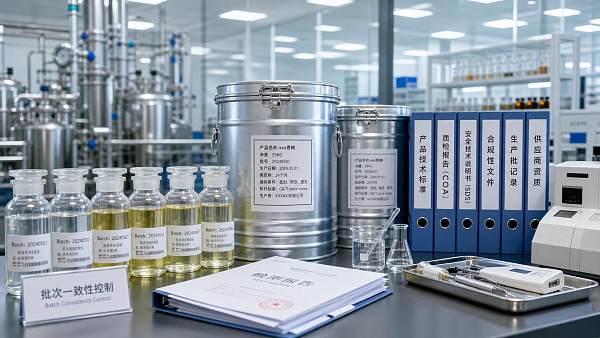
- Representative certificates of analysis from multiple production lots, with methods identified for critical measurements.
- A chromatographic profile and clarification of whether reported purity is GC area percentage or another assay basis.
- Relevant impurity, moisture, acidity, or oxidation controls, selected according to the material’s chemistry.
- Disclosure of antioxidants, carriers, or stabilizers, including their permitted use in the intended application.
- Storage recommendations, shelf-life basis, packaging details, and change-notification arrangements.
Do not request every possible test simply to make the questionnaire look rigorous. A peroxide-related control may be informative for an oxidation-prone material but irrelevant or methodologically unsuitable for another. Agree on tests that detect plausible failures.
Sensory consistency deserves its own specification. Trace impurities can affect odor disproportionately, while a high assay value can conceal differences that matter in the finished product. A retained reference sample and a defined sensory comparison method make supplier discussions less subjective.
Run a qualification trial that can explain failure
A practical trial follows the material from receipt through processing, storage, and release. Assess the incoming ingredient, the fresh encapsulate, and the encapsulate in its intended product base. Where useful, include an unencapsulated control to distinguish the protection gained from encapsulation from the ingredient’s inherent stability.
Agree on acceptance criteria before reviewing results. Depending on the application, these may cover component recovery, external or surface oil, degradation products, odor balance, capsule integrity, and aroma after activation. Confirm how “encapsulation efficiency” is calculated: a favorable initial value does not establish storage retention.
Accelerated storage is useful for screening, but elevated temperature can change the failure mechanism. It may soften a wall material or alter partitioning in ways that do not represent normal storage. Use accelerated results alongside real-time data rather than treating them as automatic proof of shelf life.
Test the release event realistically. A friction-release fragrance needs assessment after relevant deposition, drying, and rubbing conditions. A flavor powder should be evaluated under its intended reconstitution or consumption conditions. Smelling a sealed jar measures something different.
Make the purchase decision on usable performance
Compare cost at the dose needed to achieve the target sensory result after processing and storage. A lower purchase price can disappear if the material requires higher loading, additional protection, or frequent adjustment. Conversely, paying for exceptional purity offers little value when the controlled impurities do not affect safety, stability, or aroma performance.
Regulatory suitability remains a separate approval gate. Food flavor use requires confirmation for the substance, intended use, and destination market. Fragrance applications may require assessment against applicable IFRA Standards and local obligations; IFRA conformity does not replace legal review. Capsule-wall requirements also need separate attention.
This application-led approach reflects the sourcing perspective covered by Global Fine Chemicals & Agrochemical Intelligence Network (FCAS): evaluate chemical identity alongside formulation behavior, documentation, and supply reliability. For stable synthetic aroma chemicals, none of those factors is sufficient alone.
Before placing a production order, retain approved samples, document critical specifications, and require notification of changes to the manufacturing route, production site, or stabilizer package. Approve the grade that works in your capsule and finished product—not merely the sample that smells best when the bottle is opened.
Facing technical bottlenecks in manufacturing or looking for more efficient industrial solutions? Leave your details below and let the engineering experts at FCAS solve them for you.
We respect your privacy. Your information is strictly confidential.
Related News
 Microencapsulated FragrancesHow Can Citrus Terpene Fragrances Stay Fresh in Formulations?Keep citrus terpene fragrances fresh for longer. Explore practical formulation, packaging, and testing strategies to protect their vibrant scent.MORE+
 Microencapsulated FragrancesHow Fragrance Encapsulation Systems for Detergents WorkDiscover how fragrance encapsulation systems for detergents protect perfume, deposit on fabric, and release scent—and learn how to choose the right system.MORE+
 Microencapsulated FragrancesHow to Choose a Reliable Fragrance Carriers SupplierChoose a reliable fragrance carriers supplier with confidence. Compare formulation fit, quality controls, documentation, supply risks, and total cost.MORE+
 Microencapsulated FragrancesHow Can Microencapsulation Help Essential Oil Blends Last Longer?Essential Oil Blends can retain their aroma longer with the right microencapsulation strategy. Explore carrier choices, release mechanisms, and stability testing.MORE+
 Microencapsulated FragrancesHow to Choose a Fragrance Capsules Manufacturer for Your ProductChoose the right fragrance capsules manufacturer with practical tips on formulation testing, quality specifications, compliance, and supply reliability.MORE+
 Microencapsulated FragrancesHow to Choose Fragrance Bases for Consistent Product ScentFragrance Bases can make or break scent consistency. Learn how to compare performance, stability, supplier controls and true cost before you buy.MORE+
 Microencapsulated FragrancesHow to Choose an Encapsulated Perfumes ManufacturerChoose an encapsulated perfumes manufacturer with confidence. Compare fragrance performance, true costs, quality, compliance, and supply reliability.MORE+
 Microencapsulated FragrancesHow to Choose a Fabric Fragrances ManufacturerChoose a fabric fragrances manufacturer with confidence. Learn how to compare scent performance, quality controls, documentation, costs, and supply reliability.MORE+
 Microencapsulated FragrancesHow to Keep Encapsulated Perfumes for Fabric Care Fresh LongerKeep encapsulated perfumes for fabric care fresh longer with practical storage, handling, formulation and testing tips that help preserve lasting fragrance.MORE+
 Microencapsulated FragrancesHow to Choose Home Fragrances for Room Sprays That LastDiscover how to choose home fragrances for room sprays that last, with practical tips on scent longevity, formula compatibility, and testing.MORE+
 Microencapsulated FragrancesHow to Choose Bulk Cyclodextrins for Fragrance EncapsulationChoose bulk cyclodextrins for fragrance encapsulation with confidence. Compare formulation fit, scent retention, supplier quality, and total cost.MORE+
 Microencapsulated FragrancesHow to Choose Stable Synthetic Aroma Chemicals for EncapsulationChoose stable synthetic aroma chemicals for encapsulation with confidence. Learn how to assess compatibility, verify supplier quality, and protect aroma through storage and release.MORE+
 Microencapsulated FragrancesHow Do You Evaluate a Fragrance Encapsulation Systems Manufacturer?Evaluate a fragrance encapsulation systems manufacturer for compatibility, scent retention, quality, and compliance. Discover key checks to reduce risk and choose the right supplier.MORE+
 Microencapsulated FragrancesHow Does Microencapsulation Affect the Release of Fine Fragrances?Fine Fragrances meet controlled release: discover how microencapsulation shapes scent longevity, aroma balance, and performance—and what to test before choosing a system.MORE+
 Microencapsulated FragrancesHow Do Fragrance Bases Affect Scent Release After Encapsulation?Discover how Fragrance Bases shape scent release after encapsulation. Explore volatility, shell compatibility, and testing strategies to improve lasting aroma and product performance.MORE+
 Microencapsulated FragrancesHow Microencapsulation Helps Personal Care Fragrances Last LongerPersonal Care Fragrances can last longer with microencapsulation. Discover how controlled release, formula compatibility, and testing help deliver a lasting scent experience.MORE+
 Microencapsulated FragrancesHow to Select Air Freshener Fragrances That Last in Car FreshenersDiscover how to select air freshener fragrances for car fresheners with lasting appeal, balancing scent performance, carrier compatibility, heat stability, and packaging.MORE+
 Microencapsulated FragrancesHow Encapsulated Perfumes for Fabric Care Improve Scent LongevityEncapsulated perfumes for fabric care extend scent longevity through controlled release, fiber deposition, and smarter formulation—discover how to create lasting fragrance experiences.MORE+
 Microencapsulated FragrancesHow Fragrance Carriers for Detergents Improve Scent PerformanceFragrance carriers for detergents improve stability, fabric deposition, and long-lasting scent. Explore practical solutions for better wash-to-wear fragrance performance.MORE+
 Microencapsulated FragrancesHow to Add Encapsulated Laundry Fragrances Without Weakening Wash ResultsEncapsulated laundry fragrances: learn how to boost long-lasting scent while protecting cleaning power, stability, foam control, and fabric care.MORE+
 Microencapsulated FragrancesHow Laundry Fragrances for Liquid Detergents Improve Scent LongevityLaundry fragrances for liquid detergents: discover how fragrance design, deposition, and encapsulation create lasting fabric freshness and stronger product appeal.MORE+
 Microencapsulated FragrancesHow Fragrance Delivery Systems Improve Fabric Softener LongevityFragrance delivery systems for fabric softeners improve scent longevity through smart protection, reliable deposition, and controlled release for lasting freshness.MORE+
 Microencapsulated FragrancesEssential Oil Extracts Compared for Fragrance and Wellness UsesEssential Oil Extracts compared for fragrance and wellness: explore scent profiles, extraction methods, stability, safety, and sourcing insights for smarter formulation choices.MORE+
 Microencapsulated FragrancesHow Aroma Chemicals Shape Lasting Fine Fragrance PerformanceAroma chemicals for fine fragrance enhance longevity, diffusion, and signature retention. Discover how smart material selection creates stable, premium scent performance.MORE+
 Microencapsulated FragrancesHow Encapsulated Laundry Fragrances Improve Scent LongevityEncapsulated laundry fragrances deliver controlled scent release for longer-lasting freshness on fabrics. Discover how they improve deposition, durability, and re-bloom.MORE+
 Microencapsulated FragrancesHow to Select Perfume Ingredients for Long-Lasting FragrancePerfume Ingredients guide: learn how to select balanced, long-lasting fragrance materials for fine fragrance, personal care, laundry, and home care products.MORE+
 Microencapsulated FragrancesHow Fragrance Encapsulates Extend Scent Performance in Household ProductsFragrance encapsulates for household products deliver longer-lasting scent in laundry, fabric care, and cleaners. Discover release triggers, formula compatibility, and practical selection tips.MORE+
 Microencapsulated FragrancesWater Soluble Air Freshener Fragrances That Prevent CloudinessWater soluble air freshener fragrances: learn how to prevent cloudiness with smarter fragrance selection, solubilizers, water quality, and stability testing.MORE+
 Microencapsulated FragrancesHow Cyclodextrin Inclusion Complexes for Fragrances Improve Scent LongevityCyclodextrin inclusion complexes for fragrances enhance scent longevity through controlled release, improved stability, and application-specific performance. Discover how to optimize lasting aroma.MORE+
 Microencapsulated FragrancesHow Microencapsulated Fragrance Systems Improve Long-Lasting ScentMicroencapsulated fragrance systems protect scent, control release triggers, and deliver longer-lasting fragrance across laundry, personal care, and cleaning products.MORE+
 Microencapsulated FragrancesHow Aroma Chemicals Shape Consistent Fragrance PerformanceAroma Chemicals shape fragrance stability, diffusion, solubility, and lasting sensory appeal. Explore practical strategies for reliable performance across product formulas.MORE+
 Microencapsulated FragrancesWhat to Look for in a Scratch and Sniff Fragrances ManufacturerScratch and sniff fragrances manufacturer guide: evaluate encapsulation, print compatibility, compliance documents, quality control, and total sourcing cost for reliable sensory campaigns.MORE+
 Microencapsulated FragrancesWhat a Reliable Perfume Compounds Manufacturer Should Offer in 2026Perfume compounds manufacturer selection in 2026 demands more than scent creativity. Learn how to assess consistency, compliance, scalability, and supply reliability before you buy.MORE+
 Microencapsulated FragrancesHow Fragrance Capsules for Detergents Improve Scent LongevityFragrance capsules for detergents help protect perfume during washing and release scent gradually, keeping clothes fresher longer. Learn how they work and why they’re worth choosing.MORE+
 Microencapsulated FragrancesWhy Terpene Fragrances Supplier Options Matter in Premium Scent DevelopmentTerpene fragrances supplier selection shapes premium scent quality, stability, compliance, and scale. Discover how to choose the right partner for safer, more consistent fragrance development.MORE+