How Fragrance Delivery Systems Improve Fabric Softener Longevity
Fragrance longevity in a fabric softener is not determined by fragrance oil loading alone. A higher dose of free perfume can improve the initial bottle impression, yet still produce weak scent after line drying, tumble drying, storage, or garment wear. The central technical problem is that many desirable aroma materials are volatile, susceptible to oxidation, or readily lost during manufacturing and the rinse cycle. Fragrance delivery systems address this gap by protecting selected perfume components and releasing them at stages when consumers are most likely to notice them.
The most effective approach is therefore not “maximum fragrance,” but a coordinated system: a free perfume portion for immediate sensory impact, a protected portion for delayed release, and a softener base that deposits both reliably onto fibers. Evaluation must consider the full performance chain—processing, storage, dilution in the rinse bath, deposition, drying, abrasion, and odor perception on dry textiles. A delivery technology that performs well in one part of that chain can fail in another.
Why conventional perfume addition loses longevity
Fabric softeners are commonly cationic emulsions or dispersions designed to deposit conditioning materials onto textile surfaces during the final rinse. Perfume is generally added as an oil phase, often with solubilizers, emulsifiers, or carriers selected to maintain product appearance and stability. This is a demanding environment for fragrance materials.
During manufacture, the formula may experience heat, shear, prolonged mixing, and contact with surfactants or preservatives. These conditions can alter the distribution of perfume between the continuous phase, dispersed softener phase, and any solubilized fraction. During storage, reactive fragrance constituents may oxidize, hydrolyze, discolor, or interact with packaging and formulation ingredients. Once diluted in the rinse bath, the free perfume is exposed to a large volume of water and can be partly carried away with the drain liquor rather than retained on the textile.
Even perfume that deposits successfully may not remain perceptible. Low-boiling top notes tend to evaporate quickly after drying. Some heavier materials remain on fabric but may provide limited diffusion into the air, producing less noticeable odor than expected. A long-lasting fabric scent therefore requires both retention on fibers and controlled availability of odor-active compounds over time.
The role of delivery systems: protecting perfume and timing its release
Fragrance delivery systems for fabric softeners are designed to change the location, protection level, and release timing of perfume ingredients. Their value lies in separating fragrance persistence from the initial perfume bloom. Depending on the technology, the perfume may be held inside a polymer shell, absorbed into a porous carrier, associated with a deposition aid, or incorporated into a structured matrix that slows migration and evaporation.
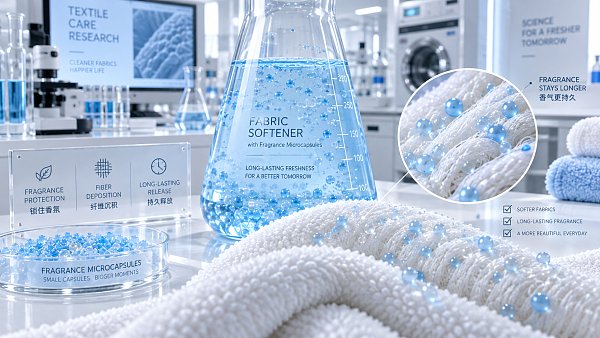
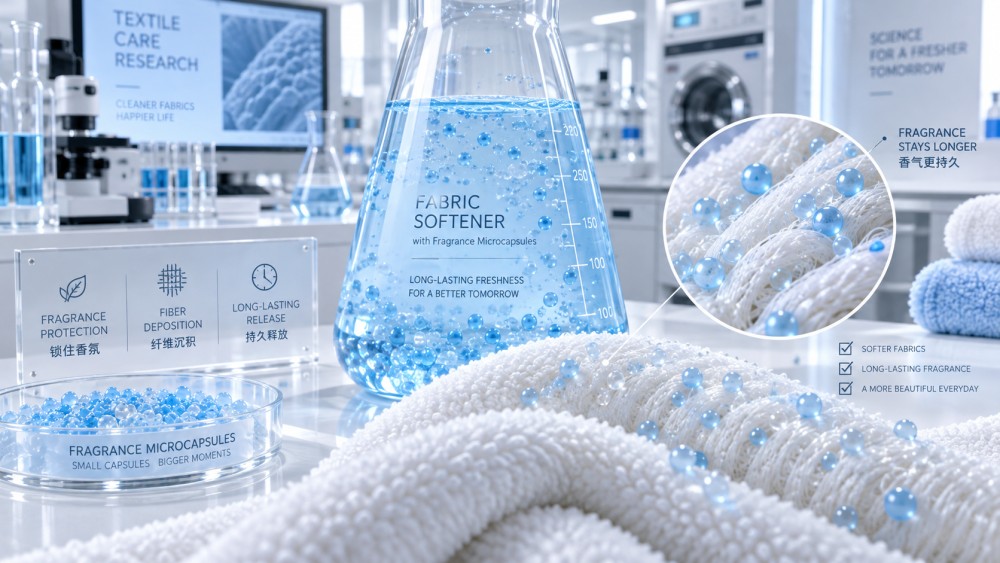
Microcapsules are among the most recognizable systems. In a typical design, fragrance oil is enclosed by a polymeric shell. The capsule should remain sufficiently intact during manufacturing, filling, transport, storage, and rinse dilution, while depositing onto fabric during the conditioning step. Later, mechanical forces such as rubbing, folding, handling, and wear can rupture or deform the capsule shell, releasing perfume near the time of use.
This mechanism explains why capsule performance cannot be judged only by smelling the bottle or a freshly washed towel. A successful system should deliver a balanced sensory profile at several points:
- acceptable odor and appearance in the packaged softener;
- controlled perfume loss during storage;
- adequate deposition after the rinse cycle;
- pleasant odor on dry fabric;
- renewed scent after movement, friction, or handling; and
- no unacceptable residue, spotting, harsh feel, or visual defects on textiles.
Other delivery formats can serve different objectives. Porous inorganic or organic carriers may adsorb perfume and reduce its immediate evaporation, although their deposition behavior and compatibility with the softener matrix must be examined closely. Cyclodextrin-based inclusion systems can associate with selected fragrance molecules, but water solubility and competitive interactions in a surfactant-rich formula may limit retention. Polymer matrices, perfume-fixed particles, and deposition-enhancing polymers may be used where gradual release, wash stability, or fabric substantivity matters more than a distinct rupture event.
The correct system depends on the desired sensory claim. “Long-lasting” can mean a persistent dry-fabric scent, a fragrance refreshed by garment movement, reduced scent loss from the bottle, or a combination of these effects. These are related but not identical targets.
Encapsulation efficiency is only the starting point
Encapsulation efficiency describes how much of the intended perfume load is retained in capsules after their production. It is important because poor retention reduces active fragrance availability and can increase free oil in the finished formulation. However, a high encapsulation value does not automatically translate into better laundry performance.
A capsule with strong retention but poor deposition may leave most of its perfume in the rinse liquor. A highly deposited capsule with an excessively robust shell may survive on fabric but release too little fragrance under realistic handling. Conversely, a fragile shell can create strong immediate odor while losing the delayed-release benefit during production, transport, or washing.
Evaluation should therefore distinguish among at least four related properties:
- Perfume loading: the amount of fragrance incorporated into the delivery material.
- Capsule integrity: resistance to rupture, leakage, and degradation during formulation and storage.
- Fabric deposition: the fraction of delivery material retained on textiles after rinsing.
- Release response: the relationship between physical triggers and the perfume released from the deposited system.
These properties can conflict. Increasing shell thickness may improve survivability, but it can also reduce release sensitivity. Raising perfume load may improve fragrance potential but can alter shell formation, increase leakage risk, or change particle density and deposition behavior. A technically sound decision is based on the complete balance rather than a single supplier specification.
Deposition is the bridge between the bottle and the fabric
For rinse-added softeners, deposition is often the decisive link in fragrance longevity. The delivery system must reach the textile surface in a diluted, dynamic wash environment and remain there through water removal and drying. This depends on the chemistry of the softener base, the surface characteristics of the particle or carrier, water hardness, textile composition, wash load, rinse volume, and machine conditions.
Cationic esterquats and related conditioning systems are used because of their affinity for negatively charged textile surfaces. A fragrance capsule or carrier that is compatible with this deposition environment is more likely to be co-deposited with the conditioning active. Particle surface charge, hydrophobicity, size distribution, and the use of deposition polymers can influence this behavior.
Compatibility must be assessed beyond simple visual stability. A formula can remain smooth and homogeneous while the delivery system experiences gradual agglomeration, shell damage, sedimentation, creaming, or altered deposition. The fragrance system can also modify rheology. If viscosity falls during storage, particles may settle; if viscosity rises excessively, pumping, filling, dosing, and consumer pourability can become problematic.
Textile differences matter as well. Cotton, polyester, blends, towels, knitwear, and technical fabrics do not provide identical surfaces for conditioning-agent and particle retention. Results from one standardized textile swatch should not be treated as a universal predictor of performance across a whole laundry portfolio. Testing should reflect the fabric types associated with the intended product positioning.
Release triggers must match real consumer use
Mechanical rupture is only one release pathway. Capsules may release perfume through shell breakage, shell permeability, gradual diffusion, dissolution of a carrier, thermal effects during drying, or changes in humidity. The relevance of each pathway depends on the delivery technology and the use conditions.
A tumble-dried garment experiences heat and extensive movement, which may produce a different fragrance profile from line-dried textiles. A towel is repeatedly compressed and rubbed, whereas a stored garment may need to retain aroma in a closed wardrobe before it is worn. A system optimized exclusively for high-friction release may underperform in applications where fabric is handled gently. Similarly, a design that responds strongly to dryer heat may not provide the same benefit in low-temperature or air-dried routines.
Release should also be considered at the fragrance-composition level. A perfume is not a single material. It contains components with different vapor pressures, odor thresholds, solubilities, and affinities for polymer shells or carriers. Some ingredients may diffuse through a shell faster than others, changing the fragrance character over time. A fresh floral top note may disappear while woody or musky materials remain, creating a dry-down that differs substantially from the original perfume brief.
For this reason, capsule development and perfume development should not proceed as isolated tasks. The encapsulated perfume should be evaluated as a released fragrance, not merely as the perfume before encapsulation. The free perfume fraction should be designed to complement the released fraction rather than duplicate it without purpose.
Formulation compatibility determines whether the technology survives scale-up
Many performance failures emerge after a promising delivery system is introduced into a full fabric softener formula. The carrier may be stable in water yet destabilized by cationic surfactants, electrolyte content, solvents, pH adjustment, preservatives, dyes, opacifiers, or anti-foam agents. Some fragrance oils can plasticize polymeric shells, increasing permeability or causing leakage. Certain solubilizers can extract perfume from capsules or change the particle surface in ways that reduce deposition.
Processing order is equally important. Introducing capsules before the bulk has cooled sufficiently may compromise shell integrity. High-shear mixing after capsule addition can break sensitive particles. Long recirculation times through pumps, narrow valves, filters, or filling equipment may create shear conditions not represented in laboratory beaker tests. The same issue applies to bulk storage and transport: repeated temperature cycling can alter viscosity, phase structure, and particle distribution.
A robust assessment should include the actual production sequence, not only the final formula composition. This includes temperature at addition, mixing intensity, dwell time, transfer equipment, filling conditions, and expected storage conditions. Where the softener is supplied in concentrated format, dilution behavior requires special attention because a delivery system can respond differently before and after dilution.
How to evaluate longevity without relying on a single sensory check
Fragrance performance is inherently sensory, but sensory assessment alone can obscure the cause of failure. A useful evaluation combines analytical, physical, and use-relevant evidence.
Analytical methods such as headspace techniques or chromatographic analysis can track perfume loss, compare free and retained fractions, and monitor changes during storage. Microscopy and particle-size analysis can reveal capsule damage, aggregation, or distribution shifts. Deposition may be examined through appropriate tracer approaches, extraction methods, or fabric-level measurements, provided the method is validated for the specific material and textile substrate.
Sensory work remains essential because instrument results do not directly equal perceived odor. Evaluation points should represent the actual use sequence: neat product, diluted rinse bath where relevant, wet fabric, freshly dried fabric, fabric after storage, and fabric after defined handling or abrasion. Controls are critical. A formula containing the same overall perfume level but no delivery system helps separate the contribution of protection and controlled release from simple fragrance dosage.
Interpretation should avoid treating one time point as decisive. Strong scent immediately after drying may indicate high free-perfume transfer rather than durable retention. A weak initial signal paired with strong later release may be appropriate for a freshness-through-wear objective but unsuitable if the product requires a clear post-laundry fragrance bloom. The acceptable performance pattern must be defined before screening technologies.
Common selection errors
One recurring mistake is selecting a delivery system from capsule size or perfume-load data alone. These specifications matter, but they do not establish formula stability, fabric deposition, or release quality. Another is assuming that all capsules can be added interchangeably to any softener base. Polymer composition, shell surface properties, and manufacturing history can lead to materially different behavior in the same formula.
It is also risky to assess performance only in accelerated storage. Elevated temperature can reveal leakage and instability, but it may not reproduce shear exposure, real dilution, textile deposition, or the tactile forces that trigger release. Conversely, a system that performs well on a laboratory wash protocol can still be unsuitable if it causes nozzle fouling, poor bulk homogeneity, visible sediment, or inconsistent dosage during manufacturing.
Finally, the capsule shell and associated raw materials must be reviewed alongside the fragrance itself for intended market requirements. Material disclosure, safety documentation, labeling implications, biodegradability considerations, and restrictions affecting intentionally added microplastic particles can differ by jurisdiction and product category. Technical suitability and compliance suitability should be assessed together early in development, because reformulating a delivery technology late in the process can alter both fragrance profile and deposition behavior.
A practical decision framework
The appropriate fragrance delivery system begins with a precise performance question: Is the objective to preserve perfume in the package, increase scent on dry fabric, create a scent burst during wear, or extend wardrobe freshness? From there, the delivery system should be screened within the actual softener base and tested across the expected processing and use conditions.
The strongest candidates are not necessarily those with the most complex delivery mechanism. They are the systems that maintain physical stability, deposit consistently, release fragrance at a useful point in the fabric-use cycle, and preserve a coherent perfume character. In fabric softeners, longevity is a system property. It arises from the interaction of perfume design, delivery material, cationic base, production process, textile surface, and consumer handling—not from encapsulation alone.
Related News
 Nano-microcapsule FormulationsChoosing Fragrance Preparations That Perform Well in Personal WashFragrance preparations for personal wash: learn how to select options that protect clarity, stability, foam, scent performance, and packaging compatibility.MORE+
 Controlled-Release ThermodynamicsModified Cyclodextrins Explained for Controlled Fragrance ReleaseModified cyclodextrins enable controlled fragrance release, odor control, and volatile-note protection. Explore how they optimize performance in detergents, fabric care, and more.MORE+
 Microencapsulated FragrancesHow Fragrance Delivery Systems Improve Fabric Softener LongevityFragrance delivery systems for fabric softeners improve scent longevity through smart protection, reliable deposition, and controlled release for lasting freshness.MORE+
 Supercritical CO2 Essential OilsHow to Evaluate a Natural Cardamom Oil Supplier for Reliable SupplyNatural cardamom oil supplier evaluation guide: verify botanical origin, purity, batch consistency, documentation, packaging, and delivery reliability for confident sourcing.MORE+
 Maillard Reaction Savory FlavorsHow Ethyl Maltol Purity Testing Supports Flavor Safety ComplianceEthyl Maltol purity testing strengthens flavor safety compliance through identity checks, impurity profiling, supplier verification, and audit-ready documentation.MORE+
 Microencapsulated FragrancesEssential Oil Extracts Compared for Fragrance and Wellness UsesEssential Oil Extracts compared for fragrance and wellness: explore scent profiles, extraction methods, stability, safety, and sourcing insights for smarter formulation choices.MORE+
 Zero-Calorie Sweeteners & AcidulantsWhat Drives Zero Calorie Sweeteners Bulk Price in 2026Zero calorie sweeteners bulk price in 2026: compare specifications, dosage, quality, freight, and supply risk to make smarter sourcing decisions.MORE+
 EPA FIFRA & FDA GRAS RegsSynthetic Food Preservatives Rules That Support Safer FormulasSynthetic Food Preservatives: learn the rules for safer formulas, compliant use levels, validated shelf life, labeling, and reliable microbial control.MORE+
 Micelle Fluidics & ChelationHow Anionic Industrial Dispersants Improve Coating StabilityAnionic industrial dispersants improve coating stability, pigment wetting, viscosity control, gloss, and storage performance. Learn how to select and test the right solution.MORE+
 Supercritical CO2 Essential OilsHow to Choose Eucalyptus Oil Grades for Clean, Consistent ProductsChoose the right Eucalyptus Oil grade with confidence. Compare cineole content, purity, origin, processing, documentation, and application fit for consistent products.MORE+
 Micelle Fluidics & ChelationWhat Are Cationic Surfactants and Where Are They Commonly Used?Cationic Surfactants deliver powerful surface affinity for disinfection, fabric softening, hair conditioning, antistatic control, and industrial treatments. Explore key uses and selection factors.MORE+
 Antioxidants & Natural PreservativesNatural Food Antioxidants That Help Extend Shelf Life in Clean LabelsNatural Food Antioxidants: learn how tocopherols, rosemary extracts, and ascorbic systems help protect flavor, color, and shelf life in clean-label foods.MORE+
 Non-ionic Surfactants & DefoamersChoosing Defoamers for Agrochemical Formulations Without Reducing EfficacyDefoamers for agrochemical formulations: learn how to control foam while protecting stability, spray performance, and active ingredient efficacy.MORE+
 Supercritical CO2 Essential OilsHow Food Grade Citrus Oils Improve Flavor in Beverage FormulationsFood grade citrus oils help beverage formulators create brighter, more authentic flavor. Learn how to select, stabilize, dose, and protect citrus oils for lasting appeal.MORE+
 Maillard Reaction Savory FlavorsHow to Evaluate an Ethyl Maltol Supplier for Reliable Flavor QualityChoose an ethyl maltol supplier with confidence. Learn how to assess sensory consistency, purity, documentation, compliance, and supply reliability for dependable flavor quality.MORE+
 Heavy-duty Industrial DegreasersHow to Qualify a Solvent Degreasers Manufacturer for Industrial CleaningQualify a solvent degreasers manufacturer with proven batch control, safety documentation, compatibility testing, and process-specific cleaning performance.MORE+
 Antioxidants & Natural PreservativesWhat to Check Before Choosing a Butylparaben Wholesale SupplierButylparaben wholesale buyers: learn how to assess quality, documentation, market fit, packaging, supply reliability, and total landed cost before choosing a supplier.MORE+
 Non-ionic Surfactants & DefoamersWhy Mild Cocamidopropyl Betaine Matters in Gentle Cleansing FormulasMild cocamidopropyl betaine helps create gentler cleansers with creamy foam, balanced viscosity, and improved surfactant compatibility. Explore its formulation benefits.MORE+
 Hydrocolloids & EmulsifiersHow Locust Bean Gum Thickener Improves Texture and StabilityLocust bean gum thickener improves texture, water retention, suspension, and stability. Learn practical hydration and blending tips for better product performance.MORE+
 Non-ionic Surfactants & DefoamersHow to Compare Alkyl Polyglucosides for High-Performance CleanersAlkyl Polyglucosides guide: compare APG grades for wetting, grease removal, foam control, stability, and substrate safety in high-performance cleaners.MORE+
 Ultra-pure Semiconductor CleanersA Practical Guide to Semiconductor Process Cleaner Purity RequirementsSemiconductor process cleaners purity requirements explained: assess metals, particles, ions, residues, packaging, and batch consistency to protect yield and process reliability.MORE+
 Maillard Reaction Savory FlavorsHow Aroma Ingredients for Baked Goods Shape Fresh-Baked AppealAroma ingredients for baked goods help create authentic fresh-baked appeal. Explore heat stability, sensory balance, sourcing, and formulation tips for better bakery products.MORE+
 Supercritical CO2 Essential OilsWhy Citrus Terpene Fragrances Are Growing in Home Care ProductsCitrus terpene fragrances are transforming home care products with fresh, trusted cleaning cues. Explore performance, stability, compliance, sourcing, and cost factors for smarter fragrance selection.MORE+
 Non-ionic Surfactants & DefoamersHow Low Residue Wet Cleaning Agents Improve Precision Cleaning ResultsLow residue wet cleaning agents improve precision cleaning with better wetting, efficient rinsing, reduced films, and reliable results for sensitive surfaces.MORE+
 Maillard Reaction Savory FlavorsHow to Select Liquid Flavorings for Consistent Beverage ProfilesLiquid Flavorings guide for consistent beverage profiles—compare stability, dosage, carriers, processing performance, and supplier reliability for better product results.MORE+
 Maillard Reaction Savory FlavorsHow Flavoring Preparations for Confectionery Stay Stable in ProductionFlavoring preparations for confectionery: learn how to protect aroma, ensure even dispersion, control heat exposure, and achieve consistent production quality.MORE+
 Hydrocolloids & EmulsifiersChoosing Maltodextrin for Flavor Carriers in Dry Food BlendsMaltodextrin for flavor carriers: discover how to optimize aroma protection, powder flow, moisture control, compliance, and supply reliability in dry food blends.MORE+
 Heavy-duty Industrial DegreasersHow Zeolite Detergent Builders Improve Cleaning at Lower DosageZeolite detergent builders help improve hardness control, protect surfactant efficiency, and support effective cleaning at lower detergent dosage. Explore key formulation factors and testing insights.MORE+
 Non-ionic Surfactants & DefoamersHow to Compare Degreasing Surfactants Bulk Price and PerformanceCompare degreasing surfactants bulk price beyond cost per kg. Evaluate dosage, foam, rinse quality, compatibility, and supplier reliability to choose the best-value cleaner.MORE+
 Heavy-duty Industrial DegreasersHow Fast Drying Degreasing Solvents Reduce Cleaning Cycle TimesFast drying degreasing solvents cut cleaning cycle times by improving evaporation, reducing residue risks, and enabling faster production handoffs. Learn how to choose the right solution.MORE+
 Chelated Trace Element FertilizersHow Fertigation Fertilizer Improves Nutrient Delivery in IrrigationFertigation Fertilizer improves nutrient delivery with precise, water-based feeding. Learn how to prevent clogging, optimize timing, and support healthier crop growth.MORE+
 Herbicides & Plant Growth RegulatorsWhat to Verify Before Choosing a Suspoemulsion Pesticides SupplierChoose a reliable suspoemulsion pesticides supplier with confidence. Verify formulation stability, dilution performance, documentation, packaging, batch control, and supply reliability.MORE+
 Ultra-pure Semiconductor CleanersHow to Select Semiconductor Process Cleaners for Fab UseSemiconductor process cleaners for fab use: learn how to match chemistry, material compatibility, particle control, rinse performance, and tool requirements to protect yield.MORE+
 Hydrocolloids & EmulsifiersHow Guar Gum Derivatives Solve Texture and Stability IssuesGuar Gum Derivatives help solve texture, settling, separation, and viscosity loss. Discover practical formulation strategies for stable, high-performing products.MORE+
 Microencapsulated FragrancesHow Aroma Chemicals Shape Lasting Fine Fragrance PerformanceAroma chemicals for fine fragrance enhance longevity, diffusion, and signature retention. Discover how smart material selection creates stable, premium scent performance.MORE+
 Ultra-pure Semiconductor CleanersHow Precision Cleaning Agents Protect Semiconductor Yield and ReliabilityPrecision cleaning agents for semiconductors protect yield and reliability by removing trace contaminants, safeguarding sensitive materials, and improving rinse performance.MORE+
 Antioxidants & Natural PreservativesWhat to Check Before Choosing a Synthetic Food Preservatives SupplierSynthetic food preservatives supplier selection: check regulatory fit, batch consistency, documentation, logistics, and support to reduce risks and hidden costs.MORE+
 Hydrocolloids & EmulsifiersHow Non-GMO Food Emulsifiers Improve Label-Friendly FormulationsNon-GMO food emulsifiers help create stable, label-friendly sauces, beverages, bakery products, and frozen foods. Explore sourcing, processing, and formulation insights.MORE+
 Heavy-duty Industrial DegreasersSelecting Degreasing Surfactants for Hard Surface CleanersDegreasing surfactants for hard surface cleaners: learn how to match soil, foam, rinseability, and material compatibility for reliable cleaning performance.MORE+
 Controlled-Release ThermodynamicsHow Cyclodextrin Inclusion Complexes Stabilize Fragrance ReleaseCyclodextrin inclusion complexes for fragrances help control volatile aroma release, protect key notes, and support longer-lasting sensory performance across formulations.MORE+