How to Add Encapsulated Laundry Fragrances Without Weakening Wash Results
Adding Encapsulated Laundry Fragrances Without Sacrificing Wash Performance
Encapsulated laundry fragrances are often introduced to create a more memorable “fresh-from-the-dryer” impression: a scent that survives the wash, remains on fabric after storage, and is released gradually through movement, friction, or wear. For consumers, this can feel simple. For technical evaluators, it is rarely simple.
A fragrance capsule enters a detergent system that already has to manage soil removal, surfactant balance, foam behavior, water hardness, anti-redeposition, viscosity, preservation, packaging compatibility, and stability across transport conditions. If the capsule is selected or incorporated without considering that wider system, the formula may smell impressive in a short evaluation yet perform poorly in wash testing, storage, or real household use.
The practical objective is not to add the highest possible fragrance load. It is to achieve reliable fragrance deposition and controlled release while preserving the detergent’s primary job: cleaning fabrics predictably and rinsing cleanly. This requires decisions about capsule chemistry, particle size, addition sequence, product format, surfactant architecture, and the test methods used to approve the finished formulation.
Start with the wash system, not the fragrance brief
When evaluating encapsulated laundry fragrances, teams sometimes begin with the sensory target: stronger bloom, longer dry-fabric freshness, or better fragrance release during wear. Those targets matter, but they should be translated into formulation questions before a capsule supplier is selected.
For example, a high-detergency heavy-duty liquid may contain a dense blend of anionic and non-ionic surfactants, hydrotropes, enzymes, polymers, solvents, chelants, and salts. A capsule that performs well in a mild fabric conditioner may not tolerate that environment. It may settle, float, leak fragrance oil, lose shell integrity, or interfere with product appearance. The same fragrance technology can therefore produce very different outcomes depending on whether it is used in liquid detergent, laundry pods, powder detergent, scent boosters, or rinse conditioners.
Technical review should begin with several basic questions:
- What consumer moment is expected to deliver the fragrance benefit: during washing, immediately after drying, in the wardrobe, or during garment wear?
- Does the detergent rely on high foam, controlled foam, or low-foam machine-wash performance?
- Will the product be used in cold water, short wash cycles, high-efficiency machines, or hand-wash conditions?
- Is the desired effect achieved through capsule deposition, free fragrance, or a deliberate combination of both?
- Which performance attributes cannot be compromised: oily soil removal, particulate soil suspension, whiteness maintenance, rinse clarity, viscosity, or enzyme activity?
These questions prevent a common mistake: treating fragrance capsules as a stand-alone decorative additive. In reality, they are particles with a perfume core, a shell or matrix, surface characteristics, and their own interaction with the detergent’s chemical environment.
The first compatibility screen: capsule shell, perfume core, and base chemistry
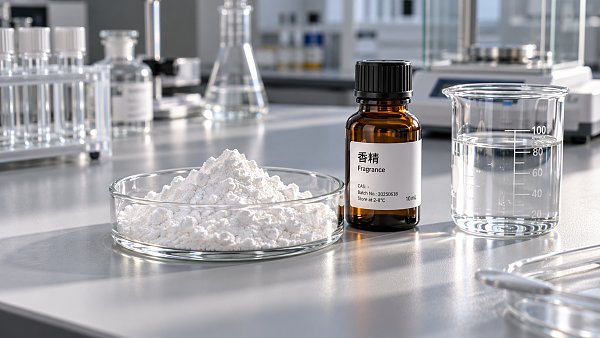
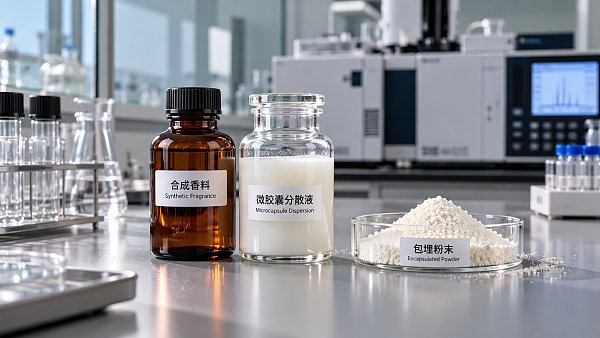
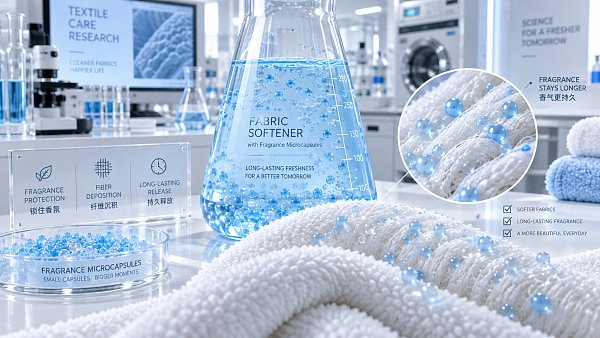
Encapsulated fragrance systems vary substantially. Some use polymeric shells designed to rupture under friction; others use matrix-based systems or carrier structures intended to protect volatile materials and release them over time. The shell may be sensitive to pH, solvents, surfactants, heat, shear, oxidation, or electrolyte concentration. Meanwhile, the fragrance oil itself can change the behavior of the formula if it leaks from damaged capsules.
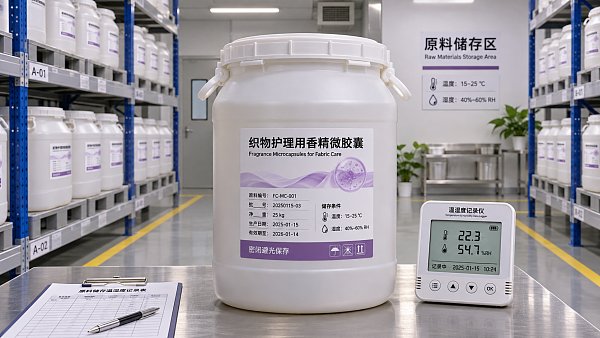
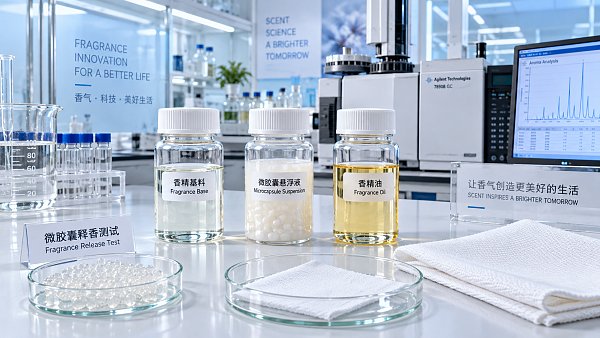
A technical evaluator should request more than a fragrance description. Useful supplier documentation normally includes the capsule concentration, particle-size range, shell type or technology class, recommended dosage range, storage guidance, compatibility notes, safety documentation, and any known restrictions related to the intended market. For regulated applications, it is also important to understand the status of fragrance allergens, residual monomers where relevant, biodegradability considerations, and labeling implications.
Compatibility work should look at the entire base, not only the surfactant blend. High levels of ethanol, glycol ethers, hydrotropes, or certain solubilizers can weaken capsule walls or promote fragrance migration. Strong alkaline conditions may affect shell stability. Electrolytes used to build viscosity can alter particle dispersion. Preservatives, dyes, optical brighteners, and polymeric deposition aids may also change the capsule surface behavior.
In a liquid detergent, a stable capsule should remain evenly suspended or visually homogeneous for the intended shelf life. In a powder, it must tolerate blending, transport vibration, moisture pickup, and the mechanical stresses of packaging. In unit-dose products, interaction with the film, water activity, and concentrated surfactant environment deserve separate evaluation.
Deposition is the real bridge between fragrance longevity and wash results
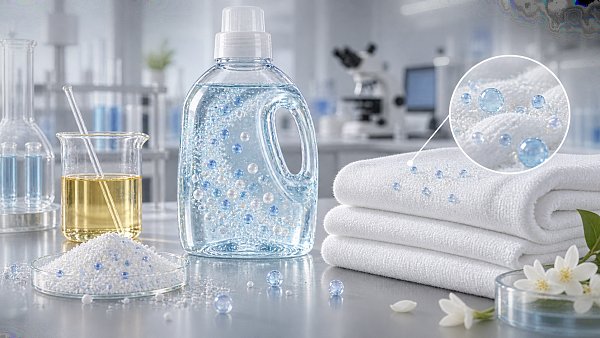
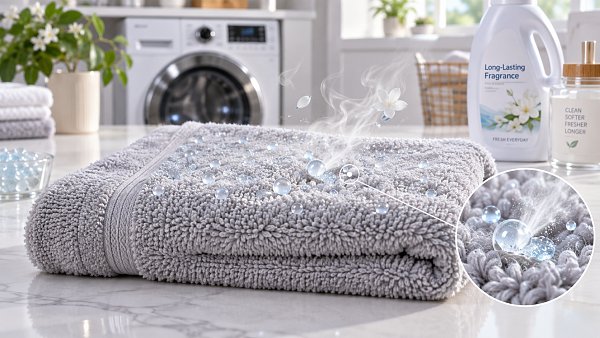
Capsules only provide a long-lasting benefit if enough of them deposit on fabric and remain intact through the wash and rinse stages. Yet increasing deposition is not always a matter of raising capsule dosage. Excess loading can create visible residues, uneven delivery, higher raw-material cost, or altered fabric hand. It can also make a formula look attractive in sensory screening while introducing instability that emerges later.
Deposition depends on a combination of fabric type, water hardness, wash temperature, liquor ratio, surfactant concentration, rinse conditions, and the capsule’s surface properties. Cotton, polyester, blended textiles, towels, and synthetic sportswear may not retain capsules in the same way. A formulation that gives a strong result on cotton terry may be less convincing on low-polarity synthetic fabrics.
Many systems use deposition polymers or cationic aids to improve substantivity. This approach can be effective, but it requires discipline. The polymer must be compatible with the anionic surfactant system and should not undermine soil suspension, clarity, or rinse behavior. Overuse can create a “soft” or coated feel on fabric, increase residue risk, and complicate processing viscosity. The right evaluation asks whether deposition improves at a meaningful level without disturbing core cleaning performance.
It is also wise to separate two sensory measurements: fragrance intensity immediately after laundering and fragrance persistence after dry-down or storage. High initial intensity may come from free fragrance oil rather than durable capsule deposition. Conversely, a less dramatic first impression may lead to a more satisfying delayed release during garment handling. The target should reflect the product category and consumer promise rather than a single sniff test.
Where wash performance is most likely to be weakened
Encapsulated laundry fragrances do not necessarily reduce detergency. Problems usually appear when their addition changes the balance of the existing formulation or when evaluation is limited to fragrance performance alone. The following areas deserve close attention.
Free perfume is particularly important to monitor. When capsules break in the product rather than on fabric, released oil may affect clarity, create an oily ring, destabilize the surfactant system, or cause an overly sharp fragrance profile. A low level of free fragrance may be intentional for top-note impact, but it should be controlled rather than treated as an unavoidable consequence of capsule addition.
Process conditions can damage a good capsule
A capsule that is compatible on paper can still fail during manufacturing. High-shear mixing, aggressive recirculation, pumping through narrow passages, excessive homogenization, or late-stage viscosity adjustment can mechanically damage particles. The result may not be obvious immediately; the product may pass a visual inspection but show declining fragrance retention weeks later.
For most liquid systems, encapsulated fragrance is better added during a controlled finishing stage, after major pH adjustment, heating, and high-shear dispersion steps are complete. Gentle agitation should be sufficient to distribute particles without excessive breakage. Exact mixing conditions depend on the capsule technology and plant design, so a small-scale trial should not be assumed to represent full production. Shear exposure in transfer lines and filling equipment must also be considered.
Temperature deserves equal attention. Adding capsules to a batch that is still warm from processing can affect shell integrity or accelerate fragrance loss. A sensible operating window should be defined jointly by the formulation and process teams, supported by retained-sample data rather than assumptions.
In powder formulations, mechanical handling is often the larger issue. Capsules may be added after high-energy granulation or spray-drying stages, depending on the technology. Dust control, particle segregation, and distribution uniformity become important, especially where the visual appearance of colored or white capsule particles may influence consumer perception.
Do not judge the system with a single stability test
Technical evaluators need a test plan that reflects how the product will actually be stored, transported, dosed, and used. A bottle standing undisturbed in a laboratory at room temperature does not represent warehouse heat, cold-weather logistics, repeated consumer shaking, or prolonged contact with a dispensing cap.
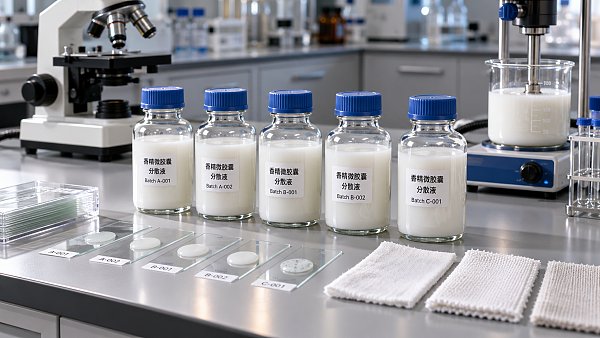
A practical approval program may include accelerated and ambient storage, freeze-thaw cycling where relevant, centrifugation for early separation screening, viscosity monitoring, microscopy or particle observation, fragrance retention analysis, and visual checks for leakage or sediment. Finished-product packaging should be part of the test, since certain plastics, seals, and dispensing systems can interact with perfume components over time.
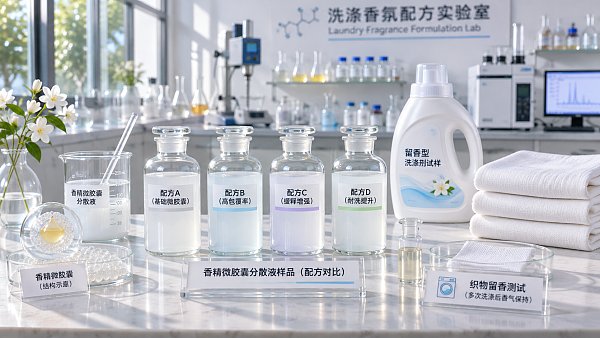
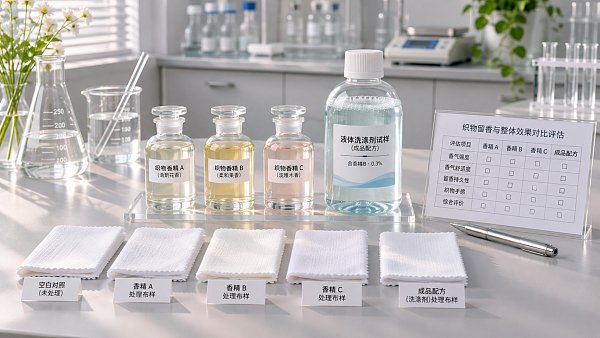
Wash testing should use representative fabrics and water conditions. At minimum, compare the base detergent and capsule-containing version under the same dose, machine setting, soil load, and rinse sequence. Measure cleaning performance with recognized internal or external protocols, but also inspect practical outcomes: foam during operation, residue on dark fabrics, scent uniformity, and the character of the fabric after drying.
Where the product is intended for multiple regions, test water hardness and wash-temperature ranges that reflect those markets. Cold-water performance may be especially revealing because capsule deposition, surfactant dissolution, and perfume release can behave differently from warm-wash conditions.
A disciplined route to dosage selection
The optimum dosage of encapsulated laundry fragrances is usually found through a stepped evaluation rather than a single supplier recommendation. Start with a low, technically defensible loading. Confirm that the formula remains stable and that wash performance is unchanged. Then increase dosage only if the fragrance benefit is insufficient after dry-down and wear simulation.
This approach is more reliable than starting at the maximum sensory impact level and attempting to correct downstream problems with extra polymer, surfactant, or viscosity modifier. Such corrections can create a formulation that is harder to manufacture and less robust in the market.
Consider a design-of-experiments mindset when the project is complex. Capsule loading, deposition polymer level, free fragrance level, surfactant ratio, and salt concentration may all influence the result. Studying them together can reveal interactions that isolated bench trials miss. For example, a small capsule increase may be acceptable at one polymer level but cause settling or residue at another.
Common shortcuts that create avoidable risk
One shortcut is assuming that a capsule developed for fabric conditioner will transfer directly into detergent. Conditioner systems often have very different charge balance, pH, surfactant content, and consumer use patterns. Another is relying on fragrance-panel feedback alone. Sensory assessment is essential, but it cannot confirm detergency, foam management, capsule survival, or rinse quality.
It is equally risky to judge success only by a bottle’s appearance. A perfectly smooth liquid may contain damaged capsules, while a slightly opaque product may be physically stable and perform well. The relevant question is whether the appearance is consistent, acceptable for the product concept, and maintained throughout the claimed shelf life.
Finally, do not let capsule technology replace broader fragrance design. A balanced system may combine a small free-fragrance fraction for immediate recognition with encapsulated notes for persistence. The composition should be selected around consumer experience and formulation tolerance, not around the assumption that every note needs encapsulation.
What a technically credible decision looks like
A sound decision on encapsulated laundry fragrances is supported by evidence across three connected areas: capsule integrity in the detergent, preservation of wash performance, and meaningful fabric fragrance after laundering. If any one of these is missing, the concept remains incomplete.
For technical teams evaluating new ingredients or supplier proposals, the most useful mindset is to treat fragrance capsules as functional formulation components. They affect particle behavior, deposition, sensory delivery, processing, safety review, and product stability. A well-integrated system can create a lasting scent experience without asking consumers to trade away the cleanliness, rinse feel, or reliability they expect from the detergent.
Platforms such as FCAS can help formulation and procurement teams frame these discussions more clearly by connecting fragrance technology with surfactant behavior, application conditions, documentation needs, and supply-chain evaluation. In a category where a pleasant scent can quickly become a product liability if the chemistry is poorly balanced, structured technical assessment remains the safest route to a successful launch.
Facing technical bottlenecks in manufacturing or looking for more efficient industrial solutions? Leave your details below and let the engineering experts at FCAS solve them for you.
We respect your privacy. Your information is strictly confidential.
Related News
 Microencapsulated FragrancesHow Can Citrus Terpene Fragrances Stay Fresh in Formulations?Keep citrus terpene fragrances fresh for longer. Explore practical formulation, packaging, and testing strategies to protect their vibrant scent.MORE+
 Microencapsulated FragrancesHow Fragrance Encapsulation Systems for Detergents WorkDiscover how fragrance encapsulation systems for detergents protect perfume, deposit on fabric, and release scent—and learn how to choose the right system.MORE+
 Microencapsulated FragrancesHow to Choose a Reliable Fragrance Carriers SupplierChoose a reliable fragrance carriers supplier with confidence. Compare formulation fit, quality controls, documentation, supply risks, and total cost.MORE+
 Microencapsulated FragrancesHow Can Microencapsulation Help Essential Oil Blends Last Longer?Essential Oil Blends can retain their aroma longer with the right microencapsulation strategy. Explore carrier choices, release mechanisms, and stability testing.MORE+
 Microencapsulated FragrancesHow to Choose a Fragrance Capsules Manufacturer for Your ProductChoose the right fragrance capsules manufacturer with practical tips on formulation testing, quality specifications, compliance, and supply reliability.MORE+
 Microencapsulated FragrancesHow to Choose Fragrance Bases for Consistent Product ScentFragrance Bases can make or break scent consistency. Learn how to compare performance, stability, supplier controls and true cost before you buy.MORE+
 Microencapsulated FragrancesHow to Choose an Encapsulated Perfumes ManufacturerChoose an encapsulated perfumes manufacturer with confidence. Compare fragrance performance, true costs, quality, compliance, and supply reliability.MORE+
 Microencapsulated FragrancesHow to Choose a Fabric Fragrances ManufacturerChoose a fabric fragrances manufacturer with confidence. Learn how to compare scent performance, quality controls, documentation, costs, and supply reliability.MORE+
 Microencapsulated FragrancesHow to Keep Encapsulated Perfumes for Fabric Care Fresh LongerKeep encapsulated perfumes for fabric care fresh longer with practical storage, handling, formulation and testing tips that help preserve lasting fragrance.MORE+
 Microencapsulated FragrancesHow to Choose Home Fragrances for Room Sprays That LastDiscover how to choose home fragrances for room sprays that last, with practical tips on scent longevity, formula compatibility, and testing.MORE+
 Microencapsulated FragrancesHow to Choose Bulk Cyclodextrins for Fragrance EncapsulationChoose bulk cyclodextrins for fragrance encapsulation with confidence. Compare formulation fit, scent retention, supplier quality, and total cost.MORE+
 Microencapsulated FragrancesHow to Choose Stable Synthetic Aroma Chemicals for EncapsulationChoose stable synthetic aroma chemicals for encapsulation with confidence. Learn how to assess compatibility, verify supplier quality, and protect aroma through storage and release.MORE+
 Microencapsulated FragrancesHow Do You Evaluate a Fragrance Encapsulation Systems Manufacturer?Evaluate a fragrance encapsulation systems manufacturer for compatibility, scent retention, quality, and compliance. Discover key checks to reduce risk and choose the right supplier.MORE+
 Microencapsulated FragrancesHow Does Microencapsulation Affect the Release of Fine Fragrances?Fine Fragrances meet controlled release: discover how microencapsulation shapes scent longevity, aroma balance, and performance—and what to test before choosing a system.MORE+
 Microencapsulated FragrancesHow Do Fragrance Bases Affect Scent Release After Encapsulation?Discover how Fragrance Bases shape scent release after encapsulation. Explore volatility, shell compatibility, and testing strategies to improve lasting aroma and product performance.MORE+
 Microencapsulated FragrancesHow Microencapsulation Helps Personal Care Fragrances Last LongerPersonal Care Fragrances can last longer with microencapsulation. Discover how controlled release, formula compatibility, and testing help deliver a lasting scent experience.MORE+
 Microencapsulated FragrancesHow to Select Air Freshener Fragrances That Last in Car FreshenersDiscover how to select air freshener fragrances for car fresheners with lasting appeal, balancing scent performance, carrier compatibility, heat stability, and packaging.MORE+
 Microencapsulated FragrancesHow Encapsulated Perfumes for Fabric Care Improve Scent LongevityEncapsulated perfumes for fabric care extend scent longevity through controlled release, fiber deposition, and smarter formulation—discover how to create lasting fragrance experiences.MORE+
 Microencapsulated FragrancesHow Fragrance Carriers for Detergents Improve Scent PerformanceFragrance carriers for detergents improve stability, fabric deposition, and long-lasting scent. Explore practical solutions for better wash-to-wear fragrance performance.MORE+
 Microencapsulated FragrancesHow to Add Encapsulated Laundry Fragrances Without Weakening Wash ResultsEncapsulated laundry fragrances: learn how to boost long-lasting scent while protecting cleaning power, stability, foam control, and fabric care.MORE+
 Microencapsulated FragrancesHow Laundry Fragrances for Liquid Detergents Improve Scent LongevityLaundry fragrances for liquid detergents: discover how fragrance design, deposition, and encapsulation create lasting fabric freshness and stronger product appeal.MORE+
 Microencapsulated FragrancesHow Fragrance Delivery Systems Improve Fabric Softener LongevityFragrance delivery systems for fabric softeners improve scent longevity through smart protection, reliable deposition, and controlled release for lasting freshness.MORE+
 Microencapsulated FragrancesEssential Oil Extracts Compared for Fragrance and Wellness UsesEssential Oil Extracts compared for fragrance and wellness: explore scent profiles, extraction methods, stability, safety, and sourcing insights for smarter formulation choices.MORE+
 Microencapsulated FragrancesHow Aroma Chemicals Shape Lasting Fine Fragrance PerformanceAroma chemicals for fine fragrance enhance longevity, diffusion, and signature retention. Discover how smart material selection creates stable, premium scent performance.MORE+
 Microencapsulated FragrancesHow Encapsulated Laundry Fragrances Improve Scent LongevityEncapsulated laundry fragrances deliver controlled scent release for longer-lasting freshness on fabrics. Discover how they improve deposition, durability, and re-bloom.MORE+
 Microencapsulated FragrancesHow to Select Perfume Ingredients for Long-Lasting FragrancePerfume Ingredients guide: learn how to select balanced, long-lasting fragrance materials for fine fragrance, personal care, laundry, and home care products.MORE+
 Microencapsulated FragrancesHow Fragrance Encapsulates Extend Scent Performance in Household ProductsFragrance encapsulates for household products deliver longer-lasting scent in laundry, fabric care, and cleaners. Discover release triggers, formula compatibility, and practical selection tips.MORE+
 Microencapsulated FragrancesWater Soluble Air Freshener Fragrances That Prevent CloudinessWater soluble air freshener fragrances: learn how to prevent cloudiness with smarter fragrance selection, solubilizers, water quality, and stability testing.MORE+
 Microencapsulated FragrancesHow Cyclodextrin Inclusion Complexes for Fragrances Improve Scent LongevityCyclodextrin inclusion complexes for fragrances enhance scent longevity through controlled release, improved stability, and application-specific performance. Discover how to optimize lasting aroma.MORE+
 Microencapsulated FragrancesHow Microencapsulated Fragrance Systems Improve Long-Lasting ScentMicroencapsulated fragrance systems protect scent, control release triggers, and deliver longer-lasting fragrance across laundry, personal care, and cleaning products.MORE+
 Microencapsulated FragrancesHow Aroma Chemicals Shape Consistent Fragrance PerformanceAroma Chemicals shape fragrance stability, diffusion, solubility, and lasting sensory appeal. Explore practical strategies for reliable performance across product formulas.MORE+
 Microencapsulated FragrancesWhat to Look for in a Scratch and Sniff Fragrances ManufacturerScratch and sniff fragrances manufacturer guide: evaluate encapsulation, print compatibility, compliance documents, quality control, and total sourcing cost for reliable sensory campaigns.MORE+
 Microencapsulated FragrancesWhat a Reliable Perfume Compounds Manufacturer Should Offer in 2026Perfume compounds manufacturer selection in 2026 demands more than scent creativity. Learn how to assess consistency, compliance, scalability, and supply reliability before you buy.MORE+
 Microencapsulated FragrancesHow Fragrance Capsules for Detergents Improve Scent LongevityFragrance capsules for detergents help protect perfume during washing and release scent gradually, keeping clothes fresher longer. Learn how they work and why they’re worth choosing.MORE+
 Microencapsulated FragrancesWhy Terpene Fragrances Supplier Options Matter in Premium Scent DevelopmentTerpene fragrances supplier selection shapes premium scent quality, stability, compliance, and scale. Discover how to choose the right partner for safer, more consistent fragrance development.MORE+