How Encapsulated Laundry Fragrances Improve Scent Longevity
A laundry product can smell appealing when a bottle is opened and still disappoint the user a day later. The difference often comes down to what happens to the fragrance after it enters the wash liquor, contacts fabric, passes through drying, and sits in a wardrobe. Conventional perfume oils are exposed to surfactants, heat, air, and repeated evaporation. Their most noticeable notes may be lost long before clothing is worn.
Encapsulated laundry fragrances address this gap by enclosing fragrance materials inside small protective particles, commonly called fragrance capsules or perfume microcapsules. Rather than releasing all aroma at once, a well-designed capsule system protects part of the fragrance through processing and washing, then releases it gradually when fabrics are rubbed, moved, warmed, or exposed to moisture. The result is not simply a stronger smell at the end of a wash; it is a more controlled scent experience across drying, storage, and everyday wear.
For operators handling detergent, fabric conditioner, scent booster, or institutional laundry formulations, the practical question is not whether encapsulation works in principle. It is how to use it without damaging capsules, destabilizing the formula, staining fabrics, or creating a scent profile that feels overpowering at first and absent later.
Why free fragrance fades so quickly in laundry products
Fragrance is a mixture of aroma compounds with different volatility, solubility, and affinity for textile fibers. Bright citrus, green, aldehydic, and some floral notes often create an attractive opening impression, but many are relatively volatile. During manufacturing and storage, they may migrate into packaging headspace, interact with surfactants, or slowly degrade under heat and light. In the wash, fragrance also faces dilution and rinse-off.
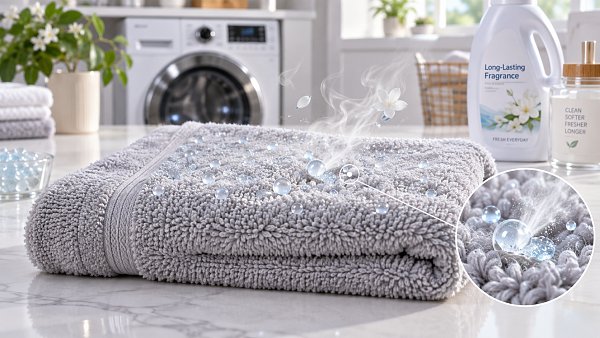
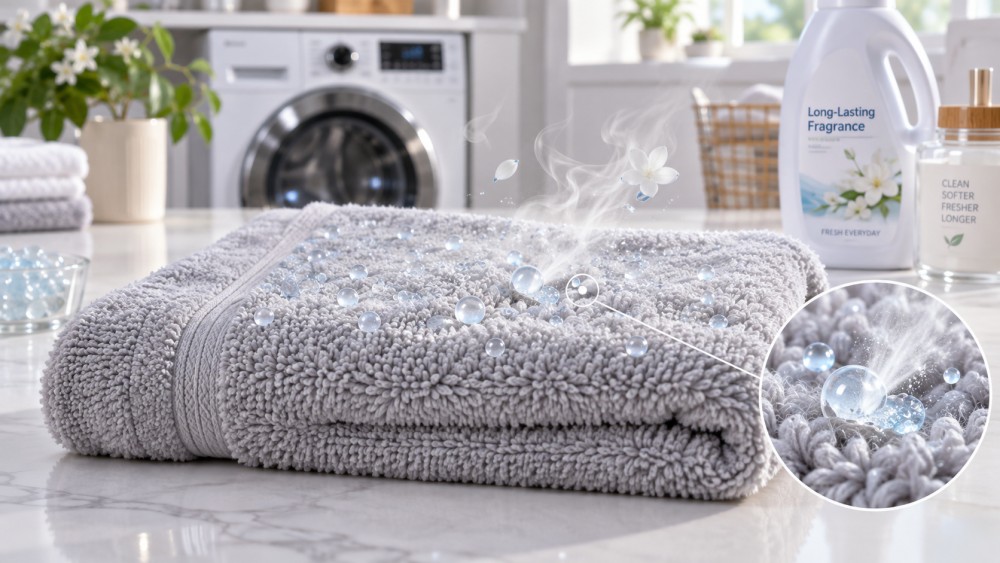
Some perfume components deposit directly onto fabric, particularly when supported by appropriate deposition aids or delivered through a rinse-stage product. Yet deposited free oil still evaporates continuously. A towel pulled from a dryer may smell pleasant, while the same towel used a week later offers only a faint trace.
Encapsulation changes the timing. The fragrance core remains separated from the surrounding formulation until capsule walls are disrupted or become permeable under selected conditions. This creates an important distinction between initial bloom—the scent noticed immediately after washing—and long-term re-bloom, the fragrance that returns when a garment is handled or worn.
What happens inside an encapsulated fragrance system
A fragrance capsule usually contains a liquid perfume core surrounded by a polymeric shell. The shell must survive enough of the product’s journey to reach the textile, but it cannot be so robust that it never releases fragrance in normal use. This balance is the center of capsule design.
In fabric care, release is often driven by mechanical friction. When a wearer puts on a shirt, folds bedding, rubs a sleeve, or moves through the day, some deposited capsules may rupture and release their contents. Moisture, temperature changes, and gradual diffusion through the shell can also contribute. Not every capsule behaves identically, which is useful: a distribution of release events can make fragrance feel more continuous rather than like a single short burst.
The shell chemistry, core composition, capsule size distribution, and surface treatment all affect this behavior. So does the product format. Capsules in a concentrated fabric conditioner face a different environment from those in a liquid laundry detergent, a unit-dose pod, a dry scent bead, or a sprayable textile refresher.
Durability and deposition: the two conditions that determine longevity
Operators sometimes focus only on capsule strength. Stronger capsules may indeed resist mixing, pumping, and storage stress, but fragrance longevity depends on two linked outcomes: capsules must remain intact and they must deposit effectively on fabric. A capsule that survives perfectly but rinses away contributes little to in-use scent.
Deposition is influenced by fabric type, wash conditions, product dosage, rinse volume, water hardness, surfactant system, and the use of compatible deposition polymers. Cotton, polyester, blends, and towels do not all retain fragrance systems in the same way. High soil loads and aggressive wash conditions can further alter retention. This is why an encapsulated fragrance that performs well on a clean cotton swatch in a controlled test may need further adjustment for mixed household laundry or commercial linen operations.
For rinse-added fabric conditioners, the lower surfactant burden during the final stage can support deposition. In main-wash detergents, the formulation challenge is often greater because the capsule must coexist with builders, enzymes, surfactants, chelants, and sometimes bleaching systems before it has a chance to reach the fabric. Neither format is automatically better; they require different formulation strategies and different expectations of sensory performance.
Matching capsule behavior to the product’s real use moment
A useful fragrance program begins with a simple question: When should the consumer notice the scent? The answer changes the selection criteria.
- Detergents: The fragrance should give a pleasant product and wash-stage impression while retaining enough encapsulated material for post-wash freshness. Capsule stability in the surfactant base is a central concern.
- Fabric conditioners: Deposition and soft, close-to-fabric scent are often priorities. Capsules can support wardrobe freshness and re-bloom during wear.
- Scent boosters and beads: These formats can carry a higher fragrance contribution, but operators still need to manage dissolution, dispersion, and the risk of uneven perfume loading.
- Commercial or institutional laundry: Scent may need to remain noticeable after high-temperature drying, folding, transport, and storage. The acceptable intensity should suit the end setting, such as hospitality linen, workwear, or healthcare-related textiles.
It is also worth separating fragrance profile from delivery system. A warm musky or woody base may naturally linger longer than a crisp top-note profile, but even a long-lasting perfume can benefit from controlled release. Conversely, encapsulation cannot fully rescue a fragrance composition that is poorly suited to the product base or the desired consumer experience.
How to incorporate capsules without losing their value
Capsules are functional particles, not simply another liquid perfume ingredient. Their handling should reflect that fact. Excessive shear, unsuitable pump selection, long recirculation loops, narrow valves, abrasive filtration, and aggressive mixing can damage shells before filling. Once ruptured, the fragrance core is released into the bulk formula, which may reduce delayed-release performance and change the product’s odor over time.
As a general operating approach, add the capsule dispersion late in the batch after the main formulation has reached its target temperature, viscosity, and pH range. Use the lowest practical agitation needed for uniform distribution. Confirm that transfer pumps and filling equipment are suitable for suspensions containing fragile particles. Exact conditions should follow the capsule supplier’s technical guidance and the site’s own validated process.
Storage conditions matter as well. Very high or low temperatures, repeated temperature cycling, prolonged exposure to direct light, and inappropriate freeze-thaw conditions can affect both the capsule dispersion and the broader formula. The finished product should be assessed in the intended package, not only in a laboratory beaker. Packaging materials, headspace, closure quality, and transport conditions can influence fragrance perception and physical stability.
A practical compatibility review before scale-up
Before a full production run, review the capsule system alongside the complete formulation. Check pH, electrolyte level, viscosity modifiers, solvents, surfactant type and concentration, enzymes, preservatives, colorants, optical brighteners, and deposition aids. Oxidizing components deserve special attention, as do systems with strong solvent action. A formula can look physically acceptable at the start while still weakening capsule integrity during accelerated storage.
Visual inspection is useful but not sufficient. Track changes in fragrance headspace, capsule distribution, sedimentation or creaming, viscosity, color, and odor character over time. Microscopic examination, where available, can help identify shell damage or agglomeration. Operators should also inspect process points where unexpected stress may occur: pump inlets, bends, filters, homogenizers, filling nozzles, and recirculation lines.
Testing scent longevity in a way that reflects real life
A strong wash-day smell is not proof of long-lasting performance. Evaluate encapsulated laundry fragrances across several moments: immediately after washing, after line or tumble drying, after 24 hours of storage, after several days in a drawer or cupboard, and after controlled fabric rubbing. Assessing both dry fabric and fabric exposed to warmth or humidity gives a more realistic picture of re-bloom.
Panel evaluation remains valuable because scent longevity is ultimately a human perception issue. However, panel observations should be paired with controlled washing conditions: defined load size, textile composition, water hardness, dosage, temperature, and rinse settings. Without this consistency, one test may reflect variation in the wash process rather than genuine formulation differences.
Do not ignore residue and appearance checks. A fragrance system that provides good scent but leaves visible spots, affects fabric hand feel, or creates deposits in dispensing equipment is not a complete solution. White textiles, dark synthetics, towels, and mixed loads should all be included in a practical evaluation program.
Common reasons long-lasting fragrance programs underperform
Over-processing the capsule dispersion. A product may pass initial quality checks but provide weak re-bloom because capsules were damaged during manufacture. Review mixing order and mechanical stress before assuming the fragrance dosage is too low.
Using more fragrance instead of improving delivery. Raising the perfume level can make product odor stronger, yet it may not improve post-wear freshness. It can also create cost, stability, and consumer acceptance issues. A more balanced core fragrance, better deposition, or a more suitable shell may solve the actual problem.
Testing only fresh product. Capsules and perfume can behave differently after weeks of storage. Accelerated and ambient stability work is essential, especially for formulas intended for global distribution across varying climates.
Ignoring the wash environment. Hard water, load size, soil level, machine type, drying temperature, and rinse performance all influence the final result. A product designed around one narrow condition may give inconsistent consumer experiences elsewhere.
Treating all capsules as interchangeable. Encapsulated fragrance systems vary in shell material, fragrance load, particle size, release mode, slurry composition, and compatibility limits. Selection should be based on the complete formulation and use case, not only a sample’s opening odor.
A balanced route to fresher fabrics after the wash
Encapsulated laundry fragrances are most effective when viewed as part of a delivery system rather than a stand-alone sensory add-on. The fragrance core must fit the desired scent signature. The capsule must withstand manufacturing and storage. The formula must support deposition. The finished product must release fragrance naturally during the moments users value: opening a wardrobe, putting on clothing, making a bed, or handling freshly laundered linens.
For formulation and production teams, this means combining sensory evaluation with process discipline. Start with the intended user experience, select capsules appropriate to the product format, protect them during processing, and validate performance under realistic wash and storage conditions. That approach turns fragrance longevity from a vague marketing claim into a repeatable application outcome.
As consumer expectations shift from “smells nice after washing” to “still feels fresh when used,” controlled fragrance release will remain an important tool in detergent and fabric-care development. The best results come from careful alignment of capsule technology, formulation chemistry, operating practice, and the everyday fabric experience.
Related News
 Heavy-duty Industrial DegreasersSelecting Degreasing Surfactants for Hard Surface CleanersDegreasing surfactants for hard surface cleaners: learn how to match soil, foam, rinseability, and material compatibility for reliable cleaning performance.MORE+
 Controlled-Release ThermodynamicsHow Cyclodextrin Inclusion Complexes Stabilize Fragrance ReleaseCyclodextrin inclusion complexes for fragrances help control volatile aroma release, protect key notes, and support longer-lasting sensory performance across formulations.MORE+
 Hydrocolloids & EmulsifiersWhat to Evaluate When Choosing a Hydrocolloid Systems ManufacturerHydrocolloid systems manufacturer selection made easier: evaluate performance, documentation, supply reliability, and total cost for dependable results.MORE+
 Microencapsulated FragrancesHow Encapsulated Laundry Fragrances Improve Scent LongevityEncapsulated laundry fragrances deliver controlled scent release for longer-lasting freshness on fabrics. Discover how they improve deposition, durability, and re-bloom.MORE+
 Zero-Calorie Sweeteners & AcidulantsHow to Choose Zero Calorie Sweeteners for Sugar Free ProductsZero calorie sweeteners for sugar free products: compare taste, stability, labeling, and cost to choose the right system for beverages, bakery, and functional foods.MORE+
 Non-ionic Surfactants & DefoamersWhy Silicone Cleaning Defoamers Prevent Foam-Related Production DelaysSilicone cleaning defoamers prevent foam-related production delays by stabilizing cleaning systems, improving pump performance, and protecting process efficiency.MORE+
 Herbicides & Plant Growth RegulatorsHow to Assess Quality Risks at a Pesticide Formulation Intermediates FactoryPesticide formulation intermediates factory assessment guide: identify quality risks in raw materials, processes, testing, traceability, and storage.MORE+
 Antioxidants & Natural PreservativesWhat to Verify Before Choosing a Synthetic Food Preservatives FactorySynthetic food preservatives factory checklist: verify food-grade quality, impurity control, traceability, packaging, and regulatory fit before supplier approval.MORE+
 Heavy-duty Industrial DegreasersHow Degreasing Surfactants Improve Performance in Heavy-Duty CleaningDegreasing Surfactants improve heavy-duty cleaning by lifting oils, controlling redeposition, and supporting cleaner rinses. Explore practical selection and process tips.MORE+
 Heavy-duty Industrial DegreasersHow to Evaluate an Industrial Cleaning Auxiliaries ManufacturerEvaluate an industrial cleaning auxiliaries manufacturer by performance, batch consistency, documentation, technical support, and supply reliability.MORE+
 Hydrocolloids & EmulsifiersWhat to Check Before Buying Natural Food Emulsifiers WholesaleNatural food emulsifiers wholesale: learn how to evaluate label fit, formula performance, documentation, supplier reliability, and total landed cost before buying.MORE+
 Hydrocolloids & EmulsifiersPreventing Melt-Down With Ice Cream Stabilizer Blend SelectionHydrocolloid stabilizer blends for ice cream: diagnose melt-down, improve creamy melt quality, and select formulas for stable texture and cold-chain resilience.MORE+
 Non-ionic Surfactants & DefoamersHow Non Ionic Intermediates Improve Pesticide Formulation StabilityDiscover how non ionic pesticide formulation intermediates enhance emulsion stability, wetting, hard-water tolerance, and storage performance in crop protection products.MORE+
 Supercritical CO2 Essential OilsHow to Choose Ginger Oil for Beverages With a Clean Flavor ProfileGinger oil for beverages: learn how to select a clean, bright, stable profile that performs through processing, shelf life, and every sip.MORE+
 Polymer-Coated Water Soluble NPKHow Fully Soluble NPK Fertilizer Improves Precision FertigationFully soluble NPK fertilizer improves precision fertigation with clean injection, uniform nutrient delivery, flexible crop-stage feeding, and lower clogging risk. Learn practical system-management tips.MORE+
 Supercritical CO2 Essential OilsCO2 Essential Oil Extracts for Functional Foods and Clean LabelsDiscover CO2 essential oil extracts for functional foods: clean-label potential, botanical flavor innovation, formulation insights, and smarter sourcing strategies.MORE+
 Maillard Reaction Savory FlavorsHow Powder Flavors Improve Consistency in Snack SeasoningPowder flavors for snack seasoning improve blend uniformity, adhesion, aroma release, and shelf-life stability. Learn how to control key process variables.MORE+
 Microencapsulated FragrancesHow to Select Perfume Ingredients for Long-Lasting FragrancePerfume Ingredients guide: learn how to select balanced, long-lasting fragrance materials for fine fragrance, personal care, laundry, and home care products.MORE+
 Supercritical CO2 Essential OilsHow to Use Cardamom Oil for Flavoring Without Overpowering FoodsCardamom oil for flavoring: learn dilution, dispersion, blending, and process tips to create balanced beverages, bakery, and desserts without overpowering taste.MORE+
 Chelated Trace Element FertilizersHow Granular Calcium Ammonium Nitrate Improves Nitrogen EfficiencyGranular calcium ammonium nitrate improves nitrogen efficiency with rapid uptake, reliable spreading, and lower volatilization risk. Explore smarter application strategies.MORE+
 Ultra-pure Semiconductor CleanersHow to Assess a Semiconductor Wafer Cleaners ExporterSemiconductor wafer cleaners exporter assessment guide: compare purity controls, packaging, documentation, process fit, and supply reliability before sourcing.MORE+
 Maillard Reaction Savory FlavorsHow Natural Flavor Bases Create Consistent Savory Food ProfilesNatural flavor bases help create consistent savory food profiles. Learn how sensory testing, processing control, and storage practices protect flavor quality.MORE+
 Polymer-Coated Water Soluble NPKHow Potassium Chloride Fertilizer 60 K2O Supports Crop YieldPotassium chloride fertilizer 60 K2O supports crop yield with efficient potassium nutrition. Explore benefits, chloride considerations, application tips, and smarter fertilizer selection.MORE+
 Herbicides & Plant Growth RegulatorsSoluble Concentrates Explained for Reliable Field ApplicationsSoluble Concentrates explained: improve mixing, calibration, water quality, compatibility, and spray coverage for more reliable field applications.MORE+
 Nano-microcapsule FormulationsHow to Select Spray Drying Wall Materials for Better StabilitySpray drying wall materials: learn how to select the right matrix for improved stability, moisture resistance, encapsulation, release performance, and cost-efficient scale-up.MORE+
 EPA FIFRA & FDA GRAS RegsButylparaben for Wet Wipes and Key Safety Compliance ConsiderationsButylparaben for wet wipes: explore regulatory compliance, preservative efficacy, skin safety, packaging risks, and supplier controls for confident product development.MORE+
 Supercritical CO2 Essential OilsWhat to Evaluate When Sourcing Custom Essential Oil BlendsCustom essential oil blends: discover how to evaluate formulation fit, quality consistency, compliance, total cost, and supply reliability for confident sourcing decisions.MORE+
 Microencapsulated FragrancesHow Fragrance Encapsulates Extend Scent Performance in Household ProductsFragrance encapsulates for household products deliver longer-lasting scent in laundry, fabric care, and cleaners. Discover release triggers, formula compatibility, and practical selection tips.MORE+
 Zero-Calorie Sweeteners & AcidulantsChoosing Sucralose for Dairy Products Without Compromising TasteSucralose for dairy products: learn how to protect clean sweetness, optimize sensory performance, verify quality, and source reliably for reduced-sugar dairy.MORE+
 Maillard Reaction Savory FlavorsHow High Color Oleoresins Improve Consistency in Savory Food FormulationsHigh color oleoresins improve savory food consistency through precise dosing, stable dispersion, and heat-aware processing. Discover practical formulation controls.MORE+
 Polymer-Coated Water Soluble NPKWhat Determines Fertigation Systems Price and Long-Term Operating CostFertigation systems price depends on capacity, automation, filtration, water quality, and fertilizer compatibility. Explore total ownership costs and compare suppliers smarter.MORE+
 Nano-microcapsule FormulationsFood Grade Cyclodextrin Inclusion Complexes for Stable Flavor DeliveryFood grade cyclodextrin inclusion complexes help protect volatile flavors, improve handling, and support controlled release for reliable food formulation performance.MORE+
 Hydrocolloids & EmulsifiersWhen Cold Soluble Tara Gum Is the Right Choice for Beverage FormulasCold soluble tara gum helps beverage formulators achieve rapid hydration, smooth texture, and reliable stability. Explore when it delivers the right processing advantage.MORE+
 Ultra-pure Semiconductor CleanersHow to Verify Semiconductor Process Cleaners Purity RequirementsSemiconductor process cleaners purity requirements: learn how to verify trace metals, ions, particles, residues, COAs, and packaging controls for reliable wafer cleaning.MORE+
 Targeted Bio-pesticides & APIsHow Microbial Inoculants for Seed Treatment Improve Early Crop VigorDiscover how microbial inoculants for seed treatment support early crop vigor through viable microbes, precise application, compatibility, storage, and stronger root establishment.MORE+
 Targeted Bio-pesticides & APIsSelecting Fungicide APIs for Soluble Liquid FormulationsFungicide APIs for soluble liquid formulations: explore solubility, stability, solvent selection, compliance, and sourcing factors for scalable product development.MORE+
 Antioxidants & Natural PreservativesHow to Compare Food Preservative Blends Wholesale QuotesFood preservative blends wholesale: compare quotes by true cost, dosage, compliance, quality consistency, and supply reliability to choose the best-value solution.MORE+
 EPA FIFRA & FDA GRAS RegsWhat to Check When Using Synthetic Food Preservatives SafelySynthetic Food Preservatives: learn the essential checks for safe, compliant use—from dosage and pH to supplier control, labeling, and shelf-life validation.MORE+
 Non-ionic Surfactants & DefoamersHow to Choose Low Foam Cleaning Auxiliaries for CIP SystemsLow foam cleaning auxiliaries for CIP systems: learn how to balance foam control, wetting, soil removal, compatibility, and rinseability for reliable cleaning results.MORE+
 Hydrocolloids & EmulsifiersHow High Viscosity Locust Bean Gum Improves Texture StabilityHigh viscosity locust bean gum improves texture stability, water control, and mouthfeel in dairy, sauces, fillings, and frozen foods. Explore practical selection insights.MORE+