
How Fragrance Encapsulates Extend Scent Performance in Household Products
Fragrance encapsulates for household products help formulators deliver a more consistent, long-lasting scent experience in detergents, fabric conditioners, surface cleaners, and air-care systems.
By protecting fragrance ingredients during storage and releasing them through use, friction, or moisture, encapsulation can improve sensory performance while supporting formulation stability.
For operators and product teams, understanding capsule compatibility, release triggers, and processing requirements is essential to achieving reliable fragrance impact.
The practical question is not simply whether capsules extend scent. It is whether the selected capsule system survives production, remains stable in the formula, and releases appropriately during consumer use.
When those conditions are met, encapsulation can make a noticeable difference in perceived product quality, repeat purchase potential, and the consistency of a household product fragrance program.
What Fragrance Encapsulates Actually Do in Household Formulas
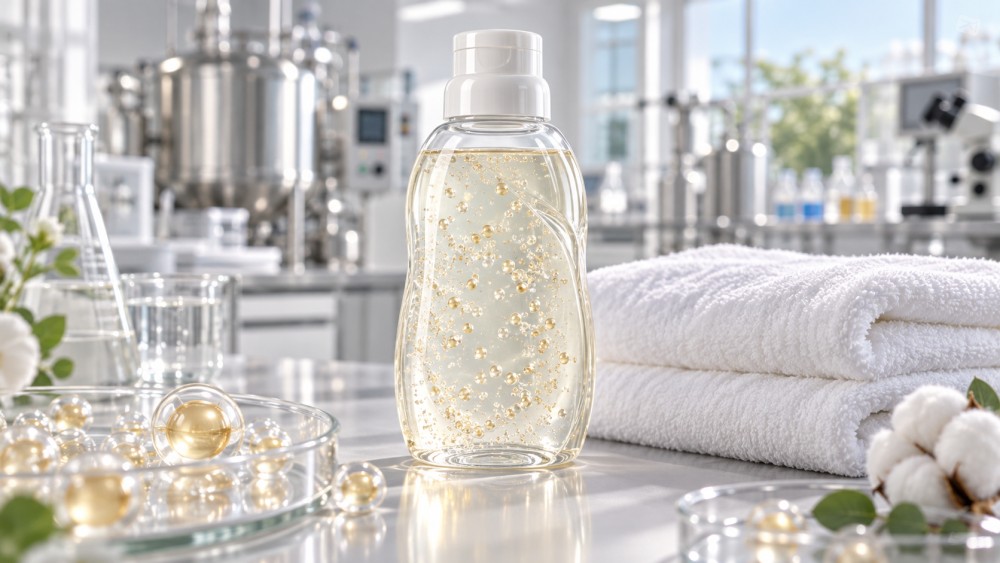
Fragrance encapsulates are small particles containing fragrance oil within a protective shell. The shell reduces early fragrance loss and helps preserve aroma materials until a defined release event occurs.
In household products, the protected fragrance may be released by rubbing fabric, squeezing a cleaning wipe, adding water, changing temperature, or simply allowing the product to dry.
Without encapsulation, volatile fragrance materials can evaporate during manufacturing, storage, washing, or drying. This may leave a product smelling pleasant initially but weak after real use.
Encapsulation does not replace a conventional free fragrance oil. In most formulations, both systems work together to create an immediate scent and a delayed sensory effect.
Free fragrance normally provides the opening impression when a consumer opens a bottle, pours detergent, or sprays a cleaner. Capsules are more relevant to the later experience.
For example, laundry capsules can deposit on textiles during washing. Later, normal movement or rubbing may rupture the shell and release fragrance during wearing, folding, or handling.
In fabric conditioners, this delayed release can support a longer-lasting scent claim. However, measurable longevity depends on dosage, capsule deposition, fabric type, wash conditions, and fragrance composition.
In hard-surface cleaners, fragrance encapsulates may improve the residual scent after wiping. Their value is strongest when the cleaning system leaves enough capsule material on the treated surface.
Operators should therefore view encapsulates as a delivery technology, not as a universal fragrance enhancer. Their performance is determined by the entire formulation and use environment.
Which Household Products Benefit Most from Encapsulated Fragrance?
Laundry detergents and fabric conditioners are usually the most suitable applications because they offer repeated consumer contact, fabric deposition opportunities, and clear expectations for long-lasting freshness.
Liquid laundry detergents often use fragrance encapsulates to enhance the scent remaining on washed textiles. The formulation must still protect capsules from surfactants, enzymes, salts, and processing stress.
Fabric conditioners can be particularly effective because cationic deposition aids may help fragrance capsules attach to fabric. This can improve release during drying, storage, and later wear.
Unit-dose laundry products may also use capsules, but capsule stability must be evaluated against concentrated surfactants, water activity, film materials, and the product’s expected storage conditions.
Surface cleaners can benefit when a fresh scent after cleaning matters commercially. Kitchen, bathroom, floor, and multipurpose cleaners may use capsules to extend sensory presence after application.
Not every surface cleaner is appropriate. Highly abrasive systems, strong solvents, extreme pH, or aggressive mixing can damage capsule shells before the product reaches the consumer.
Toilet care products may use encapsulation where lasting fragrance is important, although water exposure, surfactant levels, acidic conditions, and release timing require careful application-specific testing.
Air-care systems use other controlled-release approaches more frequently, but fragrance encapsulates can still contribute in gels, coatings, dry products, or products activated by handling or moisture.
Hand dishwashing liquids may present a less predictable case. Consumers often value immediate fragrance, while repeated water contact can reduce capsule retention and limit later release benefits.
For operators, the best candidates are products where fragrance needs to remain noticeable after the initial product application, rather than only at the moment of purchase or opening.
How Release Triggers Affect Consumer Scent Experience
The release trigger is one of the most important selection factors for fragrance encapsulates for household products. A capsule must release fragrance at a useful moment, not randomly.
Mechanical release occurs when friction, pressure, or rubbing breaks the capsule shell. This mechanism is especially relevant for treated fabrics, wipes, powder products, and certain coated surfaces.
Moisture-triggered release can be useful where water activates the product or changes the capsule environment. This may be relevant in laundry, toilet care, cleaning wipes, and wet-use applications.
Temperature-sensitive systems can release more fragrance under warmer conditions. However, high temperature may also increase fragrance loss, so heat stability must be assessed before commercial use.
Diffusion-controlled capsules release fragrance gradually through the shell rather than breaking suddenly. These systems may provide a softer and more continuous scent profile over time.
Different triggers produce different consumer perceptions. A strong burst from friction may communicate freshness, while slow diffusion can create a cleaner, less dramatic background fragrance impression.
Fragrance oil composition also changes the result. Light citrus notes may provide brightness but disappear quickly, while heavier woody, musky, or amber notes may remain detectable longer.
A supplier should explain whether the capsule is designed for burst release, gradual release, fabric deposition, water activation, or another performance mechanism. This information supports realistic claim development.
Operators should avoid assuming that higher capsule loading automatically means better scent. Excessive loading can create uneven performance, higher cost, visible residue, or an overpowering fragrance profile.
What Operators Should Check Before Adding Capsules to a Formula
Compatibility testing should begin before pilot production. The first step is confirming whether the capsule shell can tolerate the formula’s pH, surfactants, solvents, salts, preservatives, and active ingredients.
Many household products contain ingredients that can affect capsule integrity. High surfactant concentration, strong oxidizers, bleach, enzymes, solvents, and certain polymers can alter shell performance.
pH is especially important. A capsule stable in a neutral fabric conditioner may not perform similarly in an alkaline laundry detergent or an acidic bathroom cleaner.
Operators should review the full formula rather than testing capsules only in water. A simple dilution test cannot predict behavior in a concentrated commercial product during normal storage.
Mixing conditions also matter. High shear pumping, aggressive homogenization, narrow valve passages, and extended recirculation can rupture capsules, reducing the delayed-release benefit before filling.
Capsules are often added near the end of the process, after major mixing steps are complete. The exact addition point should follow supplier guidance and site-specific process validation.
Temperature control is another operational requirement. Elevated processing temperatures can weaken shells, accelerate fragrance evaporation, or alter viscosity in ways that affect capsule suspension and distribution.
Storage testing should cover ordinary warehouse conditions and realistic abuse conditions. Heat, freeze-thaw cycles, long storage periods, and transportation vibration can reveal formulation weaknesses early.
Visual inspection is useful but insufficient. Operators should check separation, sedimentation, particle damage, viscosity change, fragrance intensity, and actual release performance after ageing.
When capsules settle, the issue may involve density differences, poor rheology, inadequate suspending agents, or insufficient mixing. The solution should preserve both physical stability and capsule integrity.
How to Evaluate Fragrance Capsule Performance During Development
A useful evaluation program combines physical stability checks with sensory testing. A capsule can look stable in a bottle while delivering little meaningful fragrance after real product use.
Start by documenting the desired performance outcome. Examples include stronger scent on dry laundry, longer fragrance after floor cleaning, or a noticeable freshness burst when fabrics are handled.
Then define the comparison formula. Testing an encapsulated fragrance system against the same formula containing only free fragrance makes performance differences easier to interpret.
For laundry products, test across common fabric types such as cotton, polyester, blends, towels, and synthetics. Different fibers can retain fragrance and capsules very differently.
Wash variables should also be controlled. Water hardness, temperature, detergent dose, machine type, rinse volume, and drying method can all influence capsule deposition and fragrance perception.
For surface cleaners, evaluate scent directly after application, after drying, and after simulated contact. The relevant test surface should match likely consumer use, including tile, glass, laminate, or sealed wood.
Sensory panels should use clear scoring language. Participants can rate immediate intensity, residual intensity, pleasantness, freshness, release after friction, and overall product performance at defined time points.
Instrumental methods may support development, particularly when comparing fragrance loss or particle size. However, instrumental data should not replace human sensory evaluation for consumer-facing scent claims.
Repeated testing is important because fragrance perception can vary between users. A reliable conclusion needs enough samples, controlled conditions, and a documented method for comparing results.
Operators should keep pilot batch records showing capsule batch number, addition point, mixing speed, temperature, formula viscosity, and filling conditions. These details are essential during troubleshooting.
Common Problems and Practical Ways to Reduce Risk
Premature fragrance loss is a common problem. It can occur when capsule shells break during processing, when free fragrance is insufficiently stabilized, or when the selected fragrance is unsuitable.
If the product smells strong in the bottle but weak after use, investigate deposition, release trigger, dosage, and fragrance composition. The cause is not always low capsule concentration.
If capsules break before filling, reduce mechanical stress where possible. Review mixer type, pumping speed, recirculation time, screen size, valve restrictions, and the order of ingredient addition.
If capsules settle during storage, assess the formula’s viscosity profile and suspension system. Simply increasing viscosity may affect pouring, dosing, consumer acceptance, or manufacturing efficiency.
Visible particles can concern consumers, particularly in transparent products. Capsule size, color, refractive index, dispersion quality, and packaging appearance should be reviewed during product design.
Fragrance encapsulates may also affect foam, viscosity, clarity, or cleaning performance. These interactions require testing because a sensory benefit should not reduce the product’s core functional performance.
Some formulas require careful preservative and microbial-control review. Although encapsulates are not generally a microbial nutrient source by themselves, formulation changes can influence overall preservation performance.
Packaging compatibility is often overlooked. Fragrance materials can interact with plastic containers, closures, liners, labels, and dispensing components, particularly during long-term storage at elevated temperatures.
Regulatory and safety requirements should be confirmed early. Suppliers should provide relevant safety data, allergen information, restricted-substance details, transport information, and market-specific documentation where applicable.
Claims should remain evidence-based. “Long-lasting fragrance” may be supportable, but the precise consumer benefit should be aligned with validated test results and local advertising requirements.
How to Select a Supplier and Build a Reliable Capsule Program
Supplier selection should extend beyond fragrance strength or capsule price. The supplier must understand the intended household application, the formula environment, processing equipment, and performance objective.
Ask for technical information on shell chemistry, particle size range, fragrance loading, density, recommended use level, storage conditions, release behavior, and compatibility limitations.
Batch consistency matters because small changes in particle size, shell quality, or fragrance loading can affect sensory performance, appearance, deposition, and manufacturing behavior in finished products.
A capable supplier should support application testing rather than supplying only a sample. Product developers need guidance on dosing, mixing sequence, stability testing, sensory methods, and troubleshooting.
For global household product programs, documentation readiness is important. Teams may need safety data sheets, technical data sheets, composition declarations, regulatory statements, and traceability information.
Supply reliability also deserves attention. Capsule systems can be specialized materials, and a disruption can affect product launches, reformulations, or ongoing production if alternatives are not qualified.
It is useful to establish acceptance criteria before scale-up. These can include appearance, particle distribution, viscosity, fragrance intensity, accelerated stability, washing performance, and consumer sensory scores.
Commercial decisions should consider total value rather than material cost alone. A more effective capsule system may support lower fragrance dosage, stronger product differentiation, or improved consumer satisfaction.
However, encapsulation is not automatically justified for every product. It is most valuable where delayed scent performance supports a meaningful consumer benefit and can be demonstrated consistently.
Final Perspective on Fragrance Encapsulates for Household Products
Fragrance encapsulates for household products can extend scent performance by protecting volatile fragrance ingredients and releasing them later through friction, moisture, diffusion, or other controlled triggers.
The strongest applications are usually laundry detergents, fabric conditioners, and selected surface cleaners where consumers value freshness after washing, drying, wiping, or regular surface contact.
Successful use depends on more than capsule dosage. Formula compatibility, addition sequence, mixing stress, storage stability, deposition behavior, fragrance design, and sensory validation all influence the outcome.
For operators, the most practical approach is to define the required scent moment first, test capsules in the complete formula, validate processing conditions, and compare results against a non-encapsulated control.
When the system is selected and processed correctly, fragrance encapsulation can turn a short-lived opening scent into a more durable and recognizable household product experience.







































