How Do Fragrance Bases Affect Scent Release After Encapsulation?
How Do Fragrance Bases Affect Scent Release After Encapsulation?
Fragrance bases influence scent release after encapsulation through ingredient volatility, interactions with the capsule wall, and partitioning into the surrounding formulation. A strong initial aroma does not necessarily indicate lasting performance: the same fragrance blend can behave differently across shell materials, carrier systems, and application conditions. The useful question is not simply whether a capsule retains perfume, but whether it releases the right odor profile at the intended moment.
That distinction matters in a fabric conditioner designed to release scent when clothing is rubbed, a body-care product expected to smell pleasant during application, or a household cleaner evaluated after the surface dries. Each application rewards a different balance between retention and release. Choosing a fragrance base without considering that balance can leave a technically stable capsule with disappointing sensory performance.
The fragrance base is part of the delivery system
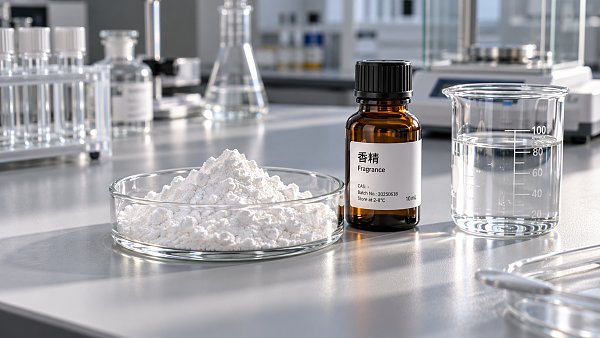
Here, “fragrance base” means the perfume blend loaded into the encapsulation system, including any diluent or carrier incorporated into that blend. It should not be confused with the finished detergent, lotion, or cleaning formulation. Establishing this definition early avoids a common comparison problem: two suppliers may report the same capsule loading while using different proportions of actual odorants and carrier.
Encapsulation does not make every component behave alike. Each aroma ingredient has its own vapor pressure, solubility, molecular size, and affinity for the shell and surrounding medium. As components leave at different rates, the fragrance remaining inside changes composition. The released scent can therefore drift away from the original perfume, even when total fragrance retention appears acceptable.
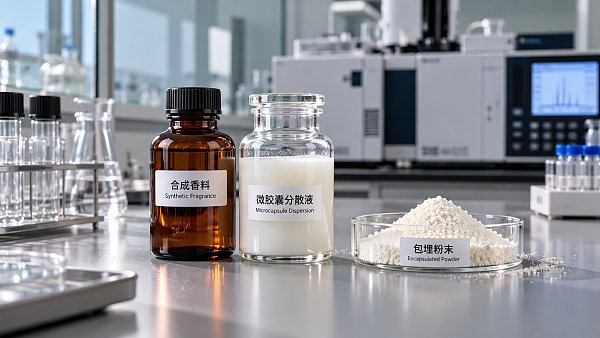
Nor do all encapsulation formats release fragrance through the same pathway. A core-shell microcapsule may rely on diffusion and mechanical rupture. A spray-dried matrix may release through moisture uptake and matrix dissolution. A cyclodextrin inclusion system involves guest binding and displacement. Results from one format should not be transferred to another without checking the underlying release mechanism.
Volatility matters, but it does not predict release on its own
Highly volatile ingredients can provide an immediate lift once exposed to air. However, boiling point or vapor pressure alone cannot tell an evaluator how quickly an ingredient will escape an intact capsule. Before reaching the headspace, it may need to move through the core, partition into the wall, diffuse across it, and enter the external formulation.
This creates an important trade-off. Reducing volatile top notes may improve retention but weaken freshness after activation. Increasing less volatile materials may extend the dry-down without producing a noticeable burst. An encapsulated perfume should be judged against its intended sensory sequence, not simply against the longest possible retention time.
Odor thresholds also complicate interpretation. A small released quantity of a potent ingredient can dominate perception, while a larger quantity of a less odor-active material contributes little. “Percentage released” and “perceived intensity” are different measurements. Neither should substitute for the other when comparing fragrance bases.
A practical analytical panel should track representative ingredients across the perfume profile, rather than relying on one convenient marker. Otherwise, a retained woody component could conceal the loss of the fresh notes that define the product.
The shell can interact with the perfume, not just contain it
Capsule walls are selective barriers. An ingredient with an affinity for the wall material may enter it more readily than another ingredient of similar volatility. Some perfume components or solvents can also plasticize or swell certain polymer shells, changing permeability or mechanical strength. Whether this happens depends on the specific shell chemistry and exposure conditions.
Chemical compatibility deserves separate attention. In reactive shell-forming processes, certain fragrance constituents may interfere with wall formation or participate in side reactions. Reactive aldehydes, for example, warrant compatibility checks in systems involving amine chemistry. This is not a blanket reason to exclude an ingredient; it is a reason to examine processing conditions and analytical recovery.
A useful warning sign is a base that encapsulates satisfactorily but produces rising free perfume during storage. Possible causes include diffusion through intact walls, wall damage, or an initially unencapsulated fraction. These require different remedies. Making the wall thicker may help one mechanism while doing little for another—and may reduce the desired release on rubbing.
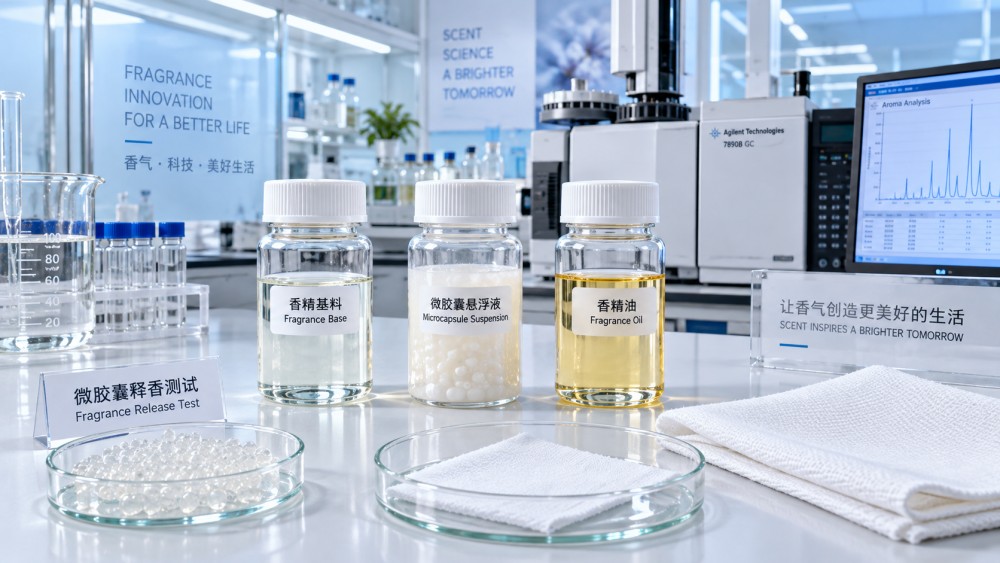
The diagnostic model is a sequence: fragrance core, capsule wall, external formulation, then air or substrate. Each interface can control the observed release. Capsule images help identify breakage or aggregation, but microscopy alone cannot establish molecular leakage.
The finished formulation can pull fragrance out
A capsule suspension that performs well in water may behave differently in a surfactant-rich product. Micelles can solubilize perfume outside the capsules, helping maintain a concentration gradient that favors further migration. The extent depends on the surfactant system, perfume composition, shell permeability, and temperature; it is not determined by surfactant concentration alone.
Solvents, hydrotropes, salts, and pH can also affect the external environment or capsule wall. In personal care, an oil phase may become a competing reservoir for fragrance. In home care, dilution during use changes the surrounding medium. These changes can alter release without obvious capsule rupture.
Carrier selection introduces another variable. A low-volatility carrier may reduce odorant activity in the core, but it also changes viscosity, ingredient solubility, and wall interactions. Adding more carrier is therefore not a universal solution to leakage. It can improve storage retention while reducing the aroma delivered after activation.
This connection between perfume chemistry and surfactant behavior is central to the application-focused coverage of Global Fine Chemicals & Agrochemical Intelligence Network (FCAS). For formulation decisions, fragrance ingredients, carriers, and delivery materials need to be evaluated as an interacting system rather than as isolated specifications.
Separate leakage, diffusion, and triggered release
A higher headspace reading after storage is not automatically evidence of successful controlled release. It may represent unwanted perfume migration before use. Conversely, low headspace intensity from an unopened sample may be entirely appropriate for a capsule designed to break on friction.
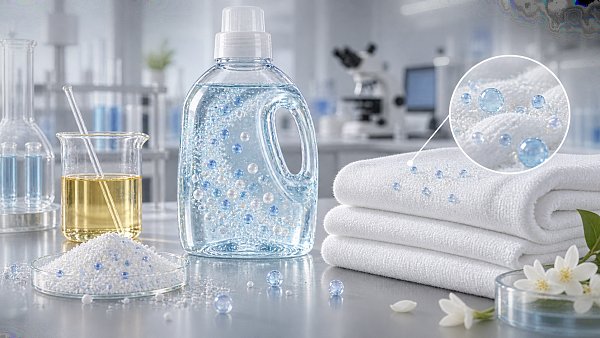
For laundry applications, deposition deserves particular attention. A perfume may release well from capsules in a laboratory vessel yet contribute little on fabric if the capsules fail to deposit or remain through rinsing. Increasing fragrance loading does not resolve a delivery failure.
Build comparisons around the actual use sequence
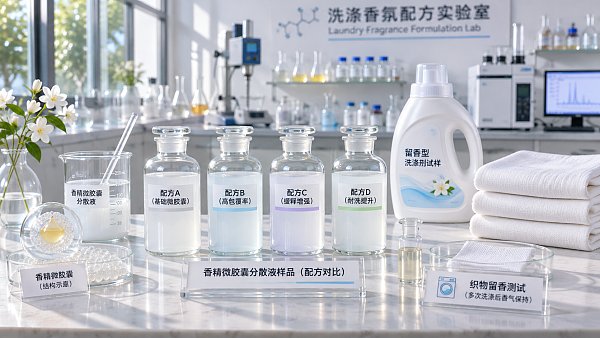
Start with a defined performance brief: scent during dispensing, after drying, after rubbing, or after a specified storage period. Then compare fragrance bases under controlled conditions. Where practical, keep shell chemistry, particle-size distribution, core-to-wall ratio, and manufacturing process consistent. If changing the base also changes capsule formation, report that interaction rather than attributing every difference to volatility.
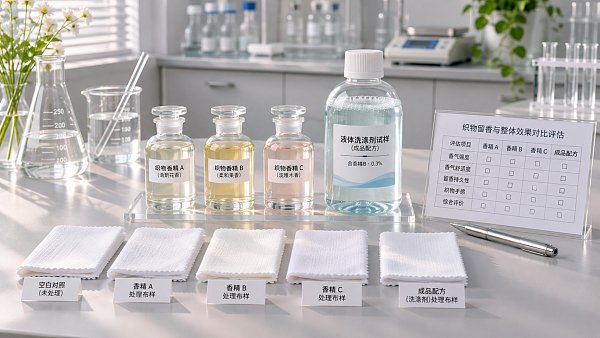
Dose comparisons should use actual fragrance content, not merely equal weights of capsule slurry. Include an unencapsulated fragrance control and an untriggered encapsulated sample. These help distinguish the contribution of free perfume from the additional aroma generated by activation.
A defensible evaluation combines complementary measurements:
- Retention and distribution: determine total fragrance and the external fraction using a validated separation and extraction procedure that does not itself rupture capsules.
- Release profile: measure headspace before and after a defined trigger, controlling temperature, humidity, equilibration time, and sample geometry.
- Sensory response: use blinded comparisons to assess intensity and character at application-relevant stages.
- Physical condition: monitor aggregation, particle-size changes, and capsule damage alongside chemical results.
Headspace GC-MS can show compositional changes, but sampling methods need care. With solid-phase microextraction, fiber selectivity and competition between compounds can influence responses. Peak areas should not be presented as absolute release quantities without appropriate calibration. Sensory testing remains necessary because instrumental abundance does not directly translate into perceived odor.
Storage testing should include the finished formulation and relevant packaging, not only the capsule concentrate. Elevated-temperature screening can reveal incompatibility, but it should not automatically be converted into a shelf-life prediction. Heat may change the failure mechanism rather than merely accelerate it.
What a useful technical specification should establish
There is no single universal release specification suitable for every encapsulated fragrance application. Acceptance criteria should identify the matrix, dose, storage conditions, trigger, sampling method, and sensory endpoint. “Long-lasting fragrance” is not a test method, and encapsulation efficiency at manufacture is not proof of storage retention.
Supplier discussions should establish the fragrance-content basis, initial free-perfume fraction, compatibility limits, and evidence behind release claims. Safety and regulatory suitability require separate review. Applicable IFRA Standards, ingredient restrictions, and any requirements affecting capsule materials should be checked for the intended use and market; good release performance does not establish compliance.
When choosing between fragrance bases, favor the one that preserves the required character through the actual product lifecycle—not necessarily the one with the strongest fresh-sample aroma or highest retention figure. Before changing the perfume or strengthening the shell, identify where performance is being lost: inside the capsule, across the wall, in the formulation, or during delivery to the substrate. That diagnosis makes the next formulation trial far more useful.
Facing technical bottlenecks in manufacturing or looking for more efficient industrial solutions? Leave your details below and let the engineering experts at FCAS solve them for you.
We respect your privacy. Your information is strictly confidential.
Related News
 Microencapsulated FragrancesHow Can Citrus Terpene Fragrances Stay Fresh in Formulations?Keep citrus terpene fragrances fresh for longer. Explore practical formulation, packaging, and testing strategies to protect their vibrant scent.MORE+
 Microencapsulated FragrancesHow Fragrance Encapsulation Systems for Detergents WorkDiscover how fragrance encapsulation systems for detergents protect perfume, deposit on fabric, and release scent—and learn how to choose the right system.MORE+
 Microencapsulated FragrancesHow to Choose a Reliable Fragrance Carriers SupplierChoose a reliable fragrance carriers supplier with confidence. Compare formulation fit, quality controls, documentation, supply risks, and total cost.MORE+
 Microencapsulated FragrancesHow Can Microencapsulation Help Essential Oil Blends Last Longer?Essential Oil Blends can retain their aroma longer with the right microencapsulation strategy. Explore carrier choices, release mechanisms, and stability testing.MORE+
 Microencapsulated FragrancesHow to Choose a Fragrance Capsules Manufacturer for Your ProductChoose the right fragrance capsules manufacturer with practical tips on formulation testing, quality specifications, compliance, and supply reliability.MORE+
 Microencapsulated FragrancesHow to Choose Fragrance Bases for Consistent Product ScentFragrance Bases can make or break scent consistency. Learn how to compare performance, stability, supplier controls and true cost before you buy.MORE+
 Microencapsulated FragrancesHow to Choose an Encapsulated Perfumes ManufacturerChoose an encapsulated perfumes manufacturer with confidence. Compare fragrance performance, true costs, quality, compliance, and supply reliability.MORE+
 Microencapsulated FragrancesHow to Choose a Fabric Fragrances ManufacturerChoose a fabric fragrances manufacturer with confidence. Learn how to compare scent performance, quality controls, documentation, costs, and supply reliability.MORE+
 Microencapsulated FragrancesHow to Keep Encapsulated Perfumes for Fabric Care Fresh LongerKeep encapsulated perfumes for fabric care fresh longer with practical storage, handling, formulation and testing tips that help preserve lasting fragrance.MORE+
 Microencapsulated FragrancesHow to Choose Home Fragrances for Room Sprays That LastDiscover how to choose home fragrances for room sprays that last, with practical tips on scent longevity, formula compatibility, and testing.MORE+
 Microencapsulated FragrancesHow to Choose Bulk Cyclodextrins for Fragrance EncapsulationChoose bulk cyclodextrins for fragrance encapsulation with confidence. Compare formulation fit, scent retention, supplier quality, and total cost.MORE+
 Microencapsulated FragrancesHow to Choose Stable Synthetic Aroma Chemicals for EncapsulationChoose stable synthetic aroma chemicals for encapsulation with confidence. Learn how to assess compatibility, verify supplier quality, and protect aroma through storage and release.MORE+
 Microencapsulated FragrancesHow Do You Evaluate a Fragrance Encapsulation Systems Manufacturer?Evaluate a fragrance encapsulation systems manufacturer for compatibility, scent retention, quality, and compliance. Discover key checks to reduce risk and choose the right supplier.MORE+
 Microencapsulated FragrancesHow Does Microencapsulation Affect the Release of Fine Fragrances?Fine Fragrances meet controlled release: discover how microencapsulation shapes scent longevity, aroma balance, and performance—and what to test before choosing a system.MORE+
 Microencapsulated FragrancesHow Do Fragrance Bases Affect Scent Release After Encapsulation?Discover how Fragrance Bases shape scent release after encapsulation. Explore volatility, shell compatibility, and testing strategies to improve lasting aroma and product performance.MORE+
 Microencapsulated FragrancesHow Microencapsulation Helps Personal Care Fragrances Last LongerPersonal Care Fragrances can last longer with microencapsulation. Discover how controlled release, formula compatibility, and testing help deliver a lasting scent experience.MORE+
 Microencapsulated FragrancesHow to Select Air Freshener Fragrances That Last in Car FreshenersDiscover how to select air freshener fragrances for car fresheners with lasting appeal, balancing scent performance, carrier compatibility, heat stability, and packaging.MORE+
 Microencapsulated FragrancesHow Encapsulated Perfumes for Fabric Care Improve Scent LongevityEncapsulated perfumes for fabric care extend scent longevity through controlled release, fiber deposition, and smarter formulation—discover how to create lasting fragrance experiences.MORE+
 Microencapsulated FragrancesHow Fragrance Carriers for Detergents Improve Scent PerformanceFragrance carriers for detergents improve stability, fabric deposition, and long-lasting scent. Explore practical solutions for better wash-to-wear fragrance performance.MORE+
 Microencapsulated FragrancesHow to Add Encapsulated Laundry Fragrances Without Weakening Wash ResultsEncapsulated laundry fragrances: learn how to boost long-lasting scent while protecting cleaning power, stability, foam control, and fabric care.MORE+
 Microencapsulated FragrancesHow Laundry Fragrances for Liquid Detergents Improve Scent LongevityLaundry fragrances for liquid detergents: discover how fragrance design, deposition, and encapsulation create lasting fabric freshness and stronger product appeal.MORE+
 Microencapsulated FragrancesHow Fragrance Delivery Systems Improve Fabric Softener LongevityFragrance delivery systems for fabric softeners improve scent longevity through smart protection, reliable deposition, and controlled release for lasting freshness.MORE+
 Microencapsulated FragrancesEssential Oil Extracts Compared for Fragrance and Wellness UsesEssential Oil Extracts compared for fragrance and wellness: explore scent profiles, extraction methods, stability, safety, and sourcing insights for smarter formulation choices.MORE+
 Microencapsulated FragrancesHow Aroma Chemicals Shape Lasting Fine Fragrance PerformanceAroma chemicals for fine fragrance enhance longevity, diffusion, and signature retention. Discover how smart material selection creates stable, premium scent performance.MORE+
 Microencapsulated FragrancesHow Encapsulated Laundry Fragrances Improve Scent LongevityEncapsulated laundry fragrances deliver controlled scent release for longer-lasting freshness on fabrics. Discover how they improve deposition, durability, and re-bloom.MORE+
 Microencapsulated FragrancesHow to Select Perfume Ingredients for Long-Lasting FragrancePerfume Ingredients guide: learn how to select balanced, long-lasting fragrance materials for fine fragrance, personal care, laundry, and home care products.MORE+
 Microencapsulated FragrancesHow Fragrance Encapsulates Extend Scent Performance in Household ProductsFragrance encapsulates for household products deliver longer-lasting scent in laundry, fabric care, and cleaners. Discover release triggers, formula compatibility, and practical selection tips.MORE+
 Microencapsulated FragrancesWater Soluble Air Freshener Fragrances That Prevent CloudinessWater soluble air freshener fragrances: learn how to prevent cloudiness with smarter fragrance selection, solubilizers, water quality, and stability testing.MORE+
 Microencapsulated FragrancesHow Cyclodextrin Inclusion Complexes for Fragrances Improve Scent LongevityCyclodextrin inclusion complexes for fragrances enhance scent longevity through controlled release, improved stability, and application-specific performance. Discover how to optimize lasting aroma.MORE+
 Microencapsulated FragrancesHow Microencapsulated Fragrance Systems Improve Long-Lasting ScentMicroencapsulated fragrance systems protect scent, control release triggers, and deliver longer-lasting fragrance across laundry, personal care, and cleaning products.MORE+
 Microencapsulated FragrancesHow Aroma Chemicals Shape Consistent Fragrance PerformanceAroma Chemicals shape fragrance stability, diffusion, solubility, and lasting sensory appeal. Explore practical strategies for reliable performance across product formulas.MORE+
 Microencapsulated FragrancesWhat to Look for in a Scratch and Sniff Fragrances ManufacturerScratch and sniff fragrances manufacturer guide: evaluate encapsulation, print compatibility, compliance documents, quality control, and total sourcing cost for reliable sensory campaigns.MORE+
 Microencapsulated FragrancesWhat a Reliable Perfume Compounds Manufacturer Should Offer in 2026Perfume compounds manufacturer selection in 2026 demands more than scent creativity. Learn how to assess consistency, compliance, scalability, and supply reliability before you buy.MORE+
 Microencapsulated FragrancesHow Fragrance Capsules for Detergents Improve Scent LongevityFragrance capsules for detergents help protect perfume during washing and release scent gradually, keeping clothes fresher longer. Learn how they work and why they’re worth choosing.MORE+
 Microencapsulated FragrancesWhy Terpene Fragrances Supplier Options Matter in Premium Scent DevelopmentTerpene fragrances supplier selection shapes premium scent quality, stability, compliance, and scale. Discover how to choose the right partner for safer, more consistent fragrance development.MORE+