What Determines Controlled Release Fertilizer Systems Price
A request for a controlled-release fertilizer program often reaches the finance desk as a simple comparison: price per tonne, price per bag, or price per hectare. That comparison is understandable—but it is rarely sufficient. The controlled release fertilizer systems price reflects not only nutrient analysis, but also coating technology, release duration, production controls, packaging, technical documentation, logistics, and the management model the product is meant to support.
For a financial approver, the central question is not simply, “Why does this material cost more than conventional fertilizer?” A more useful question is, “What costs, risks, and field operations does the higher unit price replace?” In crops where labor is constrained, nutrient loss is costly, or timing strongly affects quality, the answer can materially change the economics of a fertilizer decision.
Controlled-release fertilizers (CRFs) are designed to supply nutrients gradually rather than dissolving immediately after application. Their value depends on whether the release profile matches crop demand, soil conditions, irrigation practice, and the grower’s operational schedule. A coating that performs well in a nursery may not offer the same return in open-field production; a longer-duration product may reduce applications in one system while becoming unnecessarily expensive in another. Price needs to be reviewed in that context.
Why the quoted price is only the visible part of the cost
Conventional fertilizer pricing is commonly linked to nutrient content, raw-material markets, and freight. Those factors still matter for controlled-release products, but the finished price carries additional layers. The fertilizer granule must be produced to a consistent size, coated or encapsulated, cured, quality-checked, packed, and transported in a way that protects its physical integrity. Each stage affects the final quotation.
A low initial offer may be attractive on a procurement sheet, yet it can create exposure elsewhere: uneven release, damaged coatings after handling, incomplete product documentation, inconsistent batches, or limited technical guidance when field conditions differ from expectations. Conversely, the highest offer is not automatically the best choice. A financial review should separate genuine functional value from features that do not improve the intended crop program.
The most practical way to assess a quote is to divide it into three levels:
- Material cost: the purchase price of the fertilizer and its nutrient composition.
- Delivered program cost: freight, import procedures, storage, repacking, and field distribution.
- Economic use cost: application labor, equipment passes, nutrient losses, yield or quality risk, and working-capital exposure.
This broader view is particularly important when a controlled-release fertilizer replaces multiple applications of standard granular materials. The product may cost more per kilogram, but the full program may require fewer field visits, less seasonal labor, lower handling volume, and more predictable nutrition during a critical crop stage.
What determines controlled release fertilizer systems price?
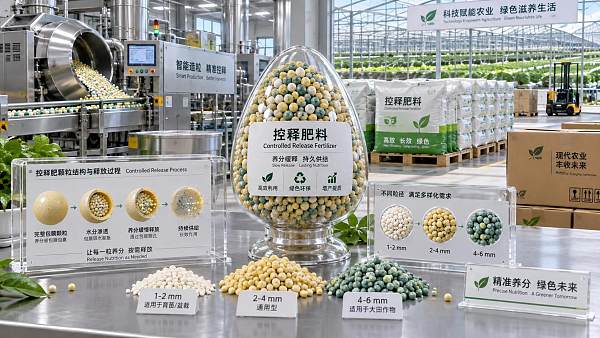
There is no universal CRF price because a “controlled-release system” can describe very different products. Some are polymer-coated granules designed for a defined release window. Others use sulfur coatings, resin systems, hybrid layers, inhibitor technologies, or blends that combine immediately available and delayed-release nutrients. Their cost structures are not interchangeable.
Nutrient sources and formulation complexity
Nitrogen, phosphorus, potassium, magnesium, sulfur, and micronutrients do not carry the same input cost or processing requirements. A basic nitrogen-focused coated granule may be less expensive than a multi-nutrient formulation that includes chelated trace elements or specialty nutrient sources. The stated NPK grade alone does not reveal the full formulation value.
Financial teams should ask whether the nutrient package is designed for a specific crop, growth stage, substrate, soil type, or fertigation strategy. In some cases, a tailored blend avoids the cost of purchasing and applying supplementary products later. In other cases, a broad “premium” formulation may duplicate nutrients already supplied through irrigation water, soil amendments, or foliar feeding.
Coating material and release technology
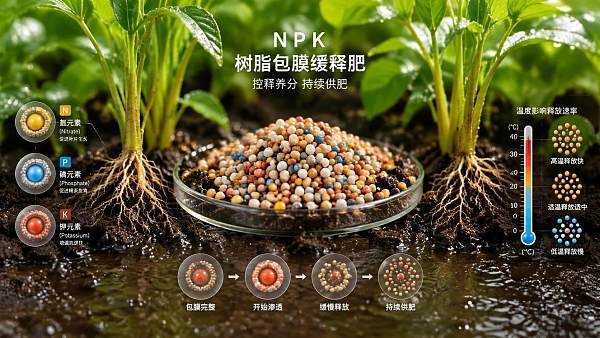
The coating is often the largest differentiator between standard fertilizer and a controlled-release product. Coating materials may include polymers, resins, sulfur-based layers, waxes, or combinations of these technologies. Their quality influences water penetration, nutrient diffusion, granule durability, and the consistency of nutrient delivery.
More sophisticated coatings generally require more controlled manufacturing conditions and tighter quality assurance. They may also be developed to reduce sudden nutrient release, minimize cracking during transport, or achieve a more stable release curve under expected temperatures. These factors can raise the purchase price, but they are directly connected to the product’s intended function.
It is worth noting that release is not governed by coating alone. Temperature, moisture, microbial activity, soil texture, irrigation frequency, and placement all influence actual behavior. A supplier that describes release duration without explaining the relevant test conditions leaves an important commercial question unanswered.
Release longevity and predictability
A three-month product, a six-month product, and a nine-month product should not be treated as equivalent alternatives merely because they have similar nutrient grades. Longer-duration systems usually require more coating material or more refined process control. Their price can therefore be higher, but their practical value depends on whether they reduce the need for a later top-dress application.
Predictability matters as much as nominal longevity. Financial approvers should distinguish between “nutrients are still present after six months” and “nutrient release aligns with the crop’s demand over six months.” The latter is the performance outcome that may protect yield, quality, and labor schedules. It is also the harder claim to evaluate without credible technical information.
Granule uniformity, process control, and batch consistency
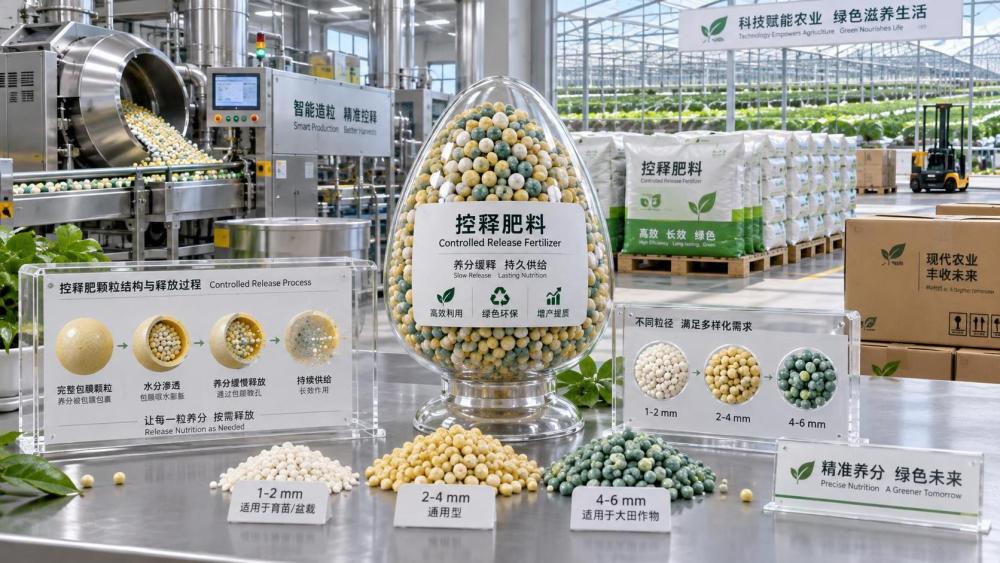
Controlled release depends on physical consistency. If particle sizes vary widely, coatings are uneven, or granules are prone to breakage, the fertilizer may release nutrients at different speeds. That can create uneven crop growth and make the original nutrient plan unreliable.
Manufacturers with disciplined granulation, coating, curing, sampling, and batch-control procedures often have higher operating costs than suppliers of commodity fertilizer. For procurement teams, this is not simply a manufacturing detail. Batch consistency affects whether the same application rate can be used confidently across seasons, locations, or contract-growing operations.
A finance-friendly comparison: cost per hectare, not just cost per tonne
A decision can become clearer when the purchasing team builds a side-by-side model based on the real production program. Start with the nutrient requirement per hectare, then compare how each option delivers it. One option may involve a lower-priced conventional fertilizer plus several applications; another may involve a higher-priced coated product applied once or in fewer passes.
The calculation should include more than the fertilizer invoice:
This approach does not assume that CRF will always win. For short-cycle crops, highly responsive fertigation systems, or operations with inexpensive and reliable labor, conventional or water-soluble fertilizers may remain more economical. The purpose of the model is to identify where a controlled-release system earns its premium and where it does not.
Scale, packaging, and logistics can move the final number substantially
Order volume has a visible effect on controlled release fertilizer systems price, but volume discounts should be interpreted carefully. A large seasonal order can improve unit pricing, yet it may also increase inventory risk if demand is uncertain, crop plans change, or the product has specific storage requirements. A lower price per tonne is not a saving if a portion of the stock is carried too long, damaged by moisture, or used outside its intended release season.
Packaging also matters more than it may appear. Small bags can support precise distribution and reduce handling losses in high-value crop operations. Bulk packaging can lower packaging cost per tonne, but may require appropriate unloading, storage, and application equipment. For export programs, moisture barriers, pallet stability, labeling, and container loading practices all influence delivered cost and product condition on arrival.
Freight should be evaluated alongside product density and nutrient concentration. Two fertilizers with similar quoted price may produce different delivered economics if one requires substantially more volume to supply the same nutrient program. For cross-border procurement, add the cost of inspection, customs documentation, local labeling, insurance, and potential port delays to the approval file rather than treating them as later operational issues.
Documentation is a cost driver—and a risk control
In regulated agricultural supply chains, documentation has commercial value. Product specifications, safety data sheets, nutrient declarations, batch records, storage guidance, release-rate information, and local registration status can all affect whether a fertilizer is usable, insurable, and acceptable to downstream growers or retailers.
A supplier offering a lower price without clear technical documentation may shift the burden to the buyer. That burden can emerge as delayed clearance, additional testing, customer disputes, or uncertainty over how the product should be applied. Finance approvers do not need to become agronomists, but they should require the commercial and technical teams to confirm that the documentation matches the planned market and application.
Questions worth placing in a purchase approval process include:
- What test method supports the stated release duration, and under what temperature or moisture conditions?
- Is the release profile relevant to the target crop and application environment?
- What tolerance applies to nutrient analysis, granule size, and coating quality?
- How is batch traceability maintained?
- What storage conditions preserve coating performance?
- Who bears responsibility if the supplied material does not meet the agreed specification?
Common pricing mistakes that make a “cheap” purchase expensive
One frequent mistake is comparing CRF and conventional fertilizer only by nutrient percentage. This ignores the operational purpose of controlled release: timing. A product with slightly lower nutrient analysis may still be the more economical option if it sustains supply through a period when a second application would be difficult or costly.
Another is accepting a stated release period as a guaranteed field outcome. Release duration is influenced by real conditions. A financial model that assumes perfect performance in every climate, soil, or irrigation scenario may overstate the return. It is wiser to use conservative assumptions and, where purchase volumes are significant, consider a staged evaluation or limited commercial trial before committing to a full program.
A third mistake is separating procurement from agronomy. The purchasing team may secure an attractive quote, while field teams later discover that the product does not fit local application equipment, irrigation schedules, or crop timing. Early alignment between procurement, operations, technical staff, and finance can prevent this kind of false saving.
Building a stronger approval case
A sound approval request for controlled-release fertilizer should state the intended use case clearly: crop, area, season, nutrient objective, application method, expected release window, and alternative program being replaced. Then it should show the financial logic in plain terms. What is the incremental material cost? What applications may be eliminated? What labor and timing risks are reduced? Which assumptions are verified, and which still require technical confirmation?
For distributors and agricultural input suppliers, the same discipline applies at a portfolio level. The best-priced product is not necessarily the easiest to sell or support. Consider shelf-life management, customer education needs, seasonal demand, claims documentation, and the consequences of a failed release-performance expectation. A reliable supplier relationship can be worth more than a narrow short-term saving when a product category depends on trust and correct application.
FCAS tracks fertilizer technologies, formulation factors, supply-chain considerations, and application-driven purchasing criteria across the agrochemical value chain. For decision-makers, this kind of market intelligence is useful because it connects a fertilizer quotation to the realities behind it: manufacturing quality, release behavior, documentation readiness, logistics, and farm-level operating economics.
The practical conclusion for budget holders
The right controlled release fertilizer systems price is not the lowest number on a supplier list. It is the cost that delivers an appropriate release profile, credible consistency, workable logistics, and a measurable fit with the crop management plan. When the product replaces labor-intensive applications, protects nutrition during vulnerable growth periods, or improves nutrient-use efficiency, a higher upfront price may be commercially justified.
When those benefits are uncertain, poorly documented, or unnecessary for the production system, the premium may not be warranted. Financial approval is strongest when it treats controlled-release fertilizer as a managed nutrient-delivery investment rather than a commodity purchase. That perspective gives procurement teams a clearer basis for comparing offers—and gives the business a better chance of paying for performance it can actually use.
Related News
 Non-ionic Surfactants & DefoamersWhat Are Octylphenol Ethoxylates and Where Are They RestrictedOctylphenol Ethoxylates explained: explore their uses, environmental risks, global restrictions, compliance challenges, and practical replacement strategies.MORE+
 Controlled-Release ThermodynamicsWhat Determines Controlled Release Fertilizer Systems PriceControlled release fertilizer systems price explained: compare coating technology, release performance, logistics, and per-hectare value for smarter purchasing decisions.MORE+
 Zero-Calorie Sweeteners & AcidulantsHow to Choose Artificial Sweeteners for Beverages That Taste BetterArtificial sweeteners for beverages: learn how to choose solutions with better taste, stability, labeling fit, and cost efficiency for successful reduced-sugar drinks.MORE+
 Zero-Calorie Sweeteners & AcidulantsHow Acidity Regulators Improve Beverage Flavor and Shelf LifeAcidity Regulators help beverage brands balance flavor, pH control, microbial stability, and shelf life. Explore practical formulation insights for safer, more consistent drinks.MORE+
 Nano-microcapsule FormulationsHow Oxidation Resistant Flavor Encapsulation Protects Taste StabilityOxidation resistant flavor encapsulation protects aroma, freshness, and taste stability. Discover how smart barriers, release control, and packaging improve shelf life.MORE+
 Microencapsulated FragrancesWater Soluble Air Freshener Fragrances That Prevent CloudinessWater soluble air freshener fragrances: learn how to prevent cloudiness with smarter fragrance selection, solubilizers, water quality, and stability testing.MORE+
 Hydrocolloids & EmulsifiersChoosing Cold Soluble Hydrocolloid Systems for Instant Beverage TextureCold soluble hydrocolloid systems for instant beverages: compare dispersion, texture, stability, process fit, and cost to select the right solution for scalable production.MORE+
 Maillard Reaction Savory FlavorsEthyl Maltol in Food Formulations for Balanced Sweet Aroma ProfilesEthyl Maltol helps food formulators create balanced sweet aroma profiles. Explore dosage control, sensory performance, quality assurance, and compliance insights.MORE+
 Targeted Bio-pesticides & APIsHow to Select Insecticide APIs for Reliable Stored Grain ProtectionInsecticide APIs for stored grain: learn how to select compliant, reliable actives for pest control, residue limits, formulation fit, and supplier quality.MORE+
 Micelle Fluidics & ChelationHow Cationic Surfactants Improve Formulation Performance and StabilityCationic Surfactants improve deposition, conditioning, anti-static control, and formulation stability. Explore compatibility, dispersion, and selection insights for better-performing products.MORE+
 Heavy-duty Industrial DegreasersWhat to Compare When Selecting a Cleaning Chemicals ManufacturerCompare a cleaning chemicals manufacturer by performance, compliance, batch consistency, technical support, and total applied cost to choose a reliable supplier.MORE+
 Targeted Bio-pesticides & APIsHow Botanical Insecticides Support Greenhouse Pest ControlBotanical insecticides for greenhouse use: learn practical IPM strategies for pest control, spray coverage, crop safety, and beneficial insect protection.MORE+
 Targeted Bio-pesticides & APIsChoosing Fungicide APIs for Stable Water Dispersible GranulesFungicide APIs for water dispersible granules: learn how particle behavior, wettability, carrier compatibility, and stability drive reliable WDG performance.MORE+
 Supercritical CO2 Essential OilsHow Mint Oils for Oral Care Improve Flavor and Fresh BreathMint oils for oral care create cooling flavor, lasting freshness, and a better daily brushing experience. Explore peppermint, spearmint, and smart product choices.MORE+
 Ultra-pure Semiconductor CleanersHow to Verify Residue Control in Semiconductor Process CleanersSemiconductor Process Cleaners: learn how to verify ionic, organic, metal, and particle residue control with risk-based qualification, rinse testing, and ongoing process monitoring.MORE+
 Controlled-Release ThermodynamicsWhen Potassium Sulfate Fertilizer 52 K2O Is the Better ChoicePotassium sulfate fertilizer 52 K2O delivers low-chloride potassium and sulfur for quality-focused crops. Explore when SOP can improve nutrient balance, crop value, and sourcing decisions.MORE+
 Non-ionic Surfactants & DefoamersAre Octylphenol Ethoxylates Still Suitable for Industrial CleanersExplore whether octylphenol ethoxylates for industrial cleaners still deliver reliable performance amid evolving regulations, wastewater demands, and safer formulation alternatives.MORE+
 Chelated Trace Element FertilizersWhat to Check Before Buying Powder Potassium Chloride FertilizerPowder potassium chloride fertilizer buying guide: compare nutrient value, chloride suitability, particle size, moisture, packaging, and delivered cost before ordering.MORE+
 Targeted Bio-pesticides & APIsHow Botanical Fungicides Protect Vegetables Without Residue RisksBotanical fungicides for vegetables help reduce residue risks while supporting effective disease control, compliance, and market-ready crop quality.MORE+
 Polymer-Coated Water Soluble NPKHow Drip Irrigation Fertilizers Improve Nutrient EfficiencyDrip Irrigation Fertilizers improve nutrient efficiency with precise root-zone feeding, smarter timing, and reduced waste. Discover practical fertigation strategies.MORE+
 Hydrocolloids & EmulsifiersWhy Spray Dried Gum Arabic Is Used to Improve Powder StabilitySpray dried gum arabic improves powder stability by protecting sensitive ingredients, supporting flow, and enhancing water dispersibility. Discover its key benefits.MORE+
 Chelated Trace Element FertilizersHow Fertigation Systems Help Vegetable Farms Reduce Water and Fertilizer WasteDiscover how fertigation systems for vegetable farming reduce water and fertilizer waste, improve root-zone delivery, and support more consistent crop quality.MORE+
 Heavy-duty Industrial DegreasersWhat to Compare When Buying Degreasing Solvents Wholesale in 2026Degreasing solvents wholesale guide for 2026: compare cleaning yield, safety, VOC status, total operating cost, specifications, and supplier reliability before buying.MORE+
 Hydrocolloids & EmulsifiersHow to Select Flavor Emulsions That Keep Juice Drinks Smooth and StableFlavor emulsions for juice drinks: learn how to select stable systems that prevent oil rings, maintain cloud, protect aroma, and support smooth shelf-life performance.MORE+
 Non-ionic Surfactants & DefoamersHow Ethoxylated Surfactants Improve Wetting and Cleaning in Textile ProcessingDiscover how ethoxylated surfactants for textile processing enhance wetting, oil removal, foam control, and rinse performance for reliable fabric quality.MORE+
 Supercritical CO2 Essential OilsWhat to Evaluate Before Choosing an Essential Oil Blends ManufacturerEssential oil blends manufacturer selection guide: evaluate quality, traceability, compliance, formula performance, and supply reliability to source with confidence.MORE+
 Hydrocolloids & EmulsifiersWhy Gellan Gum Is Used to Control Texture in Modern FoodsGellan Gum gives modern foods precise texture control, from light beverage suspension to clean gels and creamy body. Explore uses, processing factors, and formulation tips.MORE+
 Targeted Bio-pesticides & APIsHow to Select Intermediates for Stable Emulsifiable ConcentratesPesticide formulation intermediates for emulsifiable concentrate: learn how to select solvents and emulsifiers for robust solubility, dilution stability, hard-water performance, and scalable EC products.MORE+
 Zero-Calorie Sweeteners & AcidulantsKey Quality Checks for High Purity Aspartame in Food FormulationHigh purity aspartame quality checks for food formulation: evaluate assay, impurities, particle consistency, stability, documentation, and total cost.MORE+
 Herbicides & Plant Growth RegulatorsHow Plant Growth Promoters Improve Crop Uniformity and YieldPlant Growth Promoters help improve crop uniformity, root development, stress recovery, and yield potential. Learn how to choose the right product, timing, and application strategy.MORE+
 Antioxidants & Natural PreservativesHow Propionates Extend Shelf Life While Meeting Food Safety RequirementsPropionates extend shelf life by controlling mold in bakery and moisture-sensitive foods. Explore smart dosage, compliance, supplier quality, and safer distribution strategies.MORE+
 Maillard Reaction Savory FlavorsHow Concentrated Flavor Pastes Solve Batch-to-Batch Flavor VariationConcentrated flavor pastes help manufacturers reduce batch-to-batch variation with precise dosing, reliable dispersion, and stronger sensory consistency.MORE+
 Nano-microcapsule FormulationsWhat to Verify When Choosing a Cyclodextrin Inclusion Complexes ManufacturerChoose a cyclodextrin inclusion complexes manufacturer with confidence: verify complexation evidence, loading, stability, process control, and batch consistency.MORE+
 Zero-Calorie Sweeteners & AcidulantsHow Liquid Flavors for Soft Drinks Improve Taste Consistency at ScaleLiquid flavors for soft drinks help manufacturers achieve reliable taste consistency at scale through accurate dosing, controlled mixing, stability management, and sensory quality control.MORE+
 Heavy-duty Industrial DegreasersHow to Evaluate a Degreasing Surfactants Factory for Industrial CleaningDegreasing surfactants factory evaluation guide: compare cleaning performance, foam control, quality consistency, documentation, compatibility, and supply reliability.MORE+
 Zero-Calorie Sweeteners & AcidulantsWhat to Check When Choosing a Saccharin Sodium Supplier for Global OrdersChoose a reliable saccharin sodium supplier for global orders. Learn how to assess quality, documentation, packaging, export readiness, and total landed reliability.MORE+
 Non-ionic Surfactants & DefoamersHow Non Ionic Industrial Dispersants Prevent Sedimentation in Water Based FormulasNon ionic industrial dispersants help prevent sedimentation in water-based formulas. Discover practical controls for stable, redispersible industrial suspensions.MORE+
 Antioxidants & Natural PreservativesHow Oxidation Resistant Flavor Encapsulates Protect Taste During ProcessingOxidation resistant flavor encapsulates help protect delicate taste through heat, oxygen, and storage. Discover how to improve flavor retention, release, and processing consistency.MORE+
 Polymer-Coated Water Soluble NPKHow to Choose Resin Coated NPK Fertilizers for Efficient Nutrient ReleaseResin Coated NPK Fertilizers: learn how to match release duration, nutrient profiles, granule quality, and supplier reliability to your crop programme for better efficiency and lower costs.MORE+
 Microencapsulated FragrancesHow Cyclodextrin Inclusion Complexes for Fragrances Improve Scent LongevityCyclodextrin inclusion complexes for fragrances enhance scent longevity through controlled release, improved stability, and application-specific performance. Discover how to optimize lasting aroma.MORE+