
How Botanical Fungicides Protect Vegetables Without Residue Risks
How Botanical Fungicides Protect Vegetables Without Residue Risks
Vegetable growers are under pressure from several directions at once: persistent disease pressure, tighter buyer specifications, short harvest intervals, and increasing scrutiny of pesticide residues. For quality and safety teams, the question is no longer simply whether a fungicide controls powdery mildew, botrytis, downy mildew, or leaf spot. It is whether the crop can be protected without creating an avoidable residue issue at packing, export, processing, or retail inspection.
That is why botanical fungicides for vegetables have moved from a niche discussion into routine crop-protection planning. These products are based on plant-derived compounds, extracts, or essential-oil fractions that may suppress fungal development, inhibit spore germination, interfere with pathogen membranes, or support plant defense responses. Their residue profile can be favorable in certain programs, but “botanical” should never be treated as shorthand for “risk-free” or “residue-free.” The actual outcome depends on the active substance, formulation, use rate, spray timing, crop type, local registration, and the residue rules applied by the destination market.
The practical value of botanical products lies in how they are used: as part of a disciplined disease-management program, not as a late rescue treatment after an epidemic is already established.
Why residue pressure is different in vegetable production
Vegetables are particularly sensitive to residue concerns because many are harvested frequently and sold with limited processing. Leafy vegetables, herbs, tomatoes, cucumbers, peppers, brassicas, and berries can move from field to supply chain quickly. In protected cultivation, repeated applications may also create more opportunity for spray deposits to remain on foliage or fruit surfaces if the program is poorly managed.
A conventional fungicide may have a well-established role in disease control, but it can bring a defined pre-harvest interval, residue monitoring requirement, or export-market limitation. Botanical alternatives may offer shorter persistence or more favorable residue expectations in some use situations. Yet this advantage is not automatic. A plant-derived active can still be regulated as a pesticide, can still require a registered label, and can still be subject to market-specific restrictions. Quality managers should avoid a common but costly assumption: natural origin does not replace compliance documentation.
In practice, the residue question has three layers. First, is the product legally approved for the crop and application method? Second, does the intended market recognize the residue status of that active substance? Third, can the grower demonstrate that the product was applied according to label instructions and within the farm’s own traceability system? A product can perform well in the field and still cause a commercial problem if these three points are not aligned.
How botanical fungicides act on vegetable diseases
Botanical fungicides are not one uniform chemistry class. Their behavior varies widely according to the source plant, the extraction process, the concentration of active fractions, and the formulation system. Some products are based on essential-oil components or plant extracts with direct contact activity. Others may function mainly as preventive treatments by limiting spore germination or colonization on the crop surface.
Many botanical materials have multi-site or broad biochemical activity rather than a single highly specific mode of action. This can be useful in resistance-management programs, especially where a vegetable crop receives repeated fungicide applications in one season. However, broad activity also means formulation details matter. A volatile botanical compound that works in a laboratory test may lose practical value if it evaporates too quickly, does not spread across a waxy leaf, separates in the spray tank, or causes phytotoxicity under high temperature or strong light.
Most botanical products are better positioned as preventive tools than curative ones. They are typically most reliable when applied before disease pressure becomes severe, when canopy coverage is good, and when environmental conditions are being monitored. Once botrytis is established inside a dense greenhouse canopy, or downy mildew is moving rapidly through wet foliage, relying on a mild-contact botanical treatment alone may be unrealistic.
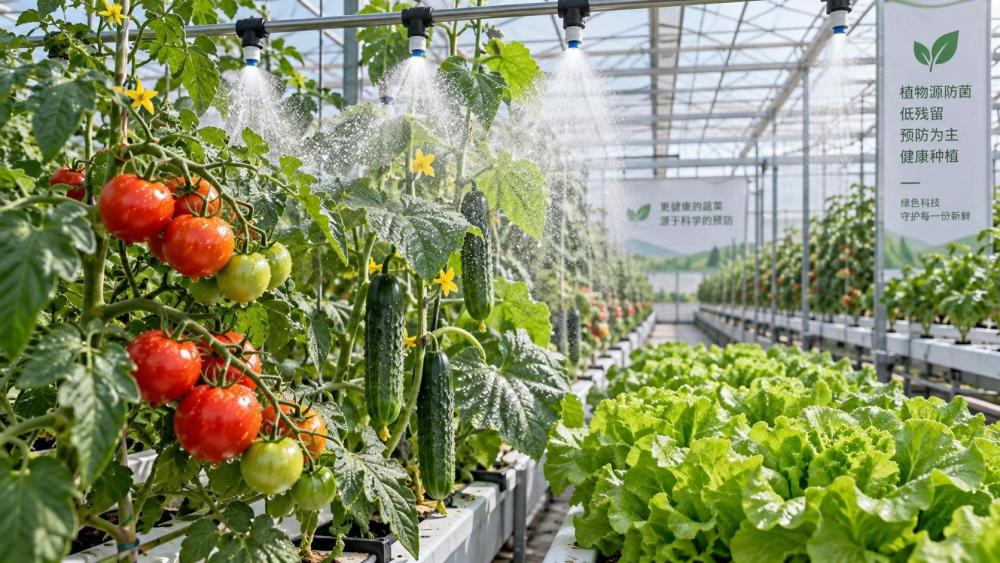
This is where experienced crop teams make a distinction that is easy to miss in marketing claims: visible suppression is not the same as dependable disease control. A treatment may reduce superficial symptoms but fail to protect marketable yield if it is applied too late, reaches only the upper canopy, or is washed off by irrigation or rain shortly after treatment.
Residue advantages depend on formulation, not just the plant source
The active ingredient is only part of the residue and safety picture. Botanical fungicide formulations may include solvents, emulsifiers, wetting agents, dispersants, stabilizers, preservatives, and other co-formulants needed to create a stable, usable product. These materials affect spray coverage, storage stability, odor, worker handling, tank-mix behavior, and potentially the quality of the harvested crop.
For example, an oil-based botanical formulation may adhere well to leaf surfaces, which can improve contact activity. On the other hand, excessive oil loading, poor emulsification, or application during hot conditions can increase the chance of leaf burn, surface marking, or fruit finish problems. This matters greatly for premium vegetables sold on appearance. A residue test may pass while the crop is still rejected because cucumbers show surface injury or herbs carry an objectionable odor.
Formulation quality is therefore a safety issue as much as a performance issue. Suppliers should be able to provide a meaningful technical data sheet, safety data sheet, batch identification, storage guidance, and information on the composition or specification of relevant active markers. For plant extracts, consistency is often more difficult than for a single-molecule synthetic active. The botanical source, harvest conditions, extraction method, and standardization approach can all influence composition between batches.
What quality teams should check before approving a product
A botanical fungicide should enter the approval process with the same discipline applied to any crop-protection input. The following checks are especially useful where vegetables are supplied to processors, retailers, or export channels:
- Crop and use authorization: confirm that the product is registered or otherwise permitted for the specific vegetable crop, disease target, and country of use.
- Destination-market residue requirements: do not rely only on the rules in the production country. Retailer protocols and importing-country requirements may be stricter or different.
- Active-content consistency: review how the supplier identifies and controls the relevant botanical fractions or marker compounds.
- Co-formulant suitability: ask about solvents, surfactants, and other ingredients that may affect worker safety, crop finish, odor, or compatibility with packing operations.
- Impurity and contaminant controls: botanical raw materials may require attention to contaminants that are not obvious from the product name alone.
- Label discipline: verify application rate, interval, re-entry guidance, pre-harvest requirements where applicable, and restrictions related to temperature, crop stage, or mixing.
It is also sensible to retain product samples and batch records when a new formulation is introduced into a high-value vegetable program. This is not bureaucracy for its own sake. If a residue, phytotoxicity, or odor complaint appears later, the farm and packer need to know exactly which lot was used, at what rate, on which blocks, and under what conditions.
Application timing is where many programs succeed or fail
Botanical fungicides tend to work best when the agronomy supports them. In protected tomato or cucumber production, that may mean reducing leaf wetness, improving ventilation, removing diseased plant material, and making sure spray droplets reach the lower canopy. In field-grown leafy vegetables, it may mean adjusting treatment schedules around rainfall, irrigation, and rapid leaf expansion.
Coverage is particularly important for contact-active botanical products. A spray that lands only on exposed leaves leaves untreated tissue vulnerable. Water volume, nozzle selection, droplet spectrum, canopy density, and operator calibration can matter as much as the nominal application rate. This is one reason why trials conducted under controlled conditions do not always translate directly to commercial blocks.
There is also a tendency to overapply products viewed as “soft” or natural. That can be a mistake. Higher rates may not improve disease control proportionally, but can raise the likelihood of crop stress, residues from formulation components, or incompatibility in tank mixes. When introducing a botanical product, a limited-area commercial evaluation is often more informative than immediately switching an entire crop program.
Botanical products work best inside an integrated program
For vegetables with high disease pressure, botanical fungicides are rarely a complete replacement for every other intervention. Their strongest role is often within integrated pest and disease management: sanitation, resistant varieties where available, climate management, scouting, irrigation control, biological tools, and carefully selected conventional products when justified and permitted.
A practical approach may be to use botanicals during lower-pressure periods, at early disease-risk stages, or closer to harvest where residue flexibility is particularly valuable. Conventional products, where legally available and technically needed, may be reserved for periods of high infection risk. The correct sequence depends on disease biology, resistance-management strategy, crop stage, and customer requirements. It should not be reduced to a simple “natural versus synthetic” choice.
For safety managers, this integrated view is helpful because it shifts the discussion from product claims to control points: what disease risk exists, what materials are applied, what residues could reasonably be expected, and how each decision is documented. That is a more defensible framework during supplier audits and food-safety reviews.
Questions to ask suppliers before a botanical fungicide enters the supply chain
A credible supplier discussion goes beyond asking whether a product is “organic,” “green,” or “low residue.” Procurement and technical teams should ask for the product’s approved use pattern, active specification, formulation type, recommended storage conditions, shelf-life basis, and batch-control approach. They should also clarify whether the supplier has application guidance for the intended vegetable crop rather than relying on general claims across unrelated crops.
Documentation readiness is increasingly part of product quality. Global Fine Chemicals & Agrochemical Intelligence Network (FCAS) tracks the broader factors that shape such decisions: active ingredient characteristics, formulation stability, wetting and dispersion behavior, handling requirements, regulatory expectations, and supply consistency. In botanical crop protection, these details are often what separate a workable program from a product that looks attractive only on a sales sheet.
The supplier should also be prepared to discuss what the product cannot do. If it is primarily preventive, that should be stated clearly. If rainfastness is limited, or if certain crop stages need caution, those limits should appear in technical guidance. Honest limitations are useful information, especially for teams responsible for food safety and customer compliance.
A lower-residue strategy requires evidence, not assumptions
Botanical fungicides can help vegetable operations reduce dependence on residue-sensitive disease-control options, particularly when they are selected for a defined role and applied before disease becomes difficult to contain. Their plant-based origin may support a favorable residue strategy, but it does not remove the need for registration review, formulation assessment, traceability, and market-specific verification.
The most reliable decision is usually the least dramatic one: validate the product on the actual crop, review the full formulation and documentation package, confirm the requirements of the intended market, and keep application records precise. In vegetable production, residue risk is managed long before harvest day.
Related News
 Antioxidants & Natural PreservativesWhat Quality Checks Matter When Sourcing Butylparaben for Personal CareButylparaben for personal care sourcing guide: compare assay, impurities, physical performance, documentation, traceability, and supplier quality to reduce formulation risk.MORE+
 Nano-microcapsule FormulationsHow Encapsulated Flavors Protect Taste During Processing and StorageEncapsulated Flavors protect taste from heat, oxygen, moisture, and storage loss. Explore smarter release, carrier selection, and processing strategies.MORE+
 Chelated Trace Element FertilizersHow Greenhouse Fertigation Systems Reduce Water and Fertilizer WasteGreenhouse fertigation systems reduce water and fertilizer waste with precise dosing, uniform irrigation, drainage monitoring, and smarter crop-zone control. Learn practical strategies.MORE+
 Supercritical CO2 Essential OilsHow Natural Essential Oil Blends Improve Consistent Product FragranceNatural essential oil blends help brands achieve consistent, appealing fragrance across batches. Explore smart blend design, stability testing, and product compatibility strategies.MORE+
 Non-ionic Surfactants & DefoamersHow to Choose Non Ionic Low Foaming Surfactants for CIP CleaningNon ionic low foaming surfactants for CIP cleaning: learn how to balance wetting, foam control, compatibility, and rinseability for reliable cleaning performance.MORE+
 Nano-microcapsule FormulationsHow Food Grade Cyclodextrin Complexes Protect Sensitive FlavorsFood grade cyclodextrin inclusion complexes help protect sensitive flavors from oxidation, evaporation, and processing loss while supporting controlled release and consistent sensory quality.MORE+
 Polymer-Coated Water Soluble NPKHow Fertilizer Coating Polymers Improve NPK Granule ReleaseFertilizer coating polymers for NPK granules improve controlled nutrient release, reduce loss risks, and enhance product consistency. Discover key selection and process insights.MORE+
 Chelated Trace Element FertilizersWhat Diammonium Phosphate Means for Crop Nutrition PlanningDiammonium Phosphate: learn how DAP supports early phosphorus access, nitrogen budgeting, smart placement, and balanced crop nutrition planning.MORE+
 Maillard Reaction Savory FlavorsHow to Assess a Flavor Bases Supplier List for Reliable SourcingGlobal Fine Chemicals & Agrochemical Intelligence Network flavor bases supplier list: assess specs, samples, supply risk, and true cost to source with confidence.MORE+
 Hydrocolloids & EmulsifiersHow Konjac Gum Powder Improves Texture in Low-Calorie FoodsKonjac gum powder improves body, stability, and mouthfeel in low-calorie foods. Discover practical tips for smoother sauces, beverages, and reduced-fat formulations.MORE+
 Supercritical CO2 Essential OilsWhat to Check Before Choosing a Botanical Essential Oils ManufacturerChoose a botanical essential oils manufacturer with confidence. Explore key checks for purity, traceability, compliance, batch consistency, and reliable supply.MORE+
 Microencapsulated FragrancesHow Fragrance Carriers for Detergents Improve Scent PerformanceFragrance carriers for detergents improve stability, fabric deposition, and long-lasting scent. Explore practical solutions for better wash-to-wear fragrance performance.MORE+
 Antioxidants & Natural PreservativesWhen Propyl Gallate Antioxidant Is the Right Choice for Oil StabilityPropyl gallate antioxidant: learn when it is the right choice for oil stability, shelf-life protection, processing compatibility, and smarter formulation decisions.MORE+
 Antioxidants & Natural PreservativesHow Potassium Sorbate Extends Shelf Life in Food and Beverage ProductsPotassium Sorbate helps food and beverage brands control yeast and mold spoilage. Explore pH, dosage, processing, and packaging strategies for reliable shelf life.MORE+
 Antioxidants & Natural PreservativesHow to Source Bulk Herbal Extracts With Reliable Quality ControlBulk herbal extracts sourcing guide: compare suppliers, verify traceability, review CoAs, and build reliable quality controls for safer, consistent purchasing.MORE+
 Antioxidants & Natural PreservativesWhat to Check Before Sourcing Butylparaben for Personal Care FormulasButylparaben for personal care sourcing guide: check market eligibility, purity, supplier controls, formula compatibility, packaging, and total risk before buying.MORE+
 Targeted Bio-pesticides & APIsChoosing Microbial Fungicides for Foliar Diseases in Integrated Crop ProgramsMicrobial fungicides for foliar diseases: learn how to match biology, formulation, tank compatibility, and timing for stronger integrated crop protection.MORE+
 Targeted Bio-pesticides & APIsHow Microbial Insecticides Control Caterpillars With Lower Crop Residue RiskMicrobial insecticides for caterpillars help protect crops with targeted early-larval control and lower residue-management pressure. Learn timing, coverage, compliance, and scouting essentials.MORE+
 Microencapsulated FragrancesHow to Add Encapsulated Laundry Fragrances Without Weakening Wash ResultsEncapsulated laundry fragrances: learn how to boost long-lasting scent while protecting cleaning power, stability, foam control, and fabric care.MORE+
 Supercritical CO2 Essential OilsHow Aroma Ingredients Shape Lasting and Skin-Safe Personal Care ProductsAroma ingredients for personal care: discover how to achieve lasting scent, formulation stability, skin safety, and confident product performance.MORE+
 Targeted Bio-pesticides & APIsInsecticides Explained Through Labels, Active Ingredients, and SafetyInsecticides explained through labels, active ingredients, formulations, and safety. Learn how to compare products, manage risk, and make informed crop protection decisions.MORE+
 Heavy-duty Industrial DegreasersHow to Select Parts Wash Cleaners for Automotive ComponentsParts wash cleaners for automotive components: learn how to match chemistry, materials, rinsing, safety, and waste controls for reliable cleaning results.MORE+
 Chelated Trace Element FertilizersHow Precision Fertigation Systems Improve Water and Nutrient ControlPrecision fertigation systems improve water and nutrient control with accurate dosing, uniform irrigation, smart monitoring, and reduced waste. Discover how to optimize crop performance.MORE+
 Hydrocolloids & EmulsifiersHow Bulk Price Factors Affect Hydrocolloid Stabilizer Blend SourcingHydrocolloid stabilizer blends bulk price: compare dosage efficiency, quality consistency, logistics, and documentation to reduce total sourcing costs.MORE+
 Zero-Calorie Sweeteners & AcidulantsHow to Choose a Natural Sweeteners Supplier for Clean-Label ProductsNatural sweeteners supplier selection guide for clean-label products: compare formulation fit, traceability, documentation, and supply reliability.MORE+
 Non-ionic Surfactants & DefoamersWhat Cationic Surfactants Do and Where They Are UsedCationic Surfactants deliver antimicrobial action, conditioning, antistatic control, and surface treatment benefits. Explore key uses, compatibility, and safe selection tips.MORE+
 Targeted Bio-pesticides & APIsHow to Evaluate Pesticide Suspension Concentrates for Field StabilityPesticide Suspension Concentrates: learn how to evaluate field stability, redispersibility, dilution, tank-mix compatibility, and spray safety for reliable performance.MORE+
 Hydrocolloids & EmulsifiersHow Hydrocolloid Systems for Meat Products Improve Texture and YieldHydrocolloid systems for meat products improve yield, texture, water retention, and slicing quality. Explore practical formulation strategies for stable, high-performing meat products.MORE+
 Microencapsulated FragrancesHow Laundry Fragrances for Liquid Detergents Improve Scent LongevityLaundry fragrances for liquid detergents: discover how fragrance design, deposition, and encapsulation create lasting fabric freshness and stronger product appeal.MORE+
 Nano-microcapsule FormulationsChoosing Fragrance Preparations That Perform Well in Personal WashFragrance preparations for personal wash: learn how to select options that protect clarity, stability, foam, scent performance, and packaging compatibility.MORE+
 Controlled-Release ThermodynamicsModified Cyclodextrins Explained for Controlled Fragrance ReleaseModified cyclodextrins enable controlled fragrance release, odor control, and volatile-note protection. Explore how they optimize performance in detergents, fabric care, and more.MORE+
 Microencapsulated FragrancesHow Fragrance Delivery Systems Improve Fabric Softener LongevityFragrance delivery systems for fabric softeners improve scent longevity through smart protection, reliable deposition, and controlled release for lasting freshness.MORE+
 Supercritical CO2 Essential OilsHow to Evaluate a Natural Cardamom Oil Supplier for Reliable SupplyNatural cardamom oil supplier evaluation guide: verify botanical origin, purity, batch consistency, documentation, packaging, and delivery reliability for confident sourcing.MORE+
 Maillard Reaction Savory FlavorsHow Ethyl Maltol Purity Testing Supports Flavor Safety ComplianceEthyl Maltol purity testing strengthens flavor safety compliance through identity checks, impurity profiling, supplier verification, and audit-ready documentation.MORE+
 Microencapsulated FragrancesEssential Oil Extracts Compared for Fragrance and Wellness UsesEssential Oil Extracts compared for fragrance and wellness: explore scent profiles, extraction methods, stability, safety, and sourcing insights for smarter formulation choices.MORE+
 Zero-Calorie Sweeteners & AcidulantsWhat Drives Zero Calorie Sweeteners Bulk Price in 2026Zero calorie sweeteners bulk price in 2026: compare specifications, dosage, quality, freight, and supply risk to make smarter sourcing decisions.MORE+
 EPA FIFRA & FDA GRAS RegsSynthetic Food Preservatives Rules That Support Safer FormulasSynthetic Food Preservatives: learn the rules for safer formulas, compliant use levels, validated shelf life, labeling, and reliable microbial control.MORE+
 Micelle Fluidics & ChelationHow Anionic Industrial Dispersants Improve Coating StabilityAnionic industrial dispersants improve coating stability, pigment wetting, viscosity control, gloss, and storage performance. Learn how to select and test the right solution.MORE+
 Supercritical CO2 Essential OilsHow to Choose Eucalyptus Oil Grades for Clean, Consistent ProductsChoose the right Eucalyptus Oil grade with confidence. Compare cineole content, purity, origin, processing, documentation, and application fit for consistent products.MORE+
 Micelle Fluidics & ChelationWhat Are Cationic Surfactants and Where Are They Commonly Used?Cationic Surfactants deliver powerful surface affinity for disinfection, fabric softening, hair conditioning, antistatic control, and industrial treatments. Explore key uses and selection factors.MORE+







































