How to Evaluate an Industrial Dispersants Manufacturer
A dispersant that meets its certificate of analysis can still fail in a formulation. Effective evaluation of an industrial dispersants manufacturer therefore starts with two separate questions: does the product perform under the intended processing and storage conditions, and can the manufacturer reproduce that performance from batch to batch?
Neither a favorable price nor a laboratory dispersion test answers both. A defensible selection connects application trials with evidence of manufacturing control, impurity management, documentation and a practical plan for handling changes in supply.
Define the dispersion problem before comparing suppliers
Dispersants stabilize particles by adsorbing at their surfaces and reducing their tendency to form agglomerates. The relevant interactions depend on the particle surface, the dispersant chemistry and the surrounding medium. A product that controls one pigment in water is not automatically suitable for a mineral slurry, a solvent-based coating or a crop protection suspension.
Send shortlisted suppliers a description of the complete operating window, not just the name of the solid to be dispersed. Information that can materially change a recommendation includes:
- The identity and concentration of the solid, including relevant variations in grade, particle-size distribution and surface treatment.
- The continuous phase, pH range, ionic strength and presence of salts, solvents or other additives.
- The order of addition, mixing equipment, available shear, processing temperature and target solids loading.
- Required properties during manufacture, storage and use, such as viscosity, sedimentation behavior, color development or redispersibility.
Where formulation details are confidential, a representative test system can still be agreed. Its limitations should be explicit: a simplified slurry can screen adsorption and viscosity, but it cannot establish compatibility with ingredients that were left out.
A credible manufacturer should explain why it proposes a particular chemistry and what conditions could make it unsuitable. For example, a dispersant that relies heavily on electrostatic stabilization may behave differently when electrolyte levels rise. A polymeric dispersant that provides steric stabilization can also be sensitive to the medium and to competing ingredients. These are reasons to test the complete system, not reasons to assume one mechanism is universally better.
Compare performance at equivalent conditions
Supplier data are useful for screening only when the test method and formulation are visible. A graph showing lower viscosity has limited value if the solids content, dispersant dosage, mixing energy or measurement temperature differs from the intended process. Request the underlying method, the test material and the basis on which dosage is reported: as supplied, on an active-solids basis or relative to the mass of dispersed solid.
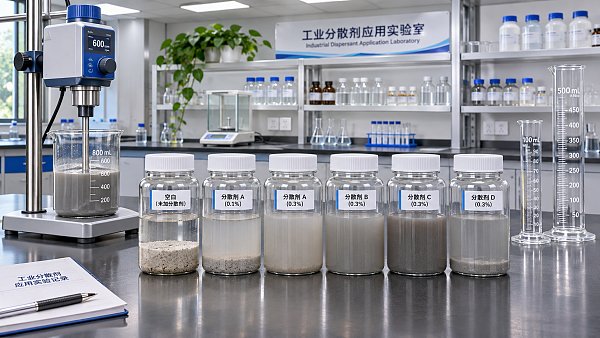
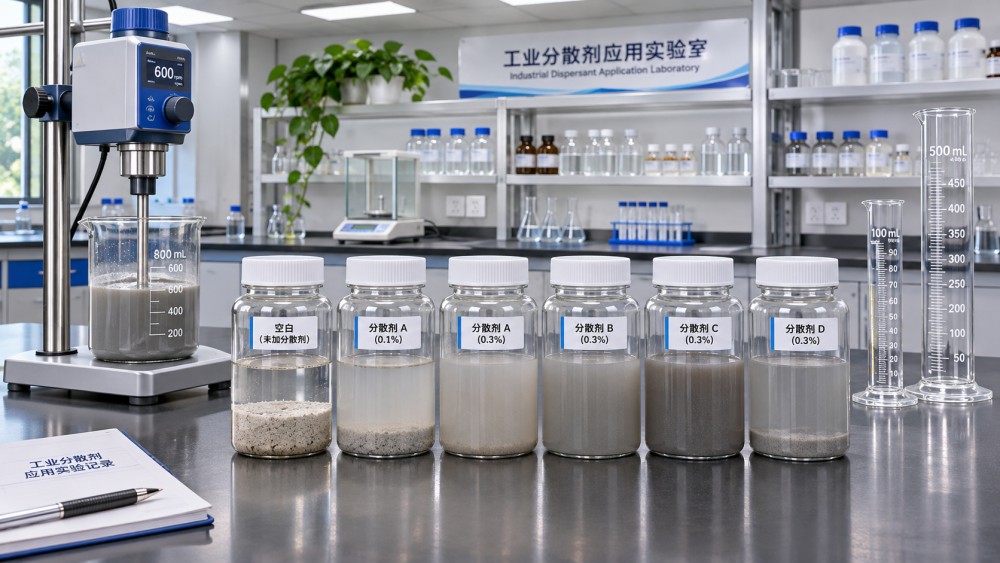
For a side-by-side trial, hold the solid, liquid phase, equipment, mixing sequence and measurement conditions constant. Test a dosage range around the supplier’s recommendation rather than relying on a single addition level. Too little dispersant can leave particle surfaces inadequately covered; excess material can alter viscosity, foam or compatibility and may destabilize some systems. The optimum is the lowest practical dosage that meets the full performance requirement, not necessarily the point of minimum initial viscosity.
Record more than the appearance immediately after mixing. Depending on the application, useful observations include particle-size distribution, viscosity at relevant shear rates, settling or phase separation, hardness of sediment and ease of redispersion. In a coating, color strength, gloss or defects after application may matter more than slurry viscosity alone. In a cleaning concentrate, compatibility after dilution and in the presence of water hardness can be decisive.
Compare product cost at the dosage needed to achieve an acceptable result. A cheaper material per kilogram can cost more in the finished formulation if it requires a higher active dosage or creates additional processing and quality losses. Conversely, a product with excellent laboratory performance is not automatically preferable if its benefit disappears at production scale.
Test stability in the actual formulation
Initial dispersion is only one part of qualification. Storage can reveal slow flocculation, sediment compaction, viscosity drift or separation that a same-day test misses. Design the storage assessment around the intended shelf life, packaging and transport conditions, with agreed inspection intervals and acceptance criteria. Accelerated temperature or cycling tests can identify weaknesses, but they should not be treated as a precise substitute for real-time shelf-life evidence unless the relationship has been established for the formulation.
Test interactions with the ingredients most likely to change the dispersant’s behavior. Surfactants, thickeners, binders, defoamers, salts and preservatives can compete at interfaces or change the liquid phase. An agricultural suspension concentrate, for example, needs evaluation not only in the concentrate but also after dilution in representative water. A stable concentrate that forms persistent agglomerates on dilution has not met its functional requirement.
Water quality deserves particular attention where the formulation or end use is sensitive to dissolved ions. Define representative hardness and salt conditions rather than testing only with purified water. Where the operating pH can change during storage or application, test across that range as well. Ask the manufacturer whether its recommended dosage or addition sequence changes under those conditions, and request data supporting the answer.
Bench equipment should also reflect the process closely enough to expose scale-up risks. High laboratory shear can conceal a wetting or dispersion problem that appears with lower energy input in production. A pilot trial should check addition time, mixing power, temperature rise, foaming and the ability to reach the required particle-size and viscosity targets without extending the cycle beyond practical limits.
Determine what the manufacturer actually controls
Commercial descriptions do not always make the supply chain clear. Establish which company manufactures the active dispersant, where blending or dilution occurs, and whether the offered product is a single substance, a reaction mixture or a formulated blend. A distributor can provide valuable technical service, but the evaluation should still identify who controls the critical manufacturing steps and who has access to batch-level quality information.
Ask for a representative certificate of analysis and the full product specification, then determine which properties are routinely measured on every batch. Depending on the chemistry, these may include active or nonvolatile content, pH, viscosity, density, appearance and selected impurity limits. A certificate reporting only that a product “conforms” offers less diagnostic value than one showing actual results against agreed limits.
Standard release tests do not necessarily measure dispersing performance. Two polymer batches can share the same solids content and pH yet differ in molecular-weight distribution, residual starting materials or other characteristics relevant to adsorption. The appropriate controls depend on the product: ask which process variables and analytical methods the manufacturer considers critical, how variability is tracked, and whether it uses an application-relevant performance test for release or periodic verification.
Request results from several independently produced batches where available, not multiple containers filled from one batch. Review the spread within specification as well as pass or fail status. If application performance is sensitive to a property that is not routinely controlled, discuss adding a suitable test or tighter limit to the agreed specification. Any new limit should be technically justified and achievable across normal production, rather than chosen solely to make a comparison look precise.
Investigate impurities and change control
Impurities matter when they affect the formulation or its intended use. Residual monomers, salts, solvents, metals or processing aids can influence odor, color, conductivity, corrosion, foam, stability or compliance. The relevant list depends on the dispersant chemistry and application; requesting “high purity” without identifying critical impurities rarely produces an actionable specification.
Discuss potential sources of variation, including raw-material substitutions, recycled process streams and cleaning between product campaigns. Where contamination would be consequential, ask about equipment segregation, cleaning validation or verification, traceability and the procedure for investigating an out-of-trend result. An audit or document review is most useful when it follows the specific risk rather than relying only on a generic quality questionnaire.
Change notification is equally important. Agree which changes require advance notice and, where appropriate, requalification: manufacturing site, key raw material, synthesis route, critical specification, analytical method or formulation composition. The agreement should define the information needed to assess the change, the notice period and the disposition of affected stock. A supplier’s ability to preserve continuity includes its willingness to make consequential changes visible.
Check documentation against the destination and use
Obtain the current safety data sheet and technical data sheet for the exact grade and intended market. Verify that product identification, composition disclosures, handling, storage and transport information are consistent across documents. If a supplier provides regulatory statements, check their scope: a statement about one substance, concentration, region or application does not establish unrestricted acceptance of the finished formulation elsewhere.
Requirements vary by jurisdiction, supply-chain role and intended use. Where relevant, request the information needed to assess chemical inventory or registration status, classification and labeling, and any application-specific restrictions. Confidential composition may limit disclosure, but the supplier should explain what it can provide under an appropriate confidentiality arrangement and who can answer regulatory questions.
Packaging and storage instructions should be checked against the proposed delivery route and site conditions. Viscous liquids, temperature-sensitive blends or products susceptible to settling can require specific handling before sampling and use. Agree how shelf life is defined, what retesting or homogenization is permitted, and how retained samples and batch records support a complaint investigation.
Use qualification results to make a supplier decision
A practical comparison separates non-negotiable requirements from preferences. Regulatory suitability, safe handling and minimum formulation stability may be pass-or-fail conditions. Processing time, dosage cost, breadth of operating window and quality of technical support can then be compared among products that have passed. This prevents a low quoted price or an impressive single test result from compensating for an unresolved failure.
The final assessment should connect each claim to evidence: laboratory and pilot results for application fit; batch data and manufacturing controls for consistency; and written specifications, change procedures and supply arrangements for ongoing reliability. Technical support is strongest when the manufacturer can explain an unexpected result, identify a plausible variable and propose a controlled test—not merely recommend a higher dosage.
Qualification is not complete when a sample works once. It is complete enough for the intended risk when the selected grade has demonstrated repeatable performance within defined conditions, its critical properties are controlled, and both parties understand what changes would require the assessment to be revisited.
Facing technical bottlenecks in manufacturing or looking for more efficient industrial solutions? Leave your details below and let the engineering experts at FCAS solve them for you.
We respect your privacy. Your information is strictly confidential.
Related News
 Micelle Fluidics & ChelationHow High Performance Industrial Dispersants Prevent SettlingHigh performance industrial dispersants can limit settling and improve redispersibility. Discover how to select and test the right chemistry for your formulation.MORE+
 Micelle Fluidics & ChelationHow to Choose a Detergent Builders ManufacturerChoose a detergent builders manufacturer with confidence. Compare quality, formulation fit, total costs, and supply reliability before you buy.MORE+
 Micelle Fluidics & ChelationHow Venturi Fertigation Systems Control Fertilizer InjectionDiscover how venturi fertigation systems control fertilizer injection, and learn how pressure, sizing, and calibration affect dosing accuracy.MORE+
 Micelle Fluidics & ChelationHow to Use Cocamidopropyl Betaine for Hand Soap FormulasDiscover how to use cocamidopropyl betaine for hand soap, balance surfactants, adjust pH and viscosity, and troubleshoot common formulation issues.MORE+
 Micelle Fluidics & ChelationHow to Evaluate an Industrial Dispersants ManufacturerEvaluate an industrial dispersants manufacturer with confidence. Learn how to assess formulation performance, batch consistency, quality controls and supply risk.MORE+
 Micelle Fluidics & ChelationHow Cationic Surfactants Affect Emulsion StabilityCationic Surfactants can improve emulsion stability—but formulation matters. Discover key risks, compatibility checks, and practical troubleshooting tips.MORE+
 Micelle Fluidics & ChelationHow Eco Friendly Detergent Builders Perform in Hard WaterExplore how eco friendly detergent builders tackle hard water, compare citrate, zeolite and chelants, and find the right approach for cleaner results.MORE+
 Micelle Fluidics & ChelationHow Does Cocamidopropyl Betaine Affect Foam and Skin Mildness?Discover how Cocamidopropyl Betaine can enhance foam and support skin mildness. Explore formulation tips, impurity controls, and testing strategies for better cleansers.MORE+
 Micelle Fluidics & ChelationWhich Detergent Builders for Hard Water Prevent Mineral Buildup?Compare detergent builders for hard water, including MGDA, GLDA, citrate and zeolites. Discover how to prevent mineral buildup, reduce residue and choose the right formulation.MORE+
 Micelle Fluidics & ChelationHow Anionic Industrial Dispersants Improve Coating StabilityAnionic industrial dispersants improve coating stability, pigment wetting, viscosity control, gloss, and storage performance. Learn how to select and test the right solution.MORE+
 Micelle Fluidics & ChelationWhat Are Cationic Surfactants and Where Are They Commonly Used?Cationic Surfactants deliver powerful surface affinity for disinfection, fabric softening, hair conditioning, antistatic control, and industrial treatments. Explore key uses and selection factors.MORE+
 Micelle Fluidics & ChelationHow Cationic Surfactants Improve Formulation Performance and StabilityCationic Surfactants improve deposition, conditioning, anti-static control, and formulation stability. Explore compatibility, dispersion, and selection insights for better-performing products.MORE+
 Micelle Fluidics & ChelationIndustrial Dispersants for Pigments and Fillers: How to Improve Stability and FlowIndustrial Dispersants help improve pigment and filler stability, boost flow, and reduce defects in production. Discover how the right choice can cut rework and improve results.MORE+