How Eco Friendly Detergent Builders Perform in Hard Water
When a detergent cleans well in softened water but leaves films or trapped soil in harder water, the builder system is a logical place to investigate. Eco friendly detergent builders can reduce the effect of calcium and magnesium, but they do not all work in the same way: citrates and biodegradable chelants bind hardness ions, zeolites exchange ions, and carbonate-based systems promote precipitation. Their performance depends on dosage, wash conditions, formulation design, and how readily the resulting materials rinse away.
No alternative is automatically the strongest or most environmentally preferable in every application. A clear liquid may favor soluble chelants, while a powder can accommodate insoluble zeolite. A high-alkalinity cleaner may tolerate precipitation, provided its dispersant and rinsing system control deposits. The useful comparison is therefore between complete formulations at the intended water hardness, not between ingredient names alone.
What hard water changes in a cleaning process
Calcium and magnesium compete with detergent ingredients in several ways. They can interact with susceptible anionic surfactants and fatty soils, reducing the amount of active material available for cleaning. They can also form insoluble deposits with carbonate or other species present in the wash liquor. On fabric, the result may be dullness, stiffness, or redeposition; on hard surfaces, it may appear as a haze or scale after drying.
Hardness is commonly reported as an equivalent concentration of calcium carbonate, even though the water contains a mixture of dissolved ions. For meaningful comparisons, record the reporting unit and distinguish the hardness of incoming water from hardness introduced by soil or process streams. Calcium and magnesium do not necessarily respond identically to a builder, so their ratio can matter as well as the total value.
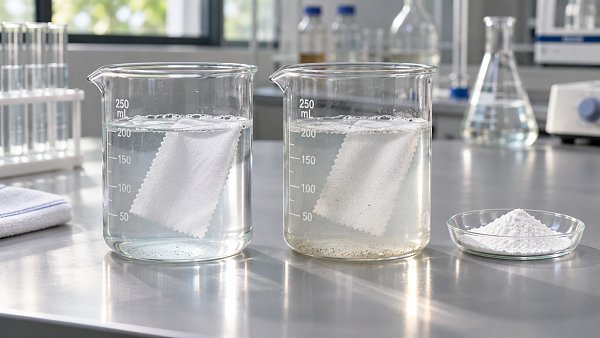
A visible film is not proof of builder failure. Undissolved powder, excess product, dried surfactant, inadequate rinsing, and soil carried over from an earlier wash can produce similar symptoms. Check whether the residue dissolves in water or responds to an appropriate mild acid under controlled conditions; mineral-rich deposits may respond differently from organic or formulation residues. Use material-compatible procedures and do not treat this observation as a complete chemical identification.
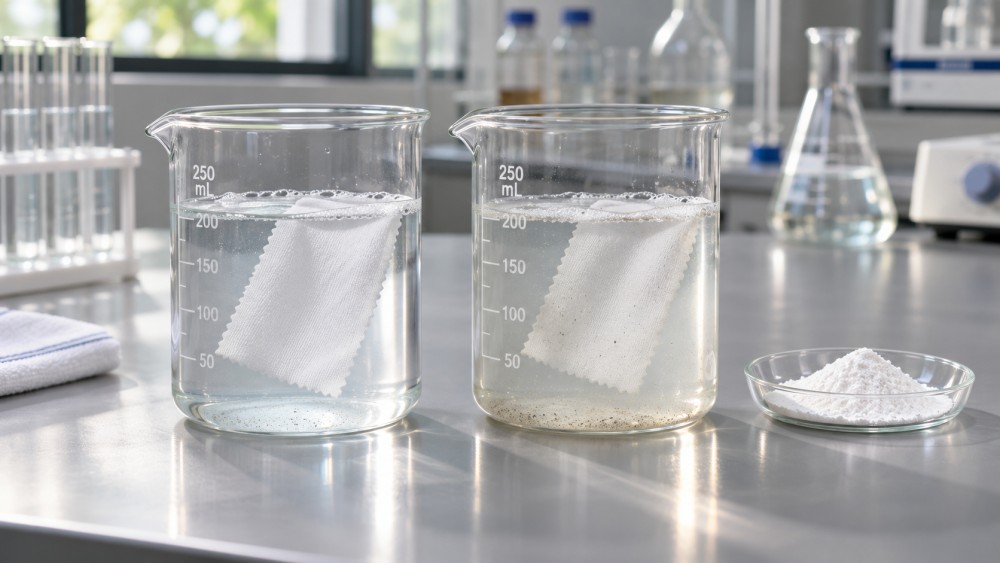
Four approaches to hardness control
Citrate: useful, but not unlimited
Sodium citrate is water-soluble and commonly considered where biodegradability and phosphate reduction are priorities. It can bind hardness ions and contribute to buffering, making it relevant to both liquid and powder systems. Its effective contribution depends on pH, citrate concentration, the calcium-to-magnesium ratio, and competing ingredients. A formula that performs adequately at moderate hardness may lose its margin as hardness or soil load rises.
In evaluation, watch for the point at which additional citrate no longer produces a proportionate improvement in cleaning or deposit control. That can indicate a need to adjust the broader builder system rather than simply add more of one ingredient. Confirm that changes remain compatible with product clarity, viscosity, stability, and the intended use dilution.
Zeolite: exchange rather than soluble sequestration
Detergent-grade zeolites are insoluble aluminosilicates that remove hardness ions through ion exchange. They are particularly relevant to powders, where suspended particles are acceptable and can be carried away in the wash and rinse. Their performance depends on grade, particle characteristics, contact time, agitation, and the ions present. Calcium exchange is often more effective than magnesium removal under practical wash conditions.
Zeolite is not a simple replacement for a soluble chelant in a clear liquid. Suspension stability and visible sediment are immediate formulation constraints. In powders, inspect dispensing and dissolution as well as cleaning: residue left in a drawer, on a textile, or on a surface may reflect poor wetting, short cycles, insufficient agitation, or overloading rather than inadequate ion-exchange capacity alone.
Biodegradable chelants: soluble control across a range of conditions
Materials such as GLDA and MGDA can bind calcium and magnesium in solution and are used where a soluble builder or co-builder is needed. Their usable capacity is affected by concentration, pH, formulation composition, and the relevant metal ions. A supplier’s nominal chelation value is a starting point, not a substitute for testing at the actual wash dilution.
Solubility can be valuable in concentrated liquids and low-residue applications, but it does not guarantee compatibility with every ingredient. Check stability with the selected surfactants, enzymes, fragrances, preservatives, and packaging. Chelants can also affect metal-containing formulation components; any required enzyme stability or corrosion protection should be verified in the finished product.
Carbonate and dispersants: control the precipitate, not just the hardness
Carbonate raises alkalinity and can reduce dissolved calcium by forming calcium carbonate. This may support cleaning in suitable powder and alkaline cleaning systems, but it transfers part of the problem from dissolved ions to solid particles. Without sufficient dispersion and rinse removal, those particles can settle on equipment, fabric, or the cleaned surface.
A dispersant does not necessarily remove hardness ions from solution in the same way as a chelant. Its role may instead include keeping particles or soil suspended and modifying deposit formation. Evaluate the carbonate and dispersant together, especially where the process involves heated surfaces, low rinse volumes, or repeated cycles. Higher alkalinity also creates material-compatibility and handling considerations that must be assessed for the application.
Build a comparison around the use conditions
Start with a defined reference formulation and change the builder system while keeping the other variables as constant as practical. Compare candidates on an equal basis that reflects the decision: equal product dose, equal builder mass, or equal cost-in-use may answer different questions. State which basis is used; equal percentages of chemically different builders do not imply equal hardness-control capacity.
- Characterize the water. Measure or obtain total hardness, calcium and magnesium where relevant, alkalinity, and pH. Test both representative operating water and a controlled water of known composition when feasible.
- Set the process window. Fix detergent concentration, temperature, contact time, agitation, soil load, and rinse conditions. Include the shortest or coolest cycle that the product is expected to support.
- Measure more than initial cleaning. Assess soil removal alongside visible film, particulate residue, redeposition, and rinse behavior. For repeated-use applications, examine accumulation over successive cycles.
- Check the formulation itself. Observe dissolution or dispersion at the point of use, as well as storage stability, phase separation, settling, and packaging compatibility before the test.
- Repeat around the failure point. Vary hardness or dose near the condition where performance begins to fall. This shows whether the formulation has a robust operating margin or works only under favorable conditions.
Use relevant, repeatable methods for the application and document their conditions. Standardized detergency, water-hardness, biodegradability, or ecotoxicity methods may be appropriate, but a method’s scope matters: a biodegradation result does not establish cleaning performance, and a laboratory detergency result does not by itself demonstrate low environmental impact. When comparing supplier data, check whether the same method, endpoints, and test conditions were used.
Interpreting a disappointing result
Cleaning falls as hardness rises, but little residue is visible. The system may lack effective hardness binding at the use dilution, or a hardness-sensitive surfactant may be losing effectiveness. Compare performance in softened and controlled hard water before increasing builder dosage. If the gap persists, examine surfactant selection and the balance between builder and surfactant rather than attributing the entire loss to one ingredient.
Cleaning is acceptable, but a white deposit appears. Investigate precipitation, insoluble builder carryover, and rinse conditions. A carbonate-rich system may need a different dispersant strategy or less opportunity for deposits to dry on the surface. With zeolite-containing powders, inspect powder delivery and particle removal. Identify the residue before replacing the builder: a formulation deposit and calcium carbonate scale call for different corrections.
The concentrate looks stable, but performance varies in use. Check dilution order and local concentration. Adding a concentrated product to hard water can produce temporary local conditions unlike those in the final diluted bath. Likewise, changes in process water, soil loading, or temperature can shift the result even when the product batch is unchanged. Reproduce the actual addition and mixing sequence in the evaluation.
Environmental claims need ingredient-specific evidence
“Eco friendly” is not a single technical property. Request the identity and relevant data for each builder and supporting polymer, including the applicable biodegradability test and conditions, aquatic hazard information, and any restrictions or classification relevant to the destination market. A biodegradable chelant can still have a dose-dependent environmental burden; an insoluble mineral builder should be assessed for its own production, transport, discharge, and sediment-related considerations rather than described as biodegradable.
The finished detergent matters too. A builder that requires a much higher use dose, a hotter wash, or additional rinsing may change the overall resource profile. Conversely, reduced phosphate content or improved biodegradability should not be presented as proof that the whole formulation is environmentally benign. Document the claim’s scope and avoid extending an ingredient result to the complete product without supporting evidence.
For a practical decision, select the lowest-complexity builder system that meets the required cleaning and residue limits across the stated water-hardness range. Keep the conditions attached to the result: a citrate blend suitable for a short, moderately hard-water cycle is not automatically interchangeable with a zeolite powder or a soluble chelant designed for a concentrated liquid. The defensible specification is the tested operating window, together with the formulation and test method used to establish it.
Facing technical bottlenecks in manufacturing or looking for more efficient industrial solutions? Leave your details below and let the engineering experts at FCAS solve them for you.
We respect your privacy. Your information is strictly confidential.
Related News
 Micelle Fluidics & ChelationHow Venturi Fertigation Systems Control Fertilizer InjectionDiscover how venturi fertigation systems control fertilizer injection, and learn how pressure, sizing, and calibration affect dosing accuracy.MORE+
 Micelle Fluidics & ChelationHow to Use Cocamidopropyl Betaine for Hand Soap FormulasDiscover how to use cocamidopropyl betaine for hand soap, balance surfactants, adjust pH and viscosity, and troubleshoot common formulation issues.MORE+
 Micelle Fluidics & ChelationHow to Evaluate an Industrial Dispersants ManufacturerEvaluate an industrial dispersants manufacturer with confidence. Learn how to assess formulation performance, batch consistency, quality controls and supply risk.MORE+
 Micelle Fluidics & ChelationHow Cationic Surfactants Affect Emulsion StabilityCationic Surfactants can improve emulsion stability—but formulation matters. Discover key risks, compatibility checks, and practical troubleshooting tips.MORE+
 Micelle Fluidics & ChelationHow Eco Friendly Detergent Builders Perform in Hard WaterExplore how eco friendly detergent builders tackle hard water, compare citrate, zeolite and chelants, and find the right approach for cleaner results.MORE+
 Micelle Fluidics & ChelationHow Does Cocamidopropyl Betaine Affect Foam and Skin Mildness?Discover how Cocamidopropyl Betaine can enhance foam and support skin mildness. Explore formulation tips, impurity controls, and testing strategies for better cleansers.MORE+
 Micelle Fluidics & ChelationWhich Detergent Builders for Hard Water Prevent Mineral Buildup?Compare detergent builders for hard water, including MGDA, GLDA, citrate and zeolites. Discover how to prevent mineral buildup, reduce residue and choose the right formulation.MORE+
 Micelle Fluidics & ChelationHow Anionic Industrial Dispersants Improve Coating StabilityAnionic industrial dispersants improve coating stability, pigment wetting, viscosity control, gloss, and storage performance. Learn how to select and test the right solution.MORE+
 Micelle Fluidics & ChelationWhat Are Cationic Surfactants and Where Are They Commonly Used?Cationic Surfactants deliver powerful surface affinity for disinfection, fabric softening, hair conditioning, antistatic control, and industrial treatments. Explore key uses and selection factors.MORE+
 Micelle Fluidics & ChelationHow Cationic Surfactants Improve Formulation Performance and StabilityCationic Surfactants improve deposition, conditioning, anti-static control, and formulation stability. Explore compatibility, dispersion, and selection insights for better-performing products.MORE+
 Micelle Fluidics & ChelationIndustrial Dispersants for Pigments and Fillers: How to Improve Stability and FlowIndustrial Dispersants help improve pigment and filler stability, boost flow, and reduce defects in production. Discover how the right choice can cut rework and improve results.MORE+