How to Choose a Detergent Builders Manufacturer
The right detergent builders manufacturer is one that can supply a material suited to your formulation at a consistent delivered cost, with dependable quality and documentation. The lowest price per tonne is only a starting point: a cheaper builder can become more expensive if it requires a higher dosage, creates processing problems, or increases storage and freight costs.
Start by defining what the builder must do in the finished detergent and how it will be used. Then compare suppliers on the same technical and commercial basis, test representative samples, and agree on the specifications and supply terms before placing a regular order.
Start with the detergent, not the supplier’s product list
Builders support cleaning by managing water hardness and helping keep removed soil from settling back onto surfaces. Different materials achieve these effects in different ways. Some bind hardness ions in solution; others exchange ions, provide alkalinity, or support dispersion. A formulation may use a combination rather than relying on one ingredient.
Before requesting quotations, give potential suppliers enough context to recommend a suitable grade:
- Product format: Is the detergent a powder, liquid, tablet, or industrial cleaning blend? Solubility, particle properties, and handling requirements vary by format.
- Use conditions: Consider expected water hardness, wash temperature, contact time, and soil type. A formula designed for short, cool wash cycles may place different demands on the builder system than a longer industrial wash.
- Equipment and surfaces: Identify any limits on foam, deposits, alkalinity, corrosion, or residue. A builder that suits laundry powder may be unsuitable for a cleaner used on sensitive metals.
- Manufacturing process: Tell suppliers whether the ingredient will be dry blended, dissolved, incorporated into a slurry, or processed in another way.
- Commercial constraints: Set out the intended market, target cost, expected order volume, packaging needs, and applicable customer or regulatory restrictions.
If the formulation is still under development, describe the problem you need to solve rather than requesting a named ingredient alone. For example, poor cleaning in hard water may call for a different response from powder caking or residue after rinsing. The supplier’s ability to ask useful questions is itself a sign of relevant technical support.
Compare builder options in the context of the formula
There is no universal best detergent builder. The right choice depends on the balance between hardness control, cleaning performance, physical stability, processing, and market requirements.
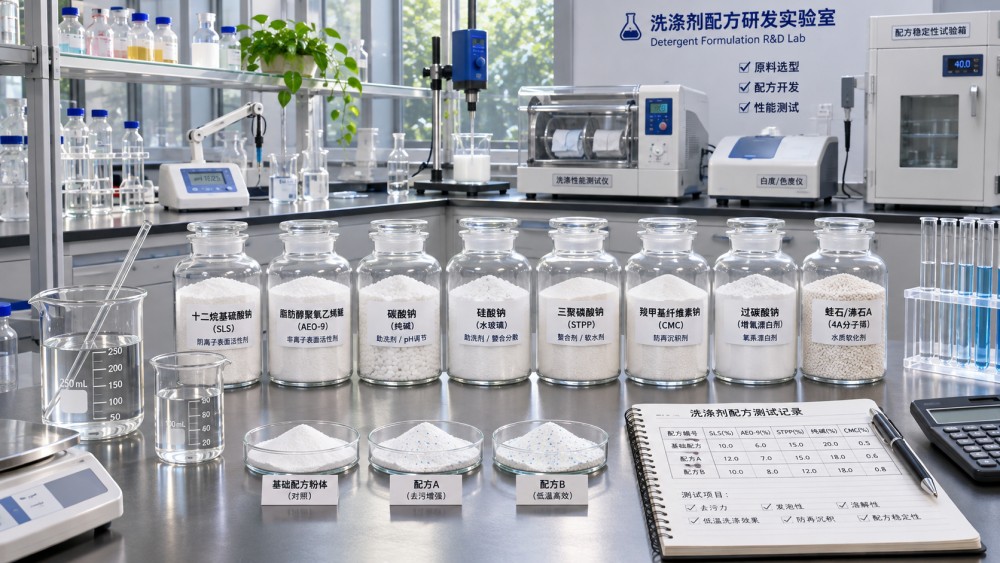
Names alone do not establish equivalence. Two grades described as the same builder may differ in particle size, moisture, bulk density, solubility, or impurity profile. Those differences can change how a powder flows, how quickly a liquid batch is prepared, or how reliably a product performs over storage.
When changing builder chemistry, allow for reformulation. A lower-cost substitute may need additional dispersant, altered alkalinity, or a different processing sequence. Ask the supplier which changes are likely to affect the application, then evaluate them in your own formula.
Check specifications that affect production and performance
A technical data sheet is a useful starting point, but purchasing specifications should reflect the properties your production team actually depends on. For a dry builder, these may include appearance, particle size distribution, moisture, active content where relevant, and bulk density. For a liquid grade, concentration, viscosity, pH, and storage behavior may be more useful.
Distinguish between a typical value and a contractual limit. A typical value describes what a supplier normally reports; it does not necessarily define what every delivered batch must meet. Agree on the test method, sampling approach, acceptable range, and response to an out-of-specification delivery for each critical property.
Impurities deserve a discussion tied to the application. A colored or odorous trace component may be commercially unacceptable in a clear, lightly fragranced liquid even if it causes no obvious issue in an industrial powder. Insoluble matter may matter more where the finished product must dissolve cleanly or pass through dispensing equipment.
Ask for a representative certificate of analysis and compare it with the proposed specification. A certificate is most useful when its reported items correspond to the agreed limits and the methods are understood by both parties. It should also allow a delivered lot to be identified and traced.
Calculate the cost of a working formulation
To compare quotations fairly, bring them to the same delivery point, packaging basis, and payment terms. Then calculate the builder cost per unit of finished detergent using the intended dosage. If the options require different supporting ingredients, include those costs as well.
A useful comparison includes:
- The purchase price at the expected order volume, including any relevant currency and payment terms.
- Freight, insurance where applicable, duties, handling, and the cost of receiving the specified packaging.
- Dosage in the finished formula and the cost of any additional dispersant, alkalinity adjustment, or other ingredient needed to reach the same target performance.
- Process costs associated with dissolution time, dust control, yield losses, cleaning, or changes to equipment settings.
- Inventory and quality costs, including storage needs, shelf-life constraints, and the commercial impact of rejected or delayed batches.
For example, a builder with a higher unit price may still offer a lower formula cost if less is needed to meet the same cleaning target. The reverse can also happen: a low-priced powder may appear attractive until its bulk density increases freight and warehouse requirements. Use trial results and actual quotation terms for the calculation rather than assuming that materials with the same name are interchangeable at the same dosage.
Be careful with quotations that do not specify the grade, concentration, delivery terms, or packaging. A low number is difficult to compare if one offer covers material at the factory gate and another includes delivery, or if the active content differs.
Establish who makes the material and how supply is managed
A supplier may manufacture the builder, blend purchased ingredients, repackage material, or distribute another company’s product. Each model can work, but it changes the questions to ask. A distributor may provide valuable local inventory and support, while the original producer controls the underlying manufacturing process. Request clarity about the manufacturing site, product origin, and who is responsible for quality investigations.
For a critical ingredient, discuss normal lead time, minimum order quantity, available packaging, production capacity relevant to your expected demand, and how the supplier manages interruptions. Ask whether material is routinely stocked or made to order. If it is sourced from more than one site, establish whether site changes require your approval and whether the same specification and test methods apply.
Traceability and change notification are equally practical concerns. A change in raw material source, process, production site, or packaging can affect a sensitive formula even when the product name remains unchanged. Agree on which changes must be communicated in advance, what supporting data will be supplied, and whether a new sample or trial is required.
For businesses that cannot tolerate a long interruption, qualifying an alternative source may be worthwhile. Qualification should cover both the material and the supply route: an alternative that performs well in a laboratory but cannot deliver in the required packaging or timeframe may not provide useful coverage.
Use trials to distinguish a promising sample from a dependable supply
Begin with a sample that represents the proposed commercial grade. Record its lot identification and compare its certificate with the specification. A sample that has been specially prepared or selected may not reflect what will arrive in routine shipments.
Test the material in the intended formulation, not only in isolation. Depending on the product, useful checks can include dissolution or dispersion during manufacture, powder flow, appearance, storage stability, cleaning performance under relevant water conditions, and residue after rinsing. Compare the candidate with the current material or another defined reference using the same procedure.
Move to a production-scale trial when laboratory results are acceptable. Mixing time, addition order, dust, heat, and equipment behavior can reveal issues that a small sample does not show. Where batch consistency is commercially significant, review material from more than one production lot when practical.
Keep a written approval record covering the grade, manufacturing source, specification, test results, and conditions of use. This creates a clear reference if a later delivery behaves differently or the supplier proposes a change.
Agree on documentation and commercial responsibilities
Before issuing a purchase order, request the documents needed to receive, store, transport, and use the material. These commonly include a technical data sheet, safety data sheet, and certificate of analysis. Depending on the destination and customer requirements, additional information about composition, regulatory status, or restricted substances may be needed.
Match each document to its purpose. A safety data sheet supports hazard communication and handling; it does not replace a purchase specification. A supplier statement can address a customer’s material requirement only if its scope covers the relevant grade and the claim being requested.
The commercial agreement should also make responsibilities clear: delivery terms, packaging, shelf life or retest arrangements where relevant, acceptance testing, complaint deadlines, and the process for handling nonconforming material. For moisture-sensitive powders, agree on packaging and storage conditions that protect the product through the expected transport and inventory period.
Once shortlisted suppliers meet the formulation and documentation requirements, compare their total cost and supply commitments on the same basis. Select the source that can consistently meet the agreed specification and delivery plan, and keep the approved grade and change-control requirements tied to future orders.
Facing technical bottlenecks in manufacturing or looking for more efficient industrial solutions? Leave your details below and let the engineering experts at FCAS solve them for you.
We respect your privacy. Your information is strictly confidential.
Related News
 Micelle Fluidics & ChelationHow High Performance Industrial Dispersants Prevent SettlingHigh performance industrial dispersants can limit settling and improve redispersibility. Discover how to select and test the right chemistry for your formulation.MORE+
 Micelle Fluidics & ChelationHow to Choose a Detergent Builders ManufacturerChoose a detergent builders manufacturer with confidence. Compare quality, formulation fit, total costs, and supply reliability before you buy.MORE+
 Micelle Fluidics & ChelationHow Venturi Fertigation Systems Control Fertilizer InjectionDiscover how venturi fertigation systems control fertilizer injection, and learn how pressure, sizing, and calibration affect dosing accuracy.MORE+
 Micelle Fluidics & ChelationHow to Use Cocamidopropyl Betaine for Hand Soap FormulasDiscover how to use cocamidopropyl betaine for hand soap, balance surfactants, adjust pH and viscosity, and troubleshoot common formulation issues.MORE+
 Micelle Fluidics & ChelationHow to Evaluate an Industrial Dispersants ManufacturerEvaluate an industrial dispersants manufacturer with confidence. Learn how to assess formulation performance, batch consistency, quality controls and supply risk.MORE+
 Micelle Fluidics & ChelationHow Cationic Surfactants Affect Emulsion StabilityCationic Surfactants can improve emulsion stability—but formulation matters. Discover key risks, compatibility checks, and practical troubleshooting tips.MORE+
 Micelle Fluidics & ChelationHow Eco Friendly Detergent Builders Perform in Hard WaterExplore how eco friendly detergent builders tackle hard water, compare citrate, zeolite and chelants, and find the right approach for cleaner results.MORE+
 Micelle Fluidics & ChelationHow Does Cocamidopropyl Betaine Affect Foam and Skin Mildness?Discover how Cocamidopropyl Betaine can enhance foam and support skin mildness. Explore formulation tips, impurity controls, and testing strategies for better cleansers.MORE+
 Micelle Fluidics & ChelationWhich Detergent Builders for Hard Water Prevent Mineral Buildup?Compare detergent builders for hard water, including MGDA, GLDA, citrate and zeolites. Discover how to prevent mineral buildup, reduce residue and choose the right formulation.MORE+
 Micelle Fluidics & ChelationHow Anionic Industrial Dispersants Improve Coating StabilityAnionic industrial dispersants improve coating stability, pigment wetting, viscosity control, gloss, and storage performance. Learn how to select and test the right solution.MORE+
 Micelle Fluidics & ChelationWhat Are Cationic Surfactants and Where Are They Commonly Used?Cationic Surfactants deliver powerful surface affinity for disinfection, fabric softening, hair conditioning, antistatic control, and industrial treatments. Explore key uses and selection factors.MORE+
 Micelle Fluidics & ChelationHow Cationic Surfactants Improve Formulation Performance and StabilityCationic Surfactants improve deposition, conditioning, anti-static control, and formulation stability. Explore compatibility, dispersion, and selection insights for better-performing products.MORE+
 Micelle Fluidics & ChelationIndustrial Dispersants for Pigments and Fillers: How to Improve Stability and FlowIndustrial Dispersants help improve pigment and filler stability, boost flow, and reduce defects in production. Discover how the right choice can cut rework and improve results.MORE+