What Food Safety Documents Should an Ethyl Maltol Manufacturer Provide?
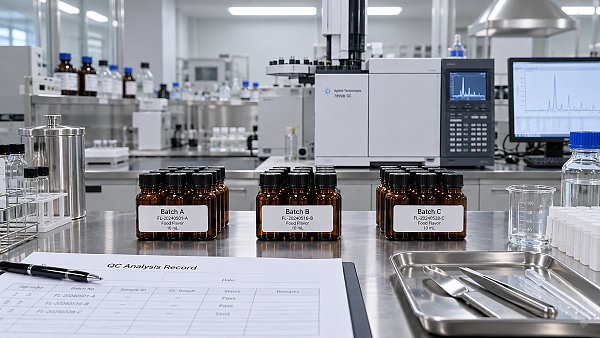
An ethyl maltol manufacturer should provide a batch-specific certificate of analysis, a controlled product specification, a current safety data sheet, and a food-use compliance statement covering the intended market. Supplier approval also needs evidence of manufacturing controls, traceability, contaminant management, and suitable packaging. These documents answer different questions: whether the delivered batch meets requirements, whether the ingredient is suitable for the proposed food use, and whether the supplier can maintain consistent control.
A purity claim alone cannot answer all three. Before approving material, connect the documents to the actual manufacturing site, product grade, delivered lot, and intended application.
Which documents belong in the approval package?
Separate documents needed for each delivery from records used to qualify the supplier. This prevents a common purchasing mistake: accepting a facility certificate as evidence that a particular batch meets the agreed specification.
The exact package depends on the application and supply chain. Single-substance ethyl maltol, a carrier-based preparation, and material repacked by a distributor can require different supporting information. Establish which product is being purchased before comparing certificates.
Read the certificate of analysis beyond the purity result
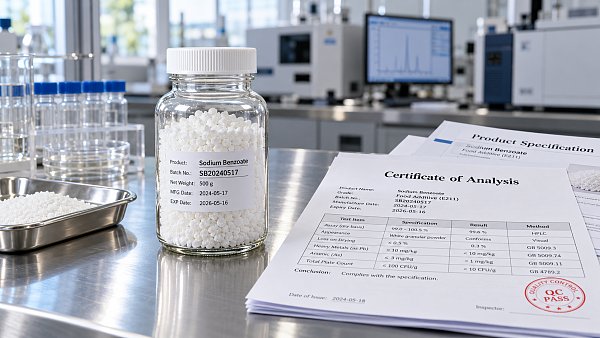
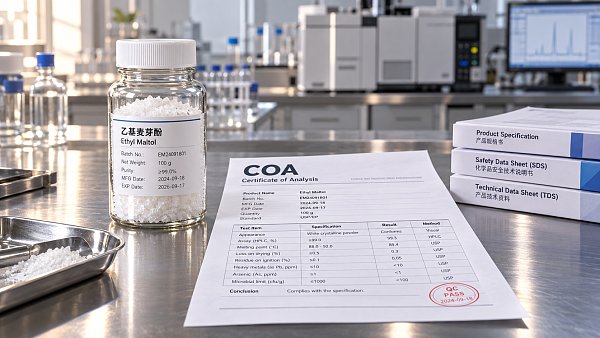
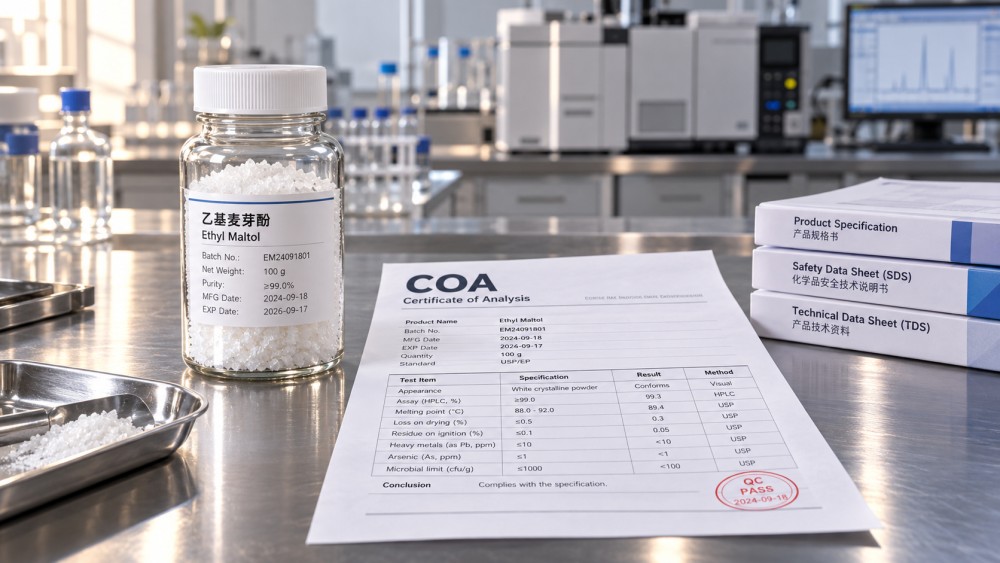
The COA should identify the manufacturer or responsible issuing organization, product name, grade, and batch number. Relevant manufacturing, testing, retest, or expiry dates should be clearly distinguished. The lot reference must match the containers and delivery records.
Look for analytical results alongside acceptance limits and test methods. Numerical results are generally more useful than a blanket “passes” statement for measured characteristics such as assay or moisture. Qualitative identity tests may appropriately report a conforming result, provided the method and acceptance criterion are clear.
Assay deserves particular attention because the reporting basis affects interpretation. A value reported on a dry basis cannot automatically be compared with a requirement expressed on an as-received basis. Similarly, chromatographic area percentage may not mean the same thing as mass-based purity. The specification should explain how the result is determined.
Ethyl maltol and maltol are distinct substances. Identity documentation should distinguish them, and purchasing records should consistently identify ethyl maltol. Appearance or odor alone provides insufficient identity evidence.
A COA also needs an understandable testing scope. Some characteristics may be tested on every batch, while others are monitored periodically under a documented program. If a reported value comes from periodic testing or another quality assurance basis, that distinction should be transparent. It affects how much evidence the certificate provides for the delivered lot.
The specification should define what “food grade” means
“Food grade” needs supporting acceptance criteria. Request a controlled specification with an issue date or revision number, product identity, relevant physical characteristics, assay requirements, impurity controls, and referenced methods. The specification establishes the purchasing standard; the COA records the supplier’s assessment of a batch against that standard.
When a supplier claims compliance with a food ingredient compendium or recognized specification, the document should identify the reference and edition clearly. Meeting selected tests does not establish full conformity with an entire monograph. A useful compliance statement explains the scope of the claim.
A chemical specification does not automatically demonstrate suitability for every destination market or application. Regulatory status, permitted food uses, and conditions of use must also be addressed.
Application requirements can justify additional purchasing criteria. For example, dissolution behavior or particle characteristics may matter when ethyl maltol is incorporated into a concentrated flavor system or dry blend. Keep these performance requirements identifiable within the specification so that a processing problem is assessed against the right acceptance criterion.
Ask for a market-specific food-use statement
A useful regulatory declaration identifies the supplied substance, its intended function, the destination market, and the basis on which the supplier considers it suitable for food use. Statements such as “internationally approved” provide too little detail for an approval decision.
Ethyl maltol is used as a flavoring substance, but its acceptability must be considered within the applicable market framework and intended use conditions. A supplier’s statement should address the product actually supplied, including carriers or other ingredients where present. Documentation for pure ethyl maltol does not fully describe a formulated preparation.
For a U.S. supply, clarify the regulatory basis claimed for the intended food use. For an EU supply, obtain a statement addressing the applicable flavoring framework and relevant identity or purity requirements. Other destinations may require different declarations or import records. A declaration covering one market should not be treated as a worldwide authorization.
Be cautious with “FDA certified” wording. An establishment registration, an inspection record, and a legal basis for using an ingredient represent different things. Ask the supplier to identify the document and explain exactly what it covers.
Contaminant evidence should follow the manufacturing risk
A high assay result does not exclude every safety-relevant contaminant. Request a documented approach to impurities associated with raw materials, synthesis, purification, equipment, storage, and transport. The manufacturer should be able to explain which hazards are relevant and how they are controlled without disclosing its full proprietary process.
Depending on that assessment, supporting evidence may include controls for elemental contaminants, residual solvents, process-related organic impurities, and microbiological contamination. Testing should use methods capable of assessing the applicable limits. A “not detected” result is meaningful only when the reporting limit is sufficiently low for the acceptance criterion.
Testing frequency should reflect risk and demonstrated process control. Some parameters may require batch testing; others may be supported by periodic verification, raw material controls, and validated processing. Request the rationale and testing schedule, especially when the COA does not show a result for a relevant hazard.
Microbiological requirements also need context. A purified crystalline ingredient and a preparation containing additional materials may have different contamination risks. Consider packaging, moisture exposure, handling, and the receiving process. Avoid copying the same microbiological panel across unrelated ingredients without assessing its relevance.
Independent laboratory testing can help resolve a concern or establish initial confidence. It remains one source of evidence alongside supplier controls, particularly where occasional sampling could miss an intermittent problem.
What food safety certificates actually demonstrate
A food safety management certificate can support supplier qualification by showing that a defined site and scope have been assessed against a particular scheme. Examples include ISO 22000, FSSC 22000, and BRCGS certification, where relevant to the operation. These are not universally mandatory certificates for selling ethyl maltol.
Read the scope carefully. It should cover the relevant manufacturing or handling activity at the site supplying the material. A certificate covering distribution, storage, or a different factory provides different assurance from one covering production. Check validity and the certificate’s status through the issuing body or scheme directory.
Where certification is absent or its scope is limited, supplier assessment may require a more detailed questionnaire, audit, or review of operating controls. Useful evidence includes hazard analysis, sanitation procedures, foreign-material prevention, maintenance, calibration, and corrective action records. Access can be arranged through summaries or confidential review where necessary.
Allergen declarations should explain their basis. Request information about intentional ingredients, processing aids, shared equipment, and cross-contact controls. A chemically defined ingredient’s identity alone does not describe every risk introduced by its manufacturing environment.
Halal, kosher, non-GMO, and similar declarations may also be needed for purchasing or labeling requirements. Their value depends on the product and site covered; they do not replace batch quality evidence or food safety controls.
The SDS, packaging records, and shelf-life statement have separate roles
The SDS supports safe unloading, storage, handling, spill response, and disposal. It should match the supplied product and contain clear supplier contact details. Information about dust exposure, protective equipment, and incompatible materials helps establish handling procedures.
An SDS does not establish food-use authorization or batch conformity. Likewise, a favorable hazard classification does not demonstrate that an ingredient meets food purity requirements. Review the SDS alongside the specification and compliance statement.
For packaging, request identification of the immediate-contact material and evidence of suitability for the intended food-contact conditions. Packaging cleanliness, closure integrity, moisture protection, and tamper evidence can affect the condition of material received. Where repacking occurs, include the repacker’s controls in the assessment.
Shelf-life documentation should state the storage conditions and whether the assigned date is an expiry date or a retest date. Ask how the period is supported and how opened containers should be managed. A retest date calls for a defined reassessment process; it does not automatically extend usability.
Trace the paperwork from the manufacturing site to the delivered container
Every important record should connect to the material being approved. Review the manufacturer name, site address, product code, grade, lot number, and specification version across the package. Differences may have legitimate explanations, but they need documented reconciliation before release.
When buying through a distributor, obtain the original manufacturer’s COA or a controlled certificate that preserves traceability to it. If the distributor splits, blends, or repacks lots, request records connecting the new lot references to the original batches and describing the additional handling.
Traceability should also support withdrawal and recall. Relevant evidence includes lot reconciliation procedures, retained records, recall contacts, and results from traceability exercises. A supplier’s ability to provide a certificate is less useful if it cannot connect that certificate to a shipment.
A written change-notification arrangement helps keep approval current. It should address changes that could affect the agreed product, including manufacturing site, significant process or raw material changes, specification revisions, test methods, and primary packaging. Define which changes require review before subsequent deliveries.
Make release decisions against an agreed evidence standard
Before ordering, define the destination market, intended use, product grade, and acceptance criteria. Build the document request around those requirements. This gives the supplier a clear target and makes competing offers easier to compare.
During qualification, review the specification, regulatory statement, manufacturing controls, and supporting declarations together. At receipt, match the batch COA and container labels to the approved product, check packaging condition, and complete the incoming checks required by the site’s risk assessment.
Hold a delivery when its lot cannot be traced, a relevant result fails specification, or the supplied grade differs from the approved material. Resolve the discrepancy through documented investigation and an authorized disposition. The release decision should rest on evidence that connects the ingredient’s identity, permitted use, batch quality, and supply chain controls.
Facing technical bottlenecks in manufacturing or looking for more efficient industrial solutions? Leave your details below and let the engineering experts at FCAS solve them for you.
We respect your privacy. Your information is strictly confidential.
Related News
 EPA FIFRA & FDA GRAS RegsEPA Cancels Pesticide Registrations Over Unpaid Maintenance FeesEPA pesticide registration cancellations over unpaid maintenance fees may affect procurement. Learn what buyers and suppliers should verify before the stated effective date.MORE+
 EPA FIFRA & FDA GRAS RegsEPA Issues Cancellation Order Affecting Certain Pesticide RegistrationsEPA pesticide registration cancellations may affect select products and supply chains. Learn what businesses should verify before making purchasing decisions.MORE+
 EPA FIFRA & FDA GRAS RegsEPA Reviews Glyphosate Safety, With Decision Expected in Early 2027EPA glyphosate safety review: Discover what the decision expected in early 2027 could mean for health, the environment, and businesses.MORE+
 EPA FIFRA & FDA GRAS RegsEPA Seeks Comment on Voluntary Pesticide Registration CancellationsEPA pesticide registration cancellations are open for public comment. Discover what the proposed changes could mean for product uses, compliance and supply.MORE+
 EPA FIFRA & FDA GRAS RegsEPA Lists Six Voluntary Paraquat Registration Cancellations for CommentEPA lists six voluntary paraquat registration cancellation requests for comment. Explore the potential supply impact and key deadline for buyers and suppliers.MORE+
 EPA FIFRA & FDA GRAS RegsEPA Settles with Colgate-Palmolive Over Chemical Import ReportingEPA's Colgate-Palmolive settlement highlights chemical import reporting obligations. Explore the CDR compliance lessons for importers and supply-chain teams.MORE+
 EPA FIFRA & FDA GRAS RegsEPA Exempts DMSO in Pesticide Formulations From Residue Tolerance RequirementsEPA exempts DMSO from pesticide residue tolerance requirements for specified uses. Explore the rule’s scope and what it means for formulators.MORE+
 EPA FIFRA & FDA GRAS RegsHow Do FDA Rules Affect Synthetic Food Preservatives for Beverages?Synthetic food preservatives for beverages face specific FDA requirements. Explore permitted uses, dosage, labeling, and safety validation to make smarter compliance decisions.MORE+
 EPA FIFRA & FDA GRAS RegsWhat FDA Compliance Records Should a Synthetic Food Preservatives Supplier Provide?Choosing a synthetic food preservatives supplier? Discover key FDA compliance records, batch certificates, and traceability checks to approve suppliers with confidence.MORE+
 EPA FIFRA & FDA GRAS RegsU.S. Health Aide’s Exit Raises Deregulation Hopes for Korean Food ExportersKorean food exporters eye U.S. deregulation after a health aide’s exit. Explore what uncertain ultra-processed food rules and additive policies mean for export planning.MORE+
 EPA FIFRA & FDA GRAS RegsTrump Administration Grants 202 Facilities Waivers From EPA Air Pollution RulesTrump administration EPA air pollution waivers cover 202 facilities. Explore what the Clean Air Act exemptions mean for industrial emissions and potential public health risks.MORE+
 EPA FIFRA & FDA GRAS RegsHow to Evaluate an Aroma Ingredients Manufacturer for Food UseEvaluate an aroma ingredients manufacturer for food use with practical checks on compliance, impurity controls, traceability, and batch consistency. Make confident sourcing decisions.MORE+
 EPA FIFRA & FDA GRAS RegsWhat Food Safety Documents Should an Ethyl Maltol Manufacturer Provide?Choosing an ethyl maltol manufacturer? Discover the COA, food-use compliance statements, and traceability records to request for safer sourcing and confident supplier approval.MORE+
 EPA FIFRA & FDA GRAS RegsSynthetic Food Preservatives Rules That Support Safer FormulasSynthetic Food Preservatives: learn the rules for safer formulas, compliant use levels, validated shelf life, labeling, and reliable microbial control.MORE+
 EPA FIFRA & FDA GRAS RegsButylparaben for Wet Wipes and Key Safety Compliance ConsiderationsButylparaben for wet wipes: explore regulatory compliance, preservative efficacy, skin safety, packaging risks, and supplier controls for confident product development.MORE+
 EPA FIFRA & FDA GRAS RegsWhat to Check When Using Synthetic Food Preservatives SafelySynthetic Food Preservatives: learn the essential checks for safe, compliant use—from dosage and pH to supplier control, labeling, and shelf-life validation.MORE+
 EPA FIFRA & FDA GRAS RegsWhat Certifications Do Flavor Bases Need for Food Export?What certifications do flavor bases need for food export? Explore food safety standards, market compliance, allergen documents, and export-ready paperwork.MORE+
 EPA FIFRA & FDA GRAS RegsHow Food Grade CO2 Extracts Meet Safety and Labeling RequirementsFood grade CO2 extracts: learn how source control, targeted testing, traceability, and accurate labeling support food safety compliance and confident product launches.MORE+
 EPA FIFRA & FDA GRAS RegsHow High Intensity Sweeteners for Tabletop Use Meet Labeling StandardsHigh intensity sweeteners for tabletop use: discover how accurate labeling, serving claims, ingredient lists, nutrition data, and regional rules support compliant market entry.MORE+
 EPA FIFRA & FDA GRAS RegsWhat to Check Before Choosing a Sucralose Supplier for Food ProductionChoose a reliable sucralose supplier with confidence. Explore essential checks for quality, compliance, batch consistency, traceability, packaging, and supply reliability.MORE+