
How to Choose a Natural Sweeteners Supplier for Clean-Label Products
How to Choose a Natural Sweeteners Supplier for Clean-Label Products
Choosing a natural sweeteners supplier is no longer a straightforward exercise in comparing price per kilogram. For a clean-label beverage, dairy product, bakery item, nutrition bar, or sauce, the sweetener affects far more than sweetness. It can change the product’s taste curve, viscosity, colour, heat stability, declared ingredient list, processing behaviour, shelf life, and ultimately whether the finished formula still delivers the claim the brand intends to make.
Procurement teams are often brought into the discussion after product development has already identified a preferred ingredient. That is understandable, but it can be expensive. A sweetener that performs well in a lab prototype may have an inconsistent crop-derived supply, a long lead time, weak traceability, or documentation that does not satisfy the destination market. The better approach is to evaluate the supplier and the ingredient as one sourcing decision.
For clean-label projects, the question is rarely “Which sweetener is natural?” More often, it is: can this supplier provide a clearly understood ingredient that works in this specific formulation, can be legally and credibly labelled in the target market, and will remain available at the required quality when production scales?
Start With the Product Claim, Not the Supplier List
“Natural” and “clean label” are commercial terms with different practical meanings across markets, product categories, and brand policies. A procurement brief that says “source a natural sweetener” is too broad to support a reliable comparison. Before approaching suppliers, align internally on what the finished label must communicate and what it must avoid.
For example, a fruit beverage seeking “no added sugar” may need a high-intensity sweetening system rather than a bulk sugar replacement. A reduced-sugar biscuit needs ingredients that contribute bulk, browning, moisture retention, and texture; sweetness alone does not solve the formulation problem. A plant-based yogurt may be especially sensitive to aftertaste and acid stability. These are fundamentally different procurement projects, even if all three begin with the same request for a natural sweetener.
The sourcing specification should therefore include the intended application, target sweetness profile, calorie or sugar-reduction objective, label language, major processing conditions, expected annual volume, destination countries, and any excluded processing aids or carriers. This gives suppliers enough context to offer an appropriate grade instead of simply sending the most familiar product in their catalogue.
It is also worth separating consumer-facing language from technical definitions. A botanical source alone does not answer questions about extraction, purification, standardisation, carrier content, or flavour masking requirements. Those details may be perfectly acceptable, but they need to be known before a brand commits to a clean-label position.
Evaluate the Ingredient in Its Real Formulation Environment
Natural sweeteners are not interchangeable. Stevia leaf extracts, monk fruit extracts, honey, date-based ingredients, coconut sugar, maple-derived ingredients, fruit concentrates, and polyol-based systems can all appear in clean-label conversations, but they solve different problems. Their sourcing routes, sensory characteristics, physical formats, and regulatory treatment may differ substantially.
A supplier’s technical data sheet is a necessary starting point, not a performance guarantee. Buyers should ask what the stated specification means in practice: the range of sweetness intensity, moisture level, solubility, particle size where relevant, colour variation, flavour profile, and carrier composition. For extracts, the standardised active sweetening compounds should be clearly described. For syrups and concentrates, solids content and microbial controls may be as important as sweetness.
The most common sourcing mistake is to approve a sample based on a simple water test, then discover issues in the actual product matrix. High-intensity sweeteners can show bitterness, liquorice-like notes, delayed sweetness, or a dry finish depending on the formulation. Bulk sweeteners can affect water activity, spread in baked products, freeze-thaw behaviour, and processing viscosity. A sweetener system that works in a still beverage may not behave the same way in carbonated drinks, protein shakes, confectionery, or fermented dairy.
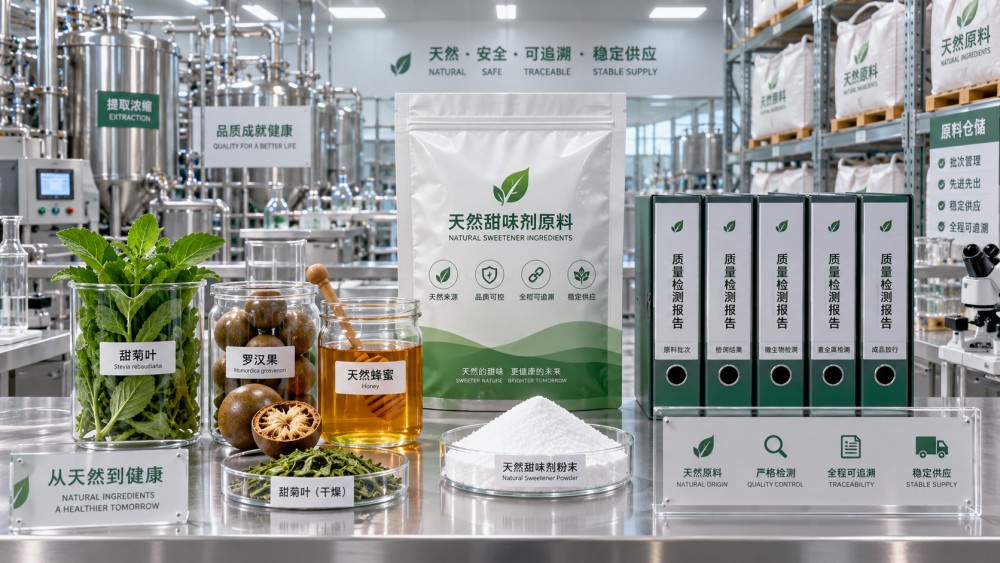
Ask shortlisted suppliers to support trials under realistic conditions: target pH, heating profile, shear, storage time, packaging format, and flavour system. This is where technically capable suppliers separate themselves from traders who can only provide a certificate and a price. A supplier does not need to formulate the entire product for you, but it should be able to explain likely compatibility issues and recommend what needs to be tested.
Questions that reveal technical depth
- What is the ingredient’s botanical or raw-material origin, and how is it processed or standardised?
- Which application categories has the supplier tested, and under what general processing conditions?
- Are carriers, solvents, anti-caking agents, or processing aids present in the supplied grade?
- How does the supplier manage sensory variation between batches?
- Can it provide guidance on blending, flavour masking, dispersion, or dosage trials without making unsupported performance claims?
Traceability Matters More When the Ingredient Story Is Part of the Label
Clean-label purchasing often turns ingredient origin into a marketing promise. That makes traceability a commercial issue as well as a quality issue. If a supplier describes an ingredient as plant-derived, fruit-based, or sustainably sourced, procurement should understand what evidence sits behind that description and how consistently it can be maintained.
For agricultural raw materials, source regions may shift with harvest quality, weather conditions, crop disease pressure, local processing capacity, or freight availability. A change in origin is not automatically a problem. The problem is discovering it after the new batch has already changed colour, taste, or documentation. Ask whether the supplier uses approved source lists, incoming material controls, lot-level traceability, and a formal notification process for significant changes.
A practical supplier review should distinguish between a manufacturer, a processor, an authorised distributor, and a broker. Each can have a place in the supply chain, especially when local warehousing or smaller order quantities are needed. But the visibility they offer is different. Where a distributor is involved, buyers should clarify who controls the original specification, who issues the certificate of analysis, who manages deviations, and whether direct technical contact with the producer is possible when a formulation issue arises.
This type of supply-chain mapping is familiar in fine chemical and food ingredient sourcing. The same discipline used to assess purity, batch consistency, packaging integrity, and transport conditions in specialty chemical purchasing is increasingly relevant for natural sweeteners. “Natural” does not mean supply risk is lower; in some cases, it means the supply base requires closer monitoring.
Documentation Should Be Reviewed Before Commercial Negotiation Gets Serious
Documentation gaps are one of the most avoidable reasons for delayed ingredient approval. Procurement should not assume that a supplier serving one market has the documents needed for another. Food regulations, additive permissions, compositional expectations, allergen declarations, labelling rules, and contaminant requirements are market-specific and product-specific.
The appropriate document package depends on the project, but it commonly includes a current specification, certificate of analysis format, safety information where applicable, allergen statement, GMO statement where relevant, microbiological information, contaminant or residue information when required, origin statement, shelf-life and storage guidance, and confirmation of food-grade manufacturing controls. Claims such as organic, non-GMO, kosher, halal, or other certification-based positions should be verified against valid project documentation rather than accepted from a sales presentation.
There is an important distinction between a supplier holding a certification and the specific ingredient being eligible for a particular claim in a target market. Regulatory teams should make that determination. Procurement’s job is to identify the question early, obtain the right evidence, and avoid locking in a supplier before the technical and regulatory review is complete.
A useful rule of thumb: if a supplier cannot explain the revision date, issuing party, and scope of its core documents, its lower price should be treated with caution. Documentation readiness is part of delivered value, not administrative overhead.
Compare Supply Reliability Beyond the Quoted Lead Time
Lead time on a quotation is only one piece of supply reliability. The more meaningful questions are whether the supplier holds buffer stock, how often it produces the relevant grade, whether the raw material has seasonal exposure, how batch release is managed, and what happens if a shipment is delayed or a lot fails internal quality checks.
This is especially relevant for companies moving from pilot quantities to regular production. A supplier may be very responsive with sample packs and small orders but have limited ability to support scheduled container quantities, regional warehousing, or consistent packaging formats. Conversely, a large producer may have strong capacity but be unwilling to accommodate a modest launch volume. Neither position is inherently wrong; the supplier needs to fit the project stage.
Total cost should be calculated with these factors in mind. A slightly higher unit price may be justified if the supplier reduces reformulation risk, avoids emergency freight, provides usable technical support, or offers more dependable lot traceability. On the other hand, buyers should not pay a premium merely for a persuasive sustainability narrative that cannot be documented or connected to the supplied material.
Use a Cross-Functional Approval Process
The strongest natural sweeteners supplier selection decisions involve procurement, R&D, quality assurance, regulatory affairs, operations, and sometimes marketing. Each function sees a different failure mode. R&D identifies sensory or process limitations. Quality focuses on specification and incoming controls. Regulatory reviews market access and claims. Operations sees handling, dosing, dusting, storage, and packaging realities. Procurement brings commercial discipline and continuity planning.
Rather than circulating a generic supplier questionnaire, build a short scorecard around the actual product. Weight application fit, documentation, supply resilience, quality systems, commercial terms, and communication quality according to project risk. For a commodity-style dry blend, price and logistics may carry more weight. For a premium reduced-sugar beverage with a prominent front-of-pack claim, sensory consistency and traceability may deserve much more attention.
It is sensible to retain at least one qualified alternative where volumes, launch timing, or source concentration make the project vulnerable. Dual sourcing is not always practical, particularly when ingredients have distinct sensory profiles. Even then, keeping an approved contingency option or a documented reformulation path is better than discovering the constraint during a supply interruption.
Choose a Partner That Makes Decisions Easier, Not Just Orders Cheaper
A capable natural sweeteners supplier should be transparent about what its ingredient can and cannot do. Be wary of broad promises that one sweetener can replace sugar in every category without trade-offs. In real product development, sweetness, mouthfeel, cost, label simplicity, processing stability, and flavour acceptance often pull in different directions.
For procurement teams, the most useful supplier is usually the one that provides a clear specification, honest application guidance, responsive documentation, traceable supply information, and a workable plan for scale-up. Industry knowledge platforms such as FCAS can help structure the comparison by linking food ingredients to their formulation context, regulatory considerations, packaging requirements, and supply-chain questions. That broader view is valuable because sweetener sourcing is rarely an isolated ingredient purchase.
Before issuing a purchase order, make sure the approved sample, commercial specification, documentation set, packaging configuration, and change-notification expectations all describe the same product. That final check is unglamorous, but it is often where a clean-label concept becomes a dependable manufacturing reality.
Related News
 Antioxidants & Natural PreservativesWhat Quality Checks Matter When Sourcing Butylparaben for Personal CareButylparaben for personal care sourcing guide: compare assay, impurities, physical performance, documentation, traceability, and supplier quality to reduce formulation risk.MORE+
 Nano-microcapsule FormulationsHow Encapsulated Flavors Protect Taste During Processing and StorageEncapsulated Flavors protect taste from heat, oxygen, moisture, and storage loss. Explore smarter release, carrier selection, and processing strategies.MORE+
 Chelated Trace Element FertilizersHow Greenhouse Fertigation Systems Reduce Water and Fertilizer WasteGreenhouse fertigation systems reduce water and fertilizer waste with precise dosing, uniform irrigation, drainage monitoring, and smarter crop-zone control. Learn practical strategies.MORE+
 Supercritical CO2 Essential OilsHow Natural Essential Oil Blends Improve Consistent Product FragranceNatural essential oil blends help brands achieve consistent, appealing fragrance across batches. Explore smart blend design, stability testing, and product compatibility strategies.MORE+
 Non-ionic Surfactants & DefoamersHow to Choose Non Ionic Low Foaming Surfactants for CIP CleaningNon ionic low foaming surfactants for CIP cleaning: learn how to balance wetting, foam control, compatibility, and rinseability for reliable cleaning performance.MORE+
 Nano-microcapsule FormulationsHow Food Grade Cyclodextrin Complexes Protect Sensitive FlavorsFood grade cyclodextrin inclusion complexes help protect sensitive flavors from oxidation, evaporation, and processing loss while supporting controlled release and consistent sensory quality.MORE+
 Polymer-Coated Water Soluble NPKHow Fertilizer Coating Polymers Improve NPK Granule ReleaseFertilizer coating polymers for NPK granules improve controlled nutrient release, reduce loss risks, and enhance product consistency. Discover key selection and process insights.MORE+
 Chelated Trace Element FertilizersWhat Diammonium Phosphate Means for Crop Nutrition PlanningDiammonium Phosphate: learn how DAP supports early phosphorus access, nitrogen budgeting, smart placement, and balanced crop nutrition planning.MORE+
 Maillard Reaction Savory FlavorsHow to Assess a Flavor Bases Supplier List for Reliable SourcingGlobal Fine Chemicals & Agrochemical Intelligence Network flavor bases supplier list: assess specs, samples, supply risk, and true cost to source with confidence.MORE+
 Hydrocolloids & EmulsifiersHow Konjac Gum Powder Improves Texture in Low-Calorie FoodsKonjac gum powder improves body, stability, and mouthfeel in low-calorie foods. Discover practical tips for smoother sauces, beverages, and reduced-fat formulations.MORE+
 Supercritical CO2 Essential OilsWhat to Check Before Choosing a Botanical Essential Oils ManufacturerChoose a botanical essential oils manufacturer with confidence. Explore key checks for purity, traceability, compliance, batch consistency, and reliable supply.MORE+
 Microencapsulated FragrancesHow Fragrance Carriers for Detergents Improve Scent PerformanceFragrance carriers for detergents improve stability, fabric deposition, and long-lasting scent. Explore practical solutions for better wash-to-wear fragrance performance.MORE+
 Antioxidants & Natural PreservativesWhen Propyl Gallate Antioxidant Is the Right Choice for Oil StabilityPropyl gallate antioxidant: learn when it is the right choice for oil stability, shelf-life protection, processing compatibility, and smarter formulation decisions.MORE+
 Antioxidants & Natural PreservativesHow Potassium Sorbate Extends Shelf Life in Food and Beverage ProductsPotassium Sorbate helps food and beverage brands control yeast and mold spoilage. Explore pH, dosage, processing, and packaging strategies for reliable shelf life.MORE+
 Antioxidants & Natural PreservativesHow to Source Bulk Herbal Extracts With Reliable Quality ControlBulk herbal extracts sourcing guide: compare suppliers, verify traceability, review CoAs, and build reliable quality controls for safer, consistent purchasing.MORE+
 Antioxidants & Natural PreservativesWhat to Check Before Sourcing Butylparaben for Personal Care FormulasButylparaben for personal care sourcing guide: check market eligibility, purity, supplier controls, formula compatibility, packaging, and total risk before buying.MORE+
 Targeted Bio-pesticides & APIsChoosing Microbial Fungicides for Foliar Diseases in Integrated Crop ProgramsMicrobial fungicides for foliar diseases: learn how to match biology, formulation, tank compatibility, and timing for stronger integrated crop protection.MORE+
 Targeted Bio-pesticides & APIsHow Microbial Insecticides Control Caterpillars With Lower Crop Residue RiskMicrobial insecticides for caterpillars help protect crops with targeted early-larval control and lower residue-management pressure. Learn timing, coverage, compliance, and scouting essentials.MORE+
 Microencapsulated FragrancesHow to Add Encapsulated Laundry Fragrances Without Weakening Wash ResultsEncapsulated laundry fragrances: learn how to boost long-lasting scent while protecting cleaning power, stability, foam control, and fabric care.MORE+
 Supercritical CO2 Essential OilsHow Aroma Ingredients Shape Lasting and Skin-Safe Personal Care ProductsAroma ingredients for personal care: discover how to achieve lasting scent, formulation stability, skin safety, and confident product performance.MORE+
 Targeted Bio-pesticides & APIsInsecticides Explained Through Labels, Active Ingredients, and SafetyInsecticides explained through labels, active ingredients, formulations, and safety. Learn how to compare products, manage risk, and make informed crop protection decisions.MORE+
 Heavy-duty Industrial DegreasersHow to Select Parts Wash Cleaners for Automotive ComponentsParts wash cleaners for automotive components: learn how to match chemistry, materials, rinsing, safety, and waste controls for reliable cleaning results.MORE+
 Chelated Trace Element FertilizersHow Precision Fertigation Systems Improve Water and Nutrient ControlPrecision fertigation systems improve water and nutrient control with accurate dosing, uniform irrigation, smart monitoring, and reduced waste. Discover how to optimize crop performance.MORE+
 Hydrocolloids & EmulsifiersHow Bulk Price Factors Affect Hydrocolloid Stabilizer Blend SourcingHydrocolloid stabilizer blends bulk price: compare dosage efficiency, quality consistency, logistics, and documentation to reduce total sourcing costs.MORE+
 Zero-Calorie Sweeteners & AcidulantsHow to Choose a Natural Sweeteners Supplier for Clean-Label ProductsNatural sweeteners supplier selection guide for clean-label products: compare formulation fit, traceability, documentation, and supply reliability.MORE+
 Non-ionic Surfactants & DefoamersWhat Cationic Surfactants Do and Where They Are UsedCationic Surfactants deliver antimicrobial action, conditioning, antistatic control, and surface treatment benefits. Explore key uses, compatibility, and safe selection tips.MORE+
 Targeted Bio-pesticides & APIsHow to Evaluate Pesticide Suspension Concentrates for Field StabilityPesticide Suspension Concentrates: learn how to evaluate field stability, redispersibility, dilution, tank-mix compatibility, and spray safety for reliable performance.MORE+
 Hydrocolloids & EmulsifiersHow Hydrocolloid Systems for Meat Products Improve Texture and YieldHydrocolloid systems for meat products improve yield, texture, water retention, and slicing quality. Explore practical formulation strategies for stable, high-performing meat products.MORE+
 Microencapsulated FragrancesHow Laundry Fragrances for Liquid Detergents Improve Scent LongevityLaundry fragrances for liquid detergents: discover how fragrance design, deposition, and encapsulation create lasting fabric freshness and stronger product appeal.MORE+
 Nano-microcapsule FormulationsChoosing Fragrance Preparations That Perform Well in Personal WashFragrance preparations for personal wash: learn how to select options that protect clarity, stability, foam, scent performance, and packaging compatibility.MORE+
 Controlled-Release ThermodynamicsModified Cyclodextrins Explained for Controlled Fragrance ReleaseModified cyclodextrins enable controlled fragrance release, odor control, and volatile-note protection. Explore how they optimize performance in detergents, fabric care, and more.MORE+
 Microencapsulated FragrancesHow Fragrance Delivery Systems Improve Fabric Softener LongevityFragrance delivery systems for fabric softeners improve scent longevity through smart protection, reliable deposition, and controlled release for lasting freshness.MORE+
 Supercritical CO2 Essential OilsHow to Evaluate a Natural Cardamom Oil Supplier for Reliable SupplyNatural cardamom oil supplier evaluation guide: verify botanical origin, purity, batch consistency, documentation, packaging, and delivery reliability for confident sourcing.MORE+
 Maillard Reaction Savory FlavorsHow Ethyl Maltol Purity Testing Supports Flavor Safety ComplianceEthyl Maltol purity testing strengthens flavor safety compliance through identity checks, impurity profiling, supplier verification, and audit-ready documentation.MORE+
 Microencapsulated FragrancesEssential Oil Extracts Compared for Fragrance and Wellness UsesEssential Oil Extracts compared for fragrance and wellness: explore scent profiles, extraction methods, stability, safety, and sourcing insights for smarter formulation choices.MORE+
 Zero-Calorie Sweeteners & AcidulantsWhat Drives Zero Calorie Sweeteners Bulk Price in 2026Zero calorie sweeteners bulk price in 2026: compare specifications, dosage, quality, freight, and supply risk to make smarter sourcing decisions.MORE+
 EPA FIFRA & FDA GRAS RegsSynthetic Food Preservatives Rules That Support Safer FormulasSynthetic Food Preservatives: learn the rules for safer formulas, compliant use levels, validated shelf life, labeling, and reliable microbial control.MORE+
 Micelle Fluidics & ChelationHow Anionic Industrial Dispersants Improve Coating StabilityAnionic industrial dispersants improve coating stability, pigment wetting, viscosity control, gloss, and storage performance. Learn how to select and test the right solution.MORE+
 Supercritical CO2 Essential OilsHow to Choose Eucalyptus Oil Grades for Clean, Consistent ProductsChoose the right Eucalyptus Oil grade with confidence. Compare cineole content, purity, origin, processing, documentation, and application fit for consistent products.MORE+
 Micelle Fluidics & ChelationWhat Are Cationic Surfactants and Where Are They Commonly Used?Cationic Surfactants deliver powerful surface affinity for disinfection, fabric softening, hair conditioning, antistatic control, and industrial treatments. Explore key uses and selection factors.MORE+







































