How Can You Reduce Bitterness When Using Natural Stevia Powder?
Reduce bitterness by lowering the stevia dose, choosing a glycoside profile that suits the recipe, and replacing part of the sweetness with another compatible sweetener when necessary. Flavor adjustments work best after these changes. Adding more powder to overcome weak sweetness often makes the lingering bitter or licorice-like note stronger.
With natural stevia sweetener powder, the first useful distinction is whether the unpleasant taste comes from excessive dosage, the ingredient itself, or the surrounding recipe. A bitter coffee, a tart yogurt, and a plain sweetened drink need different adjustments. Small, controlled comparisons reveal which change improves the finished product without creating a new taste or texture problem.
Identify the taste before changing the recipe
Stevia sweetness develops and fades differently from sugar sweetness. A sample can taste acceptable on the first sip yet leave an unpleasant finish after swallowing. Evaluate both the initial sweetness and the aftertaste; judging only the first impression encourages overdosing.
Several sensations are easily confused. Bitterness is a taste, while astringency produces a dry or puckering mouthfeel. A lingering licorice-like note is another distinct problem. Tea tannins, cocoa, coffee, citrus peel, and certain protein ingredients contribute their own bitterness or astringency. Increasing stevia to cover those sensations can add a second source of unpleasant flavor.
Prepare an unsweetened version of the base and compare it with the stevia-sweetened version at the same serving temperature. If both have a harsh finish, investigate the base ingredients as well as the sweetener. If the unpleasant finish appears only after stevia is added, dosage and grade selection deserve attention first.
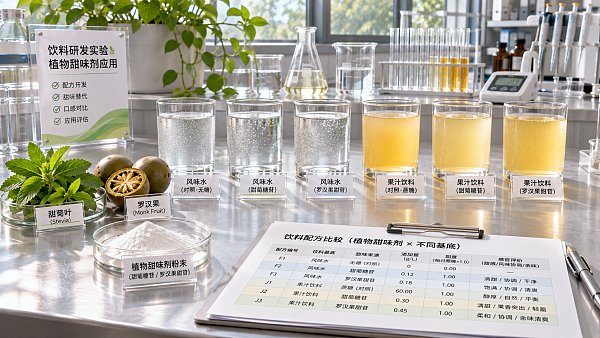
A simple water sample also helps expose the powder’s flavor, but it cannot predict performance in every food. Fat, protein, acidity, aroma, and viscosity change sweetness perception. Use water for diagnosis, then make the final decision in the actual recipe.
Find the lowest dose that gives acceptable sweetness
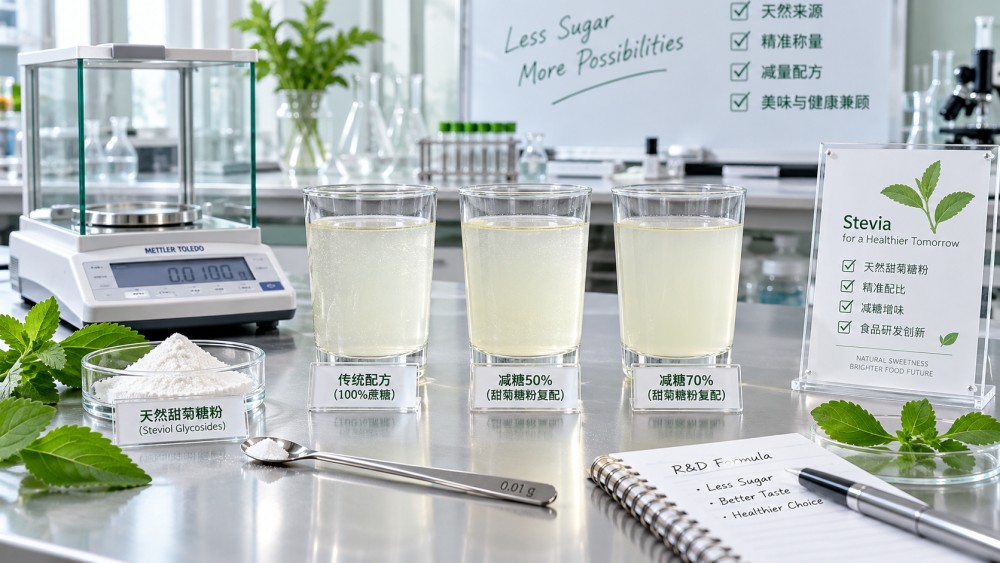
Highly concentrated stevia extracts are difficult to dose accurately with household spoons. A small measuring error can produce a noticeable sensory difference. The same spoonful also weighs differently when a powder is fluffy, compacted, or blended with a carrier. Use a balance capable of resolving the intended addition, or prepare a measured dilution when direct weighing is impractical.
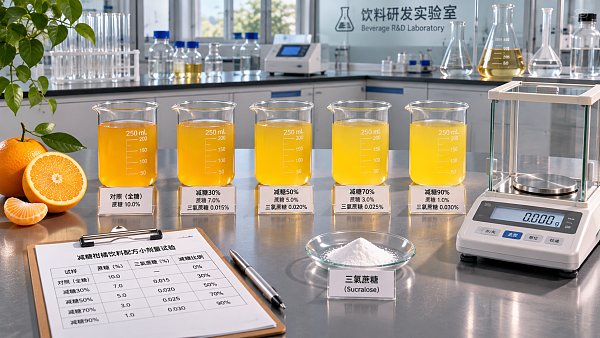
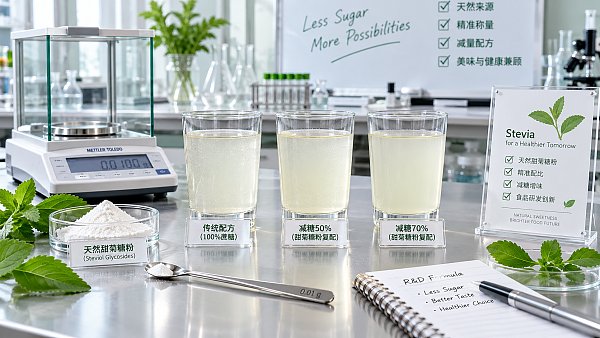
Start from the ingredient’s application guidance and prepare several samples with progressively lower additions. Keep the base recipe, mixing method, and serving temperature constant. The goal is to identify where sweetness remains acceptable while bitterness and lingering sweetness decline. A universal sugar-to-stevia conversion cannot establish that point because commercial powders differ substantially.
For liquid trials, dissolve a known mass of powder in a known mass of water, provided the grade dissolves under the chosen conditions. Dose this stock by weight. Calculate the powder delivered from the stock’s concentration, and account for the added water so that every sample has the same final composition. Prepare the stock hygienically and avoid keeping an unpreserved dilution for repeated testing over several days.
Complete dissolution matters. Undissolved particles or uneven distribution create inconsistent mouthfuls that can be mistaken for an unsuitable ingredient. Follow the grade’s dissolution guidance; if gentle warming is needed, cool the samples to the same temperature before tasting. Extra heating is not a reliable way to remove bitterness.
When a lower dose improves the finish but leaves the recipe insufficiently sweet, move to a sweetener blend or a different stevia profile. Repeatedly increasing the same powder is unlikely to resolve that tradeoff.
Choose by glycoside composition, not purity alone
“Stevia powder” can describe milled leaves, a concentrated steviol glycoside extract, or a tabletop blend containing a small amount of extract with bulk ingredients. These materials differ in flavor, sweetness strength, appearance, and behavior during mixing. Read the ingredient declaration before comparing dosage or taste.
Leaf powder brings plant material and herbal flavor into the recipe. If the objective is a clean sweetness in a lightly flavored beverage, changing to an appropriate purified extract can be more effective than attempting to mask the leaf character. A carrier-based blend requires a different addition rate from a concentrated extract, even when both packages emphasize stevia.
Within purified extracts, total steviol glycoside content does not describe the complete sensory profile. The proportions of stevioside, rebaudioside A, rebaudioside D, rebaudioside M, and other glycosides matter. Two ingredients with similar total purity can produce different bitterness and sweetness persistence.
Rebaudioside D and rebaudioside M are often considered for a cleaner sensory profile than conventional stevioside-rich or rebaudioside A-dominant materials. That preference still needs testing in the intended recipe. Solubility, concentration, and the surrounding ingredients influence the result, and changing grades does not eliminate the need to control dosage.
Compare candidate grades at similar perceived sweetness rather than equal powder weight. Equal-weight testing can make a stronger ingredient seem harsher simply because it produces a sweeter sample. Request composition and application information that distinguishes the glycoside profile from the overall assay.
Use blends to reduce the stevia contribution
A blend reduces bitterness most directly when another sweetener supplies part of the required sweetness, allowing a lower stevia dose. Adding another sweetener while leaving the original stevia level unchanged can make the product excessively sweet without improving its finish.
The right companion depends on the recipe’s other requirements. Sugar adds bulk and affects moisture, texture, and browning. Some alternative bulk sweeteners introduce cooling sensations or change digestive tolerance at higher intakes. Those effects need consideration alongside taste.
Establish the acceptable stevia level first, then adjust the companion sweetener to restore the sweetness target. Reassess the complete blend after processing. Sweetness interactions are not always additive, so calculations provide a starting formulation rather than a guaranteed sensory match.
Balance flavor without creating a different defect
Aroma can make a reduced-stevia recipe feel sweeter. Vanilla is useful in compatible dairy and bakery products, while fruit aromas can support sweetness in beverages. These additions change the overall sensory impression; they do not remove the bitter-tasting compounds.
Choose an aroma that belongs in the product. A strong vanilla note might improve a flavored yogurt yet distort a delicate tea. Cocoa and coffee can accommodate some lingering stevia character, but their existing bitterness also limits how much additional bitterness the recipe can tolerate.
Acidity requires particular care. A small adjustment can improve the balance of a flat fruit beverage, but increasing acid in an already tart drink can raise the sweetness needed to make it palatable. That creates pressure to increase stevia again. Hold the acid level steady during initial sweetener trials, then assess acidity separately once the sweetness system is close to acceptable.
A small salt adjustment sometimes softens perceived bitterness in a compatible food. Its usefulness ends when a salty taste becomes noticeable or the recipe’s sodium target is exceeded. Test it as a separate variable rather than treating salt as a standard remedy for every stevia application.
Commercial bitterness modulators also require evaluation in the finished formulation. Their effect depends on the particular off-note, dosage, and food matrix. A successful result in a supplier’s demonstration beverage does not establish performance in yogurt, a protein drink, or a baked product.
Let the finished food determine the adjustment
Beverages: evaluate temperature and the full finish
Lightly flavored drinks expose off-notes that richer foods can obscure. After confirming dissolution, taste the beverage at its intended serving temperature. A warm bench sample and a chilled finished drink can differ in sweetness, aroma release, and perceived bitterness.
For carbonated drinks, assess the carbonated version before finalizing the sweetener dose. Carbonation changes the sensory balance through acidity and oral sensation. In tea and coffee, keep extraction conditions consistent between trials; otherwise, changes in the base drink’s bitterness can obscure the effect of the sweetener adjustment.
Dairy and protein products: keep the matrix consistent
Fat, protein, and viscosity influence flavor perception, but increasing them solely to hide bitterness changes the product itself. Compare sweetener trials within the intended fat level and texture. In yogurt, assess the formulation after its normal fermentation and cooling process because tartness and texture affect the required sweetness.
Protein powders can contribute bitter notes independently of stevia. Taste an unsweetened protein base before deciding that the sweetener is responsible. If adding stevia improves the initial taste but worsens the finish, both the base flavor and the sweetener contribution need adjustment.
Baked goods: separate sweetness from sugar functionality
Replacing sugar with concentrated stevia removes much more than sweetness. Sugar contributes bulk, moisture management, browning, and structure. A dry or dense result can make the eating experience less pleasant even when the stevia dose is reasonable.
Use a formulation that replaces those functions deliberately. Distribute the sweetener uniformly through a suitable liquid phase or a validated dry premix. Taste the fully cooled product, including crust and crumb where relevant. Batter tasting alone does not capture moisture loss, browning, or the way flavor is released during chewing.
Run comparisons that reveal the next useful change
Change one main variable at a time. Lower-dose samples answer whether concentration is the problem. Different glycoside profiles answer whether ingredient selection matters. Blend trials answer whether the sweetness target exceeds what the chosen stevia can deliver with an acceptable finish.
- Prepare one consistent base and divide it into weighed portions. Keep an unsweetened reference to identify bitterness already present in the recipe.
- Compare reduced stevia additions first. Label samples with neutral codes so expectations about a grade or formulation do not guide the tasting.
- Record initial sweetness, bitterness after swallowing, lingering sweetness, and any drying or cooling sensation separately.
- Allow the previous sample’s aftertaste to fade and rinse with water between samples. Repeated rapid tasting can blur differences.
- Repeat the preferred formulation through the actual heating, cooling, fermentation, or storage conditions relevant to the product.
If samples are equally sweet but differ in bitterness, grade selection or blending is the more useful next step. If lower dosing removes the bitter finish, preserve that lower contribution while rebuilding sweetness elsewhere. Keep the final ingredient grade, addition rate, mixing conditions, and serving temperature in the recipe record so the improvement can be reproduced.
Facing technical bottlenecks in manufacturing or looking for more efficient industrial solutions? Leave your details below and let the engineering experts at FCAS solve them for you.
We respect your privacy. Your information is strictly confidential.
Related News
 Zero-Calorie Sweeteners & AcidulantsHow to Choose Plant Based Natural Sweeteners for BeveragesChoose plant based natural sweeteners for beverages with confidence. Compare stevia, monk fruit and blends for taste, processing, labeling and cost.MORE+
 Zero-Calorie Sweeteners & AcidulantsChina’s New Food Labeling Standard to Prohibit “Zero Addition” ClaimsChina’s new food labeling standard targets “zero addition” and “no added” claims. Discover what the change means for food brands and ingredient suppliers.MORE+
 Zero-Calorie Sweeteners & AcidulantsHow to Use High Sweetness Sucralose in Reduced-Sugar DrinksDiscover how to use high sweetness sucralose in reduced-sugar drinks, with practical tips for balancing taste, mouthfeel, stability, and compliance.MORE+
 Zero-Calorie Sweeteners & AcidulantsChoosing High Intensity Sweeteners for Tabletop UseHigh intensity sweeteners for tabletop use: compare taste, formats, stability and compliance to create a consistent product consumers will enjoy.MORE+
 Zero-Calorie Sweeteners & AcidulantsHow to Evaluate a Maltitol Manufacturer for Consistent QualityEvaluate a maltitol manufacturer with confidence. Discover how to assess batch consistency, food safety, traceability, and trial performance before you buy.MORE+
 Zero-Calorie Sweeteners & AcidulantsChattogram Customs Seizes 4.2 Tonnes of Banned SweetenerChattogram Customs seized 4.2 tonnes of banned sodium cyclamate. Explore what the seizure means for sweetener sourcing and food compliance in Bangladesh.MORE+
 Zero-Calorie Sweeteners & AcidulantsHow to Evaluate a Crystalline Polyols ManufacturerChoosing a crystalline polyols manufacturer? Learn how to compare quality, production performance, documentation, and delivered costs with confidence.MORE+
 Zero-Calorie Sweeteners & AcidulantsHow to Evaluate a Sucralose Supplier Before Placing a Bulk OrderEvaluate a sucralose supplier with confidence. Learn how to verify quality, compliance, traceability, delivery reliability, and total costs before placing a bulk order.MORE+
 Zero-Calorie Sweeteners & AcidulantsHow to Choose Low Calorie Bulk Sweeteners for Reduced-Sugar FoodsChoose low calorie bulk sweeteners with confidence. Compare options for taste, texture, shelf life, and compliance to create better reduced-sugar foods.MORE+
 Zero-Calorie Sweeteners & AcidulantsWhich Quality Documents Should a Liquid Sorbitol Supplier Provide?Choosing a liquid sorbitol supplier? Learn which quality documents to request, how to verify CoAs and traceability, and what gaps should block release before you buy.MORE+
 Zero-Calorie Sweeteners & AcidulantsWhat Should You Check Before Choosing an Acidulants Supplier?Choosing an acidulants supplier? Learn how to verify specifications, batch quality, compliance, and delivery reliability to reduce risks and compare true usable costs.MORE+
 Zero-Calorie Sweeteners & AcidulantsHow Can You Reduce Bitterness When Using Natural Stevia Powder?Reduce bitterness in natural stevia sweetener powder with smarter dosing, glycoside selection, and sweetener blends. Discover practical tips for cleaner sweetness and a better finish.MORE+
 Zero-Calorie Sweeteners & AcidulantsHow Food Grade Stevia Sweetener Affects Taste and Label ClaimsFood grade stevia sweetener: learn how glycoside profiles, taste control, processing stability, and label claims shape successful lower-sugar products.MORE+
 Zero-Calorie Sweeteners & AcidulantsHow to Choose a Natural Sweeteners Supplier for Clean-Label ProductsNatural sweeteners supplier selection guide for clean-label products: compare formulation fit, traceability, documentation, and supply reliability.MORE+
 Zero-Calorie Sweeteners & AcidulantsWhat Drives Zero Calorie Sweeteners Bulk Price in 2026Zero calorie sweeteners bulk price in 2026: compare specifications, dosage, quality, freight, and supply risk to make smarter sourcing decisions.MORE+
 Zero-Calorie Sweeteners & AcidulantsHow to Choose Zero Calorie Sweeteners for Sugar Free ProductsZero calorie sweeteners for sugar free products: compare taste, stability, labeling, and cost to choose the right system for beverages, bakery, and functional foods.MORE+
 Zero-Calorie Sweeteners & AcidulantsChoosing Sucralose for Dairy Products Without Compromising TasteSucralose for dairy products: learn how to protect clean sweetness, optimize sensory performance, verify quality, and source reliably for reduced-sugar dairy.MORE+
 Zero-Calorie Sweeteners & AcidulantsHow to Choose Artificial Sweeteners for Beverages That Taste BetterArtificial sweeteners for beverages: learn how to choose solutions with better taste, stability, labeling fit, and cost efficiency for successful reduced-sugar drinks.MORE+
 Zero-Calorie Sweeteners & AcidulantsHow Acidity Regulators Improve Beverage Flavor and Shelf LifeAcidity Regulators help beverage brands balance flavor, pH control, microbial stability, and shelf life. Explore practical formulation insights for safer, more consistent drinks.MORE+
 Zero-Calorie Sweeteners & AcidulantsKey Quality Checks for High Purity Aspartame in Food FormulationHigh purity aspartame quality checks for food formulation: evaluate assay, impurities, particle consistency, stability, documentation, and total cost.MORE+
 Zero-Calorie Sweeteners & AcidulantsHow Liquid Flavors for Soft Drinks Improve Taste Consistency at ScaleLiquid flavors for soft drinks help manufacturers achieve reliable taste consistency at scale through accurate dosing, controlled mixing, stability management, and sensory quality control.MORE+
 Zero-Calorie Sweeteners & AcidulantsWhat to Check When Choosing a Saccharin Sodium Supplier for Global OrdersChoose a reliable saccharin sodium supplier for global orders. Learn how to assess quality, documentation, packaging, export readiness, and total landed reliability.MORE+
 Zero-Calorie Sweeteners & AcidulantsAre High Intensity Sweeteners for Tabletop Use Right for Your ProductExplore high intensity sweeteners for tabletop use: compare taste, carriers, serving cost, stability, packaging, and compliance to build a successful product.MORE+
 Zero-Calorie Sweeteners & AcidulantsSaccharin Sodium Selection Factors for Zero-Calorie FormulasSaccharin Sodium selection factors for zero-calorie formulas: optimize taste, purity, solubility, compliance, and batch consistency for reliable production.MORE+
 Zero-Calorie Sweeteners & AcidulantsHow High Purity Aspartame Supports Consistent Zero-Calorie FormulasHigh purity aspartame supports consistent zero-calorie formulas with reliable sweetness, process stability, traceability, and quality control across every batch.MORE+
 Zero-Calorie Sweeteners & AcidulantsHow Acesulfame Potassium for Soft Drinks Affects Taste and CostAcesulfame potassium for soft drinks can improve sweetness efficiency and lower formulation cost, but only with the right blend, taste control, and sourcing strategy. Learn what drives the best ROI.MORE+