How to Choose Food Thickeners That Keep Sauces Stable After Freezing
Choose food thickeners for frozen sauces by comparing water separation, texture, and flow after thawing and reheating. A freeze–thaw-stable modified starch is a useful starting point when the sauce needs a creamy, substantial body. A gum-supported system deserves consideration when suspension or water control remains inadequate. The final choice must survive the sauce’s actual acidity, salt level, cooking process, and frozen distribution conditions.
Initial viscosity alone is a poor selection criterion. Two sauces can leave the kettle with similar consistency and behave very differently after freezing. A useful comparison starts with similar serving texture, then measures how well each formulation retains that texture through storage, thawing, and preparation.
Identify what actually fails after freezing
Ice formation concentrates dissolved salts, acids, and sugars in the remaining unfrozen liquid. This changes the environment around starch, gums, proteins, and emulsion droplets. Ice crystals also disturb the sauce structure; temperature fluctuations during storage encourage crystal growth and further disruption.
After thawing, several failures can look like “loss of stability,” but they require different responses:
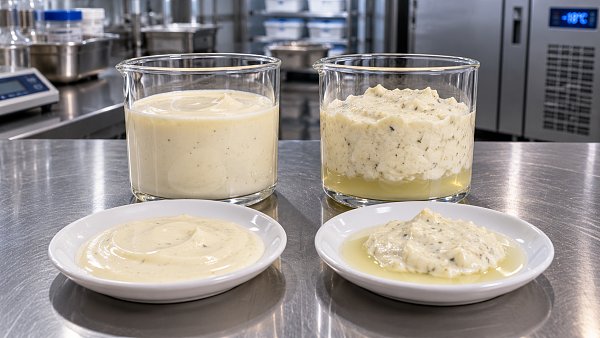
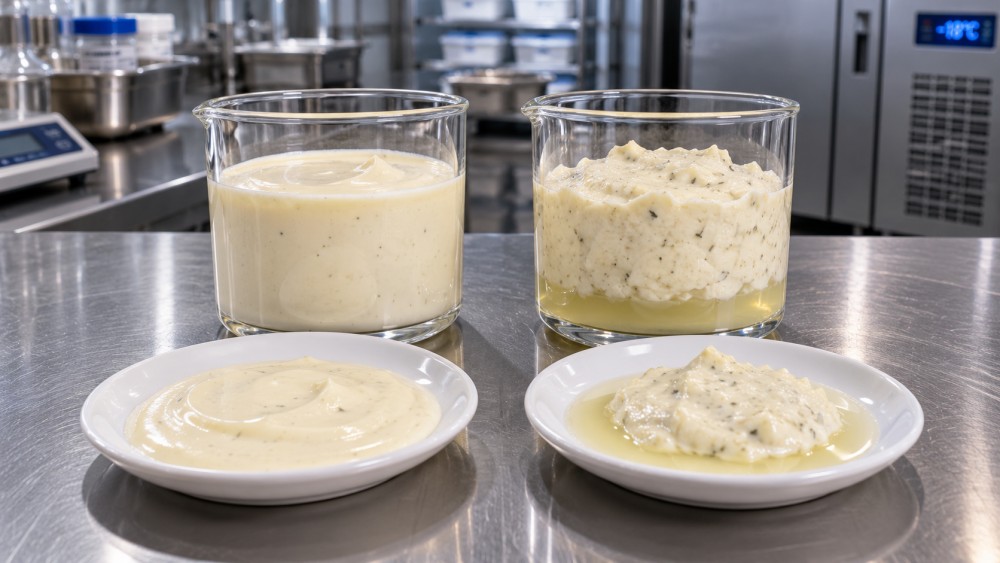
- A watery layer around a thick mass: water has separated from the structure, often through starch reassociation or contraction of a gel network.
- A uniformly thinner sauce: investigate incomplete starch cooking, acid or shear damage during processing, and loss of structure during freezing. Increasing dosage before identifying the cause can produce excessive thickness before freezing.
- Graininess: possible causes include starch aggregation, protein destabilization, or crystallization of another ingredient. Thickener substitution will not resolve every source.
- An oily surface: examine emulsion stability. Higher aqueous-phase viscosity can slow separation, but the emulsifier system and droplet structure still need attention.
Compare the fresh sauce with the thawed sample before stirring. Then apply a defined stirring procedure and compare again. Vigorous mixing can temporarily hide water separation or break down lumps, making a weak formulation appear acceptable.
Select starch chemistry around the processing conditions
Starch retrogradation occurs when gelatinized starch chains reassociate during cooling and storage. This can firm the structure and expel water. Amylose generally reassociates faster, while amylopectin also contributes to changes over longer storage. Consequently, a starch that thickens efficiently during cooking does not automatically provide good freeze–thaw stability.
Waxy starches contain predominantly amylopectin and often provide a better starting point than conventional higher-amylose starches for smooth frozen sauces. However, botanical source alone does not establish suitability. Modification type, modification level, granule behavior, and processing history all affect the result.
Cross-linking and stabilization address different problems. Cross-linking strengthens starch granules against swelling and breakdown under demanding heat, acid, or shear conditions. Stabilizing substitutions, such as acetyl or hydroxypropyl groups, interfere with chain reassociation and improve resistance to retrogradation. A grade designed around both requirements can suit an acidic sauce that undergoes pumping, cooking, freezing, and reheating.
Pregelatinized describes a starch’s preparation and hydration behavior, rather than a guarantee of frozen stability. A cold-swelling ingredient can simplify processing, but its underlying starch structure still determines much of its resistance to water release. Compare cold-process and cook-up grades using their intended preparation methods.
Use gums to address a defined texture problem
Gums can increase continuous-phase viscosity, support particle suspension, and reduce visible water movement. Their contribution differs from the body supplied by swollen starch granules. A starch–gum blend is useful when the starch gives the desired eating texture but leaves insufficient control of serum separation or settling.
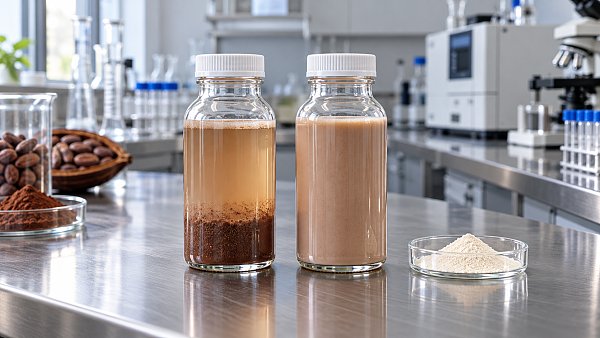
Xanthan gum is a practical screening candidate because it develops substantial viscosity at low shear and flows more readily during pouring or stirring. This behavior supports suspended herbs and spice particles while preserving pourability. Excessive addition, however, can create a ropy texture, persistent mouth coating, or an appearance that no longer matches the intended sauce.
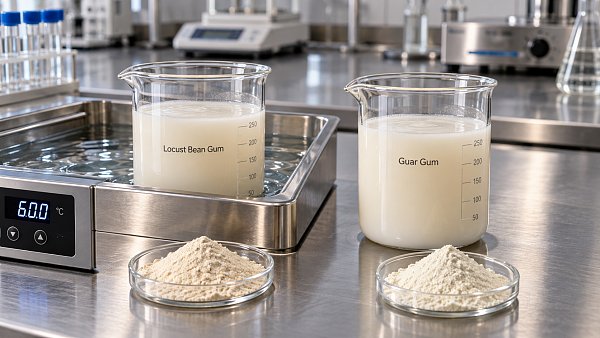
Guar gum builds viscosity and can complement starch, but hydration conditions and processing severity influence performance. Locust bean gum generally requires sufficient heating for full hydration, and interactions with other gums can create a stronger or more gel-like structure than expected. Carrageenan requires particular attention to protein interactions and the ionic environment, especially in dairy sauces.
Blend effects are not necessarily additive. A combination can produce more structure than either ingredient suggests individually. Adding gum to an already unstable starch system may reduce visible drainage while leaving an undesirable firm or grainy texture. Evaluate water retention and mouthfeel separately.
Let the sauce composition narrow the shortlist
Acidic sauces and demanding cook cycles
In tomato, fruit, or vinegar-based sauces, acidity combined with heat can reduce the viscosity of susceptible starch systems. Record when the acid enters the process and how long the thickener remains hot afterward. A candidate that performs well when acid is added after gelatinization may fail when the production recipe includes acid from the beginning.
Cross-linking improves processing tolerance, but a heavily cross-linked grade may need more demanding cooking conditions to develop its intended body. The available kettle temperature, residence time, and water availability must match the ingredient’s requirements.
Salty, sweet, and concentrated formulations
Sugars compete for water and can delay starch gelatinization. Salts alter hydrocolloid behavior, with particularly strong effects in systems involving ion-sensitive gums. During freezing, concentration in the unfrozen phase makes these interactions more pronounced. A water-only thickener demonstration therefore provides limited evidence for a concentrated sauce.
Use the actual dissolved-solids profile during screening. Where vegetables or meat release water during reheating, include that contribution in the trial. A thickener evaluated only in the sauce base can appear adequate until the finished meal introduces additional liquid.
Cream and cheese sauces
Protein stability and fat emulsification must remain part of the diagnosis. Freezing can destabilize an emulsion or concentrate salts enough to change protein interactions. If the thawed sauce contains both oil droplets and protein grains, increasing starch concentration is unlikely to address the whole failure.
Distinguish starch-derived pastiness from protein-derived graininess through comparison batches and, where available, microscopy. The corrective action could involve emulsification, mineral balance, or processing conditions alongside thickener selection.
Build a trial that exposes differences between candidates
Start with candidates adjusted to a comparable fresh serving consistency. Equal addition rates are useful for understanding thickening efficiency, but they do not provide a fair performance comparison when one ingredient produces much more viscosity than another. Record both dosage and the resulting texture.
Keep the recipe, ingredient addition sequence, mixing equipment, thermal history, and package fill conditions consistent. Gum dispersion deserves particular attention: poorly dispersed powder can form hydrated outer layers around dry centers. Such lumps indicate a preparation problem and can distort the apparent performance of the ingredient.
- Establish the fresh reference. Record pH, relevant solids measurements, cooked yield, appearance, and flow at a defined temperature. Confirm that the starch has received an adequate cook and that gums have hydrated.
- Freeze in representative packs. Container dimensions, fill depth, and freezing rate influence ice formation. A thin laboratory pouch and a deep production tray do not impose the same conditions.
- Separate storage testing from cycling. Include frozen storage that represents the intended product life. Add freeze–thaw cycles when temperature excursions are relevant, but do not assume cycling predicts long-term storage performance directly.
- Reproduce preparation. Use the intended thawing and reheating route, including heating time, stirring, final temperature, and holding period. Test a permitted alternative route separately if it imposes different stress.
Maintain a control formulation in every trial series. Repeat the most promising candidates in independently prepared batches so that an unusually good dispersion or cooking run does not determine the selection.
Measure retained performance without hiding defects
Measure separated liquid using a defined sample mass, standing time, temperature, and collection method. Report whether the result represents spontaneous drainage, drainage through a screen, or separation under centrifugation. These methods impose different stresses and their results are not interchangeable.
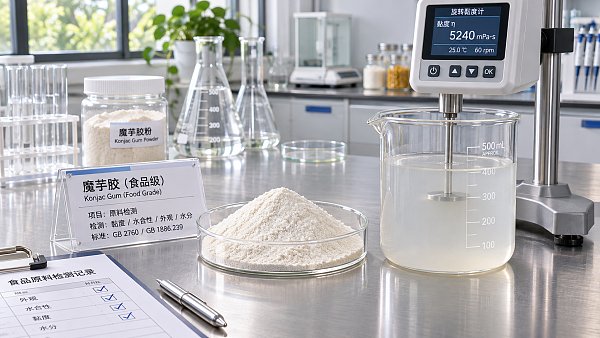
For viscosity, specify instrument geometry or spindle, speed or shear rate, measurement temperature, and sample preparation. Sauces are commonly shear-thinning, so readings taken under different conditions cannot support a reliable ranking. A single viscosity value also misses differences between resting suspension, pouring behavior, and oral texture.
Where possible, pair instrumental measurements with a practical flow or serving test. Assess coating on food, spoon release, visible graininess, and mouthfeel at the intended serving temperature. In a particulate sauce, inspect both the liquid phase and particle distribution.
Judge absolute performance alongside retention. A formulation that retains most of an initially inadequate viscosity still fails the application. Conversely, a sauce that thickens during storage may show an apparently favorable viscosity result while becoming pasty or difficult to dispense.
Set acceptance limits before ranking the final trials. These should reflect tolerable drainage, serving consistency, reheating behavior, and sensory defects in the finished food. Limits derived solely from the best laboratory sample can overlook what the product actually requires.
Turn a successful trial into a reproducible ingredient specification
Request application data that identify the tested formulation and processing conditions. “Freeze–thaw stable” without the sauce composition, preparation method, storage conditions, and assessment procedure provides little basis for substitution. A successful grade should be identified precisely enough to distinguish it from other starches or gum blends with similar names.
Document the approved dosage range, dispersion method, hydration or cooking requirements, acid addition sequence, and relevant shear limits. For blends, establish whether composition changes require renewed application testing. Ingredient viscosity specifications alone cannot guarantee equivalent performance in the sauce.
The final approval trial should use the intended production process and packaging. Pumping, holding, filling, and freezing introduce stresses that a small stirred beaker cannot reproduce. Retain samples through the planned storage period and evaluate them using the same reheating and acceptance criteria established during selection.
Facing technical bottlenecks in manufacturing or looking for more efficient industrial solutions? Leave your details below and let the engineering experts at FCAS solve them for you.
We respect your privacy. Your information is strictly confidential.
Related News
 Hydrocolloids & EmulsifiersHow Does Agar Work as a Gelling Agent in Food?Discover how agar transforms liquids into firm gels, what affects texture and setting, and how to troubleshoot common problems in food formulations.MORE+
 Hydrocolloids & EmulsifiersHow Do Hydrocolloid Gums Improve Texture and Stability in Foods?Discover how hydrocolloid gums improve food texture and stability, and learn how to choose the right gum for your formulation.MORE+
 Hydrocolloids & EmulsifiersHow to Use Hydrocolloid Stabilizer Blends for SaucesDiscover how to use hydrocolloid stabilizer blends for sauces to improve texture, prevent separation, and achieve consistent results from trial to production.MORE+
 Hydrocolloids & EmulsifiersWhat to Look for in a Konjac Gum ManufacturerChoosing a konjac gum manufacturer? Learn how to assess quality, consistency, food safety, pricing, and supply reliability before you buy.MORE+
 Hydrocolloids & EmulsifiersHow to Choose Flavor Carriers for Spray Dried FlavorsChoose flavor carriers for spray dried flavors with confidence. Compare maltodextrin, gum arabic and modified starch for retention, stability and release.MORE+
 Hydrocolloids & EmulsifiersHow to Use Tara Gum for Dessert Toppings With Better StabilityDiscover how to use tara gum for dessert toppings to improve texture and stability, with practical hydration, formulation, and testing tips.MORE+
 Hydrocolloids & EmulsifiersHow Seaweed Extract Hydrocolloids Improve Food TextureSeaweed Extract Hydrocolloids improve food texture and stability. Discover how alginate, carrageenan, and agar perform in real formulations.MORE+
 Hydrocolloids & EmulsifiersWhat to Check Before Buying Carboxymethyl Cellulose WholesaleBuying carboxymethyl cellulose wholesale? Learn how to compare grades, supplier documents, performance and delivered costs before placing your order.MORE+
 Hydrocolloids & EmulsifiersHow Cocamidopropyl Betaine Improves Foam in Bath ProductsDiscover how cocamidopropyl betaine for bath products can enhance foam, support a creamy lather, and help formulators improve bath and shower products.MORE+
 Hydrocolloids & EmulsifiersHow Does Low DE Maltodextrin Affect Texture in Powdered Drinks?Discover how low de maltodextrin adds body to powdered drinks with minimal sweetness. Learn how to select grades, improve mixing, and fine-tune texture for a better drinking experience.MORE+
 Hydrocolloids & EmulsifiersHow Do You Choose Flavor Emulsions for Beverages With Low Sugar?Choose flavor emulsions for beverages with low sugar. Learn how to balance taste, validate stability, compare cost per dose, and meet labeling requirements for a confident selection.MORE+
 Hydrocolloids & EmulsifiersNutrition Experts Urge White House to Define Ultra-Processed FoodsUltra-processed foods face a push for an official White House definition. Explore what the proposed criteria could mean for ingredient suppliers and food product development.MORE+
 Hydrocolloids & EmulsifiersHow Can Flavor Emulsions for Beverages Stay Stable During Storage?Keep flavor emulsions for beverages stable during storage. Discover practical ways to control droplet size, prevent oil rings, protect aroma, and validate shelf life.MORE+
 Hydrocolloids & EmulsifiersHow Does Locust Bean Gum Compare With Guar Gum as a Thickener?Compare locust bean gum thickener with guar gum for hydration, texture, stability, and cost. Discover which option fits your process and delivers better product performance.MORE+
 Hydrocolloids & EmulsifiersHow Can You Verify Quality at a Microcrystalline Cellulose Factory?Verify quality at a microcrystalline cellulose factory with practical audit tips on traceability, testing, and batch consistency. Explore the guide to make confident sourcing decisions.MORE+
 Hydrocolloids & EmulsifiersHow Do Clean Label Stabilizer Blends Prevent Separation in Drinks?Discover how clean label stabilizer blends help reduce drink separation while preserving texture. Learn how to choose and validate the right blend for your beverage.MORE+
 Hydrocolloids & EmulsifiersHow to Choose Food Thickeners That Keep Sauces Stable After FreezingChoose Food Thickeners that keep frozen sauces smooth and stable. Compare starches, gums, and freeze–thaw tests to reduce water separation and find the right fit for your formulation.MORE+
 Hydrocolloids & EmulsifiersHow to Prevent Lumps When Mixing Powder Hydrocolloid Stabilizer BlendsPrevent lumps in powder hydrocolloid stabilizer blends with practical tips on feeding, dispersion, temperature, and hydration. Learn how to achieve smoother, more consistent batches.MORE+
 Hydrocolloids & EmulsifiersHow Can You Use Carboxymethyl Cellulose for Food Thickening Without Clumps?Use carboxymethyl cellulose for food thickening without clumps. Discover practical dispersion, mixing, and hydration tips for smoother textures and fewer wasted batches.MORE+
 Hydrocolloids & EmulsifiersWhich Encapsulation Wall Materials for Flavors Work Best in Baking?Compare encapsulation wall materials for flavors in baking. Explore starch, gum arabic, protein and lipid options to improve aroma retention and find the right fit for your products.MORE+
 Hydrocolloids & EmulsifiersHow Locust Bean Gum Improves Texture and Stability in Dairy ProductsLocust bean gum for dairy products improves creaminess, reduces whey separation, and supports stable yogurt, ice cream, spreads, and dairy drinks.MORE+
 Hydrocolloids & EmulsifiersWhy Clean Label Food Emulsifiers Matter in Modern FormulationClean label food emulsifiers shape stability, texture, processing, and shelf life. Explore practical formulation insights for beverages, sauces, bakery, and more.MORE+
 Hydrocolloids & EmulsifiersHow Natural Food Emulsifiers Improve Plant-Based Product TextureNatural food emulsifiers for plant based products improve creaminess, stability, and texture. Explore practical formulation strategies for beverages, dressings, desserts, and more.MORE+
 Hydrocolloids & EmulsifiersHow Konjac Gum Powder Improves Texture in Low-Calorie FoodsKonjac gum powder improves body, stability, and mouthfeel in low-calorie foods. Discover practical tips for smoother sauces, beverages, and reduced-fat formulations.MORE+
 Hydrocolloids & EmulsifiersHow Bulk Price Factors Affect Hydrocolloid Stabilizer Blend SourcingHydrocolloid stabilizer blends bulk price: compare dosage efficiency, quality consistency, logistics, and documentation to reduce total sourcing costs.MORE+
 Hydrocolloids & EmulsifiersHow Hydrocolloid Systems for Meat Products Improve Texture and YieldHydrocolloid systems for meat products improve yield, texture, water retention, and slicing quality. Explore practical formulation strategies for stable, high-performing meat products.MORE+
 Hydrocolloids & EmulsifiersHow Locust Bean Gum Thickener Improves Texture and StabilityLocust bean gum thickener improves texture, water retention, suspension, and stability. Learn practical hydration and blending tips for better product performance.MORE+
 Hydrocolloids & EmulsifiersChoosing Maltodextrin for Flavor Carriers in Dry Food BlendsMaltodextrin for flavor carriers: discover how to optimize aroma protection, powder flow, moisture control, compliance, and supply reliability in dry food blends.MORE+
 Hydrocolloids & EmulsifiersHow Guar Gum Derivatives Solve Texture and Stability IssuesGuar Gum Derivatives help solve texture, settling, separation, and viscosity loss. Discover practical formulation strategies for stable, high-performing products.MORE+
 Hydrocolloids & EmulsifiersHow Non-GMO Food Emulsifiers Improve Label-Friendly FormulationsNon-GMO food emulsifiers help create stable, label-friendly sauces, beverages, bakery products, and frozen foods. Explore sourcing, processing, and formulation insights.MORE+
 Hydrocolloids & EmulsifiersWhat to Evaluate When Choosing a Hydrocolloid Systems ManufacturerHydrocolloid systems manufacturer selection made easier: evaluate performance, documentation, supply reliability, and total cost for dependable results.MORE+
 Hydrocolloids & EmulsifiersWhat to Check Before Buying Natural Food Emulsifiers WholesaleNatural food emulsifiers wholesale: learn how to evaluate label fit, formula performance, documentation, supplier reliability, and total landed cost before buying.MORE+
 Hydrocolloids & EmulsifiersPreventing Melt-Down With Ice Cream Stabilizer Blend SelectionHydrocolloid stabilizer blends for ice cream: diagnose melt-down, improve creamy melt quality, and select formulas for stable texture and cold-chain resilience.MORE+
 Hydrocolloids & EmulsifiersWhen Cold Soluble Tara Gum Is the Right Choice for Beverage FormulasCold soluble tara gum helps beverage formulators achieve rapid hydration, smooth texture, and reliable stability. Explore when it delivers the right processing advantage.MORE+
 Hydrocolloids & EmulsifiersHow High Viscosity Locust Bean Gum Improves Texture StabilityHigh viscosity locust bean gum improves texture stability, water control, and mouthfeel in dairy, sauces, fillings, and frozen foods. Explore practical selection insights.MORE+
 Hydrocolloids & EmulsifiersFood Texturants: How to Match Hydrocolloids to Beverage and Sauce SystemsFood texturants guide: match hydrocolloids to beverage and sauce systems for stable texture, smooth processing, and better sensory performance.MORE+
 Hydrocolloids & EmulsifiersChoosing Cold Soluble Hydrocolloid Systems for Instant Beverage TextureCold soluble hydrocolloid systems for instant beverages: compare dispersion, texture, stability, process fit, and cost to select the right solution for scalable production.MORE+
 Hydrocolloids & EmulsifiersWhy Spray Dried Gum Arabic Is Used to Improve Powder StabilitySpray dried gum arabic improves powder stability by protecting sensitive ingredients, supporting flow, and enhancing water dispersibility. Discover its key benefits.MORE+
 Hydrocolloids & EmulsifiersHow to Select Flavor Emulsions That Keep Juice Drinks Smooth and StableFlavor emulsions for juice drinks: learn how to select stable systems that prevent oil rings, maintain cloud, protect aroma, and support smooth shelf-life performance.MORE+
 Hydrocolloids & EmulsifiersWhy Gellan Gum Is Used to Control Texture in Modern FoodsGellan Gum gives modern foods precise texture control, from light beverage suspension to clean gels and creamy body. Explore uses, processing factors, and formulation tips.MORE+