For technical evaluators, high viscosity locust bean gum is a critical hydrocolloid for improving texture stability in food formulations.
Its ability to build body, control water migration, and work synergistically with xanthan and carrageenan supports reliable performance across demanding processed foods.
Understanding viscosity behavior, processing tolerance, and compatibility helps teams select grades that deliver consistent texture, shelf-life performance, and efficient production results.
The Core Evaluation Question: Does the Gum Stabilize Texture Under Real Processing Conditions?
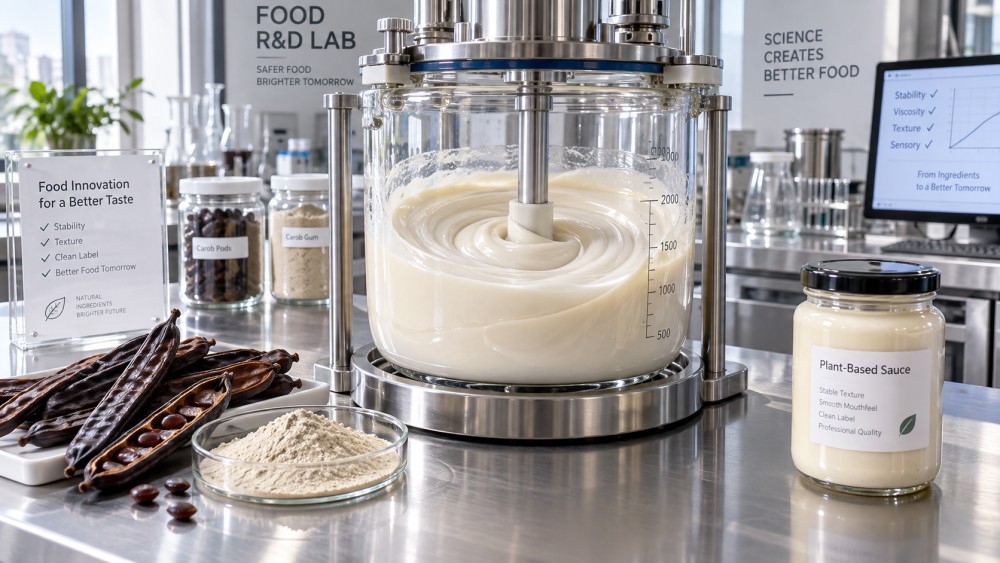
Technical evaluators usually need more than a high viscosity number. They need evidence that locust bean gum maintains the intended texture throughout manufacturing, filling, storage, and consumption.
High viscosity locust bean gum improves texture stability by increasing the continuous phase viscosity, binding available water, and supporting a more cohesive food matrix.
In practical terms, it can reduce serum separation, limit syneresis, improve suspension, and create a fuller mouthfeel without relying solely on starch or fat.
Its performance is especially valuable where manufacturers need texture resilience across changing temperatures, mechanical shear, freezing cycles, or extended distribution periods.
However, the best grade is not necessarily the one with the highest specification viscosity. Performance depends on the entire formulation and process environment.
Evaluators should therefore assess high viscosity locust bean gum as part of a system involving proteins, salts, sweeteners, acids, emulsifiers, other hydrocolloids, and processing conditions.
A suitable material should provide predictable hydration, stable rheology, acceptable sensory properties, and lot-to-lot consistency at the intended use level.
Why High Viscosity Locust Bean Gum Changes Product Structure
Locust bean gum is a galactomannan hydrocolloid obtained from carob seeds. Its molecular structure allows hydrated polymer chains to increase viscosity and modify the behavior of water.
High viscosity grades generally provide stronger thickening efficiency because their molecular weight and polymer integrity support greater resistance to flow after hydration.
This increased resistance is useful when a product needs body at relatively low dosage, particularly where excessive solids or starch addition would compromise flavor or appearance.
Unlike ingredients that only make a product thicker, locust bean gum can contribute to a more rounded, less sharply viscous texture.
That distinction matters in dairy desserts, sauces, and fillings, where consumers often associate smoothness and body with product quality.
The gum also helps manage water distribution within the formulation. Better water management can reduce visible separation and slow texture changes during storage.
In systems containing particles, cocoa, spices, fruit preparations, or insoluble nutrients, higher continuous-phase viscosity may also improve suspension stability.
Still, viscosity alone does not guarantee stable suspension. Particle size, density difference, yield stress, filling conditions, and package orientation require separate review.
Synergy With Xanthan and Carrageenan Often Delivers the Greatest Value
One of the most important reasons to use high viscosity locust bean gum is its ability to interact synergistically with selected hydrocolloids.
With xanthan gum, locust bean gum can create a structured network that provides higher viscosity and improved body compared with either gum used alone.
This combination is widely considered when formulators need a thick, smooth, shear-responsive texture in sauces, dressings, beverage concentrates, and prepared foods.
The xanthan-locust bean gum blend can also help reduce the stringy or overly elastic perception that may occur when xanthan is used at higher levels.
With carrageenan, especially in dairy systems, locust bean gum can reinforce gel texture and improve water retention within the protein-hydrocolloid network.
That interaction can support more stable chocolate milk, dairy desserts, cream-based products, and certain plant-based alternatives, depending on the broader formulation design.
Synergy should not be treated as a fixed recipe. The final result changes with gum ratio, hydration method, calcium level, protein source, pH, and heat treatment.
Technical teams should test blended systems at pilot scale because small changes in dosage can shift a product from smooth and stable to excessively firm.
Hydration Temperature Is a Critical Control Point
High viscosity locust bean gum generally requires sufficient heat for full hydration. Incomplete hydration is one of the most common causes of disappointing viscosity development.
Depending on grade and formulation, effective hydration may require temperatures approaching or exceeding 80 degrees Celsius, followed by adequate mixing time.
Cold processing can be possible with specially treated or instantized grades, but evaluators should verify whether the supplier's hydration claims match the production process.
Adding the powder directly into water without dispersion control can create lumps, fish-eyes, and uneven viscosity. These defects can remain after later heating.
Preblending the gum with sugar, starch, salt, or another dry carrier often improves powder distribution before the ingredient contacts water.
High-shear mixing may improve initial dispersion, but excessive shear after complete hydration can reduce the perceived structure of sensitive hydrocolloid systems.
The correct processing sequence depends on the product. Some systems hydrate gums before protein addition, while others require controlled addition after dry blending.
A supplier's laboratory viscosity result is useful, but it cannot replace a process trial using actual equipment, heating profiles, solids levels, and hold times.
How It Supports Stability in Dairy and Plant-Based Products
Dairy applications frequently use high viscosity locust bean gum to increase body, reduce serum separation, and improve the eating quality of cultured or heat-treated products.
In chocolate milk and flavored dairy beverages, it can support cocoa suspension while helping create a richer texture at modest inclusion levels.
For yogurt-style products, the gum may help improve water retention, although compatibility with protein structure and fermentation conditions needs close evaluation.
Acidified systems demand special attention because pH, mineral composition, and thermal treatment can affect protein stability independently of hydrocolloid performance.
Plant-based beverages and desserts may benefit from added viscosity and suspension support, especially when using oat, pea, soy, almond, or coconut bases.
These systems are often more variable than conventional dairy because protein quality, insoluble material, oil phase design, and enzyme treatment differ by supplier.
Technical evaluators should check sedimentation, creaming, mouthfeel, and viscosity recovery after shaking rather than relying on a single viscosity measurement.
They should also consider whether the chosen gum system supports the desired label position, allergen strategy, cost target, and regional food additive requirements.
Performance in Sauces, Dressings, and Bakery Fillings
Sauces and dressings require controlled flow. They must pour, spread, or pump predictably while maintaining visual uniformity and a stable texture over shelf life.
High viscosity locust bean gum can build body without producing the paste-like texture associated with excessive starch in some high-solids formulations.
When paired with xanthan gum, it can improve cling, reduce watery appearance, and support spice or vegetable particle suspension.
For acid sauces, the formulation team should assess viscosity after thermal processing and throughout storage because acid level can affect other ingredients significantly.
In bakery fillings, locust bean gum can help retain moisture, improve depositability, and reduce water migration between filling and surrounding baked components.
Water migration control is important because uncontrolled movement can soften a crust, dry a filling, weaken layers, or shorten acceptable shelf life.
Filling stability should be checked after baking, cooling, freezing, thawing, and reheating when those steps occur in the commercial supply chain.
Texture evaluation should include sensory assessment, not only instrument readings, because a suitable filling must also feel clean, smooth, and appropriate for the product category.
Frozen Products Need Protection Against Ice-Driven Texture Damage
Frozen desserts and prepared frozen foods face a different stability challenge. Temperature cycling can promote ice crystal growth and alter the distribution of unfrozen water.
High viscosity locust bean gum can contribute to a more stable unfrozen phase, helping maintain body and reducing the perception of icy or weak texture.
In ice cream and frozen desserts, it is often considered alongside guar gum, carrageenan, or emulsifier systems selected for the desired overrun and melt profile.
The objective is not maximum thickness before freezing. An excessively viscous mix can create processing difficulties and may negatively affect aeration or sensory release.
Evaluators should measure mix viscosity, draw characteristics, meltdown, heat-shock resistance, scoopability, and texture after multiple freeze-thaw or storage cycles.
For frozen sauces and meal components, the gum system should also be reviewed for thaw stability, water release, reheating behavior, and microwave performance.
These tests are particularly important for products moving through long distribution routes, variable retail storage, or consumer freezers with inconsistent temperature control.
What Specifications Should Technical Evaluators Compare?
Purchasing decisions should begin with a clear application target, then compare supplier specifications against the performance attributes that actually influence the finished product.
Viscosity is essential, but the test method matters. Evaluators should confirm concentration, temperature, hydration procedure, spindle, speed, and measurement time.
Two suppliers may report similar viscosity values under different methods, making the numbers unsuitable for direct comparison without technical clarification.
Particle size affects dispersion speed and powder handling. Finer material may hydrate more quickly, while dust control and flowability may require additional consideration.
Moisture content, microbial limits, ash level, color, odor, and foreign matter controls can also affect suitability, especially in sensitive food applications.
For global sourcing, documentation should include specification sheets, certificates of analysis, allergen statements, origin information, food safety certification, and regulatory status.
Batch consistency deserves particular attention because hydrocolloid variation can cause production adjustments, quality deviations, and unnecessary consumption of other formulation components.
A lower-cost grade can become more expensive when inconsistent hydration, reduced viscosity, or unstable texture requires rework, higher dosage, or rejected finished goods.
A Practical Trial Plan for Grade Selection
A disciplined trial plan helps technical teams distinguish between promising laboratory results and ingredients that can support reliable commercial production.
Begin by defining measurable targets, such as viscosity range, syneresis limit, suspension performance, gel firmness, process time, and shelf-life appearance.
Test the current formulation as a control, then compare candidate high viscosity locust bean gum grades at realistic dosage levels rather than arbitrary concentrations.
Review the gum alone first, but also test it with the intended xanthan, carrageenan, starch, protein, or emulsifier system.
Use the actual water quality, temperature profile, shear conditions, filling equipment, and packaging format whenever pilot equipment is available.
Collect both instrumental and sensory data. A Brookfield viscosity value may reveal a trend, but it does not fully predict consumer perception.
Accelerated storage can be informative, yet it should not replace real-time shelf-life work for products with long distribution requirements or high commercial risk.
Finally, calculate cost in use rather than price per kilogram. Include dosage, process efficiency, product yield, quality risk, and the need for supporting ingredients.
Common Formulation Mistakes to Avoid
One frequent mistake is selecting a gum based solely on a published viscosity specification. A high-value result may not translate into the desired finished-product behavior.
Another mistake is assuming that all locust bean gum grades hydrate identically. Processing temperature and dispersion method must match the selected material.
Teams also risk overusing the gum to solve a broader formulation issue, such as unstable emulsification, poor protein dispersion, or unsuitable particle size.
In those situations, added gum may mask the problem temporarily while creating excessive thickness, difficult pumping, or an undesirable mouthfeel.
Ignoring ingredient interactions can lead to unexpected gelation, weak structure, sedimentation, or variability between pilot and production batches.
Supplier qualification should extend beyond a sample test. Confirm manufacturing controls, quality systems, traceability, technical support capability, and change-notification practices.
For regulated food markets, verify additive permissions and labeling requirements in each destination market before finalizing the product formula or supply contract.
Conclusion: Evaluate High Viscosity Locust Bean Gum as a System Ingredient
High viscosity locust bean gum improves texture stability by building body, managing water, supporting suspension, and strengthening selected hydrocolloid systems.
Its greatest value appears when technical teams match the grade, hydration process, gum blend, and dosage to the actual demands of the finished food.
For dairy products, sauces, bakery fillings, and frozen foods, it can provide commercially meaningful improvements in consistency, shelf-life appearance, and sensory quality.
The right evaluation approach combines supplier specifications with pilot trials, processing validation, storage testing, and cost-in-use analysis.
By treating high viscosity locust bean gum as a functional component of the full formulation rather than a simple thickener, evaluators can make more reliable decisions.