
How Guar Gum Derivatives Solve Texture and Stability Issues
A sauce that pours differently from batch to batch, a beverage that develops visible settling, or a cleaning concentrate that thins after storage can create more than a cosmetic defect. Texture affects dosing, consumer use, equipment behavior, packaging performance, and the ability to maintain a consistent specification. When a formulation loses viscosity or separates, the immediate temptation is often to add more thickener. That can make processing harder without solving the underlying stability problem.
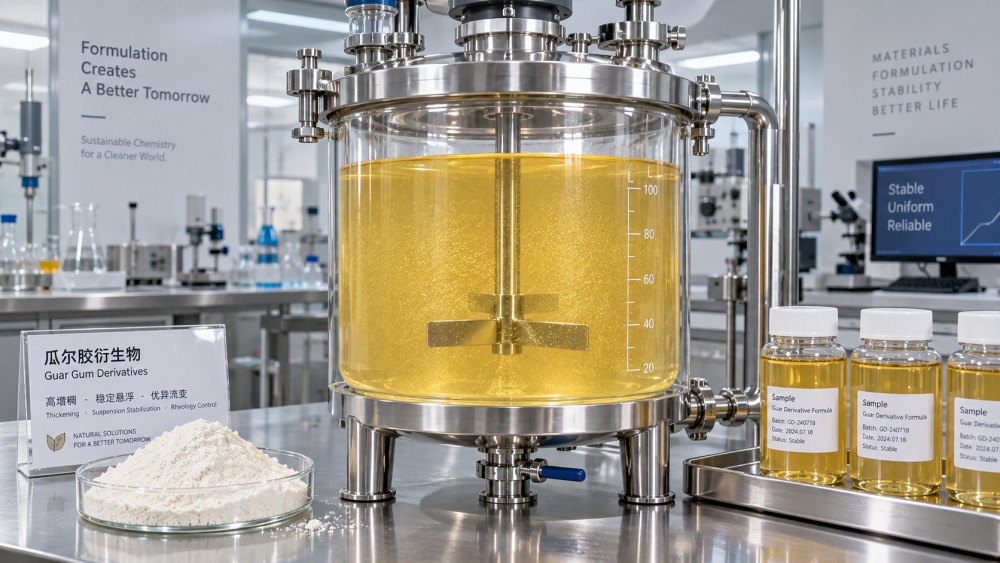
Guar Gum Derivatives can solve texture and stability issues when the derivative is matched to the failure mechanism, processing conditions, and end-use requirements. Their value is not simply high viscosity. Modified guar materials can support water binding, suspension, rheology control, emulsion stabilization, deposition, or salt tolerance depending on the chemistry and grade. The practical task is to identify whether the problem is caused by poor hydration, shear damage, incompatible ingredients, insufficient yield value, pH drift, microbial deterioration, or storage conditions before changing the formulation.
Start with the symptom, not the thickener level
Texture failures often look similar at first. A product may appear thin, uneven, grainy, separated, or difficult to pump. Yet each visible symptom points to a different part of the formulation system. Increasing polymer concentration without distinguishing among them can produce a batch that is too thick during manufacture but still unstable during transport or storage.
This approach matters because guar-based materials develop their function in water. Their performance depends on how the polymer hydrates, how it interacts with dissolved salts and surfactants, and whether the finished system preserves the polymer structure. A stable-looking fresh batch is not enough evidence that the formulation is robust.
When hydration is the real cause of uneven texture
Dry guar derivatives can form surface gels when added too quickly to water. The outer layer hydrates first and may trap dry powder inside. These “fish eyes” are especially troublesome because they can survive normal mixing and later appear as soft lumps, variable viscosity, or clogged filters and filling equipment. The issue may be mistaken for poor raw-material consistency even when the same grade would perform correctly under a better addition procedure.
Hydroxypropyl guar grades are commonly selected where smooth hydration and rheology modification are required, but grade behavior still depends on the process. Pre-dispersing the powder in a compatible nonaqueous carrier, using suitable eductor equipment, or adding the polymer into a properly moving vortex can reduce agglomeration. The correct choice depends on whether the formula permits an added carrier and whether the mixing system provides sufficient wetting without excessive localized shear.
Water quality also deserves attention. High mineral content, dissolved salts, or strongly acidic or alkaline conditions can alter hydration speed and final viscosity. A process team may obtain acceptable results in development using treated water, then see inconsistent performance after production switches to a different water source or after cleaning residues enter the batch. Recording water conductivity, pH, temperature, and order of addition alongside viscosity data can reveal patterns that a final-product test alone will miss.
Before judging a derivative as unsuitable, establish a repeatable hydration window. Use the same batch size, agitation profile, powder feed rate, hydration time, and sampling point. Check whether viscosity has reached equilibrium rather than measuring immediately after addition. A polymer that appears underperforming at an early process stage may simply not have completed hydration.
Building suspension without turning the product into a gel
Suspension is one of the most common reasons to use guar-based rheology modifiers. In sauces, seasoning systems, liquid agricultural formulations, pigment dispersions, and household products, insoluble particles can settle because gravity acts continuously while the product is at rest. A formulation does not always need very high measured viscosity to resist settling. It often needs sufficient structure at low shear to slow particle movement, while still thinning under mixing, pouring, spraying, or pumping.
This is where a single viscosity value can be misleading. Two samples can show similar readings at one instrument speed but behave differently in a package. One may be nearly Newtonian and allow dense particles to settle. The other may show stronger shear-thinning behavior and a modest yield region that keeps particles distributed during storage. The second product may pour easily once shaken or pumped, even though it is more stable on the shelf.
Guar Gum Derivatives can contribute this low-shear structure, but they are only one part of the suspension design. Particle size distribution, solids loading, particle density, wetting agents, dispersants, antifoam selection, and mixing sequence can all change the result. A coarse mineral particle may settle despite a viscosity increase that works well for a fine botanical powder. Similarly, a poorly wetted solid can float or clump rather than settle, which requires a wetting and dispersion review rather than more thickener.
Useful checks before increasing polymer dosage
- Compare the top, middle, and bottom of a stored sample rather than testing only a mixed sample.
- Observe whether separation is reversible with gentle inversion or whether a hard sediment forms.
- Measure viscosity at more than one shear condition where the method allows it.
- Review the point at which solids enter the batch; poorly dispersed solids can create a false stability problem.
- Test the packed product orientation when relevant, since headspace and closure contact can affect some systems.
A formulation that redistributes readily may be acceptable in applications where normal handling includes shaking. A hard-packed sediment that cannot be redispersed is a different failure mode. It can lead to inaccurate dosing, blocked nozzles, inconsistent active delivery, or an unacceptable appearance, even if the bulk viscosity initially meets specification.
Phase separation needs an emulsion strategy first
Guar derivatives can improve the apparent stability of emulsions by increasing the viscosity of the continuous phase and slowing droplet movement. They do not automatically replace an emulsifier. When an oil phase, fragrance oil, solvent, or hydrophobic active separates, the first question should be whether the emulsifier system is appropriate for the oil phase, process temperature, and final composition.
A thickened emulsion can still fail if droplets are too large, if the interfacial film is weak, or if an electrolyte changes surfactant behavior after production. In some systems, adding polymer before the emulsification step can also make droplet size reduction more difficult because the aqueous phase becomes too viscous for efficient mixing. A better sequence may be to form the emulsion under controlled conditions, then add or complete hydration of the rheology modifier during the finishing stage. The correct order must be confirmed against the actual equipment and formula.
When reviewing separation, distinguish creaming from coalescence. Creaming is the movement of intact droplets toward the top or bottom of the package and may be partly reversible. Coalescence involves droplets merging into larger droplets and can lead to a distinct free-oil layer. Guar-derived thickening may slow creaming, while coalescence usually requires closer attention to emulsifier selection, homogenization, temperature exposure, and ingredient compatibility.
Protecting viscosity through manufacturing and storage
A product can leave the mixing vessel with the desired body and still become thin later. High-shear pumps, narrow transfer lines, repeated recirculation, rotor-stator mixing, and aggressive filling conditions can alter the rheological profile of a hydrated polymer system. Some reduction after shear may be temporary, while other changes indicate degradation or a formula that cannot tolerate the process it is being asked to withstand.
Instead of relying only on a final bulk viscosity test, take samples at meaningful control points: after hydration, after solids addition, after high-shear processing, after transfer, and after filling. Compare both appearance and rheology after a defined recovery period. This shows whether the process creates a reversible shear-thinning response or a lasting loss of structure.
Storage failures need a similarly disciplined review. Temperature cycling can accelerate separation, affect solubility, and reveal packaging interactions. pH drift may result from ingredient reactions, dissolved gases, or microbial activity. Enzyme-containing raw materials can be relevant in food and biological systems because certain enzymes may reduce the viscosity of galactomannan-based materials. Where microbial growth is possible, a preservative system and hygienic process must be assessed as part of the whole formulation. A rheology modifier cannot compensate for a preservation failure.
Selecting the derivative by formulation environment
Not every guar derivative is interchangeable. Native guar gum, hydroxypropyl guar, carboxymethyl guar, cationic guar, and crosslinked or specially processed grades may differ in hydration behavior, ionic character, compatibility, clarity, salt response, and intended application. The selection should begin with the environment in which the polymer must work rather than with the highest viscosity listed on a technical sheet.
Nonionic modified grades may be useful where compatibility with a broad range of ingredients is needed. Cationic guar derivatives are more relevant in systems where interaction with negatively charged surfaces or materials is desired, such as certain personal-care applications, but their charge can also create incompatibilities with anionic surfactants or dispersants. Carboxymethylated grades introduce anionic character and may behave differently in electrolyte-rich formulations. These distinctions can affect not only texture but also haze, precipitation, foam behavior, and long-term stability.
For food use, the permitted identity, purity requirements, labeling position, and use conditions must be verified for the target market and product category. A derivative that performs well in an industrial or personal-care formula should not be assumed suitable for food applications. Similar care is needed for crop-input, cleaning, and specialty chemical products, where the intended-use requirements, safety documentation, and compatibility with active ingredients or packaging may differ.
A practical development sequence
- Define the failure clearly. Record whether the issue is settling, thinning, lumping, oil separation, poor flow, foam, or variable batch texture.
- Set the functional target. Specify the required behavior at rest and during use: pourability, pumpability, sprayability, particle suspension, cling, or controlled release.
- Screen process variables before reformulating. Confirm water quality, pH, addition rate, mixing time, temperature, and shear exposure.
- Compare a small number of suitable derivative types. Evaluate hydrated viscosity, low-shear structure, appearance, compatibility, and process handling rather than judging by one viscosity reading.
- Stress the finished formulation. Examine retained samples after realistic storage, temperature exposure, and handling conditions. Inspect for separation, sediment, viscosity recovery, odor change, gas formation, and package interaction where relevant.
- Lock down the control points. Once a system is selected, document the order of addition, mixing limits, hydration time, acceptable raw-material specifications, and release tests.
The most reliable use of Guar Gum Derivatives comes from treating them as part of a formulation system rather than as a last-minute viscosity correction. When hydration, shear, particle behavior, emulsification, and storage stability are checked together, quality decisions become more defensible and production adjustments are less likely to create a new problem while fixing the original one.
Related News
 Antioxidants & Natural PreservativesWhat Quality Checks Matter When Sourcing Butylparaben for Personal CareButylparaben for personal care sourcing guide: compare assay, impurities, physical performance, documentation, traceability, and supplier quality to reduce formulation risk.MORE+
 Nano-microcapsule FormulationsHow Encapsulated Flavors Protect Taste During Processing and StorageEncapsulated Flavors protect taste from heat, oxygen, moisture, and storage loss. Explore smarter release, carrier selection, and processing strategies.MORE+
 Chelated Trace Element FertilizersHow Greenhouse Fertigation Systems Reduce Water and Fertilizer WasteGreenhouse fertigation systems reduce water and fertilizer waste with precise dosing, uniform irrigation, drainage monitoring, and smarter crop-zone control. Learn practical strategies.MORE+
 Supercritical CO2 Essential OilsHow Natural Essential Oil Blends Improve Consistent Product FragranceNatural essential oil blends help brands achieve consistent, appealing fragrance across batches. Explore smart blend design, stability testing, and product compatibility strategies.MORE+
 Non-ionic Surfactants & DefoamersHow to Choose Non Ionic Low Foaming Surfactants for CIP CleaningNon ionic low foaming surfactants for CIP cleaning: learn how to balance wetting, foam control, compatibility, and rinseability for reliable cleaning performance.MORE+
 Nano-microcapsule FormulationsHow Food Grade Cyclodextrin Complexes Protect Sensitive FlavorsFood grade cyclodextrin inclusion complexes help protect sensitive flavors from oxidation, evaporation, and processing loss while supporting controlled release and consistent sensory quality.MORE+
 Polymer-Coated Water Soluble NPKHow Fertilizer Coating Polymers Improve NPK Granule ReleaseFertilizer coating polymers for NPK granules improve controlled nutrient release, reduce loss risks, and enhance product consistency. Discover key selection and process insights.MORE+
 Chelated Trace Element FertilizersWhat Diammonium Phosphate Means for Crop Nutrition PlanningDiammonium Phosphate: learn how DAP supports early phosphorus access, nitrogen budgeting, smart placement, and balanced crop nutrition planning.MORE+
 Maillard Reaction Savory FlavorsHow to Assess a Flavor Bases Supplier List for Reliable SourcingGlobal Fine Chemicals & Agrochemical Intelligence Network flavor bases supplier list: assess specs, samples, supply risk, and true cost to source with confidence.MORE+
 Hydrocolloids & EmulsifiersHow Konjac Gum Powder Improves Texture in Low-Calorie FoodsKonjac gum powder improves body, stability, and mouthfeel in low-calorie foods. Discover practical tips for smoother sauces, beverages, and reduced-fat formulations.MORE+
 Supercritical CO2 Essential OilsWhat to Check Before Choosing a Botanical Essential Oils ManufacturerChoose a botanical essential oils manufacturer with confidence. Explore key checks for purity, traceability, compliance, batch consistency, and reliable supply.MORE+
 Microencapsulated FragrancesHow Fragrance Carriers for Detergents Improve Scent PerformanceFragrance carriers for detergents improve stability, fabric deposition, and long-lasting scent. Explore practical solutions for better wash-to-wear fragrance performance.MORE+
 Antioxidants & Natural PreservativesWhen Propyl Gallate Antioxidant Is the Right Choice for Oil StabilityPropyl gallate antioxidant: learn when it is the right choice for oil stability, shelf-life protection, processing compatibility, and smarter formulation decisions.MORE+
 Antioxidants & Natural PreservativesHow Potassium Sorbate Extends Shelf Life in Food and Beverage ProductsPotassium Sorbate helps food and beverage brands control yeast and mold spoilage. Explore pH, dosage, processing, and packaging strategies for reliable shelf life.MORE+
 Antioxidants & Natural PreservativesHow to Source Bulk Herbal Extracts With Reliable Quality ControlBulk herbal extracts sourcing guide: compare suppliers, verify traceability, review CoAs, and build reliable quality controls for safer, consistent purchasing.MORE+
 Antioxidants & Natural PreservativesWhat to Check Before Sourcing Butylparaben for Personal Care FormulasButylparaben for personal care sourcing guide: check market eligibility, purity, supplier controls, formula compatibility, packaging, and total risk before buying.MORE+
 Targeted Bio-pesticides & APIsChoosing Microbial Fungicides for Foliar Diseases in Integrated Crop ProgramsMicrobial fungicides for foliar diseases: learn how to match biology, formulation, tank compatibility, and timing for stronger integrated crop protection.MORE+
 Targeted Bio-pesticides & APIsHow Microbial Insecticides Control Caterpillars With Lower Crop Residue RiskMicrobial insecticides for caterpillars help protect crops with targeted early-larval control and lower residue-management pressure. Learn timing, coverage, compliance, and scouting essentials.MORE+
 Microencapsulated FragrancesHow to Add Encapsulated Laundry Fragrances Without Weakening Wash ResultsEncapsulated laundry fragrances: learn how to boost long-lasting scent while protecting cleaning power, stability, foam control, and fabric care.MORE+
 Supercritical CO2 Essential OilsHow Aroma Ingredients Shape Lasting and Skin-Safe Personal Care ProductsAroma ingredients for personal care: discover how to achieve lasting scent, formulation stability, skin safety, and confident product performance.MORE+
 Targeted Bio-pesticides & APIsInsecticides Explained Through Labels, Active Ingredients, and SafetyInsecticides explained through labels, active ingredients, formulations, and safety. Learn how to compare products, manage risk, and make informed crop protection decisions.MORE+
 Heavy-duty Industrial DegreasersHow to Select Parts Wash Cleaners for Automotive ComponentsParts wash cleaners for automotive components: learn how to match chemistry, materials, rinsing, safety, and waste controls for reliable cleaning results.MORE+
 Chelated Trace Element FertilizersHow Precision Fertigation Systems Improve Water and Nutrient ControlPrecision fertigation systems improve water and nutrient control with accurate dosing, uniform irrigation, smart monitoring, and reduced waste. Discover how to optimize crop performance.MORE+
 Hydrocolloids & EmulsifiersHow Bulk Price Factors Affect Hydrocolloid Stabilizer Blend SourcingHydrocolloid stabilizer blends bulk price: compare dosage efficiency, quality consistency, logistics, and documentation to reduce total sourcing costs.MORE+
 Zero-Calorie Sweeteners & AcidulantsHow to Choose a Natural Sweeteners Supplier for Clean-Label ProductsNatural sweeteners supplier selection guide for clean-label products: compare formulation fit, traceability, documentation, and supply reliability.MORE+
 Non-ionic Surfactants & DefoamersWhat Cationic Surfactants Do and Where They Are UsedCationic Surfactants deliver antimicrobial action, conditioning, antistatic control, and surface treatment benefits. Explore key uses, compatibility, and safe selection tips.MORE+
 Targeted Bio-pesticides & APIsHow to Evaluate Pesticide Suspension Concentrates for Field StabilityPesticide Suspension Concentrates: learn how to evaluate field stability, redispersibility, dilution, tank-mix compatibility, and spray safety for reliable performance.MORE+
 Hydrocolloids & EmulsifiersHow Hydrocolloid Systems for Meat Products Improve Texture and YieldHydrocolloid systems for meat products improve yield, texture, water retention, and slicing quality. Explore practical formulation strategies for stable, high-performing meat products.MORE+
 Microencapsulated FragrancesHow Laundry Fragrances for Liquid Detergents Improve Scent LongevityLaundry fragrances for liquid detergents: discover how fragrance design, deposition, and encapsulation create lasting fabric freshness and stronger product appeal.MORE+
 Nano-microcapsule FormulationsChoosing Fragrance Preparations That Perform Well in Personal WashFragrance preparations for personal wash: learn how to select options that protect clarity, stability, foam, scent performance, and packaging compatibility.MORE+
 Controlled-Release ThermodynamicsModified Cyclodextrins Explained for Controlled Fragrance ReleaseModified cyclodextrins enable controlled fragrance release, odor control, and volatile-note protection. Explore how they optimize performance in detergents, fabric care, and more.MORE+
 Microencapsulated FragrancesHow Fragrance Delivery Systems Improve Fabric Softener LongevityFragrance delivery systems for fabric softeners improve scent longevity through smart protection, reliable deposition, and controlled release for lasting freshness.MORE+
 Supercritical CO2 Essential OilsHow to Evaluate a Natural Cardamom Oil Supplier for Reliable SupplyNatural cardamom oil supplier evaluation guide: verify botanical origin, purity, batch consistency, documentation, packaging, and delivery reliability for confident sourcing.MORE+
 Maillard Reaction Savory FlavorsHow Ethyl Maltol Purity Testing Supports Flavor Safety ComplianceEthyl Maltol purity testing strengthens flavor safety compliance through identity checks, impurity profiling, supplier verification, and audit-ready documentation.MORE+
 Microencapsulated FragrancesEssential Oil Extracts Compared for Fragrance and Wellness UsesEssential Oil Extracts compared for fragrance and wellness: explore scent profiles, extraction methods, stability, safety, and sourcing insights for smarter formulation choices.MORE+
 Zero-Calorie Sweeteners & AcidulantsWhat Drives Zero Calorie Sweeteners Bulk Price in 2026Zero calorie sweeteners bulk price in 2026: compare specifications, dosage, quality, freight, and supply risk to make smarter sourcing decisions.MORE+
 EPA FIFRA & FDA GRAS RegsSynthetic Food Preservatives Rules That Support Safer FormulasSynthetic Food Preservatives: learn the rules for safer formulas, compliant use levels, validated shelf life, labeling, and reliable microbial control.MORE+
 Micelle Fluidics & ChelationHow Anionic Industrial Dispersants Improve Coating StabilityAnionic industrial dispersants improve coating stability, pigment wetting, viscosity control, gloss, and storage performance. Learn how to select and test the right solution.MORE+
 Supercritical CO2 Essential OilsHow to Choose Eucalyptus Oil Grades for Clean, Consistent ProductsChoose the right Eucalyptus Oil grade with confidence. Compare cineole content, purity, origin, processing, documentation, and application fit for consistent products.MORE+
 Micelle Fluidics & ChelationWhat Are Cationic Surfactants and Where Are They Commonly Used?Cationic Surfactants deliver powerful surface affinity for disinfection, fabric softening, hair conditioning, antistatic control, and industrial treatments. Explore key uses and selection factors.MORE+







































