How Can You Use Carboxymethyl Cellulose for Food Thickening Without Clumps?
Clumps can turn a routine thickening step into wasted ingredients, uneven texture, and extra mixing time. When using carboxymethyl cellulose for food thickening, the key is to separate and wet the powder particles before their surfaces hydrate and trap dry material inside. More mixing is not always the answer: once a sticky outer layer has formed, an ordinary tank agitator may simply move the lumps around.
For operators preparing sauces, beverages, or dairy formulations, smooth results depend on powder addition, water availability, mixing conditions, and ingredient sequence. The practical goal is straightforward: disperse first, allow complete hydration, and judge viscosity only under defined conditions.
Why CMC forms lumps even when the mixer is running
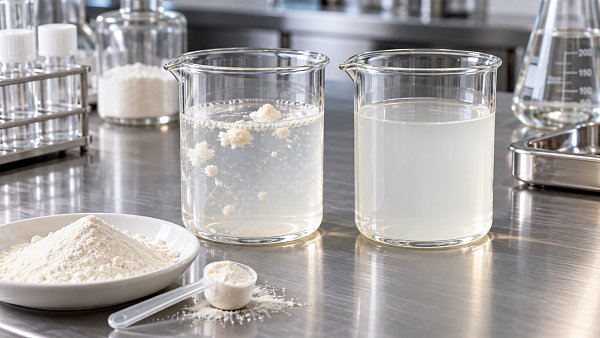
Food-grade carboxymethyl cellulose, commonly supplied as sodium CMC or cellulose gum, is a water-soluble hydrocolloid. As it contacts water, it begins to swell and hydrate. If particles enter as a pile rather than as individual grains, the outside can form a hydrated coating around a dry center. These gel-coated lumps are often called “fish eyes.”
A batch can therefore look well mixed while still containing incompletely hydrated CMC. Small lumps may escape notice until the product passes through a screen, reaches a filling nozzle, or feels grainy during a texture check.
Several conditions make this more likely:
- Fast powder addition: particles collect faster than the liquid can wet and separate them.
- Poor circulation: powder remains on the surface, against the tank wall, or in a low-flow zone.
- Early viscosity buildup: the liquid becomes too thick for the installed mixer to circulate effectively.
- Restricted water availability: high dissolved-solids levels can slow hydration.
- Unfavorable chemistry: acidity and salts can alter hydration and viscosity, depending on the CMC grade.
The most useful distinction is between dispersion and hydration. Dispersion separates the particles throughout the liquid. Hydration develops the thickening effect. A reliable process gives dispersion a head start.
Choose a dispersion method that fits your recipe
Dry blending: useful when sugar or another suitable powder is available
Blending CMC thoroughly with a larger quantity of a compatible dry ingredient helps keep its particles apart during addition. Sugar is a common choice in sweetened beverages and sauces. Other powders may be suitable, but their wetting behavior and compatibility need checking; not every dry ingredient is an effective carrier.
For an initial trial, a sugar-to-CMC ratio of roughly 5:1 to 10:1 by weight can be a useful starting point, subject to the supplier’s guidance and the formulation. This is not a universal specification. Some systems need greater dilution, and a poorly blended premix can still form lumps.
Mix the powders in clean, dry equipment until the CMC is distributed uniformly. Add the premix gradually to moving liquid. Do not empty the entire premix into the tank at once: dilution reduces the risk of clumping but does not remove the need for controlled feeding.
Slurry preparation: an option when dry blending is unsuitable
CMC can sometimes be pre-dispersed in a compatible food-grade liquid that does not substantially hydrate it during slurry preparation, such as an appropriate oil or glycerol system. When that slurry enters the aqueous phase, the separated particles can hydrate with less tendency to cluster.
This method needs recipe-specific testing. The carrier must be permitted for the intended food, acceptable for flavor and labeling, and compatible with the manufacturing process. Glycerol’s moisture content matters, while an oil-based slurry may require additional emulsification. A smooth-looking slurry is not proof of complete hydration after transfer.
Direct powder addition: workable with the right feeding and mixing system
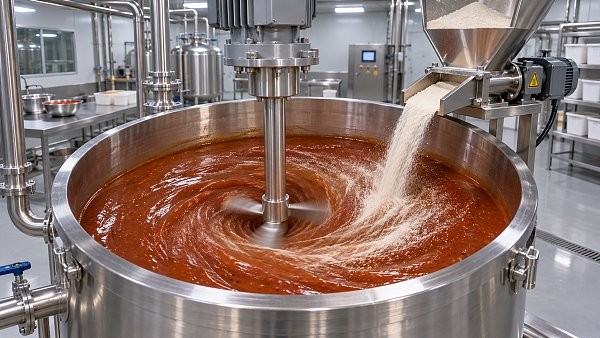
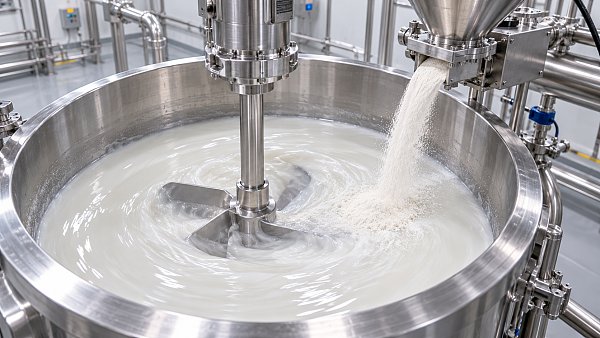
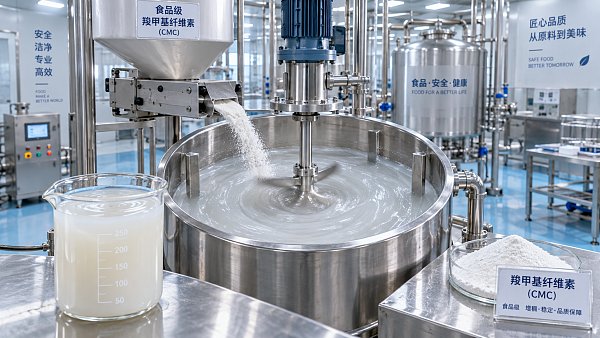
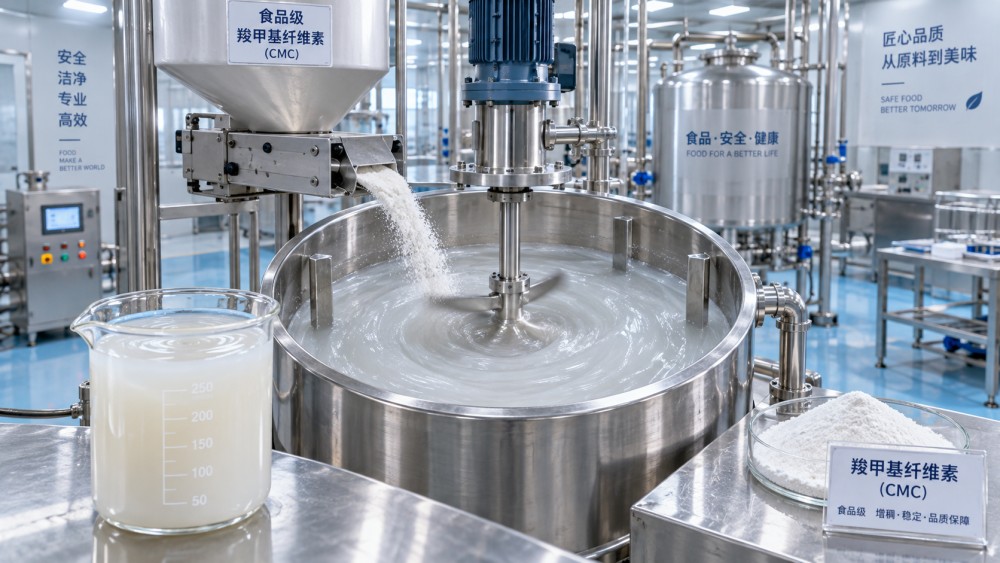
Direct addition can perform well when powder is introduced slowly into a well-circulated liquid or through suitable powder-induction equipment. It is less forgiving when operators pour from a sack into a tank with only gentle agitation.
Feed into a zone where liquid rapidly carries particles away. Avoid dumping onto the shaft, tank wall, or stagnant surface. A deep vortex is not the objective: it can entrain air and create foam without improving particle wetting. Use the mixer configuration and operating range recommended for the vessel and ingredient.
A practical workflow for carboxymethyl cellulose for food thickening
The following workflow provides a starting point for process development. Confirm the details against your CMC supplier’s instructions, approved recipe, and plant operating procedures.
- Verify the material. Check the food-grade designation, lot identity, viscosity specification, and any recommendations for pH, temperature, and hydration. Different CMC grades should not be treated as interchangeable.
- Charge enough water for circulation. Where the formulation permits, reserve a relatively low-solids water phase for CMC hydration. A small water charge can become too viscous before all the powder has dispersed.
- Establish mixing before adding powder. Confirm liquid movement throughout the vessel rather than relying only on surface motion. Keep aeration under control.
- Add the prepared CMC gradually. Use a dry premix, validated slurry, or controlled direct-feed method. If powder begins collecting on the surface, slow or pause the feed.
- Allow hydration to finish. Continue suitable agitation after addition. Follow the grade-specific time and temperature guidance, then verify the result rather than relying on the clock alone.
- Introduce challenging ingredients at a validated stage. Where practical, add concentrated acids, salts, and high-solids components after CMC hydration. Protein-containing formulations require particular care with addition sequence.
- Check the finished batch. Inspect for lumps, allow entrained air to dissipate where necessary, and measure viscosity at the specified temperature and test conditions.
CMC generally does not require cooking simply to hydrate, although temperature affects hydration speed and measured viscosity. Hotter water is not an automatic solution to clumping. Use a validated temperature window rather than changing temperature and powder-feed rate together during troubleshooting.
A batch calculation that avoids accidental overdosing
Consider a development trial containing 0.25% CMC in a 100 kg finished batch. The required CMC mass is 0.25 kg. If dry blending at a sugar-to-CMC ratio of 10:1, the premix contains 2.5 kg sugar plus 0.25 kg CMC. That sugar must come from the recipe’s existing sugar allowance, not be added on top of it.
The 0.25% concentration is an illustrative calculation, not a recommended dose for every food. The correct level depends on the CMC grade, desired texture, other ingredients, processing conditions, and applicable use restrictions. Increase dosage only after confirming that the existing CMC has hydrated properly.
Adapt the sequence to the food, not just the mixer
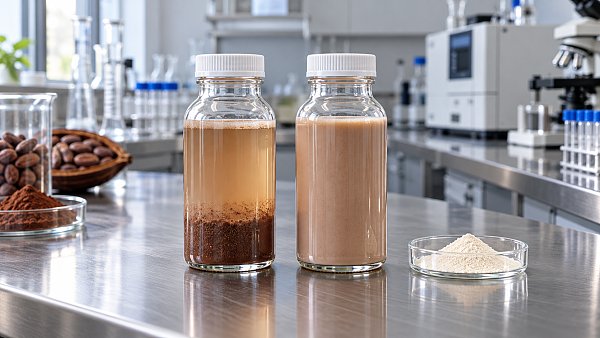
In acidified dairy drinks, CMC may contribute to protein stabilization as well as viscosity, but performance depends strongly on grade and processing sequence. A method that works in a neutral sauce should not be transferred unchanged to an acidic protein beverage.
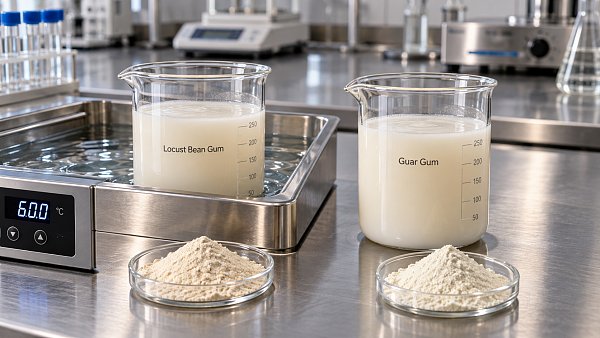
Other hydrocolloids also change the picture. When CMC is used with starch, xanthan gum, guar gum, or another thickener, rapid viscosity development from one component can prevent the others from dispersing. Test separate hydration or a validated combined premix rather than assuming all powders should enter together.
When a batch already contains lumps
Stop adding CMC and take a representative sample. Examine whether the particles have dry centers, are uniformly swollen gel fragments, or are actually another ingredient. This distinction prevents an unnecessary increase in mixing time or gum dosage.
If dry-centered fish eyes are present: additional time alone may not resolve them. Approved recirculation through suitable high-shear equipment can sometimes help, provided the product tolerates the treatment. Confirm the result on a controlled sample or trial before treating the full batch.
If viscosity is still developing: maintain the validated hydration conditions and recheck. Incomplete hydration can resemble underdosing. Adding more CMC at this point may produce an excessively thick product later.
If the batch is foamy: reduce unnecessary air entrainment and assess viscosity after appropriate deaeration. Bubbles can distort both appearance and viscosity readings.
Screening can remove visible lumps, but it also removes some of the weighed ingredient. It is not equivalent to complete hydration. Any screened or reworked batch should be assessed against approved quality criteria before release. Avoid improvised dilution, heating, or extended holding that compromises composition or food safety.
Define “fully hydrated” with repeatable checks
A smooth surface is not enough. Spread a representative sample into a thin layer and inspect for gel particles or dry-centered specks. Where suitable, a defined sieve test can help identify retained material. Record the method so different operators assess batches consistently.
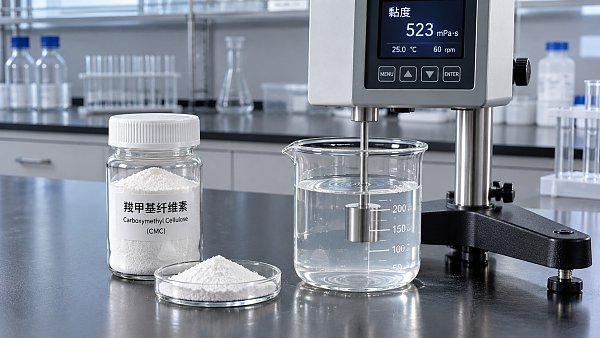
Measure viscosity at a controlled temperature using the same instrument, geometry or spindle, speed, and conditioning procedure. CMC solutions commonly show shear-dependent behavior, so readings taken under different conditions may not be comparable.
One useful development check is to compare readings after successive hydration intervals. If viscosity continues increasing substantially under identical test conditions, the initial hold may be insufficient. Establish an acceptable stabilization criterion through trials; there is no single hydration time suitable for every grade and recipe.
Make smooth batches repeatable across shifts
Record the variables operators can actually control: water charge, temperature, premix composition, addition time, mixer settings, hydration hold, and ingredient sequence. “Mix until smooth” leaves too much room for interpretation.
For sourcing teams, useful supplier information includes viscosity test conditions, particle-size characteristics, recommended dispersion methods, formulation compatibility, and food-use documentation. A viscosity specification alone does not establish application suitability. Confirm permitted uses and labeling requirements in the destination market; CMC is commonly identified as cellulose gum or E466, but local requirements differ.
FCAS approaches food ingredients through these application and purchasing questions: how a material behaves in production, what operators need to control, and which documentation buyers should request. For CMC, the practical takeaway is simple: prevent particle clustering before hydration begins, then verify hydration before adjusting the dose. That approach is more dependable than trying to rescue every thickening problem with extra powder or longer mixing.
Facing technical bottlenecks in manufacturing or looking for more efficient industrial solutions? Leave your details below and let the engineering experts at FCAS solve them for you.
We respect your privacy. Your information is strictly confidential.
Related News
 Hydrocolloids & EmulsifiersHow Does Agar Work as a Gelling Agent in Food?Discover how agar transforms liquids into firm gels, what affects texture and setting, and how to troubleshoot common problems in food formulations.MORE+
 Hydrocolloids & EmulsifiersHow Do Hydrocolloid Gums Improve Texture and Stability in Foods?Discover how hydrocolloid gums improve food texture and stability, and learn how to choose the right gum for your formulation.MORE+
 Hydrocolloids & EmulsifiersHow to Use Hydrocolloid Stabilizer Blends for SaucesDiscover how to use hydrocolloid stabilizer blends for sauces to improve texture, prevent separation, and achieve consistent results from trial to production.MORE+
 Hydrocolloids & EmulsifiersWhat to Look for in a Konjac Gum ManufacturerChoosing a konjac gum manufacturer? Learn how to assess quality, consistency, food safety, pricing, and supply reliability before you buy.MORE+
 Hydrocolloids & EmulsifiersHow to Choose Flavor Carriers for Spray Dried FlavorsChoose flavor carriers for spray dried flavors with confidence. Compare maltodextrin, gum arabic and modified starch for retention, stability and release.MORE+
 Hydrocolloids & EmulsifiersHow to Use Tara Gum for Dessert Toppings With Better StabilityDiscover how to use tara gum for dessert toppings to improve texture and stability, with practical hydration, formulation, and testing tips.MORE+
 Hydrocolloids & EmulsifiersHow Seaweed Extract Hydrocolloids Improve Food TextureSeaweed Extract Hydrocolloids improve food texture and stability. Discover how alginate, carrageenan, and agar perform in real formulations.MORE+
 Hydrocolloids & EmulsifiersWhat to Check Before Buying Carboxymethyl Cellulose WholesaleBuying carboxymethyl cellulose wholesale? Learn how to compare grades, supplier documents, performance and delivered costs before placing your order.MORE+
 Hydrocolloids & EmulsifiersHow Cocamidopropyl Betaine Improves Foam in Bath ProductsDiscover how cocamidopropyl betaine for bath products can enhance foam, support a creamy lather, and help formulators improve bath and shower products.MORE+
 Hydrocolloids & EmulsifiersHow Does Low DE Maltodextrin Affect Texture in Powdered Drinks?Discover how low de maltodextrin adds body to powdered drinks with minimal sweetness. Learn how to select grades, improve mixing, and fine-tune texture for a better drinking experience.MORE+
 Hydrocolloids & EmulsifiersHow Do You Choose Flavor Emulsions for Beverages With Low Sugar?Choose flavor emulsions for beverages with low sugar. Learn how to balance taste, validate stability, compare cost per dose, and meet labeling requirements for a confident selection.MORE+
 Hydrocolloids & EmulsifiersNutrition Experts Urge White House to Define Ultra-Processed FoodsUltra-processed foods face a push for an official White House definition. Explore what the proposed criteria could mean for ingredient suppliers and food product development.MORE+
 Hydrocolloids & EmulsifiersHow Can Flavor Emulsions for Beverages Stay Stable During Storage?Keep flavor emulsions for beverages stable during storage. Discover practical ways to control droplet size, prevent oil rings, protect aroma, and validate shelf life.MORE+
 Hydrocolloids & EmulsifiersHow Does Locust Bean Gum Compare With Guar Gum as a Thickener?Compare locust bean gum thickener with guar gum for hydration, texture, stability, and cost. Discover which option fits your process and delivers better product performance.MORE+
 Hydrocolloids & EmulsifiersHow Can You Verify Quality at a Microcrystalline Cellulose Factory?Verify quality at a microcrystalline cellulose factory with practical audit tips on traceability, testing, and batch consistency. Explore the guide to make confident sourcing decisions.MORE+
 Hydrocolloids & EmulsifiersHow Do Clean Label Stabilizer Blends Prevent Separation in Drinks?Discover how clean label stabilizer blends help reduce drink separation while preserving texture. Learn how to choose and validate the right blend for your beverage.MORE+
 Hydrocolloids & EmulsifiersHow to Choose Food Thickeners That Keep Sauces Stable After FreezingChoose Food Thickeners that keep frozen sauces smooth and stable. Compare starches, gums, and freeze–thaw tests to reduce water separation and find the right fit for your formulation.MORE+
 Hydrocolloids & EmulsifiersHow to Prevent Lumps When Mixing Powder Hydrocolloid Stabilizer BlendsPrevent lumps in powder hydrocolloid stabilizer blends with practical tips on feeding, dispersion, temperature, and hydration. Learn how to achieve smoother, more consistent batches.MORE+
 Hydrocolloids & EmulsifiersHow Can You Use Carboxymethyl Cellulose for Food Thickening Without Clumps?Use carboxymethyl cellulose for food thickening without clumps. Discover practical dispersion, mixing, and hydration tips for smoother textures and fewer wasted batches.MORE+
 Hydrocolloids & EmulsifiersWhich Encapsulation Wall Materials for Flavors Work Best in Baking?Compare encapsulation wall materials for flavors in baking. Explore starch, gum arabic, protein and lipid options to improve aroma retention and find the right fit for your products.MORE+
 Hydrocolloids & EmulsifiersHow Locust Bean Gum Improves Texture and Stability in Dairy ProductsLocust bean gum for dairy products improves creaminess, reduces whey separation, and supports stable yogurt, ice cream, spreads, and dairy drinks.MORE+
 Hydrocolloids & EmulsifiersWhy Clean Label Food Emulsifiers Matter in Modern FormulationClean label food emulsifiers shape stability, texture, processing, and shelf life. Explore practical formulation insights for beverages, sauces, bakery, and more.MORE+
 Hydrocolloids & EmulsifiersHow Natural Food Emulsifiers Improve Plant-Based Product TextureNatural food emulsifiers for plant based products improve creaminess, stability, and texture. Explore practical formulation strategies for beverages, dressings, desserts, and more.MORE+
 Hydrocolloids & EmulsifiersHow Konjac Gum Powder Improves Texture in Low-Calorie FoodsKonjac gum powder improves body, stability, and mouthfeel in low-calorie foods. Discover practical tips for smoother sauces, beverages, and reduced-fat formulations.MORE+
 Hydrocolloids & EmulsifiersHow Bulk Price Factors Affect Hydrocolloid Stabilizer Blend SourcingHydrocolloid stabilizer blends bulk price: compare dosage efficiency, quality consistency, logistics, and documentation to reduce total sourcing costs.MORE+
 Hydrocolloids & EmulsifiersHow Hydrocolloid Systems for Meat Products Improve Texture and YieldHydrocolloid systems for meat products improve yield, texture, water retention, and slicing quality. Explore practical formulation strategies for stable, high-performing meat products.MORE+
 Hydrocolloids & EmulsifiersHow Locust Bean Gum Thickener Improves Texture and StabilityLocust bean gum thickener improves texture, water retention, suspension, and stability. Learn practical hydration and blending tips for better product performance.MORE+
 Hydrocolloids & EmulsifiersChoosing Maltodextrin for Flavor Carriers in Dry Food BlendsMaltodextrin for flavor carriers: discover how to optimize aroma protection, powder flow, moisture control, compliance, and supply reliability in dry food blends.MORE+
 Hydrocolloids & EmulsifiersHow Guar Gum Derivatives Solve Texture and Stability IssuesGuar Gum Derivatives help solve texture, settling, separation, and viscosity loss. Discover practical formulation strategies for stable, high-performing products.MORE+
 Hydrocolloids & EmulsifiersHow Non-GMO Food Emulsifiers Improve Label-Friendly FormulationsNon-GMO food emulsifiers help create stable, label-friendly sauces, beverages, bakery products, and frozen foods. Explore sourcing, processing, and formulation insights.MORE+
 Hydrocolloids & EmulsifiersWhat to Evaluate When Choosing a Hydrocolloid Systems ManufacturerHydrocolloid systems manufacturer selection made easier: evaluate performance, documentation, supply reliability, and total cost for dependable results.MORE+
 Hydrocolloids & EmulsifiersWhat to Check Before Buying Natural Food Emulsifiers WholesaleNatural food emulsifiers wholesale: learn how to evaluate label fit, formula performance, documentation, supplier reliability, and total landed cost before buying.MORE+
 Hydrocolloids & EmulsifiersPreventing Melt-Down With Ice Cream Stabilizer Blend SelectionHydrocolloid stabilizer blends for ice cream: diagnose melt-down, improve creamy melt quality, and select formulas for stable texture and cold-chain resilience.MORE+
 Hydrocolloids & EmulsifiersWhen Cold Soluble Tara Gum Is the Right Choice for Beverage FormulasCold soluble tara gum helps beverage formulators achieve rapid hydration, smooth texture, and reliable stability. Explore when it delivers the right processing advantage.MORE+
 Hydrocolloids & EmulsifiersHow High Viscosity Locust Bean Gum Improves Texture StabilityHigh viscosity locust bean gum improves texture stability, water control, and mouthfeel in dairy, sauces, fillings, and frozen foods. Explore practical selection insights.MORE+
 Hydrocolloids & EmulsifiersFood Texturants: How to Match Hydrocolloids to Beverage and Sauce SystemsFood texturants guide: match hydrocolloids to beverage and sauce systems for stable texture, smooth processing, and better sensory performance.MORE+
 Hydrocolloids & EmulsifiersChoosing Cold Soluble Hydrocolloid Systems for Instant Beverage TextureCold soluble hydrocolloid systems for instant beverages: compare dispersion, texture, stability, process fit, and cost to select the right solution for scalable production.MORE+
 Hydrocolloids & EmulsifiersWhy Spray Dried Gum Arabic Is Used to Improve Powder StabilitySpray dried gum arabic improves powder stability by protecting sensitive ingredients, supporting flow, and enhancing water dispersibility. Discover its key benefits.MORE+
 Hydrocolloids & EmulsifiersHow to Select Flavor Emulsions That Keep Juice Drinks Smooth and StableFlavor emulsions for juice drinks: learn how to select stable systems that prevent oil rings, maintain cloud, protect aroma, and support smooth shelf-life performance.MORE+
 Hydrocolloids & EmulsifiersWhy Gellan Gum Is Used to Control Texture in Modern FoodsGellan Gum gives modern foods precise texture control, from light beverage suspension to clean gels and creamy body. Explore uses, processing factors, and formulation tips.MORE+