When Propyl Gallate Antioxidant Is the Right Choice for Oil Stability
A propyl gallate antioxidant is a sound choice when an oil or fat system needs strong protection against oxidative rancidity, the formulation can accommodate an oil-soluble phenolic antioxidant, and the product’s regulatory and label position permits its use. It is often most useful in lipid-rich foods and oil-based ingredients where quality loss appears as stale odor, off-flavor, color change, or shortened shelf life.
That conclusion needs qualification. Propyl gallate is not selected simply because an oil is “unstable.” Its value depends on the fatty-acid profile, exposure to heat and oxygen, processing sequence, contact with metals, packaging, and the antioxidant system already in the formulation. A material that performs well in a refined oil held in sealed packaging may be less convincing in a repeatedly heated frying medium or an emulsion with a large water phase.
Technical selection should therefore start with the failure mode: determine what is oxidizing, when it oxidizes, and which parts of the process the antioxidant must survive.
Where propyl gallate fits well
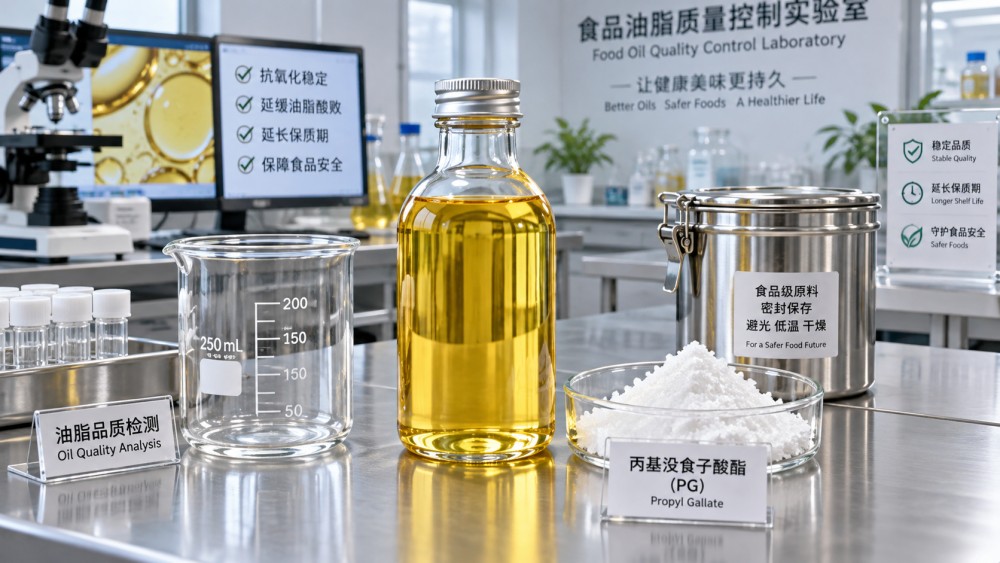
Propyl gallate is a phenolic antioxidant used to interrupt free-radical oxidation in fats and oils. In practical terms, it helps slow the chain reactions that turn a fresh oil into a product with rancid notes and declining sensory quality. It is particularly relevant when the formulation contains oxidation-sensitive lipids and requires protection during storage or distribution.
The material is generally worth evaluating in oil-rich systems such as edible oils, shortenings, bakery fats, snack seasonings, dry mixes containing fat, flavor oils, and lipid-containing food ingredients. It can also be relevant in selected non-food formulations where oxidation of an oil phase affects odor, color, viscosity, or functional stability. The application still needs to be assessed on its own chemistry; “oil-based” is not enough information to predict performance.
Its strongest case is usually a formulation with a clear oil phase, a realistic need for shelf-life protection, and a manufacturing process that allows good dispersion before oxidation has advanced. A late addition to already stressed oil may reduce further deterioration, but it cannot restore oxidation damage that has already developed.
The decision is driven by the oil, not the antioxidant name
Oil stability begins with the lipid itself. Oils rich in more oxidation-prone unsaturated components generally place a higher burden on the antioxidant system than more stable fats. Natural minor components, refining history, residual moisture, trace metals, and prior thermal exposure can change the result substantially even when two oils share the same broad description.
For this reason, a propyl gallate antioxidant should be assessed against the actual commercial material, not an idealized specification. Ask whether incoming oil quality varies by origin or season, whether the oil is blended, and whether it has already experienced high-temperature processing before the antioxidant is added. Batch variation can make an apparently successful antioxidant program inconsistent.
Use it as part of an oxidation-control system
A common selection mistake is treating antioxidant choice as a one-ingredient decision. Oxidation is influenced by oxygen exposure, light, temperature, trace metal contamination, headspace, packaging barrier performance, and handling time. Propyl gallate can address one part of that problem, but it does not compensate for poor oil handling or unsuitable packaging.
In many oil systems, technical teams evaluate propyl gallate alongside other antioxidants or synergistic components. The objective is not to create the longest ingredient list. It is to assign each component a useful role. One antioxidant may be selected for compatibility with the lipid phase, while another component supports performance by reducing the catalytic effect of metal traces. Packaging and nitrogen management, where appropriate to the product and process, can reduce the oxidative burden before the formula has to carry it.
This combined approach matters especially for oils that face several stresses at once: warm filling, oxygen pickup during transfer, transparent packaging, long distribution routes, or inclusion of mineral-containing ingredients. When these conditions are present, an apparently weak result may reflect an uncontrolled system rather than a poor antioxidant.
Processing temperature changes the answer
Propyl gallate should be considered in relation to the full temperature history of the product. The relevant question is not merely the maximum setpoint on a production line. It is how long the oil remains hot, whether air is entrained during mixing, whether the product passes through multiple heating steps, and whether the antioxidant is added before or after the most severe treatment.
For products in which the principal oxidation risk occurs during ambient storage after manufacture, an antioxidant added at the right stage can be highly useful. For applications dominated by repeated high-temperature exposure, the selection becomes more demanding. Heat accelerates oxidation, and continuous contact with air can overwhelm a strategy designed mainly for packaged shelf life.
Technical teams should avoid assuming that an antioxidant suitable for a stored oil will automatically be suitable for every frying, roasting, extrusion, or high-temperature fat-processing situation. The chemical environment and the practical definition of “stable” differ. A system may still meet basic analytical targets while developing sensory changes that are unacceptable in the finished product.
Solubility and addition method can decide performance
Propyl gallate needs to be dispersed effectively in the phase it is intended to protect. A technically appropriate antioxidant can underperform when it is added through an unsuitable carrier, mixed for too short a time, or introduced after the oil has cooled or thickened enough to limit uniform distribution.
Review the supplier’s physical form and handling guidance before committing to a formulation. The addition route should fit the plant’s actual process: direct oil addition, premixing with a compatible ingredient, dosing into a blend tank, or incorporation through an oil-based flavor or seasoning phase. Laboratory samples often receive more controlled mixing than production batches, so scale-up should specifically examine blend uniformity.
In emulsified products, the issue is more complex. Oxidation often concentrates near the oil-water interface, where pro-oxidants, proteins, salts, and surface-active ingredients can interact. A material selected only because it dissolves in the bulk oil may not provide the desired protection at that interface. The formulation may require an antioxidant strategy designed for the emulsion structure rather than for the oil alone.
Regulatory and label fit should be screened early
For food applications, antioxidant selection is inseparable from permitted uses, product category, use conditions, and destination market. The same formulation may be sold into channels with different ingredient expectations, customer standards, or label preferences. Screening these requirements early avoids spending development time on a technically effective option that cannot support the intended commercial route.
The same discipline applies outside food. A lubricant, cosmetic raw material, flavor carrier, or industrial specialty formulation can have its own documentation, purity, residual, and customer-specification requirements. A purchasing decision based only on assay and price misses the operational questions that later delay approval: batch consistency, identity documentation, impurity profile, packaging compatibility, storage conditions, and change-control practices.
FCAS supports this type of evaluation by organizing antioxidants and other food and specialty chemical ingredients around application performance, formulation compatibility, handling, and supply considerations rather than treating chemical names as interchangeable commodities.
When another approach may be better
Propyl gallate is not the default answer when the formula requires a particular consumer-facing label position, when the main oxidative risk lies in a water-rich or interfacial region, or when severe thermal abuse is the dominant challenge. In those cases, another antioxidant, a different combination of stabilizers, improved metal control, or packaging changes may provide a more appropriate solution.
It may also be the wrong starting point when the primary issue is not oxidation. Hydrolytic rancidity, contamination, poor refining quality, microbial spoilage, flavor scalping by packaging, and light-induced degradation can all produce quality failures that resemble a general “shelf-life problem.” Adding more antioxidant will not correct the underlying mechanism.
A practical evaluation sequence
- Define the failure you need to prevent. Identify whether the concern is odor, flavor, color, viscosity, analytical oxidation markers, or a combination of these.
- Map the oil’s stress history. Include refining, heating, blending, transfer, oxygen exposure, light exposure, storage temperature, and expected distribution time.
- Check formula compatibility. Confirm solubility, dispersion route, interactions with flavors, emulsifiers, minerals, and other stabilizers.
- Screen commercial constraints early. Include destination-market requirements, customer specifications, label expectations, and required supplier documentation.
- Compare the complete system. Test propyl gallate against relevant alternatives or combinations under conditions that resemble production and intended storage, not only a simplified bench sample.
- Review production controls. Check whether packaging, headspace, tank practices, and metal-contact points are creating oxidative stress that formulation changes alone cannot overcome.
Questions that often change the selection
Should propyl gallate be used alone?
It can be evaluated alone, but many demanding oil systems benefit from a coordinated stabilization approach. Whether a combination is justified depends on the oil, process stress, packaging, and the specific mechanism driving deterioration.
Does a higher addition level automatically give better stability?
No. Performance does not always improve proportionally with use level, and the practical limit may be set by formulation, sensory, regulatory, or commercial constraints. The right level is the one that delivers the required stability within the full product specification.
Can it solve rancidity in an already oxidized oil?
No. An antioxidant slows ongoing oxidative reactions; it does not remove existing rancid compounds or reverse prior damage. Incoming oil quality remains a basic control point.
The most defensible choice is to select propyl gallate when it matches the oil phase, the expected storage challenge, the manufacturing route, and the permitted product position. Evaluate it as one element of a controlled stability program, then confirm that the program works in the real package and process conditions the product will face.
Related News
 Supercritical CO2 Essential OilsHow Are Food Grade Essential Oil Extracts Made with CO2?Discover how food grade essential oil extracts are made with CO2, what shapes their flavor, and how to assess safety and suitability for food applications.MORE+
 Ultra-pure Semiconductor CleanersHow to Choose Electronic Cleaning Chemicals for Corrosion ProtectionElectronic cleaning chemicals corrosion protection starts with the right selection. Discover how to assess compatibility, residues, drying, and safety.MORE+
 Microencapsulated FragrancesHow Can Microencapsulation Help Essential Oil Blends Last Longer?Essential Oil Blends can retain their aroma longer with the right microencapsulation strategy. Explore carrier choices, release mechanisms, and stability testing.MORE+
 Synthesis CAPEX & Yield ROIWhat Affects the Triple Superphosphate Bulk Price?Explore what affects triple superphosphate bulk price, from raw materials and freight to quality and demand, and learn how to compare offers with confidence.MORE+
 Antioxidants & Natural PreservativesHow Do Food Preservation Ingredients Extend Shelf Life?Food Preservation Ingredients extend shelf life by slowing microbial growth and oxidation. Discover how to select and validate the right solution for your product.MORE+
 EPA FIFRA & FDA GRAS RegsEPA Issues Cancellation Order Affecting Certain Pesticide RegistrationsEPA pesticide registration cancellations may affect select products and supply chains. Learn what businesses should verify before making purchasing decisions.MORE+
 Chelated Trace Element FertilizersHow to Apply Single Superphosphate for Sulfur Deficient SoilLearn how to apply single superphosphate for sulfur deficient soil, calculate the right rate, and balance phosphorus needs for healthier crops.MORE+
 Heavy-duty Industrial DegreasersHow to Choose Parts Wash Cleaners for Spray WashersChoose parts wash cleaners for spray washers with confidence. Compare cleaning power, material compatibility, foam control, safety, and supplier support.MORE+
 Polymer-Coated Water Soluble NPKHow to Use Calcium Nitrate Fertilizer in Drip IrrigationCalcium Nitrate Fertilizer in drip irrigation: learn how to calculate doses, mix stock solutions, prevent clogged emitters, and support healthy crops.MORE+
 Micelle Fluidics & ChelationHow Venturi Fertigation Systems Control Fertilizer InjectionDiscover how venturi fertigation systems control fertilizer injection, and learn how pressure, sizing, and calibration affect dosing accuracy.MORE+
 Nano-microcapsule FormulationsHow to Choose a Capsule Suspension Pesticides SupplierChoose a capsule suspension pesticides supplier with confidence. Compare formulation quality, regulatory documentation, delivery reliability and total costs.MORE+
 Polymer-Coated Water Soluble NPK2026 Fertilizer Price Swings Shape 2027 Planting Decisions2026 fertilizer price swings are shaping 2027 planting decisions. Explore nutrient cost pressures and practical strategies for planning purchases.MORE+
 EPA FIFRA & FDA GRAS RegsEPA Reviews Glyphosate Safety, With Decision Expected in Early 2027EPA glyphosate safety review: Discover what the decision expected in early 2027 could mean for health, the environment, and businesses.MORE+
 Targeted Bio-pesticides & APIsHow Are Fungicide APIs Used in Crop Protection Products?Fungicide APIs for crop protection power disease control products. Discover how formulation, application and resistance management affect results.MORE+
 Ultra-pure Semiconductor CleanersWhat Affects the Bulk Price of Semiconductor Process Cleaners?Semiconductor process cleaners bulk price depends on purity, packaging, logistics, and more. Discover how to compare quotes and control costs.MORE+
 Microencapsulated FragrancesHow to Choose a Fragrance Capsules Manufacturer for Your ProductChoose the right fragrance capsules manufacturer with practical tips on formulation testing, quality specifications, compliance, and supply reliability.MORE+
 Targeted Bio-pesticides & APIsHow to Evaluate Quality Control at a Botanical Insecticides FactoryEvaluate a botanical insecticides factory with practical checks for sourcing, testing, batch traceability and stability. Learn how to identify quality risks before choosing a supplier.MORE+
 Herbicides & Plant Growth RegulatorsHow Do Herbicide Intermediates Affect Production Yield?Discover how Herbicide Intermediates influence production yield, from impurity control to product recovery, and learn how to evaluate suppliers with confidence.MORE+
 EPA FIFRA & FDA GRAS RegsEPA Seeks Comment on Voluntary Pesticide Registration CancellationsEPA pesticide registration cancellations are open for public comment. Discover what the proposed changes could mean for product uses, compliance and supply.MORE+
 Polymer-Coated Water Soluble NPKRecord Fertilizer Prices Could Shape 2027 US Corn and Soybean Planting DecisionsRecord fertilizer prices could influence 2027 US corn and soybean planting decisions. Explore the potential impact on farm budgets and acreage.MORE+
 Non-ionic Surfactants & DefoamersChoosing Low Residue Surfactants for Hard Surface CleaningLow residue surfactants for hard surface cleaning: discover how to compare cleaning performance, rinseability, residue testing, and total cost.MORE+
 Ultra-pure Semiconductor CleanersHow to Evaluate Low Ionic Electronic Grade Cleaners for ChipmakingDiscover how to evaluate low ionic electronic grade cleaners for chipmaking, from surface residue and material compatibility to supplier qualification.MORE+
 Zero-Calorie Sweeteners & AcidulantsHow to Use High Sweetness Sucralose in Reduced-Sugar DrinksDiscover how to use high sweetness sucralose in reduced-sugar drinks, with practical tips for balancing taste, mouthfeel, stability, and compliance.MORE+
 Herbicides & Plant Growth RegulatorsHow to Choose Crop Protection Chemicals for Effective Weed ControlChoose Crop Protection Chemicals with confidence. Discover how to match herbicides to weeds, crop stages, field conditions, and resistance risks for effective control.MORE+
 Hydrocolloids & EmulsifiersHow Do Hydrocolloid Gums Improve Texture and Stability in Foods?Discover how hydrocolloid gums improve food texture and stability, and learn how to choose the right gum for your formulation.MORE+
 Polymer-Coated Water Soluble NPKUSDA Announces $1.34 Billion Investment to Expand Domestic Fertilizer SupplyUSDA’s $1.34 billion fertilizer investment targets eight domestic projects. Discover what the plans could mean for suppliers, buyers and future sourcing.MORE+
 Non-ionic Surfactants & DefoamersEPA Adopts Human Airway Tissue Method for Surfactant Inhalation Risk AssessmentEPA surfactant inhalation risk assessment may use human airway tissue. Explore potential impacts for industrial cleaners and the details still to verify.MORE+
 Polymer-Coated Water Soluble NPKHow to Choose a Potassium Sulfate Fertilizer SupplierChoose a potassium sulfate fertilizer supplier with confidence. Compare product quality, delivered costs, reliability, and contract terms before you buy.MORE+
 Micelle Fluidics & ChelationHow to Use Cocamidopropyl Betaine for Hand Soap FormulasDiscover how to use cocamidopropyl betaine for hand soap, balance surfactants, adjust pH and viscosity, and troubleshoot common formulation issues.MORE+
 Antioxidants & Natural PreservativesWhat Drives Antioxidant Blends Bulk Price Changes?Discover what drives antioxidant blends bulk price changes, from ingredient costs to delivery terms, and learn how to compare quotes for better value.MORE+
 Non-ionic Surfactants & DefoamersWhy Do Low Foam Linear Alcohol Ethoxylates Still Cause Foam?Why do low foam linear alcohol ethoxylates still foam? Discover common causes and practical troubleshooting tips to restore consistent performance.MORE+
 Maillard Reaction Savory FlavorsHow Does an Ethyl Maltol Factory Control Product Quality?How does an ethyl maltol factory ensure consistent quality? Explore testing, contamination controls, traceability, and key questions to ask suppliers.MORE+
 Herbicides & Plant Growth RegulatorsBayer Launches First Group 12 Pre-Emergence Herbicide Convintro in the USBayer's Convintro brings a Group 12 pre-emergence herbicide option to US corn and soybean growers. Explore its potential role and key purchasing considerations.MORE+
 Herbicides & Plant Growth RegulatorsCalifornia Report Shows Continued Decline in High-Risk Pesticide UseCalifornia pesticide use reportedly declined 28% for carcinogen-classified products. Explore what this could mean for suppliers, buyers and market access.MORE+
 Controlled-Release ThermodynamicsHow to Select a Microcrystalline Cellulose Excipient for TabletsChoose the right microcrystalline cellulose excipient for tablets. Compare MCC grades, processing properties, and supplier documentation with this practical guide.MORE+
 Targeted Bio-pesticides & APIsHow Microbial Insecticides for Public Health Control MosquitoesDiscover how microbial insecticides for public health control mosquito larvae, and learn how to choose formulations and improve field results.MORE+
 Non-ionic Surfactants & DefoamersHow to Measure Foam Control Efficiency in Cleaning DefoamersMeasure cleaning defoamers foam control efficiency with practical tests, dose-response analysis, and plant trials to find the right solution for your process.MORE+
 Hydrocolloids & EmulsifiersHow to Use Hydrocolloid Stabilizer Blends for SaucesDiscover how to use hydrocolloid stabilizer blends for sauces to improve texture, prevent separation, and achieve consistent results from trial to production.MORE+
 Maillard Reaction Savory FlavorsHow Spray Dried Flavors Retain Flavor in Dry Food MixesDiscover how Spray Dried Flavors preserve aroma in dry food mixes, and learn how formulation, storage and packaging influence flavor quality.MORE+
 Micelle Fluidics & ChelationHow to Evaluate an Industrial Dispersants ManufacturerEvaluate an industrial dispersants manufacturer with confidence. Learn how to assess formulation performance, batch consistency, quality controls and supply risk.MORE+