What to Check Before Sourcing Butylparaben for Personal Care Formulas
Buying butylparaben for a personal care formula is a control decision, not a routine purchase of a low-dose preservative ingredient. A material can meet a stated assay requirement and still create avoidable problems through incomplete regulatory support, poor batch-to-batch consistency, unsuitable physical form, weak traceability, or incompatibility with the finished system.
For quality and safety teams, the first question is whether butylparaben is appropriate for the target product and intended markets. The second is whether a prospective supplier can provide material whose identity, impurity profile, documentation, and handling controls remain reliable after the first approved sample. Unit price matters, particularly where preservation systems are used across multiple SKUs, but the lowest quoted price can become expensive if it causes reformulation work, a release hold, a documentation gap, or a finished-product stability issue.
Start with market eligibility, not the supplier quotation
Butylparaben is a preservative used in some personal care applications, often as part of a broader preservation approach. Its acceptability is not a universal formulation decision. It depends on where the finished product will be sold, the product category, the intended use pattern, the concentration in the final formula, and the way the ingredient is declared or supported in product documentation.
This check should happen before procurement compares offers. A buyer may find a technically suitable grade with an attractive cost structure, only to learn later that the target market, retailer policy, brand standard, or customer formulation brief excludes parabens or requires documentation that the supplier cannot support. That is a commercial constraint as much as a regulatory one.
Quality and regulatory teams should define the purchase brief in practical terms:
- Finished-product markets, including export destinations and any future launch markets already under consideration.
- Product format: rinse-off, leave-on, eye-area, lip-area, baby, intimate-care, aerosol, wipe, or other use cases that may receive additional internal scrutiny.
- The intended concentration of butylparaben in the finished product, accounting for any premixes or intermediate bases.
- Applicable legal restrictions and labeling requirements for the final product, assessed by the responsible regulatory function.
- Brand, retailer, customer, or contract-manufacturing restrictions that may be stricter than the legal baseline.
- Whether the preservation system will include other antimicrobial ingredients, chelators, multifunctional materials, or packaging-based protection measures.
A supplier statement that a material is “cosmetic grade” is not a substitute for this assessment. That phrase may describe a commercial grade designation, but it does not establish suitability for every personal care formula or every destination market. The finished-product manufacturer remains responsible for deciding whether the formula, use conditions, and product information meet its obligations.
Translate “purity” into a usable specification
Assay is necessary, but it is only one part of a purchase specification. A high assay result does not reveal every quality risk relevant to a preservative used at low levels. For butylparaben for personal care, the specification should describe the material in a way that supports identity confirmation, safe formulation use, repeatable processing, and investigation of any deviation.
At a minimum, procurement should align the supplier’s certificate of analysis with an internally approved specification covering identity, assay, appearance, melting behavior where relevant, moisture or loss on drying, residue on ignition or ash where relevant, and defined limits for impurities. The precise methods and limits should be selected by the buyer’s technical and quality teams for the intended application; copying a supplier’s generic sheet without review can leave important gaps.
Impurity control deserves particular attention. The source, route of manufacture, purification method, and starting-material controls can influence the impurity pattern even when two suppliers report similar assay values. Request clarity on specified related substances, residual solvents where applicable, and controls relevant to the manufacturing route. A vague statement that impurities are “within standard” is difficult to defend during a supplier audit or a product investigation unless the standard, analytical method, acceptance limit, and reporting practice are all clear.
For a new source, a representative certificate from a single batch is useful but insufficient. Ask for multiple recent certificates, ideally covering normal production lots rather than a specially prepared qualification sample. Review the spread in assay, moisture, particle characteristics, and any reported impurities. Consistency across lots often matters more than a particularly strong result on one sample.
Physical properties should also be connected to the manufacturing process. Butylparaben may be supplied as crystals, flakes, powder, or another defined form. Particle size distribution, bulk density, flow behavior, dust generation, and dissolution time can affect weighing accuracy, worker handling, and batch cycle time. A change in material form may not alter the chemical identity, yet it can change how quickly the preservative dissolves or disperses in an oil phase, solvent system, or heated processing step.
Check formulation fit before approving a second source
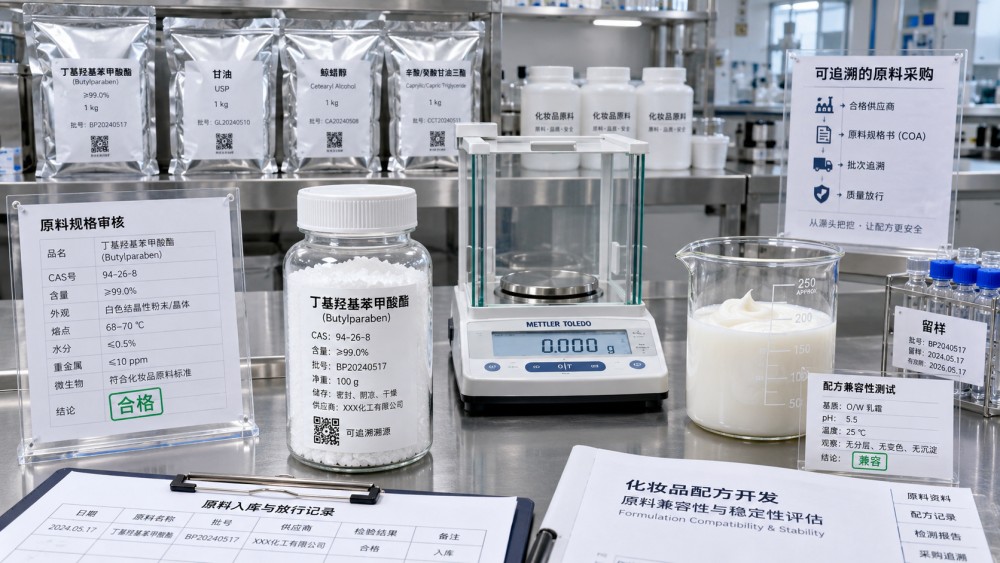
Preservative sourcing should be tied to finished-formula behavior, not just raw-material release testing. Butylparaben has formulation constraints that need to be understood in the actual system: solubility, processing temperature, phase location, pH conditions, interaction with surfactants or polymers, and the effect of packaging over the planned shelf life.
A material that works in an anhydrous fragrance base may behave differently in an emulsion, a high-surfactant wash, a water-rich cream, or a system containing substantial levels of salts, extracts, proteins, clays, or botanical materials. Formula complexity can raise microbial challenge and also make preservative distribution less predictable. The supplier’s recommended use guidance can inform development, but it cannot replace evaluation in the buyer’s own formula.
For a source change, the qualification package should be proportionate to risk. A direct replacement in a mature, simple formula may require a focused comparison. A new source for a leave-on emulsion, a high-value export product, or a formula already operating near a preservation limit warrants broader verification. Typical checks may include:
- Solubility and incorporation behavior under the intended processing sequence.
- Appearance, odor, viscosity, pH, and emulsion stability after pilot manufacture.
- Comparison of preserved formula performance under the company’s applicable microbiological test program.
- Accelerated and real-time stability observations according to the product’s established protocol.
- Compatibility with the proposed primary pack, including discoloration, odor change, adsorption concerns, and product leakage or separation.
- Confirmation that the finished-product concentration remains within the approved formula and regulatory assessment.
Microbiological performance cannot be inferred from raw-material purity alone. A clean butylparaben lot does not prove that a finished lotion, shampoo, or cleansing product has an adequate preservation system. The efficacy outcome depends on the whole formulation, process hygiene, water quality, filling conditions, packaging, consumer-use exposure, and the distribution of the preservative between phases.
There is also a practical cost issue. If a lower-priced butylparaben requires longer heating, additional solvent, altered batch sequencing, or greater use of co-preservatives to achieve comparable formula performance, the apparent saving may disappear. Procurement should therefore compare delivered formulation cost and validation burden, rather than focusing only on cost per kilogram.
Evaluate the supplier as a controlled source of evidence
A capable supplier provides more than a technical data sheet and a competitive offer. It can explain how the material is identified, tested, released, packed, stored, and traced. For quality teams, this evidence reduces uncertainty when an out-of-specification result, customer question, or finished-goods complaint occurs months after receipt.
Documentation should be reviewed for completeness and internal consistency. At a practical level, the buyer should obtain and assess the current specification, certificate of analysis format, safety data sheet, technical data sheet, composition or ingredient statement as needed, allergen or other customer-requested declarations where relevant, and regulatory-support documents appropriate to the intended markets. Documents should identify the manufacturer or responsible supply-chain party, material name, grade, revision status, and a clear connection to the purchased item.
Pay attention to documents that appear polished but provide little usable detail. A certificate that reports only assay and appearance may be inadequate if the approved specification includes impurity limits, water content, or particle controls. A safety data sheet may be current while the specification is obsolete. A distributor can provide effective local service, but quality teams should still establish who actually manufactures the material, who performs release testing, and how the distributor maintains traceability through storage and repacking.
Supplier qualification should also examine change management. Chemical producers may change a synthesis route, raw-material source, test method, production site, packaging component, or specification limit without changing the commercial product name. These changes may be technically reasonable, but a personal care manufacturer needs advance notice when they could affect formula behavior, regulatory support, or internal approval status.
Include written expectations for notification of material changes, deviations, site transfers, significant analytical-method changes, and packaging changes. The agreement should state what information will be provided, how much notice is expected, and whether the buyer can review or requalify the material before the changed product is shipped. This matters particularly when one raw material supports a large number of products and a formula change would be costly to manage.
Do not treat packaging and logistics as minor details
Butylparaben is typically purchased in quantities that may remain in a warehouse after opening, so packaging integrity and storage instructions have direct quality consequences. The pack should protect the material from conditions that could compromise identity, cleanliness, handling, or traceability. It should also fit the plant’s dispensing controls.
Check the container type, liner arrangement, tamper evidence, label content, net-weight tolerance, batch identification, retest or expiry date, and recommended storage conditions. For materials received through long distribution routes, clarify who is responsible for inspection after transport damage, how temperature or humidity excursions are handled where relevant, and whether partial containers can be returned or replaced under the supplier’s quality process.
Internal controls should continue after receipt. Incoming inspection should verify identity, label-to-document match, container condition, seal status, lot number, and quantity before release to production. Once opened, the material needs a defined status label, controlled resealing method, access restriction, and use-by approach consistent with the supplier’s instructions and the manufacturer’s own quality system. Cross-contamination and mix-up risks can be more consequential than a minor assay difference, especially in facilities handling many visually similar white powders.
Build the purchase decision around total risk, not annual volume alone
For a recurring butylparaben purchase, a practical decision matrix can prevent price from overwhelming the factors that protect product release. A quality-approved source should be assessed against regulatory fit, specification adequacy, historical consistency, formula qualification results, document reliability, change-control commitment, packaging performance, lead time, and supply continuity. Price can then be evaluated alongside the cost of testing, validation, inventory holding, and contingency sourcing.
Dual sourcing can improve resilience, but only when both sources are genuinely qualified. Keeping an untested “backup supplier” on a purchasing list may provide little help during a shortage, because the business still has to complete document review, laboratory assessment, pilot work, and preservation verification before the material can be safely used. For high-volume or business-critical formulas, qualifying an alternate source before disruption occurs is often more valuable than negotiating a small reduction in the primary supplier’s unit price.
The strongest sourcing decision for butylparaben is therefore a documented link between regulatory review, raw-material specification, supplier evidence, and finished-formula qualification. When those four elements agree, procurement has a sound basis for comparing cost. When any one of them is unresolved, a low quotation is simply an early number in a much larger risk calculation.
Related News
 Supercritical CO2 Essential OilsHow Are Food Grade Essential Oil Extracts Made with CO2?Discover how food grade essential oil extracts are made with CO2, what shapes their flavor, and how to assess safety and suitability for food applications.MORE+
 Ultra-pure Semiconductor CleanersHow to Choose Electronic Cleaning Chemicals for Corrosion ProtectionElectronic cleaning chemicals corrosion protection starts with the right selection. Discover how to assess compatibility, residues, drying, and safety.MORE+
 Microencapsulated FragrancesHow Can Microencapsulation Help Essential Oil Blends Last Longer?Essential Oil Blends can retain their aroma longer with the right microencapsulation strategy. Explore carrier choices, release mechanisms, and stability testing.MORE+
 Synthesis CAPEX & Yield ROIWhat Affects the Triple Superphosphate Bulk Price?Explore what affects triple superphosphate bulk price, from raw materials and freight to quality and demand, and learn how to compare offers with confidence.MORE+
 Antioxidants & Natural PreservativesHow Do Food Preservation Ingredients Extend Shelf Life?Food Preservation Ingredients extend shelf life by slowing microbial growth and oxidation. Discover how to select and validate the right solution for your product.MORE+
 EPA FIFRA & FDA GRAS RegsEPA Issues Cancellation Order Affecting Certain Pesticide RegistrationsEPA pesticide registration cancellations may affect select products and supply chains. Learn what businesses should verify before making purchasing decisions.MORE+
 Chelated Trace Element FertilizersHow to Apply Single Superphosphate for Sulfur Deficient SoilLearn how to apply single superphosphate for sulfur deficient soil, calculate the right rate, and balance phosphorus needs for healthier crops.MORE+
 Heavy-duty Industrial DegreasersHow to Choose Parts Wash Cleaners for Spray WashersChoose parts wash cleaners for spray washers with confidence. Compare cleaning power, material compatibility, foam control, safety, and supplier support.MORE+
 Polymer-Coated Water Soluble NPKHow to Use Calcium Nitrate Fertilizer in Drip IrrigationCalcium Nitrate Fertilizer in drip irrigation: learn how to calculate doses, mix stock solutions, prevent clogged emitters, and support healthy crops.MORE+
 Micelle Fluidics & ChelationHow Venturi Fertigation Systems Control Fertilizer InjectionDiscover how venturi fertigation systems control fertilizer injection, and learn how pressure, sizing, and calibration affect dosing accuracy.MORE+
 Nano-microcapsule FormulationsHow to Choose a Capsule Suspension Pesticides SupplierChoose a capsule suspension pesticides supplier with confidence. Compare formulation quality, regulatory documentation, delivery reliability and total costs.MORE+
 Polymer-Coated Water Soluble NPK2026 Fertilizer Price Swings Shape 2027 Planting Decisions2026 fertilizer price swings are shaping 2027 planting decisions. Explore nutrient cost pressures and practical strategies for planning purchases.MORE+
 EPA FIFRA & FDA GRAS RegsEPA Reviews Glyphosate Safety, With Decision Expected in Early 2027EPA glyphosate safety review: Discover what the decision expected in early 2027 could mean for health, the environment, and businesses.MORE+
 Targeted Bio-pesticides & APIsHow Are Fungicide APIs Used in Crop Protection Products?Fungicide APIs for crop protection power disease control products. Discover how formulation, application and resistance management affect results.MORE+
 Ultra-pure Semiconductor CleanersWhat Affects the Bulk Price of Semiconductor Process Cleaners?Semiconductor process cleaners bulk price depends on purity, packaging, logistics, and more. Discover how to compare quotes and control costs.MORE+
 Microencapsulated FragrancesHow to Choose a Fragrance Capsules Manufacturer for Your ProductChoose the right fragrance capsules manufacturer with practical tips on formulation testing, quality specifications, compliance, and supply reliability.MORE+
 Targeted Bio-pesticides & APIsHow to Evaluate Quality Control at a Botanical Insecticides FactoryEvaluate a botanical insecticides factory with practical checks for sourcing, testing, batch traceability and stability. Learn how to identify quality risks before choosing a supplier.MORE+
 Herbicides & Plant Growth RegulatorsHow Do Herbicide Intermediates Affect Production Yield?Discover how Herbicide Intermediates influence production yield, from impurity control to product recovery, and learn how to evaluate suppliers with confidence.MORE+
 EPA FIFRA & FDA GRAS RegsEPA Seeks Comment on Voluntary Pesticide Registration CancellationsEPA pesticide registration cancellations are open for public comment. Discover what the proposed changes could mean for product uses, compliance and supply.MORE+
 Polymer-Coated Water Soluble NPKRecord Fertilizer Prices Could Shape 2027 US Corn and Soybean Planting DecisionsRecord fertilizer prices could influence 2027 US corn and soybean planting decisions. Explore the potential impact on farm budgets and acreage.MORE+
 Non-ionic Surfactants & DefoamersChoosing Low Residue Surfactants for Hard Surface CleaningLow residue surfactants for hard surface cleaning: discover how to compare cleaning performance, rinseability, residue testing, and total cost.MORE+
 Ultra-pure Semiconductor CleanersHow to Evaluate Low Ionic Electronic Grade Cleaners for ChipmakingDiscover how to evaluate low ionic electronic grade cleaners for chipmaking, from surface residue and material compatibility to supplier qualification.MORE+
 Zero-Calorie Sweeteners & AcidulantsHow to Use High Sweetness Sucralose in Reduced-Sugar DrinksDiscover how to use high sweetness sucralose in reduced-sugar drinks, with practical tips for balancing taste, mouthfeel, stability, and compliance.MORE+
 Herbicides & Plant Growth RegulatorsHow to Choose Crop Protection Chemicals for Effective Weed ControlChoose Crop Protection Chemicals with confidence. Discover how to match herbicides to weeds, crop stages, field conditions, and resistance risks for effective control.MORE+
 Hydrocolloids & EmulsifiersHow Do Hydrocolloid Gums Improve Texture and Stability in Foods?Discover how hydrocolloid gums improve food texture and stability, and learn how to choose the right gum for your formulation.MORE+
 Polymer-Coated Water Soluble NPKUSDA Announces $1.34 Billion Investment to Expand Domestic Fertilizer SupplyUSDA’s $1.34 billion fertilizer investment targets eight domestic projects. Discover what the plans could mean for suppliers, buyers and future sourcing.MORE+
 Non-ionic Surfactants & DefoamersEPA Adopts Human Airway Tissue Method for Surfactant Inhalation Risk AssessmentEPA surfactant inhalation risk assessment may use human airway tissue. Explore potential impacts for industrial cleaners and the details still to verify.MORE+
 Polymer-Coated Water Soluble NPKHow to Choose a Potassium Sulfate Fertilizer SupplierChoose a potassium sulfate fertilizer supplier with confidence. Compare product quality, delivered costs, reliability, and contract terms before you buy.MORE+
 Micelle Fluidics & ChelationHow to Use Cocamidopropyl Betaine for Hand Soap FormulasDiscover how to use cocamidopropyl betaine for hand soap, balance surfactants, adjust pH and viscosity, and troubleshoot common formulation issues.MORE+
 Antioxidants & Natural PreservativesWhat Drives Antioxidant Blends Bulk Price Changes?Discover what drives antioxidant blends bulk price changes, from ingredient costs to delivery terms, and learn how to compare quotes for better value.MORE+
 Non-ionic Surfactants & DefoamersWhy Do Low Foam Linear Alcohol Ethoxylates Still Cause Foam?Why do low foam linear alcohol ethoxylates still foam? Discover common causes and practical troubleshooting tips to restore consistent performance.MORE+
 Maillard Reaction Savory FlavorsHow Does an Ethyl Maltol Factory Control Product Quality?How does an ethyl maltol factory ensure consistent quality? Explore testing, contamination controls, traceability, and key questions to ask suppliers.MORE+
 Herbicides & Plant Growth RegulatorsBayer Launches First Group 12 Pre-Emergence Herbicide Convintro in the USBayer's Convintro brings a Group 12 pre-emergence herbicide option to US corn and soybean growers. Explore its potential role and key purchasing considerations.MORE+
 Herbicides & Plant Growth RegulatorsCalifornia Report Shows Continued Decline in High-Risk Pesticide UseCalifornia pesticide use reportedly declined 28% for carcinogen-classified products. Explore what this could mean for suppliers, buyers and market access.MORE+
 Controlled-Release ThermodynamicsHow to Select a Microcrystalline Cellulose Excipient for TabletsChoose the right microcrystalline cellulose excipient for tablets. Compare MCC grades, processing properties, and supplier documentation with this practical guide.MORE+
 Targeted Bio-pesticides & APIsHow Microbial Insecticides for Public Health Control MosquitoesDiscover how microbial insecticides for public health control mosquito larvae, and learn how to choose formulations and improve field results.MORE+
 Non-ionic Surfactants & DefoamersHow to Measure Foam Control Efficiency in Cleaning DefoamersMeasure cleaning defoamers foam control efficiency with practical tests, dose-response analysis, and plant trials to find the right solution for your process.MORE+
 Hydrocolloids & EmulsifiersHow to Use Hydrocolloid Stabilizer Blends for SaucesDiscover how to use hydrocolloid stabilizer blends for sauces to improve texture, prevent separation, and achieve consistent results from trial to production.MORE+
 Maillard Reaction Savory FlavorsHow Spray Dried Flavors Retain Flavor in Dry Food MixesDiscover how Spray Dried Flavors preserve aroma in dry food mixes, and learn how formulation, storage and packaging influence flavor quality.MORE+
 Micelle Fluidics & ChelationHow to Evaluate an Industrial Dispersants ManufacturerEvaluate an industrial dispersants manufacturer with confidence. Learn how to assess formulation performance, batch consistency, quality controls and supply risk.MORE+