What Quality Checks Matter When Sourcing Butylparaben for Personal Care
Assay Is a Starting Point, Not a Sourcing Decision
A high assay result can confirm that a butylparaben lot contains the intended preservative, but it does not by itself establish whether the material is suitable for a personal care production line. For procurement teams, the more useful question is whether the supplier can repeatedly deliver a material with a controlled impurity profile, usable physical form, complete documentation, and predictable behavior in the intended formulation.
That distinction matters because butylparaben is typically purchased to support preservation systems in products where appearance, odor, stability, and regulatory positioning all affect the commercial outcome. A lot can meet a broad purity specification and still create problems through unexpected color, insoluble particles, variable particle size, residual process-related materials, weak traceability, or incomplete declarations. The price difference between suppliers can look attractive until a reformulation delay, rejected batch, or documentation gap turns a low-cost purchase into an avoidable expense.
For buyers sourcing butylparaben for personal care, the most consequential checks usually fall into four areas: identity and purity, impurity control, physical and formulation suitability, and supplier quality systems. The priority assigned to each should reflect the product category, destination markets, existing preservative system, and the buyer's tolerance for qualification risk.
Start With the Specification That the Formula Actually Needs
Procurement specifications are sometimes copied from an existing certificate of analysis or reduced to a minimum assay requirement. That approach can work for a well-established source with extensive history, but it is weak when onboarding a new supplier or buying into a sensitive formulation. The specification should distinguish between release criteria that affect every incoming lot and supplementary information needed to qualify the source.
Identity confirmation should be unambiguous. The purchase specification, certificate of analysis, safety documentation, and regulatory declarations should consistently identify the substance, its chemical form, and relevant identifiers. Mismatches between documents may be administrative, but they can also signal poor document control. It is more efficient to resolve them before a shipment enters production than after quality control has sampled a warehouse receipt.
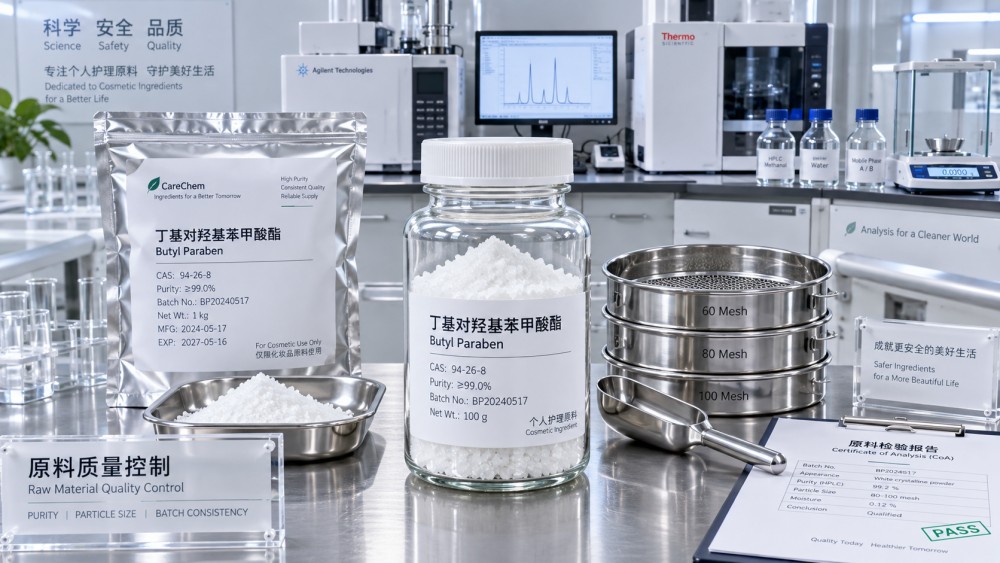
Assay remains important because it supports dose calculation and consistency. Yet a buyer should also ask how the assay is measured, whether the method is suitable for the material supplied, and whether the supplier's reported result is tied to the specific batch rather than a generic product specification. A certificate that lists only a passing result without method detail, batch number, manufacturing date, or retest date offers less assurance than one that provides a traceable batch record.
For a new source, it is reasonable to compare the supplier's analytical method with the method used by the receiving laboratory or a qualified third-party laboratory. The goal is not to force identical equipment or procedures. It is to understand whether different methods could produce materially different conclusions near a specification limit. This is particularly important when procurement is comparing offers that appear equivalent on paper but use different reporting conventions.
Check the limits, not only the typical values
Suppliers often present typical assay, appearance, or melting-point values in technical literature. Typical values are useful for describing a normal production range, but the contractual question is the permitted limit on the certificate of analysis. A quoted price should be compared against the guaranteed specification, not against the best-looking value in a brochure or sample batch.
Buyers should also examine how much operating room exists between the proposed material's guaranteed limits and the formulation team's internal needs. If the formula is sensitive to discoloration, odor, insoluble matter, or preservative-system balance, a material that merely meets a broad external specification may create recurring investigation work. A tighter material specification can be economically justified when it reduces finished-goods risk.
Impurity Profile Often Explains the Difference Between Comparable Offers
Butylparaben quality cannot be judged solely by the percentage assigned to the main component. The impurity profile matters because low-level components may affect odor, color, solubility, stability, or the acceptability of the finished product in a particular market. Procurement does not need to become an analytical chemistry function, but it should ensure that technical and regulatory teams have enough information to assess the source.
Ask suppliers to describe the relevant related substances and process-related impurities covered by their control strategy. A credible response should explain which impurities are routinely monitored, how limits are established, and whether the supplier can provide additional data under an appropriate confidentiality arrangement. A generic statement that impurities are "within specification" is less useful if neither the specification nor the controlled substances are identified.
Residual solvents may also require attention. Their relevance depends on the manufacturing route, the level present, internal product requirements, and destination-market expectations. The practical procurement question is whether the supplier has a defined testing approach and can supply a batch-specific declaration or result when required. The same principle applies to elemental impurities or other contaminants that may be relevant to a company's risk assessment.
Color and odor are often treated as minor physical observations, yet both can have a disproportionate impact in lightly fragranced, white, clear, or naturally positioned personal care products. A raw material may appear acceptable in an isolated sample but contribute to an objectionable sensory change after heating, storage, or interaction with fragrance components. For high-visibility formulas, buyers should ask the formulation team to set meaningful acceptance criteria rather than accepting a vague description such as "white powder" or "characteristic odor."
A supplier change should not be approved solely because a retained sample looks similar. The qualification sample should be assessed under the same dissolution, heating, cooling, and storage conditions that expose the preservative to the realities of manufacturing. This does not require exhaustive testing for every purchase order. It does require a structured initial comparison before the source becomes operationally important.
Physical Form Can Affect Manufacturing More Than Expected
Butylparaben has limited utility if it cannot be incorporated consistently into the selected formulation process. Its performance in a preservative system depends on the overall formula, the solvent phase, pH, surfactants, emulsifiers, processing temperature, and other preservation-supporting ingredients. Procurement should therefore avoid treating raw-material acceptance as separate from process compatibility.
Particle size distribution, bulk density, flowability, moisture, and agglomeration can influence weighing accuracy, dust control, dispersion time, and dissolution behavior. A material that is chemically compliant but physically different from the qualified source may slow charging operations or leave undissolved material in the batch. These issues become more costly when a plant runs large vessels, automated feeding, or tightly scheduled campaigns.
Not every application requires a narrow particle-size range. A supplier should not be asked for tighter controls simply because they sound more rigorous. The appropriate requirement depends on how the material is handled. Direct addition into a heated phase, pre-dissolution in a suitable carrier, and use in a liquid preservative blend each create different tolerances for particle characteristics. The purchasing specification should reflect that process reality.
- For powdered raw material handling, review flow behavior, dust management, pack-to-pack consistency, and ease of emptying.
- For products requiring dissolution, evaluate dissolution time and visible residue under actual processing conditions.
- For clear or low-color products, assess haze, particulate matter, and color contribution after storage testing.
- For emulsions and surfactant-rich systems, assess compatibility with the complete preservative package rather than the parabens in isolation.
Microbiological quality should also be addressed in proportion to the application. Butylparaben itself is used as a preservative ingredient, but that does not remove the need for appropriate incoming-material hygiene and packaging control. A microbiological specification or statement may be relevant where internal procedures, customer requirements, or the nature of the final product call for it. The useful question is whether the supplier's controls match the buyer's risk profile, not whether every chemical powder should be managed as though it were a finished cosmetic product.
Documentation Determines Whether the Material Can Move Through the Business
A technically acceptable lot can still be commercially unusable if the documentation does not support product registration, customer questionnaires, audits, or internal release. This risk is particularly acute when personal care products are sold across multiple markets or manufactured for brand owners with detailed restricted-substance policies.
Before approving a supplier, procurement should obtain the documents that regulatory, quality, and product-development teams need to make their own decisions. Depending on the business and destination market, this may include a current safety data sheet, technical data sheet, batch-specific certificate of analysis, statement of composition or origin where relevant, allergen and animal-origin declarations where requested, and information supporting applicable cosmetic ingredient or chemical inventory assessments.
No document package should be treated as permanently sufficient. Product stewardship information can change when a supplier changes a synthesis route, production site, raw-material source, analytical method, specification, packaging component, or quality-system ownership. A supplier's change-notification commitment therefore has operational value. Buyers need to know which changes will be communicated, how much notice is normally provided, and whether approval is required before supply resumes.
Regulatory status deserves a separate review because an ingredient's acceptability is not determined simply by whether it has been used in personal care elsewhere. Requirements can differ by market, concentration, product category, labeling approach, and the composition of the complete finished product. Procurement should avoid accepting broad claims such as "cosmetic grade" as a substitute for a market-specific assessment by the responsible regulatory function.
Packaging, Traceability, and Storage Are Cost Controls
Packaging is sometimes reduced to a logistics discussion, but it protects material quality and traceability. Buyers should confirm the pack size, inner liner or barrier arrangement, label information, lot coding, tamper evidence where needed, and pallet configuration. The best format is not necessarily the smallest or most robust package; it is the format that protects the material while fitting the receiving site's consumption rate, handling equipment, and inventory controls.
Damaged packaging, weak lot identification, or a certificate that cannot be matched to physical containers complicates investigation and raises the risk of accidental use. For a preservative component used across multiple formulations, traceability should allow the manufacturer to connect incoming containers, production batches, retained samples, and finished-product records without relying on manual reconstruction.
Storage and retest information should be reviewed before a buyer builds inventory around a new source. Long lead times may encourage larger purchases, but excess inventory can increase exposure to packaging degradation, documentation expiry, or loss of flexibility if specifications change. The lowest unit price is not automatically the lowest landed cost when it requires higher safety stock or creates a higher probability of write-off.
Qualify the Supplier, Not Just the Sample
A laboratory sample can demonstrate potential compatibility. It cannot prove that commercial lots will have the same quality, lead time, documentation discipline, and change-control performance. Supplier qualification should therefore examine the manufacturing and supply system behind the sample.
Useful questions include whether the supplier is the manufacturer or a distributor, whether the manufacturing site is identified, how batch records and retained samples are managed, whether multiple sites can supply the same grade, and what happens when a nonconforming lot is identified after delivery. Procurement should also understand the chain of custody if material passes through repacking, consolidation, or regional warehousing.
Second-source approval is valuable, but only when it is genuinely usable. A backup supplier with different impurity limits, different physical form, incomplete documents, or untested formulation behavior is a contingency on paper rather than a reliable supply option. A practical dual-source strategy qualifies the alternative against the attributes that matter to the finished product, then maintains enough commercial engagement to keep that source viable.
For routine buying, the most efficient approach is often a tiered incoming-control plan. New suppliers, changed manufacturing sites, and high-risk applications receive deeper review and formulation confirmation. Established suppliers with stable performance may be managed through batch certificate review, periodic verification, and documented supplier-performance monitoring. This focuses laboratory and quality resources where they reduce the most risk.
Build the Purchase Decision Around Total Cost of Use
The right buying decision for butylparaben for personal care balances material price with the cost of qualification, testing, inventory, production handling, regulatory review, and supply interruption. A lower-priced offer may be appropriate when the supplier meets the required specification, provides a transparent impurity and documentation package, and performs consistently in the intended formula. It becomes a false economy when quality teams must repeatedly investigate variation or when the material creates uncertainty in products with narrow appearance or compliance margins.
Before issuing a long-term order, procurement should align with formulation, quality, and regulatory stakeholders on a short list of non-negotiable attributes: assay and identity, controlled impurities, physical handling requirements, batch documentation, packaging and traceability, change notification, and qualification testing appropriate to the formula. That list gives suppliers a clear basis for quotation and gives internal teams a defensible way to compare offers that may otherwise look identical on price and headline purity.
Related News
 Supercritical CO2 Essential OilsHow Are Food Grade Essential Oil Extracts Made with CO2?Discover how food grade essential oil extracts are made with CO2, what shapes their flavor, and how to assess safety and suitability for food applications.MORE+
 Ultra-pure Semiconductor CleanersHow to Choose Electronic Cleaning Chemicals for Corrosion ProtectionElectronic cleaning chemicals corrosion protection starts with the right selection. Discover how to assess compatibility, residues, drying, and safety.MORE+
 Microencapsulated FragrancesHow Can Microencapsulation Help Essential Oil Blends Last Longer?Essential Oil Blends can retain their aroma longer with the right microencapsulation strategy. Explore carrier choices, release mechanisms, and stability testing.MORE+
 Synthesis CAPEX & Yield ROIWhat Affects the Triple Superphosphate Bulk Price?Explore what affects triple superphosphate bulk price, from raw materials and freight to quality and demand, and learn how to compare offers with confidence.MORE+
 Antioxidants & Natural PreservativesHow Do Food Preservation Ingredients Extend Shelf Life?Food Preservation Ingredients extend shelf life by slowing microbial growth and oxidation. Discover how to select and validate the right solution for your product.MORE+
 EPA FIFRA & FDA GRAS RegsEPA Issues Cancellation Order Affecting Certain Pesticide RegistrationsEPA pesticide registration cancellations may affect select products and supply chains. Learn what businesses should verify before making purchasing decisions.MORE+
 Chelated Trace Element FertilizersHow to Apply Single Superphosphate for Sulfur Deficient SoilLearn how to apply single superphosphate for sulfur deficient soil, calculate the right rate, and balance phosphorus needs for healthier crops.MORE+
 Heavy-duty Industrial DegreasersHow to Choose Parts Wash Cleaners for Spray WashersChoose parts wash cleaners for spray washers with confidence. Compare cleaning power, material compatibility, foam control, safety, and supplier support.MORE+
 Polymer-Coated Water Soluble NPKHow to Use Calcium Nitrate Fertilizer in Drip IrrigationCalcium Nitrate Fertilizer in drip irrigation: learn how to calculate doses, mix stock solutions, prevent clogged emitters, and support healthy crops.MORE+
 Micelle Fluidics & ChelationHow Venturi Fertigation Systems Control Fertilizer InjectionDiscover how venturi fertigation systems control fertilizer injection, and learn how pressure, sizing, and calibration affect dosing accuracy.MORE+
 Nano-microcapsule FormulationsHow to Choose a Capsule Suspension Pesticides SupplierChoose a capsule suspension pesticides supplier with confidence. Compare formulation quality, regulatory documentation, delivery reliability and total costs.MORE+
 Polymer-Coated Water Soluble NPK2026 Fertilizer Price Swings Shape 2027 Planting Decisions2026 fertilizer price swings are shaping 2027 planting decisions. Explore nutrient cost pressures and practical strategies for planning purchases.MORE+
 EPA FIFRA & FDA GRAS RegsEPA Reviews Glyphosate Safety, With Decision Expected in Early 2027EPA glyphosate safety review: Discover what the decision expected in early 2027 could mean for health, the environment, and businesses.MORE+
 Targeted Bio-pesticides & APIsHow Are Fungicide APIs Used in Crop Protection Products?Fungicide APIs for crop protection power disease control products. Discover how formulation, application and resistance management affect results.MORE+
 Ultra-pure Semiconductor CleanersWhat Affects the Bulk Price of Semiconductor Process Cleaners?Semiconductor process cleaners bulk price depends on purity, packaging, logistics, and more. Discover how to compare quotes and control costs.MORE+
 Microencapsulated FragrancesHow to Choose a Fragrance Capsules Manufacturer for Your ProductChoose the right fragrance capsules manufacturer with practical tips on formulation testing, quality specifications, compliance, and supply reliability.MORE+
 Targeted Bio-pesticides & APIsHow to Evaluate Quality Control at a Botanical Insecticides FactoryEvaluate a botanical insecticides factory with practical checks for sourcing, testing, batch traceability and stability. Learn how to identify quality risks before choosing a supplier.MORE+
 Herbicides & Plant Growth RegulatorsHow Do Herbicide Intermediates Affect Production Yield?Discover how Herbicide Intermediates influence production yield, from impurity control to product recovery, and learn how to evaluate suppliers with confidence.MORE+
 EPA FIFRA & FDA GRAS RegsEPA Seeks Comment on Voluntary Pesticide Registration CancellationsEPA pesticide registration cancellations are open for public comment. Discover what the proposed changes could mean for product uses, compliance and supply.MORE+
 Polymer-Coated Water Soluble NPKRecord Fertilizer Prices Could Shape 2027 US Corn and Soybean Planting DecisionsRecord fertilizer prices could influence 2027 US corn and soybean planting decisions. Explore the potential impact on farm budgets and acreage.MORE+
 Non-ionic Surfactants & DefoamersChoosing Low Residue Surfactants for Hard Surface CleaningLow residue surfactants for hard surface cleaning: discover how to compare cleaning performance, rinseability, residue testing, and total cost.MORE+
 Ultra-pure Semiconductor CleanersHow to Evaluate Low Ionic Electronic Grade Cleaners for ChipmakingDiscover how to evaluate low ionic electronic grade cleaners for chipmaking, from surface residue and material compatibility to supplier qualification.MORE+
 Zero-Calorie Sweeteners & AcidulantsHow to Use High Sweetness Sucralose in Reduced-Sugar DrinksDiscover how to use high sweetness sucralose in reduced-sugar drinks, with practical tips for balancing taste, mouthfeel, stability, and compliance.MORE+
 Herbicides & Plant Growth RegulatorsHow to Choose Crop Protection Chemicals for Effective Weed ControlChoose Crop Protection Chemicals with confidence. Discover how to match herbicides to weeds, crop stages, field conditions, and resistance risks for effective control.MORE+
 Hydrocolloids & EmulsifiersHow Do Hydrocolloid Gums Improve Texture and Stability in Foods?Discover how hydrocolloid gums improve food texture and stability, and learn how to choose the right gum for your formulation.MORE+
 Polymer-Coated Water Soluble NPKUSDA Announces $1.34 Billion Investment to Expand Domestic Fertilizer SupplyUSDA’s $1.34 billion fertilizer investment targets eight domestic projects. Discover what the plans could mean for suppliers, buyers and future sourcing.MORE+
 Non-ionic Surfactants & DefoamersEPA Adopts Human Airway Tissue Method for Surfactant Inhalation Risk AssessmentEPA surfactant inhalation risk assessment may use human airway tissue. Explore potential impacts for industrial cleaners and the details still to verify.MORE+
 Polymer-Coated Water Soluble NPKHow to Choose a Potassium Sulfate Fertilizer SupplierChoose a potassium sulfate fertilizer supplier with confidence. Compare product quality, delivered costs, reliability, and contract terms before you buy.MORE+
 Micelle Fluidics & ChelationHow to Use Cocamidopropyl Betaine for Hand Soap FormulasDiscover how to use cocamidopropyl betaine for hand soap, balance surfactants, adjust pH and viscosity, and troubleshoot common formulation issues.MORE+
 Antioxidants & Natural PreservativesWhat Drives Antioxidant Blends Bulk Price Changes?Discover what drives antioxidant blends bulk price changes, from ingredient costs to delivery terms, and learn how to compare quotes for better value.MORE+
 Non-ionic Surfactants & DefoamersWhy Do Low Foam Linear Alcohol Ethoxylates Still Cause Foam?Why do low foam linear alcohol ethoxylates still foam? Discover common causes and practical troubleshooting tips to restore consistent performance.MORE+
 Maillard Reaction Savory FlavorsHow Does an Ethyl Maltol Factory Control Product Quality?How does an ethyl maltol factory ensure consistent quality? Explore testing, contamination controls, traceability, and key questions to ask suppliers.MORE+
 Herbicides & Plant Growth RegulatorsBayer Launches First Group 12 Pre-Emergence Herbicide Convintro in the USBayer's Convintro brings a Group 12 pre-emergence herbicide option to US corn and soybean growers. Explore its potential role and key purchasing considerations.MORE+
 Herbicides & Plant Growth RegulatorsCalifornia Report Shows Continued Decline in High-Risk Pesticide UseCalifornia pesticide use reportedly declined 28% for carcinogen-classified products. Explore what this could mean for suppliers, buyers and market access.MORE+
 Controlled-Release ThermodynamicsHow to Select a Microcrystalline Cellulose Excipient for TabletsChoose the right microcrystalline cellulose excipient for tablets. Compare MCC grades, processing properties, and supplier documentation with this practical guide.MORE+
 Targeted Bio-pesticides & APIsHow Microbial Insecticides for Public Health Control MosquitoesDiscover how microbial insecticides for public health control mosquito larvae, and learn how to choose formulations and improve field results.MORE+
 Non-ionic Surfactants & DefoamersHow to Measure Foam Control Efficiency in Cleaning DefoamersMeasure cleaning defoamers foam control efficiency with practical tests, dose-response analysis, and plant trials to find the right solution for your process.MORE+
 Hydrocolloids & EmulsifiersHow to Use Hydrocolloid Stabilizer Blends for SaucesDiscover how to use hydrocolloid stabilizer blends for sauces to improve texture, prevent separation, and achieve consistent results from trial to production.MORE+
 Maillard Reaction Savory FlavorsHow Spray Dried Flavors Retain Flavor in Dry Food MixesDiscover how Spray Dried Flavors preserve aroma in dry food mixes, and learn how formulation, storage and packaging influence flavor quality.MORE+
 Micelle Fluidics & ChelationHow to Evaluate an Industrial Dispersants ManufacturerEvaluate an industrial dispersants manufacturer with confidence. Learn how to assess formulation performance, batch consistency, quality controls and supply risk.MORE+