
Why High Terpinen Tea Tree Oil Quality Depends on Chemotype and Testing
A high-terpinen tea tree oil sample cannot be judged reliably from aroma, color, or a single headline assay value. Its quality rests on whether the oil represents the intended chemotype, whether the compositional profile is analytically credible, and whether that profile remains stable from production through use. An oil with an appealing fresh, medicinal odor can still be unsuitable when its terpinen-4-ol level, minor-component balance, oxidation state, or origin evidence does not align with the required specification.
Tea tree oil is a natural distillate rather than a single purified chemical. Its composition reflects plant genetics, growing conditions, harvest timing, leaf condition, distillation practice, storage, and subsequent handling. This creates a practical distinction between an oil that merely contains terpinenes and an oil with a verified composition appropriate for performance-sensitive fragrance, personal care, hygiene, or formulation work.
Chemotype Defines the Starting Point
A chemotype is a chemically distinct expression within plant material associated with a botanical source. In tea tree oil assessment, the chemotype establishes the expected balance of terpinen-4-ol, gamma-terpinene, alpha-terpinene, terpinolene, 1,8-cineole, alpha-terpineol, and other naturally occurring constituents. The profile matters because these components do not contribute equally to odor, stability, compatibility, or biological activity.
Terpinen-4-ol commonly receives the greatest attention because it is a principal characteristic constituent associated with the desired tea tree profile. However, treating its concentration as a complete quality verdict is a common analytical error. A sample can meet a terpinen-4-ol target while showing an unusual distribution of related monoterpenes, elevated oxidation markers, or evidence of dilution. Such a sample may smell broadly recognizable yet behave differently in a finished formula.
The surrounding compositional pattern gives terpinen-4-ol its meaning. Gamma-terpinene and alpha-terpinene are relevant both as natural profile markers and as oxidation-sensitive precursors. 1,8-cineole requires particular attention because an elevated level can shift odor character and alter the expected profile. Minor constituents also contribute to the fingerprint. They should not be dismissed as analytical noise when their presence, absence, or disproportionate level conflicts with the stated material identity.
Chemotype confirmation is therefore an identity exercise before it becomes a pass-or-fail assay exercise. A narrow specification that names only one or two constituents leaves too much room for material that appears compliant on paper while differing materially from the intended natural oil.
Why a Single Assay Result Is Insufficient
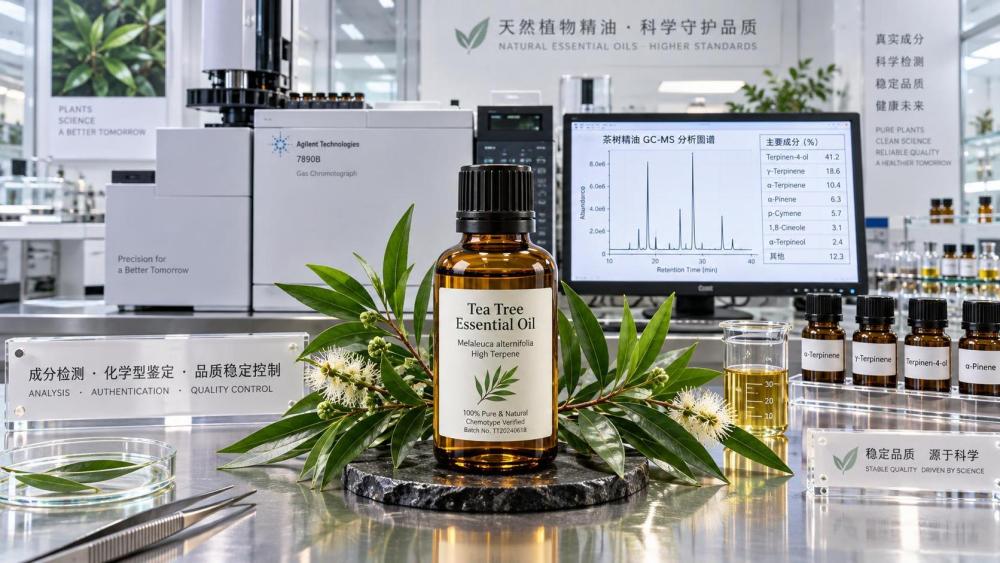
Gas chromatography is central to essential-oil evaluation because volatile constituents can be separated into a profile rather than viewed as one combined signal. A certificate stating a terpinen-4-ol result without the associated chromatogram, method conditions, peak identification approach, or full composition table has limited diagnostic value. It reports an outcome but does not allow meaningful review of how the outcome fits the rest of the oil.
Routine GC with flame ionization detection is useful for compositional quantification when retention times, standards, response assumptions, and integration practices are controlled. GC-MS adds a further identity layer by comparing mass spectral information with expected constituents. Neither technique automatically guarantees authenticity. Results remain dependent on sample preparation, column selection, reference materials, integration settings, library matches, and the analyst's treatment of co-eluting peaks.
A robust review looks for agreement across several types of evidence:
- Full GC profile: The major peaks should form a plausible pattern for the declared tea tree chemotype, rather than simply presenting an acceptable terpinen-4-ol area percentage.
- Peak assignments: Constituents with close retention behavior require defensible identification. A library suggestion alone is weaker than confirmation using standards, retention indices, or an established validated method.
- Batch comparison: Natural variation is expected, but a sequence of batches should not show unexplained profile shifts, missing minor peaks, or abrupt changes in the ratio between related terpenes.
- Orthogonal observations: Relative density, refractive index, optical rotation where relevant, sensory assessment, and oxidation-related testing can expose inconsistencies that a selected GC result does not reveal.
Chromatographic area percentages also need to be interpreted carefully. They are usually a composition estimate based on detector response and method assumptions; they are not necessarily an absolute mass measurement of every compound. If a requirement depends on an exact quantitative threshold, the method basis, calibration strategy, and reporting convention need to be understood before comparing results from different laboratories.
Reading the Chromatogram as a Quality Record
A chromatogram is often more informative than a compact specification sheet because it preserves the shape of the compositional evidence. Review begins with the dominant peaks, but the less prominent portion deserves attention. Unexpected peaks can arise from adulteration, cross-contamination, processing residues, degraded components, or legitimate natural variation. The correct interpretation depends on pattern and provenance, not on the mere presence of an unfamiliar signal.
For example, an oil supplemented with isolated terpinen-4-ol could potentially improve one reported assay value while flattening the natural relationship among other constituents. Conversely, a batch produced from genuine material can vary because of seasonal conditions or distillation cut management. The first situation raises an authenticity concern; the second requires comparison with documented historical ranges and a reasoned explanation. A rigid comparison with one reference chromatogram can wrongly reject authentic variability, while overly broad limits can conceal an altered oil.
Retention time alone should not be treated as conclusive identity proof. It moves with column condition, carrier-gas flow, temperature program, and instrument configuration. Retention index data, authenticated reference compounds, and mass spectra strengthen identification. When an unusual peak materially affects acceptance, it is better to investigate it than to classify it as “other” and proceed.
Chromatogram review should also include baseline quality, unresolved peak clusters, manual integration decisions, and detector overload. A poorly separated trace may still produce a clean-looking numeric report, especially where a target constituent overlaps with a neighboring component. Re-analysis on an alternative column polarity or through a corroborating laboratory method can be justified when a result lies close to a contractual limit or contradicts the sensory profile.
Oxidation Changes Both Composition and Use Behavior
Freshness is not a cosmetic attribute in tea tree oil. The terpene-rich fraction is vulnerable to oxygen, light, and heat. As oxidation progresses, original hydrocarbons can form peroxides and oxygenated secondary products. The odor may become harsher, stale, resinous, or less characteristic, although sensory change alone is not sufficiently reliable for release decisions.
Oxidized material can present a more serious formulation issue than a modest variation in the main terpinenes. Reactive oxidation products may affect fragrance consistency, color stability, odor persistence, and skin-contact suitability. The exact risk depends on concentration in the finished product, exposure route, co-formulants, packaging, and the applicable safety assessment. A fresh GC profile that omits oxidation testing can therefore leave an important quality question unanswered.
Peroxide value is commonly used as one indicator of primary oxidation, but its limitations matter. Peroxides may rise during early oxidation and later decline as they decompose into secondary products. A low result does not always prove that an older oil is intact. It should be read alongside storage history, odor, chromatographic changes, and, where justified, complementary indicators of oxidative deterioration.
Sampling and retained samples are part of this control. Testing a newly filled production sample does not establish the condition of the material delivered months later. Retention samples stored under defined conditions make it possible to distinguish a production issue from deterioration during warehousing or transport. Without that comparison, an out-of-specification complaint can lead to an incorrect conclusion about the original batch.
Storage and Packaging Are Analytical Variables
The composition reported at release only remains meaningful when packaging and storage protect the oil. Oxygen headspace, repeated opening of partially used containers, clear packaging, elevated warehouse temperature, and contact with unsuitable closures all accelerate uncertainty. Large containers opened repeatedly for dispensing experience a different exposure pattern from sealed small packs, even when both originated from the same lot.
Suitable packaging normally minimizes light exposure and limits air exchange. Container, cap liner, gasket, transfer hose, pump, and sampling device should be compatible with an aromatic, terpene-rich liquid. Material compatibility is not limited to leakage or visible swelling. Extractables, odor transfer, adsorption, and trace contamination can affect a high-value oil before obvious physical failure occurs.
Lot segregation is equally important. Combining residual material from several drums may create a blend for which the original certificate no longer represents the actual composition. Reworked material needs its own identity and testing record. A retained quantity from each incoming lot, a controlled blending record, and a final composite test reduce ambiguity when results differ between incoming inspection and finished-product production.
Specification Design Should Reflect the Intended Use
A meaningful specification has an identity layer, a compositional layer, and a condition layer. Identity establishes the botanical and chemotype claim. Composition sets justified ranges for selected major and diagnostic minor constituents. Condition addresses oxidation, appearance, odor, and physical properties appropriate to the agreed material. Documentation connects the laboratory sample to the shipment, container labels, production lot, and analytical report.
The limits should be connected to formulation sensitivity. A material used at a low level in a wash-off product may tolerate a wider natural range than an oil used as a prominent fragrance note or in a system where odor consistency is tightly controlled. Likewise, a specification built only around a recognized compositional standard may be incomplete where internal formula stability requires additional controls on color, peroxide development, or trace contaminants.
Standards are useful reference points, but compliance language should be precise. A supplier statement that an oil “meets standard” is only meaningful when the applicable edition, test method, acceptance limits, sampling basis, and lot identity are clear. A standard profile does not replace a formulation-specific compatibility assessment, and it does not excuse inadequate traceability.
Traceability Connects the Sample to the Material
Analytical results are valuable only when the tested aliquot demonstrably represents the supplied batch. The laboratory report should be linked to a unique lot code, sampling date, sample seal or custody record where appropriate, production or distillation date, and container identification. A generic certificate reused across multiple lots cannot establish batch consistency.
Sampling itself can distort results if volatile oils are drawn from poorly mixed blended stock, sampled through contaminated equipment, or left in loosely sealed vials before analysis. Amber glass vials with compatible closures, minimal headspace, prompt sealing, and documented sample handling reduce avoidable variation. The same discipline applies when a referee sample is retained for dispute resolution.
High quality is therefore demonstrated through a coherent evidence chain: a chemotype-consistent profile, analytically sound testing, controlled oxidation exposure, and records that connect every reported result to the oil actually received. When those elements agree, terpinen-4-ol becomes a useful quality indicator rather than an isolated number asked to carry the entire decision.
Related News
 Antioxidants & Natural PreservativesWhat Quality Checks Matter When Sourcing Butylparaben for Personal CareButylparaben for personal care sourcing guide: compare assay, impurities, physical performance, documentation, traceability, and supplier quality to reduce formulation risk.MORE+
 Nano-microcapsule FormulationsHow Encapsulated Flavors Protect Taste During Processing and StorageEncapsulated Flavors protect taste from heat, oxygen, moisture, and storage loss. Explore smarter release, carrier selection, and processing strategies.MORE+
 Chelated Trace Element FertilizersHow Greenhouse Fertigation Systems Reduce Water and Fertilizer WasteGreenhouse fertigation systems reduce water and fertilizer waste with precise dosing, uniform irrigation, drainage monitoring, and smarter crop-zone control. Learn practical strategies.MORE+
 Supercritical CO2 Essential OilsHow Natural Essential Oil Blends Improve Consistent Product FragranceNatural essential oil blends help brands achieve consistent, appealing fragrance across batches. Explore smart blend design, stability testing, and product compatibility strategies.MORE+
 Non-ionic Surfactants & DefoamersHow to Choose Non Ionic Low Foaming Surfactants for CIP CleaningNon ionic low foaming surfactants for CIP cleaning: learn how to balance wetting, foam control, compatibility, and rinseability for reliable cleaning performance.MORE+
 Nano-microcapsule FormulationsHow Food Grade Cyclodextrin Complexes Protect Sensitive FlavorsFood grade cyclodextrin inclusion complexes help protect sensitive flavors from oxidation, evaporation, and processing loss while supporting controlled release and consistent sensory quality.MORE+
 Polymer-Coated Water Soluble NPKHow Fertilizer Coating Polymers Improve NPK Granule ReleaseFertilizer coating polymers for NPK granules improve controlled nutrient release, reduce loss risks, and enhance product consistency. Discover key selection and process insights.MORE+
 Chelated Trace Element FertilizersWhat Diammonium Phosphate Means for Crop Nutrition PlanningDiammonium Phosphate: learn how DAP supports early phosphorus access, nitrogen budgeting, smart placement, and balanced crop nutrition planning.MORE+
 Maillard Reaction Savory FlavorsHow to Assess a Flavor Bases Supplier List for Reliable SourcingGlobal Fine Chemicals & Agrochemical Intelligence Network flavor bases supplier list: assess specs, samples, supply risk, and true cost to source with confidence.MORE+
 Hydrocolloids & EmulsifiersHow Konjac Gum Powder Improves Texture in Low-Calorie FoodsKonjac gum powder improves body, stability, and mouthfeel in low-calorie foods. Discover practical tips for smoother sauces, beverages, and reduced-fat formulations.MORE+
 Supercritical CO2 Essential OilsWhat to Check Before Choosing a Botanical Essential Oils ManufacturerChoose a botanical essential oils manufacturer with confidence. Explore key checks for purity, traceability, compliance, batch consistency, and reliable supply.MORE+
 Microencapsulated FragrancesHow Fragrance Carriers for Detergents Improve Scent PerformanceFragrance carriers for detergents improve stability, fabric deposition, and long-lasting scent. Explore practical solutions for better wash-to-wear fragrance performance.MORE+
 Antioxidants & Natural PreservativesWhen Propyl Gallate Antioxidant Is the Right Choice for Oil StabilityPropyl gallate antioxidant: learn when it is the right choice for oil stability, shelf-life protection, processing compatibility, and smarter formulation decisions.MORE+
 Antioxidants & Natural PreservativesHow Potassium Sorbate Extends Shelf Life in Food and Beverage ProductsPotassium Sorbate helps food and beverage brands control yeast and mold spoilage. Explore pH, dosage, processing, and packaging strategies for reliable shelf life.MORE+
 Antioxidants & Natural PreservativesHow to Source Bulk Herbal Extracts With Reliable Quality ControlBulk herbal extracts sourcing guide: compare suppliers, verify traceability, review CoAs, and build reliable quality controls for safer, consistent purchasing.MORE+
 Antioxidants & Natural PreservativesWhat to Check Before Sourcing Butylparaben for Personal Care FormulasButylparaben for personal care sourcing guide: check market eligibility, purity, supplier controls, formula compatibility, packaging, and total risk before buying.MORE+
 Targeted Bio-pesticides & APIsChoosing Microbial Fungicides for Foliar Diseases in Integrated Crop ProgramsMicrobial fungicides for foliar diseases: learn how to match biology, formulation, tank compatibility, and timing for stronger integrated crop protection.MORE+
 Targeted Bio-pesticides & APIsHow Microbial Insecticides Control Caterpillars With Lower Crop Residue RiskMicrobial insecticides for caterpillars help protect crops with targeted early-larval control and lower residue-management pressure. Learn timing, coverage, compliance, and scouting essentials.MORE+
 Microencapsulated FragrancesHow to Add Encapsulated Laundry Fragrances Without Weakening Wash ResultsEncapsulated laundry fragrances: learn how to boost long-lasting scent while protecting cleaning power, stability, foam control, and fabric care.MORE+
 Supercritical CO2 Essential OilsHow Aroma Ingredients Shape Lasting and Skin-Safe Personal Care ProductsAroma ingredients for personal care: discover how to achieve lasting scent, formulation stability, skin safety, and confident product performance.MORE+
 Targeted Bio-pesticides & APIsInsecticides Explained Through Labels, Active Ingredients, and SafetyInsecticides explained through labels, active ingredients, formulations, and safety. Learn how to compare products, manage risk, and make informed crop protection decisions.MORE+
 Heavy-duty Industrial DegreasersHow to Select Parts Wash Cleaners for Automotive ComponentsParts wash cleaners for automotive components: learn how to match chemistry, materials, rinsing, safety, and waste controls for reliable cleaning results.MORE+
 Chelated Trace Element FertilizersHow Precision Fertigation Systems Improve Water and Nutrient ControlPrecision fertigation systems improve water and nutrient control with accurate dosing, uniform irrigation, smart monitoring, and reduced waste. Discover how to optimize crop performance.MORE+
 Hydrocolloids & EmulsifiersHow Bulk Price Factors Affect Hydrocolloid Stabilizer Blend SourcingHydrocolloid stabilizer blends bulk price: compare dosage efficiency, quality consistency, logistics, and documentation to reduce total sourcing costs.MORE+
 Zero-Calorie Sweeteners & AcidulantsHow to Choose a Natural Sweeteners Supplier for Clean-Label ProductsNatural sweeteners supplier selection guide for clean-label products: compare formulation fit, traceability, documentation, and supply reliability.MORE+
 Non-ionic Surfactants & DefoamersWhat Cationic Surfactants Do and Where They Are UsedCationic Surfactants deliver antimicrobial action, conditioning, antistatic control, and surface treatment benefits. Explore key uses, compatibility, and safe selection tips.MORE+
 Targeted Bio-pesticides & APIsHow to Evaluate Pesticide Suspension Concentrates for Field StabilityPesticide Suspension Concentrates: learn how to evaluate field stability, redispersibility, dilution, tank-mix compatibility, and spray safety for reliable performance.MORE+
 Hydrocolloids & EmulsifiersHow Hydrocolloid Systems for Meat Products Improve Texture and YieldHydrocolloid systems for meat products improve yield, texture, water retention, and slicing quality. Explore practical formulation strategies for stable, high-performing meat products.MORE+
 Microencapsulated FragrancesHow Laundry Fragrances for Liquid Detergents Improve Scent LongevityLaundry fragrances for liquid detergents: discover how fragrance design, deposition, and encapsulation create lasting fabric freshness and stronger product appeal.MORE+
 Nano-microcapsule FormulationsChoosing Fragrance Preparations That Perform Well in Personal WashFragrance preparations for personal wash: learn how to select options that protect clarity, stability, foam, scent performance, and packaging compatibility.MORE+
 Controlled-Release ThermodynamicsModified Cyclodextrins Explained for Controlled Fragrance ReleaseModified cyclodextrins enable controlled fragrance release, odor control, and volatile-note protection. Explore how they optimize performance in detergents, fabric care, and more.MORE+
 Microencapsulated FragrancesHow Fragrance Delivery Systems Improve Fabric Softener LongevityFragrance delivery systems for fabric softeners improve scent longevity through smart protection, reliable deposition, and controlled release for lasting freshness.MORE+
 Supercritical CO2 Essential OilsHow to Evaluate a Natural Cardamom Oil Supplier for Reliable SupplyNatural cardamom oil supplier evaluation guide: verify botanical origin, purity, batch consistency, documentation, packaging, and delivery reliability for confident sourcing.MORE+
 Maillard Reaction Savory FlavorsHow Ethyl Maltol Purity Testing Supports Flavor Safety ComplianceEthyl Maltol purity testing strengthens flavor safety compliance through identity checks, impurity profiling, supplier verification, and audit-ready documentation.MORE+
 Microencapsulated FragrancesEssential Oil Extracts Compared for Fragrance and Wellness UsesEssential Oil Extracts compared for fragrance and wellness: explore scent profiles, extraction methods, stability, safety, and sourcing insights for smarter formulation choices.MORE+
 Zero-Calorie Sweeteners & AcidulantsWhat Drives Zero Calorie Sweeteners Bulk Price in 2026Zero calorie sweeteners bulk price in 2026: compare specifications, dosage, quality, freight, and supply risk to make smarter sourcing decisions.MORE+
 EPA FIFRA & FDA GRAS RegsSynthetic Food Preservatives Rules That Support Safer FormulasSynthetic Food Preservatives: learn the rules for safer formulas, compliant use levels, validated shelf life, labeling, and reliable microbial control.MORE+
 Micelle Fluidics & ChelationHow Anionic Industrial Dispersants Improve Coating StabilityAnionic industrial dispersants improve coating stability, pigment wetting, viscosity control, gloss, and storage performance. Learn how to select and test the right solution.MORE+
 Supercritical CO2 Essential OilsHow to Choose Eucalyptus Oil Grades for Clean, Consistent ProductsChoose the right Eucalyptus Oil grade with confidence. Compare cineole content, purity, origin, processing, documentation, and application fit for consistent products.MORE+
 Micelle Fluidics & ChelationWhat Are Cationic Surfactants and Where Are They Commonly Used?Cationic Surfactants deliver powerful surface affinity for disinfection, fabric softening, hair conditioning, antistatic control, and industrial treatments. Explore key uses and selection factors.MORE+







































