
How to Verify Purity and Sourcing of Cosmetic Grade Lavender Oil
“Cosmetic grade” is not a legal guarantee that lavender oil is pure, authentic, or suitable for every skin application. It is a commercial description that can appear on oils with very different botanical origins, extraction methods, levels of documentation, and quality controls. A bottle may smell pleasant and still be diluted, blended with cheaper lavender-related oils, or sold with information too vague to verify.
For a personal-care purchase, the most useful question is not whether the oil is marketed as premium, therapeutic, natural, or cosmetic grade. It is whether the seller can clearly establish what plant was used, where it was sourced, how it was extracted, what the batch contains, and how the oil should be used safely. Those details also explain price differences far better than front-label claims.
Start with the botanical identity, not the common name
“Lavender oil” can refer to oils from several related plants. They are not interchangeable in aroma, chemical profile, cost, or intended use. The ingredient name should identify the species in Latin, ideally on the label, product page, or supporting documentation.
- Lavandula angustifolia is commonly called true lavender, English lavender, or fine lavender. Its oil is widely used in premium fragrance and personal-care applications and is generally the reference point when consumers expect a soft, sweet, floral lavender profile.
- Lavandula × intermedia, often sold as lavandin, is a hybrid. It can produce more oil per hectare and is often less expensive. Its sharper, more camphoraceous scent can work well in soaps, home fragrance, and cleaning products, but it is not the same raw material as true lavender oil.
- Lavandula latifolia, often called spike lavender, has a different aromatic profile and may have a noticeably stronger camphor character. It should not be presented as equivalent to Lavandula angustifolia.
A listing that says only “100% lavender oil” leaves too much unresolved. The phrase may be technically true while still concealing whether the bottle contains true lavender, lavandin, spike lavender, or a blend. A reliable seller should not resist a direct question such as: “Is this oil distilled solely from Lavandula angustifolia, and can you provide the botanical name for the batch currently being sold?”
For cosmetic use, this distinction matters because the sensory character of the oil affects the finished product, while compositional differences influence formulation decisions and skin-use precautions. It also matters commercially: comparing the price of an unspecified “lavender oil” with a documented Lavandula angustifolia oil is not a like-for-like comparison.
What “pure” should mean in a purchase decision
In practical terms, pure lavender essential oil should be the volatile oil obtained from the named lavender plant, without dilution in a carrier oil, addition of synthetic fragrance materials, or undisclosed blending with other essential oils. Purity is different from quality. An oil can be undiluted but poorly stored, oxidized, incorrectly identified, or inconsistent with the botanical source claimed. Conversely, an oil in a finished cosmetic product may be deliberately diluted and still be appropriately formulated; it simply should not be sold as a bottle of pure essential oil.
Several descriptions are often confused with proof of purity:
- “Natural” does not identify the species or exclude undisclosed blending.
- “Therapeutic grade” has no universally recognized technical definition for essential oils.
- “Premium” or “professional” may describe positioning rather than composition.
- “Organic” can be meaningful when backed by a recognizable certification and traceable certification scope, but it does not replace identity testing or batch documentation.
- “GC-MS tested” is stronger than a vague quality claim, but only when the seller can connect the report to the actual batch and explain what the result shows.
The word “cosmetic” adds another layer of confusion. A raw essential oil is not automatically safe to apply directly to skin merely because it is called cosmetic grade. Essential oils are concentrated aromatic substances. Suitability depends on dilution, the rest of the formula, the area of application, exposure frequency, individual sensitivity, and the product’s safety assessment. For leave-on facial products, eye-area products, and products for sensitive skin, the margin for careless use is narrower than it is for a scented candle or a rinse-off soap.
Ask for batch-specific evidence, not general assurances
The strongest consumer-level verification comes from documents that identify a particular production batch. A polished website, a country-of-origin statement, or a generic laboratory image cannot establish that the bottle in hand matches the oil described.
A credible seller should be able to provide, on request, a batch number and a certificate of analysis (CoA) linked to that number. The CoA should normally state the product name, botanical name, batch or lot number, analysis date, and basic physical data such as relative density and refractive index. These measurements alone cannot prove authenticity, but values outside an expected range can indicate that further questions are needed.
For a higher-value purchase or a supplier being considered for repeated use, request a gas chromatography–mass spectrometry report, commonly called a GC-MS report. This technique separates and identifies volatile components in the oil. Lavender oil naturally contains a pattern of aromatic compounds rather than one single “active ingredient.” A qualified interpretation considers the whole profile and the relationship among major and minor constituents, not merely whether linalool and linalyl acetate appear somewhere on the report.
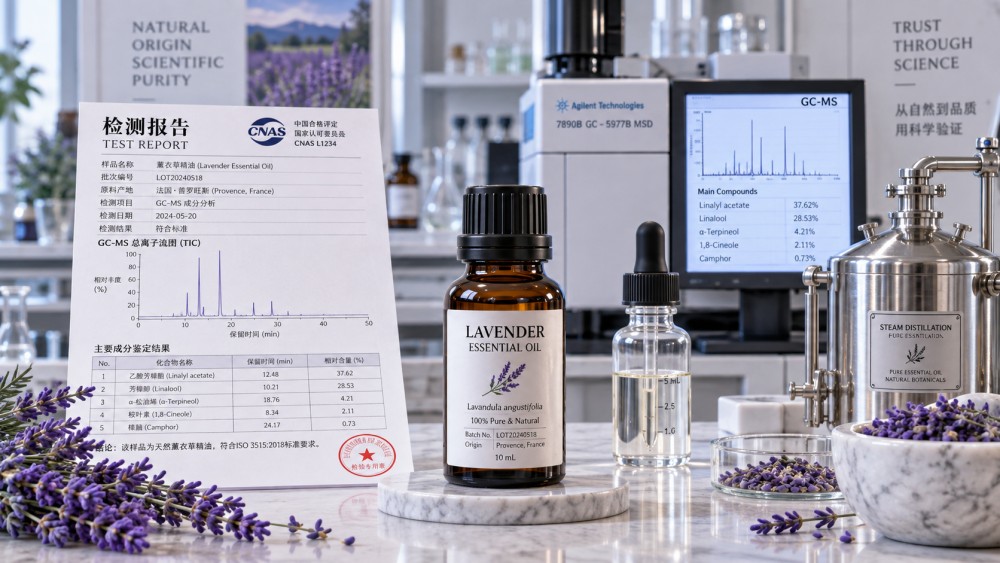
A GC-MS report is useful only if it is readable and traceable. Look for the laboratory name, sample or batch reference, test date, and a list of identified components with percentages. A report with no batch identifier may describe a historical sample rather than the oil currently offered. A document that lists only two or three desirable compounds is incomplete evidence. A seller does not need to disclose every commercial detail of its supply chain, but should be able to establish basic traceability without evasive answers.
It is also reasonable to ask whether the analysis was performed by an independent laboratory or in-house. Neither source is automatically invalid. Independent testing can add confidence, while an in-house report may be useful if the supplier maintains clear quality-control procedures. The critical issue is whether the report is specific, internally consistent, and tied to the actual product lot.
How to read lavender chemistry without treating it as a pass-or-fail checklist
True lavender oil is often associated with linalool and linalyl acetate, but authenticity cannot be judged by demanding one fixed percentage. Natural composition changes with cultivar, growing conditions, harvest timing, distillation practice, storage, and geographic origin. An oil from a legitimate crop can vary from another legitimate crop without being adulterated.
That said, the chemical profile should make botanical sense. A seller offering Lavandula angustifolia should be able to explain a profile that appears unusually harsh, overly camphoraceous, or inconsistent with its stated species. High camphor character may point toward a different lavender species, lavandin, spike lavender, or an undisclosed blend. It is not proof by itself, but it is a reason to seek better documentation.
Adulteration can take several forms. The oil may be extended with inexpensive carrier oils, mixed with lavandin or another essential oil, or supplemented with isolated aroma chemicals to imitate a desired fragrance profile. Sensory evaluation can identify obvious problems, but smell is not a dependable purity test. A sophisticated blend may smell attractive precisely because it has been designed to resemble a familiar lavender profile.
Simple home tests are similarly limited. A paper “evaporation test” may reveal a heavy fixed oil in some cases, but it cannot reliably detect many forms of adulteration. Refrigeration, color, viscosity, and whether an oil dissolves in alcohol are not decisive tests either. They can generate confidence or suspicion without providing a defensible answer. When purity matters, documentation and analytical traceability are more valuable than internet folklore.
Sourcing claims should be specific enough to verify
Lavender is cultivated in multiple regions, and origin can influence aroma and composition. A country name alone, however, is not a quality certificate. “French lavender” may refer to a botanical type, a fragrance style, a supplier location, or the place where the oil was bottled rather than the farm or distillation origin.
Useful sourcing information usually includes the botanical species, country of cultivation or distillation, extraction method, and batch identity. More detailed sellers may also identify the growing region, harvest year, distiller, or whether material was sourced from a named cooperative or farm. Such information does not make an oil automatically superior, but it makes the claim auditable.
Steam distillation is the standard extraction method expected for lavender essential oil. It produces a volatile essential oil and does not require a carrier solvent. If a product is labeled as lavender oil but uses language such as “infused,” “macerated,” or “lavender extract,” it may be a different material entirely. A lavender-infused carrier oil can be useful in skincare, but it should be priced and labeled as an infusion, not presented as pure lavender essential oil.
Pay attention to the ingredient declaration as well. A pure essential oil should not list jojoba, sunflower, mineral oil, or another carrier unless it is intentionally diluted. If fragrance is listed alongside lavender oil, the product may be a fragrance blend rather than a single essential oil. That is not inherently a poor product, but it is not the same purchase.
Price is a signal, not proof
Very low prices deserve scrutiny because genuine Lavandula angustifolia oil requires agricultural production, harvesting, distillation, analytical control, appropriate packaging, and transport. However, a high price does not confirm authenticity. Retail cost also reflects bottle size, packaging, branding, distribution margins, organic certification, market positioning, and whether the company sells directly or through multiple intermediaries.
The most meaningful comparison is the price per milliliter among oils with the same species, similar documentation, and comparable packaging. A small bottle that appears inexpensive may be costly on a unit basis; a large bottle may be poor value if it will oxidize before being used. For occasional personal use, purchasing a modest quantity from a transparent supplier is often more rational than buying a large bottle solely because the unit price is lower.
Costs can also be hidden in poor storage. Lavender oil should be supplied in a tightly closed, light-protective container, preferably amber or another suitable UV-reducing material, and stored away from heat and direct sunlight. Oxidation can alter odor and increase the likelihood of skin sensitization in susceptible individuals. A bargain bottle stored in clear plastic near a warm window is not a bargain if its condition is already compromised.
Safety documentation is relevant, but it does not authenticate the oil
A safety data sheet (SDS) and allergen information can be useful, especially for anyone making soaps, lotions, bath products, or other personal-care preparations. These documents help identify handling considerations and fragrance allergens that may require attention in certain markets or formulations. They should be consistent with the product identity and supplier details.
Still, an SDS is primarily a hazard-communication document. It does not prove that the oil is authentic, freshly distilled, or free from dilution. The same is true of broad statements such as “IFRA compliant.” Fragrance safety guidance can inform use levels in particular product categories, but it is not a certificate of botanical purity and does not replace a product-specific safety evaluation.
For direct skin use, dilution remains important even when an oil is genuine and well documented. Patch testing can help identify individual reactions, but it does not eliminate risk. Avoid applying undiluted lavender oil to broken skin, around the eyes, or to infants without appropriate professional guidance. Anyone with a history of fragrance allergy, eczema, or unexplained reactions to scented products should be especially cautious.
Warning signs that justify walking away
One missing detail does not always indicate fraud; small sellers may have limited technical resources. But several gaps together create a meaningful purchasing risk. Be cautious when a seller cannot name the lavender species, provides no batch number, treats “therapeutic grade” as its only quality evidence, refuses to share even a basic CoA, or offers a laboratory report unrelated to the current stock.
Other concerns include a product described as pure oil while the ingredient list contains carrier oils or fragrance, an implausibly low price for a heavily documented true lavender oil, and contradictory origin claims across the label, website, and marketplace listing. A strong artificial perfume smell, a marked lack of floral complexity, or an unusually camphor-like note may justify questions, but these sensory impressions should lead to document review rather than replace it.
The most dependable purchase is rarely the one with the most elaborate marketing language. It is the one for which the species, extraction method, batch, analytical evidence, storage conditions, and intended use all align. When a seller can show that chain clearly, cosmetic grade lavender oil becomes a traceable ingredient choice rather than a scented gamble.
Related News
 Antioxidants & Natural PreservativesWhat Quality Checks Matter When Sourcing Butylparaben for Personal CareButylparaben for personal care sourcing guide: compare assay, impurities, physical performance, documentation, traceability, and supplier quality to reduce formulation risk.MORE+
 Nano-microcapsule FormulationsHow Encapsulated Flavors Protect Taste During Processing and StorageEncapsulated Flavors protect taste from heat, oxygen, moisture, and storage loss. Explore smarter release, carrier selection, and processing strategies.MORE+
 Chelated Trace Element FertilizersHow Greenhouse Fertigation Systems Reduce Water and Fertilizer WasteGreenhouse fertigation systems reduce water and fertilizer waste with precise dosing, uniform irrigation, drainage monitoring, and smarter crop-zone control. Learn practical strategies.MORE+
 Supercritical CO2 Essential OilsHow Natural Essential Oil Blends Improve Consistent Product FragranceNatural essential oil blends help brands achieve consistent, appealing fragrance across batches. Explore smart blend design, stability testing, and product compatibility strategies.MORE+
 Non-ionic Surfactants & DefoamersHow to Choose Non Ionic Low Foaming Surfactants for CIP CleaningNon ionic low foaming surfactants for CIP cleaning: learn how to balance wetting, foam control, compatibility, and rinseability for reliable cleaning performance.MORE+
 Nano-microcapsule FormulationsHow Food Grade Cyclodextrin Complexes Protect Sensitive FlavorsFood grade cyclodextrin inclusion complexes help protect sensitive flavors from oxidation, evaporation, and processing loss while supporting controlled release and consistent sensory quality.MORE+
 Polymer-Coated Water Soluble NPKHow Fertilizer Coating Polymers Improve NPK Granule ReleaseFertilizer coating polymers for NPK granules improve controlled nutrient release, reduce loss risks, and enhance product consistency. Discover key selection and process insights.MORE+
 Chelated Trace Element FertilizersWhat Diammonium Phosphate Means for Crop Nutrition PlanningDiammonium Phosphate: learn how DAP supports early phosphorus access, nitrogen budgeting, smart placement, and balanced crop nutrition planning.MORE+
 Maillard Reaction Savory FlavorsHow to Assess a Flavor Bases Supplier List for Reliable SourcingGlobal Fine Chemicals & Agrochemical Intelligence Network flavor bases supplier list: assess specs, samples, supply risk, and true cost to source with confidence.MORE+
 Hydrocolloids & EmulsifiersHow Konjac Gum Powder Improves Texture in Low-Calorie FoodsKonjac gum powder improves body, stability, and mouthfeel in low-calorie foods. Discover practical tips for smoother sauces, beverages, and reduced-fat formulations.MORE+
 Supercritical CO2 Essential OilsWhat to Check Before Choosing a Botanical Essential Oils ManufacturerChoose a botanical essential oils manufacturer with confidence. Explore key checks for purity, traceability, compliance, batch consistency, and reliable supply.MORE+
 Microencapsulated FragrancesHow Fragrance Carriers for Detergents Improve Scent PerformanceFragrance carriers for detergents improve stability, fabric deposition, and long-lasting scent. Explore practical solutions for better wash-to-wear fragrance performance.MORE+
 Antioxidants & Natural PreservativesWhen Propyl Gallate Antioxidant Is the Right Choice for Oil StabilityPropyl gallate antioxidant: learn when it is the right choice for oil stability, shelf-life protection, processing compatibility, and smarter formulation decisions.MORE+
 Antioxidants & Natural PreservativesHow Potassium Sorbate Extends Shelf Life in Food and Beverage ProductsPotassium Sorbate helps food and beverage brands control yeast and mold spoilage. Explore pH, dosage, processing, and packaging strategies for reliable shelf life.MORE+
 Antioxidants & Natural PreservativesHow to Source Bulk Herbal Extracts With Reliable Quality ControlBulk herbal extracts sourcing guide: compare suppliers, verify traceability, review CoAs, and build reliable quality controls for safer, consistent purchasing.MORE+
 Antioxidants & Natural PreservativesWhat to Check Before Sourcing Butylparaben for Personal Care FormulasButylparaben for personal care sourcing guide: check market eligibility, purity, supplier controls, formula compatibility, packaging, and total risk before buying.MORE+
 Targeted Bio-pesticides & APIsChoosing Microbial Fungicides for Foliar Diseases in Integrated Crop ProgramsMicrobial fungicides for foliar diseases: learn how to match biology, formulation, tank compatibility, and timing for stronger integrated crop protection.MORE+
 Targeted Bio-pesticides & APIsHow Microbial Insecticides Control Caterpillars With Lower Crop Residue RiskMicrobial insecticides for caterpillars help protect crops with targeted early-larval control and lower residue-management pressure. Learn timing, coverage, compliance, and scouting essentials.MORE+
 Microencapsulated FragrancesHow to Add Encapsulated Laundry Fragrances Without Weakening Wash ResultsEncapsulated laundry fragrances: learn how to boost long-lasting scent while protecting cleaning power, stability, foam control, and fabric care.MORE+
 Supercritical CO2 Essential OilsHow Aroma Ingredients Shape Lasting and Skin-Safe Personal Care ProductsAroma ingredients for personal care: discover how to achieve lasting scent, formulation stability, skin safety, and confident product performance.MORE+
 Targeted Bio-pesticides & APIsInsecticides Explained Through Labels, Active Ingredients, and SafetyInsecticides explained through labels, active ingredients, formulations, and safety. Learn how to compare products, manage risk, and make informed crop protection decisions.MORE+
 Heavy-duty Industrial DegreasersHow to Select Parts Wash Cleaners for Automotive ComponentsParts wash cleaners for automotive components: learn how to match chemistry, materials, rinsing, safety, and waste controls for reliable cleaning results.MORE+
 Chelated Trace Element FertilizersHow Precision Fertigation Systems Improve Water and Nutrient ControlPrecision fertigation systems improve water and nutrient control with accurate dosing, uniform irrigation, smart monitoring, and reduced waste. Discover how to optimize crop performance.MORE+
 Hydrocolloids & EmulsifiersHow Bulk Price Factors Affect Hydrocolloid Stabilizer Blend SourcingHydrocolloid stabilizer blends bulk price: compare dosage efficiency, quality consistency, logistics, and documentation to reduce total sourcing costs.MORE+
 Zero-Calorie Sweeteners & AcidulantsHow to Choose a Natural Sweeteners Supplier for Clean-Label ProductsNatural sweeteners supplier selection guide for clean-label products: compare formulation fit, traceability, documentation, and supply reliability.MORE+
 Non-ionic Surfactants & DefoamersWhat Cationic Surfactants Do and Where They Are UsedCationic Surfactants deliver antimicrobial action, conditioning, antistatic control, and surface treatment benefits. Explore key uses, compatibility, and safe selection tips.MORE+
 Targeted Bio-pesticides & APIsHow to Evaluate Pesticide Suspension Concentrates for Field StabilityPesticide Suspension Concentrates: learn how to evaluate field stability, redispersibility, dilution, tank-mix compatibility, and spray safety for reliable performance.MORE+
 Hydrocolloids & EmulsifiersHow Hydrocolloid Systems for Meat Products Improve Texture and YieldHydrocolloid systems for meat products improve yield, texture, water retention, and slicing quality. Explore practical formulation strategies for stable, high-performing meat products.MORE+
 Microencapsulated FragrancesHow Laundry Fragrances for Liquid Detergents Improve Scent LongevityLaundry fragrances for liquid detergents: discover how fragrance design, deposition, and encapsulation create lasting fabric freshness and stronger product appeal.MORE+
 Nano-microcapsule FormulationsChoosing Fragrance Preparations That Perform Well in Personal WashFragrance preparations for personal wash: learn how to select options that protect clarity, stability, foam, scent performance, and packaging compatibility.MORE+
 Controlled-Release ThermodynamicsModified Cyclodextrins Explained for Controlled Fragrance ReleaseModified cyclodextrins enable controlled fragrance release, odor control, and volatile-note protection. Explore how they optimize performance in detergents, fabric care, and more.MORE+
 Microencapsulated FragrancesHow Fragrance Delivery Systems Improve Fabric Softener LongevityFragrance delivery systems for fabric softeners improve scent longevity through smart protection, reliable deposition, and controlled release for lasting freshness.MORE+
 Supercritical CO2 Essential OilsHow to Evaluate a Natural Cardamom Oil Supplier for Reliable SupplyNatural cardamom oil supplier evaluation guide: verify botanical origin, purity, batch consistency, documentation, packaging, and delivery reliability for confident sourcing.MORE+
 Maillard Reaction Savory FlavorsHow Ethyl Maltol Purity Testing Supports Flavor Safety ComplianceEthyl Maltol purity testing strengthens flavor safety compliance through identity checks, impurity profiling, supplier verification, and audit-ready documentation.MORE+
 Microencapsulated FragrancesEssential Oil Extracts Compared for Fragrance and Wellness UsesEssential Oil Extracts compared for fragrance and wellness: explore scent profiles, extraction methods, stability, safety, and sourcing insights for smarter formulation choices.MORE+
 Zero-Calorie Sweeteners & AcidulantsWhat Drives Zero Calorie Sweeteners Bulk Price in 2026Zero calorie sweeteners bulk price in 2026: compare specifications, dosage, quality, freight, and supply risk to make smarter sourcing decisions.MORE+
 EPA FIFRA & FDA GRAS RegsSynthetic Food Preservatives Rules That Support Safer FormulasSynthetic Food Preservatives: learn the rules for safer formulas, compliant use levels, validated shelf life, labeling, and reliable microbial control.MORE+
 Micelle Fluidics & ChelationHow Anionic Industrial Dispersants Improve Coating StabilityAnionic industrial dispersants improve coating stability, pigment wetting, viscosity control, gloss, and storage performance. Learn how to select and test the right solution.MORE+
 Supercritical CO2 Essential OilsHow to Choose Eucalyptus Oil Grades for Clean, Consistent ProductsChoose the right Eucalyptus Oil grade with confidence. Compare cineole content, purity, origin, processing, documentation, and application fit for consistent products.MORE+
 Micelle Fluidics & ChelationWhat Are Cationic Surfactants and Where Are They Commonly Used?Cationic Surfactants deliver powerful surface affinity for disinfection, fabric softening, hair conditioning, antistatic control, and industrial treatments. Explore key uses and selection factors.MORE+







































