How Natural Essential Oil Blends Improve Consistent Product Fragrance
Consistent fragrance begins with designing a scent system that can absorb natural variation without losing its recognizable character. A single essential oil often shifts in aroma from one harvest, origin, distillation run, or storage period to another. Natural essential oil blends reduce that exposure by distributing the fragrance identity across several materials with complementary sensory roles. The result is not an identical raw-material fingerprint in every batch; it is a controlled product impression that remains familiar in the bottle, during use, and after drying or rinsing.
A stable fragrance program therefore needs to define the desired sensory outcome before selecting oils. “Fresh citrus,” “soft herbal,” or “clean floral” is too broad for production control. A usable brief describes the opening impression, the body of the scent, the dry-down or residual character, intensity at the intended use level, and the product conditions under which the fragrance will be experienced. A lemon-forward dish liquid, for example, is judged largely from the neat product and wet-use bloom, while a lavender fabric conditioner must also be evaluated after dilution, drying, and storage on textile.
Blend architecture creates room for natural variation
Essential oils contain many volatile constituents, and the proportion of these constituents changes with plant genetics, growing conditions, harvest timing, extraction method, and post-distillation handling. A citrus oil with a brighter peel note may make a blend seem more lively, while a batch with lower brightness and more terpenic body can read softer, heavier, or less clean. Treating each incoming oil as a simple interchangeable ingredient creates avoidable reformulation cycles.
A better approach is to assign each oil a functional sensory role within the blend. One material may carry the recognizable top note; another provides a bridge into the middle; a third adds herbal, woody, floral, or balsamic depth that prevents the profile from becoming thin after the most volatile components evaporate. When two or more oils contribute to a key sensory impression, modest movement in one material is less likely to alter the final fragrance sharply.
This does not require making every blend overly complex. Too many botanicals can create a muddy profile, obscure the intended identity, and make incoming-material assessment harder. The useful level of complexity is the one that gives the fragrance enough sensory redundancy to remain recognizable while retaining a clear signature. A bright citrus accord may need a supporting aromatic herb or gentle floral element to round its edges; a warm spa-style blend may need a clean lift in addition to its woody and resinous body.
Natural essential oil blends also benefit from deliberate contrast. A formula composed only of similarly volatile oils can smell appealing in the first seconds but disappear quickly. A formula made primarily of persistent woody or balsamic oils can survive longer but lose the immediate character expected by consumers. Balancing volatility bands makes the fragrance feel more continuous over time. The goal is not maximum persistence in every application. In a hand wash, rapid clean bloom may be more appropriate than a heavy residual note. In a room product or leave-on personal care format, the later stages carry more weight.

Control the scent profile, not just the oil name
Ordering an oil by botanical name and origin is rarely sufficient for consistent fragrance work. Two lots can meet the same broad identity while differing enough to affect the product. Material control should connect sensory review with compositional information that is relevant to the blend. For a citrus oil, brightness, peel character, oxidation condition, and terpene balance may matter. For lavender-type materials, floral freshness, herbal facets, camphoraceous notes, and harshness can shift the perceived result. For patchouli, cedarwood, vetiver, or other base materials, earthy, woody, smoky, dry, or damp facets can change the whole dry-down.
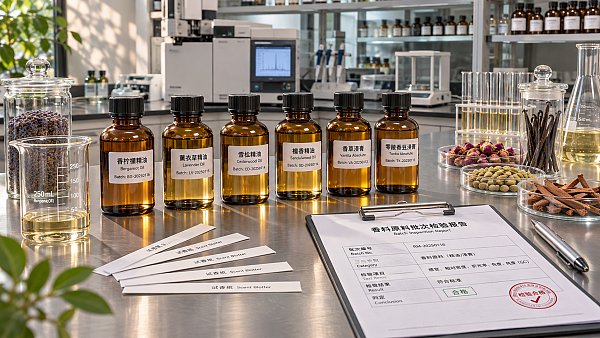
A reference retained from an approved lot is useful because a numerical profile alone does not tell the full sensory story. The reference should be smelled alongside the new material under consistent conditions, then assessed again in the actual product base. A raw oil that appears acceptable on a blotter can behave differently after incorporation into a surfactant system, emulsion, alcohol base, wax, powder, or food matrix.
Acceptance ranges work best when they focus on features that affect finished-product identity. A narrow compositional range for a marker constituent may be important when that constituent drives the desired aroma. In other situations, a strict number can be misleading: two oils with similar marker values may still smell materially different because of minor components or oxidation products. Sensory evaluation and analytical data answer different questions. One establishes whether the material supports the intended smell; the other supports traceability and helps identify why a change occurred.
Separate harvest variation from quality deterioration
These two issues are often confused. Harvest variation changes the native character of an oil while it is still sound. Deterioration develops after production through exposure to oxygen, light, heat, moisture, or incompatible packaging. Oxidized citrus oils may lose their fresh peel quality and develop harsher, duller, or stale notes. A darker appearance, unexpected sharpness, or a changed opening can signal a storage problem rather than a normal seasonal difference.
The distinction matters because the response is different. A sound but more herbal lot may be managed through an established blending tolerance or minor formula adjustment. An oxidized lot should not be treated as a normal variation to be covered up in the finished fragrance. Retained samples, documented receipt dates, protected storage, and sensible stock rotation make the source of deviation easier to identify before it reaches production.
Compatibility determines the fragrance that reaches the consumer
A blend that smells balanced in a glass vial is only a starting point. The product base controls solubility, partitioning, release rate, and sometimes chemical stability. Fragrance materials can concentrate in a surfactant micelle, remain partly dispersed, associate with oils in an emulsion, bind to a polymeric carrier, or migrate into packaging. Each outcome changes how the fragrance is perceived.
In clear aqueous products, incomplete solubilization can produce haze, ring formation, droplets, or uneven fragrance delivery. Raising the fragrance level to compensate for a weak scent may worsen the physical instability instead of improving performance. The problem may lie in the solubilizer ratio, order of addition, temperature during processing, electrolyte level, or interaction with surfactants and preservatives. Visual clarity alone is not enough: a clear formula can still release fragrance poorly after dilution or during use.
Emulsions present a different question. Essential oil components may partition into the oil phase and release gradually, which can soften the initial impact. A cream with an attractive fragrance in bulk may smell weaker when applied because the volatile top notes remain less available at the surface. The solution may involve rebalancing the accord toward the desired in-use profile, rather than simply increasing total oil content. Higher loading can introduce irritation concerns, instability, or an unbalanced dry-down.
For powdered products, tablets, or absorbent substrates, fragrance loss during processing and storage deserves early attention. Heat, vacuum, airflow, mechanical mixing, and dwell time can selectively remove the most volatile materials. A blend built around citrus, mint, or certain light floral notes may emerge from the process flatter than expected. Encapsulation or a suitable carrier can be considered where the product format supports it, but the release behavior must match the intended moment of use. A fragrance protected too effectively may remain trapped and fail to deliver the desired bloom.
Stability testing needs more than a single smell test
Fragrance stability should be evaluated as a sequence of sensory moments. The freshly made product shows immediate compatibility. After storage, the same sample reveals oxidation, interaction with the base, color change, phase effects, or loss of lift. After use, the product demonstrates the fragrance that actually reaches the consumer. These stages can produce different outcomes, particularly when natural oils contain highly volatile or oxidation-sensitive components.
Side-by-side comparison is more informative than evaluating samples separately. Compare the retained fragrance concentrate, a fresh finished product, stored finished product, and a control batch where appropriate. Smell the headspace first, then apply or dilute the product according to its normal use. This sequence helps distinguish a weak top note from a weak overall accord. A fragrance that seems faint in package headspace may become suitable during washing; another may smell strong when opened but vanish after rinse-off.
Packaging is part of this test. Essential oil constituents can be absorbed by some plastics, migrate through closures, or react with unsuitable liners. Headspace loss can make the product seem weaker even when the bulk formula remains physically stable. Conversely, a tight package may retain volatile materials but reveal an overly strong opening after first use. Packaging trials should therefore use the intended container, closure, fill level, and storage orientation wherever possible.
Change control prevents unnecessary reformulation
Many fragrance inconsistencies are introduced when several small changes occur at once: a new essential oil lot, a different solubilizer source, revised processing temperature, alternate packaging, or a modified preservative system. Once these variables overlap, the cause of the sensory shift becomes difficult to establish. Fragrance-related changes need to be recorded with the same discipline applied to visible stability changes.
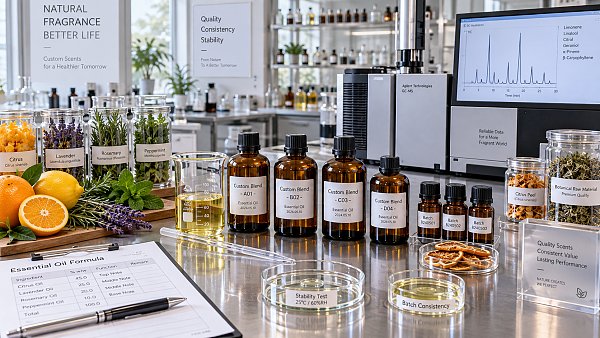
A practical release record links the approved fragrance concentrate to its constituent lot references, sensory description, appearance, addition point, processing temperature range, and finished-product evaluation. The purpose is not paperwork for its own sake. It provides a route back to the likely cause when the next batch smells brighter, flatter, greener, or less persistent than the approved reference.
Minor adjustment rules can be prepared before a problem appears. If a citrus component arrives slightly softer but otherwise acceptable, a pre-approved balancing material may restore the opening without disturbing the entire accord. Such adjustments should remain limited and traceable. Repeated compensation for an unsuitable incoming oil gradually changes the fragrance identity and masks a raw-material issue that needs correction.
Design around the use moment
Natural essential oil blends deliver consistency when their design reflects where and when the scent is judged. A hand soap needs a recognizable wet-use bloom after dilution and foam generation. A surface cleaner needs to remain pleasant around alkaline ingredients and leave an appropriate residual character on the cleaned surface. A shampoo needs to work through the bottle opening, lather, rinse, and hair dry-down. A candle, diffuser, or solid air-care format has yet another release pathway shaped by heat, substrate, airflow, and package headspace.
Evaluating only the concentrate creates false confidence. Evaluating only the finished product at one time point creates another. The durable approach is to specify the intended scent journey, build redundancy into the blend, qualify raw materials through both sensory and compositional evidence, and test the blend inside the real formulation and package. That is how botanical character can remain natural without allowing routine variation to redefine the product fragrance.
Facing technical bottlenecks in manufacturing or looking for more efficient industrial solutions? Leave your details below and let the engineering experts at FCAS solve them for you.
We respect your privacy. Your information is strictly confidential.
Related News
 Supercritical CO2 Essential OilsWhat Should You Check When Choosing a CO2 Essential Oils Supplier?Choosing a CO2 essential oils supplier? Learn how to assess sourcing, batch testing, documentation, and delivery to secure quality and reliable supply.MORE+
 Supercritical CO2 Essential OilsWhat Affects the Botanical Oleoresins Bulk Price?Botanical oleoresins bulk price depends on sourcing, strength, extraction and freight. Learn how to compare supplier quotes and reduce total costs.MORE+
 Supercritical CO2 Essential OilsHow Are Food Grade Essential Oil Extracts Made with CO2?Discover how food grade essential oil extracts are made with CO2, what shapes their flavor, and how to assess safety and suitability for food applications.MORE+
 Supercritical CO2 Essential OilsWhat to Check When Buying Aroma Ingredients WholesaleBuying aroma ingredients wholesale? Discover how to assess quality, supplier reliability, documentation and landed cost before placing your order.MORE+
 Supercritical CO2 Essential OilsHow to Choose Citrus Oils for Beverages Without CloudingChoose citrus oils for beverages with confidence. Compare delivery systems and stability tests to prevent clouding while preserving fresh citrus flavor.MORE+
 Supercritical CO2 Essential OilsWhat to Check When Choosing a CO2 Botanical Extracts ManufacturerChoosing a CO2 botanical extracts manufacturer? Discover how to assess quality, traceability, compliance and true costs before you commit.MORE+
 Supercritical CO2 Essential OilsHow Can You Verify Quality Controls at a CO2 Extracts Factory?Evaluate a co2 extracts factory with confidence. Learn how to verify batch testing, traceability, and quality controls to reduce sourcing risks and choose a reliable supplier.MORE+
 Supercritical CO2 Essential OilsWhat Determines Essential Oil Blend Bulk Prices Beyond Order Size?Explore essential oil blends bulk price factors beyond volume, from botanical quality to testing and freight. Learn how to compare suppliers and uncover the true cost before buying.MORE+
 Supercritical CO2 Essential OilsHow Do Extraction Methods and Grades Affect Oleoresin Bulk Prices?Compare oleoresins bulk price by extraction method, grade, and potency. Discover how to evaluate supplier quotes, verify quality, and lower costs at the right application dose.MORE+
 Supercritical CO2 Essential OilsWhat Should You Ask a Citrus Oils Supplier About CO2 Extraction?Choosing a citrus oils supplier? Discover what to ask about CO2 extraction, purity, testing, and cost to verify quality, avoid costly mistakes, and buy with confidence.MORE+
 Supercritical CO2 Essential OilsWhat Determines the Bulk Price of CO2 Botanical Extracts Before Shipping?Compare co2 botanical extracts bulk price drivers before shipping, from yield and potency to testing and packaging. Learn how to assess supplier quotes and buy with confidence.MORE+
 Supercritical CO2 Essential OilsHow to Verify the Purity of High Cineole Eucalyptus Oil With GC-MSVerify high cineole eucalyptus oil with GC-MS. Learn how to confirm identity, measure cineole accurately, and spot quality risks before approving your next batch.MORE+
 Supercritical CO2 Essential OilsHow Does Supercritical CO2 Extraction Affect Bulk Tea Tree Oil?Discover how supercritical CO2 extraction affects bulk tea tree oil composition, stability, and formulation performance—and what to check before approving a bulk replacement.MORE+
 Supercritical CO2 Essential OilsHow Do CO2 Botanical Extract Certifications Affect Sourcing Costs?CO2 botanical extracts supplier certifications can raise prices but lower sourcing costs. Learn how to verify coverage, compare total costs, and pay only for credentials that add value.MORE+
 Supercritical CO2 Essential OilsHow to Evaluate a Natural Aroma Chemicals Supplier for QualityNatural aroma chemicals supplier evaluation made practical: assess quality, traceability, odor consistency, documentation, packaging, and total delivered cost before you buy.MORE+
 Supercritical CO2 Essential OilsHow to Verify CO2 Botanical Extract Supplier CertificationsCO2 botanical extracts supplier certifications: learn how to verify certificates, site scope, batch traceability, and process controls before approving suppliers.MORE+
 Supercritical CO2 Essential OilsHow Oleoresins Bulk Price Changes with Crop Quality and SupplyOleoresins bulk price insights: learn how crop quality, extraction yield, grade availability and supply risks shape costs—compare supplier offers with confidence.MORE+
 Supercritical CO2 Essential OilsHow Natural Essential Oil Blends Improve Consistent Product FragranceNatural essential oil blends help brands achieve consistent, appealing fragrance across batches. Explore smart blend design, stability testing, and product compatibility strategies.MORE+
 Supercritical CO2 Essential OilsWhat to Check Before Choosing a Botanical Essential Oils ManufacturerChoose a botanical essential oils manufacturer with confidence. Explore key checks for purity, traceability, compliance, batch consistency, and reliable supply.MORE+
 Supercritical CO2 Essential OilsHow Aroma Ingredients Shape Lasting and Skin-Safe Personal Care ProductsAroma ingredients for personal care: discover how to achieve lasting scent, formulation stability, skin safety, and confident product performance.MORE+
 Supercritical CO2 Essential OilsHow to Evaluate a Natural Cardamom Oil Supplier for Reliable SupplyNatural cardamom oil supplier evaluation guide: verify botanical origin, purity, batch consistency, documentation, packaging, and delivery reliability for confident sourcing.MORE+
 Supercritical CO2 Essential OilsHow to Choose Eucalyptus Oil Grades for Clean, Consistent ProductsChoose the right Eucalyptus Oil grade with confidence. Compare cineole content, purity, origin, processing, documentation, and application fit for consistent products.MORE+
 Supercritical CO2 Essential OilsHow Food Grade Citrus Oils Improve Flavor in Beverage FormulationsFood grade citrus oils help beverage formulators create brighter, more authentic flavor. Learn how to select, stabilize, dose, and protect citrus oils for lasting appeal.MORE+
 Supercritical CO2 Essential OilsWhy Citrus Terpene Fragrances Are Growing in Home Care ProductsCitrus terpene fragrances are transforming home care products with fresh, trusted cleaning cues. Explore performance, stability, compliance, sourcing, and cost factors for smarter fragrance selection.MORE+
 Supercritical CO2 Essential OilsHow to Choose Ginger Oil for Beverages With a Clean Flavor ProfileGinger oil for beverages: learn how to select a clean, bright, stable profile that performs through processing, shelf life, and every sip.MORE+
 Supercritical CO2 Essential OilsCO2 Essential Oil Extracts for Functional Foods and Clean LabelsDiscover CO2 essential oil extracts for functional foods: clean-label potential, botanical flavor innovation, formulation insights, and smarter sourcing strategies.MORE+
 Supercritical CO2 Essential OilsHow to Use Cardamom Oil for Flavoring Without Overpowering FoodsCardamom oil for flavoring: learn dilution, dispersion, blending, and process tips to create balanced beverages, bakery, and desserts without overpowering taste.MORE+
 Supercritical CO2 Essential OilsWhat to Evaluate When Sourcing Custom Essential Oil BlendsCustom essential oil blends: discover how to evaluate formulation fit, quality consistency, compliance, total cost, and supply reliability for confident sourcing decisions.MORE+
 Supercritical CO2 Essential OilsHow to Verify Purity and Sourcing of Cosmetic Grade Lavender OilCosmetic grade lavender oil: learn how to verify botanical origin, batch-specific purity, GC-MS reports, sourcing, storage, and safe cosmetic use before you buy.MORE+
 Supercritical CO2 Essential OilsWhat to Evaluate Before Choosing an Aromatic Extracts FactoryChoose the right aromatic extracts factory with expert guidance on traceability, extraction methods, batch consistency, documentation, and reliable supply.MORE+
 Supercritical CO2 Essential OilsAre CO2 Botanical Extracts More Stable Than Solvent Extracts?Are CO2 botanical extracts more stable than solvent extracts? Compare oxidation risk, packaging, and formulation factors to make smarter sourcing decisions.MORE+
 Supercritical CO2 Essential OilsWhy High Terpinen Tea Tree Oil Quality Depends on Chemotype and TestingHigh terpinen tea tree oil quality starts with verified chemotype, full GC/MS testing, oxidation control, and traceable storage—learn how to choose reliable oil.MORE+
 Supercritical CO2 Essential OilsHow Mint Oils for Oral Care Improve Flavor and Fresh BreathMint oils for oral care create cooling flavor, lasting freshness, and a better daily brushing experience. Explore peppermint, spearmint, and smart product choices.MORE+
 Supercritical CO2 Essential OilsWhat to Evaluate Before Choosing an Essential Oil Blends ManufacturerEssential oil blends manufacturer selection guide: evaluate quality, traceability, compliance, formula performance, and supply reliability to source with confidence.MORE+
 Supercritical CO2 Essential OilsHow to Evaluate a Natural Aroma Chemicals Manufacturer for Reliable SupplyNatural aroma chemicals manufacturer evaluation guide: verify traceability, batch consistency, compliance, application support, capacity, and total cost to secure reliable supply.MORE+
 Supercritical CO2 Essential OilsWhat Should You Know About Natural Aroma Chemicals and Their UsesNatural Aroma Chemicals: explore how to select, test, and formulate natural aroma ingredients for fragrances, food, personal care, and home care products.MORE+
 Supercritical CO2 Essential OilsWhen Oil Soluble Essential Oil Extracts Work Best in FormulationsOil soluble essential oil extracts work best in anhydrous beauty, fragrance, food, and cleaning formulas. Explore compatibility, stability, and application tips.MORE+
 Supercritical CO2 Essential OilsWhy Solvent Free Aromatic Extracts Matter for Clean Label Fragrance FormulasSolvent free aromatic extracts are reshaping clean label fragrance formulas by improving transparency, sensory appeal, and sourcing credibility. Learn why they matter now.MORE+
 Supercritical CO2 Essential OilsWhy Citrus Oils Matter in Clean Label Food and Wellness TrendsCitrus Oils drive clean label food and wellness innovation with fresh flavor, natural appeal, and versatile formulation value. Explore why buyers and brands are paying closer attention.MORE+
 Supercritical CO2 Essential OilsWhy Steam Distilled Clove Oil Is Gaining Ground in Natural FormulationsSteam distilled clove oil is gaining attention for its natural appeal, eugenol profile, and formulation versatility. Discover why buyers value it across personal care, fragrance, and home care.MORE+