
How to Select Liquid Flavorings for Consistent Beverage Profiles
A beverage can match its target flavor in a development sample and still drift noticeably in commercial production. The usual cause is not simply an incorrect dosage. Liquid Flavorings interact with water, sweeteners, acids, proteins, carbonation, heat treatment, packaging, and storage time. A flavor that smells bright in its original container may taste muted, artificial, separated, or unbalanced after processing.
Selection should therefore begin with the finished beverage system, not with a preferred aroma sample. The most suitable liquid flavor is one that delivers the intended sensory profile at the required dosage, remains compatible with the formulation and process, and can be supplied with dependable batch control and documentation. Cost per kilogram matters, but cost per serving, rework risk, and shelf-life consistency are usually more meaningful measures.
Define the beverage profile before comparing samples
“Lemon,” “mango,” “coffee,” or “berry” are not complete flavor specifications. The same flavor name can describe very different products: a fresh peel-like lemon, a sweet lemonade note, a sharp citrus top note, or a cooked citrus profile designed for heat-treated drinks. Comparing flavor samples without a defined target often produces confusing results because each supplier may interpret the descriptor differently.
A useful brief describes the intended beverage in practical terms:
- The primary flavor identity and the desired balance of top, middle, and lingering notes.
- The sweetness, acidity, bitterness, cooling sensation, or dairy character that the flavor must work alongside.
- Whether the drink is still, carbonated, concentrated, powdered after reconstitution, alcoholic, plant-based, dairy-based, or protein-fortified.
- The processing route, including mixing order, pasteurization, hot filling, aseptic treatment, or cold filling.
- The expected shelf life, package type, storage conditions, and distribution environment.
- Any label direction, such as natural positioning, botanical character, reduced sugar, or the exclusion of particular carriers.
This brief does not need to prescribe the chemistry of the flavor. It gives suppliers the conditions needed to recommend an appropriate system. It also makes sensory evaluation more disciplined: samples can be judged against a defined profile rather than against personal preference alone.
Start with the base system, because solubility is not a minor detail
Liquid flavorings are supplied in different carrier systems. A water-soluble flavor is often the straightforward choice for clear beverages, syrups, and many ready-to-drink products. Oil-based systems may bring certain aroma materials effectively, but they can create haze, surface rings, sediment, or separation when added to an aqueous drink without a suitable emulsification approach. Some flavors are supplied as emulsions specifically to disperse oil-soluble aromatic components in water.
“Dispersed” and “stable” are not the same. A beverage can look acceptable immediately after mixing yet develop a ring at the neck of the bottle, cloudiness, or a visible layer after time in storage. The risk increases when the formula includes challenging elements such as high mineral content, protein, alcohol, strong acid, or a low level of stabilizing solids.
Clear beverages require particular care. A flavor that is technically usable in water may still reduce clarity or produce an appearance that conflicts with the intended product. In contrast, a cloudy juice-style beverage may tolerate or even require an emulsified flavor system. The correct choice depends on the visual specification as much as the aroma profile.
Ask for samples that match the intended product format. Evaluating a flavor in plain water may be useful for early screening, but it is not a reliable decision basis for an acidic carbonated drink, a protein beverage, or a concentrated syrup.
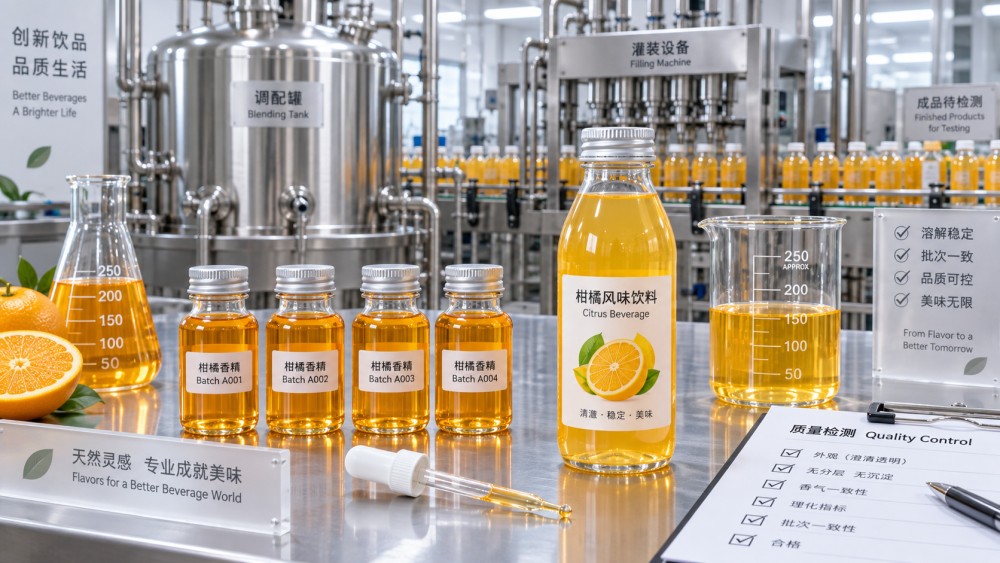
Evaluate flavor performance at the full processing sequence
A liquid flavor should not be approved solely because it performs well in a bench-top blend. Volatile aroma compounds can be lost during heating, deaeration, homogenization, carbonation, or filling. Other compounds may survive but become less recognizable once sweetness, acid, and body are adjusted to commercial levels.
The practical test sequence should follow the real manufacturing route as closely as possible. Prepare the beverage at the target solids, pH, and dosage. Apply the intended process conditions. Package the sample in a representative material. Then assess it after production and again after storage under relevant conditions. The purpose is not to create an elaborate research program. It is to reveal whether the flavor remains recognizable, balanced, and visually compatible after the conditions it will actually face.
Thermal stability deserves a more precise question than “Is this heat stable?” A supplier may confirm that a flavor can tolerate heat, but the relevant issue is whether the preferred sensory notes survive the beverage’s specific heat exposure. Fresh citrus, mint, floral, and delicate fruit notes are often more vulnerable to change than heavier vanilla, brown, roasted, or spice profiles. A more robust flavor may be appropriate for hot-filled products, but it may also taste less fresh in a cold-filled drink. The final choice is a balance between the desired profile and the process limitations.
Dosage accuracy affects both consistency and economics
Flavor dosage is often discussed as a single number, but a working range is more useful. A narrow acceptable range can make production vulnerable to normal variation in syrup solids, acid level, ingredient age, or dosing equipment performance. A flavor with a slightly higher purchase price may be operationally preferable when it offers a clear, repeatable dosage window and maintains its character across reasonable formula variation.
Do not compare offers only on cost per kilogram. Compare the cost at the intended use rate, then consider the total consequences of use. A lower-cost flavor can become expensive if it needs a higher dosage, requires additional masking ingredients, causes more frequent sensory adjustment, or loses character before the beverage reaches the market.
The physical form also matters. Confirm viscosity, pumpability at expected warehouse and production temperatures, recommended mixing method, and whether the flavor should be pre-diluted. A material that pours well in a laboratory may behave differently in a larger dosing system. Where very low addition rates are used, a pre-dilution step or a standardized dosing solution can reduce variation, provided the dilution medium is compatible and controlled.
Carrier selection can affect taste, labeling, and operations
The carrier in a liquid flavor is not merely an inactive delivery medium. It can affect solubility, flavor release, alcohol content, sweetness perception, viscosity, label declarations, and suitability for a particular product concept. Common carrier approaches include water, alcohol, glycols, oils, or blends designed for a specific application. The appropriate carrier depends on the flavor composition and the beverage system.
A carrier may be acceptable from a technical standpoint but unsuitable for a product’s label strategy or market positioning. Conversely, restricting carriers too early can unnecessarily reduce the supplier’s ability to build a stable, expressive flavor system. The better approach is to establish the non-negotiable requirements at the start, then allow formulation options within those boundaries.
Compatibility must also extend beyond the beverage. Flavor components and carriers can interact with closures, liners, coatings, and some packaging materials. Aroma scalping, where flavor compounds migrate into packaging, can flatten the beverage profile over time. This is especially relevant for delicate aroma notes and long storage periods. Packaging should be part of shelf-life evaluation rather than an afterthought.
Natural, nature-identical, and standard flavor language should be handled carefully
Terms used to describe flavor origin or positioning can carry different commercial and regulatory implications depending on the intended market. The sensory result alone does not determine whether a flavor supports a particular label claim. Nor does a natural-sounding profile automatically mean the material is suitable for every claim or market.
The selection process should separate three questions: what sensory profile is required, what source or declaration approach is desired, and what documentation is needed for the product’s route to market. Combining them into one vague request often leads to unsuitable samples and delays later in development.
A natural flavor option may fit a brand direction well, but it can have different color, stability, supply, or cost characteristics than another flavor system. That is not a reason to assume one type is superior. It is a reason to evaluate performance and commercial fit at the same time.
Documentation is part of the material specification
A flavorful sample is not enough for commercial approval. The supporting information should be reviewed early, particularly where products are sold across multiple markets or supplied through several manufacturing sites. The exact documentation set depends on the application and destination, but the review commonly covers a technical specification, composition or allergen information where relevant, safety information, storage guidance, shelf-life details, traceability, and statements needed for the intended food application and label review.
Consistency begins with a clear agreement on what may vary and what may not. Flavor ingredients can naturally vary in character, and complex flavor systems can show slight sensory movement between batches. That does not make a product unsuitable. The supplier should, however, have defined controls for identity, appearance, aroma, physical properties, and relevant analytical or sensory checks. A batch-to-batch reference standard, retained samples, and a clear procedure for handling deviations are practical indicators of a controlled supply arrangement.
For a beverage with a tightly defined signature profile, it is useful to retain approved production samples and reference them during future evaluations. This is more useful than relying on a flavor name alone. A name may remain unchanged while the specific sensory expectation has not been documented well enough.
Compare suppliers on repeatability, not sample quality alone
During sourcing, it is easy to favor the supplier that delivers the most appealing first sample. That is only one part of the decision. The more relevant question is whether the supplier can produce the same usable profile repeatedly, communicate formulation or raw-material changes responsibly, protect the material during transport, and provide technical support when the beverage formula changes.
Questions that expose supply risk tend to be practical rather than promotional:
- Is the recommended flavor designed for this beverage format, or is it a general-purpose sample?
- What storage conditions protect its intended sensory quality?
- How is batch sensory consistency managed?
- What packaging is used to reduce leakage, oxidation, or aroma loss in transit?
- Can the flavor be supplied reliably at the planned commercial volume and in the required pack size?
- How are material changes, specification updates, and quality deviations communicated?
These questions should be considered alongside lead time and price. A flavor is a small-dose ingredient, but an interruption or inconsistent batch can affect an entire beverage run.
A practical approval path for Liquid Flavorings
The most reliable route is to move from sensory fit to system fit, then to supply fit. Start by providing a complete application brief and screening a manageable number of samples in the finished base. Shortlist the options that meet the sensory target without visible instability or unwanted aftertaste. Next, test those candidates through the actual processing and packaging route. Only after the formulation performs should the commercial, documentary, and supply criteria determine the final approval.
This sequence prevents a common mistake: selecting the most attractive neat flavor sample and attempting to solve all incompatibility problems later with emulsifiers, masking agents, or higher dosage. Those adjustments can be necessary in some formulations, but they should not compensate for a flavor system that was poorly matched to the beverage from the beginning.
For teams comparing flavor compounds, carriers, and formulation considerations across food applications, FCAS provides structured industry information that can support more focused supplier discussions. The decision still belongs to the finished beverage formula, but clearer comparison criteria make it easier to identify which samples deserve full process testing.
Questions that often change the final choice
Should a flavor be selected before the sweetener and acid system are finalized?
Early flavor screening can begin before finalization, but approval should not. Sweetener type, acidity, and bitterness strongly affect perceived aroma and flavor balance. A flavor that works in a sucrose prototype may need adjustment in a beverage using high-intensity sweeteners or a different acid blend.
Is a stronger flavor always better for shelf life?
No. Increasing dosage may create harshness, artificial notes, or an unbalanced finish at the start of shelf life. A better option is a flavor designed to retain the intended profile through the relevant process and storage conditions.
Can one liquid flavor be used across still and carbonated versions of the same drink?
Sometimes, but this should be tested rather than assumed. Carbonation changes aroma release and can alter the perception of sweetness, acidity, and freshness. The same profile may require a different dosage or a modified flavor composition.
What is the first issue to resolve when a beverage flavor fades in storage?
Review the complete system: thermal exposure, headspace oxygen, package interaction, storage temperature, and the stability of the most volatile notes. Raising dosage without identifying the cause can make the fresh product taste excessive while doing little to improve the stored product.
Related News
 Antioxidants & Natural PreservativesWhat Quality Checks Matter When Sourcing Butylparaben for Personal CareButylparaben for personal care sourcing guide: compare assay, impurities, physical performance, documentation, traceability, and supplier quality to reduce formulation risk.MORE+
 Nano-microcapsule FormulationsHow Encapsulated Flavors Protect Taste During Processing and StorageEncapsulated Flavors protect taste from heat, oxygen, moisture, and storage loss. Explore smarter release, carrier selection, and processing strategies.MORE+
 Chelated Trace Element FertilizersHow Greenhouse Fertigation Systems Reduce Water and Fertilizer WasteGreenhouse fertigation systems reduce water and fertilizer waste with precise dosing, uniform irrigation, drainage monitoring, and smarter crop-zone control. Learn practical strategies.MORE+
 Supercritical CO2 Essential OilsHow Natural Essential Oil Blends Improve Consistent Product FragranceNatural essential oil blends help brands achieve consistent, appealing fragrance across batches. Explore smart blend design, stability testing, and product compatibility strategies.MORE+
 Non-ionic Surfactants & DefoamersHow to Choose Non Ionic Low Foaming Surfactants for CIP CleaningNon ionic low foaming surfactants for CIP cleaning: learn how to balance wetting, foam control, compatibility, and rinseability for reliable cleaning performance.MORE+
 Nano-microcapsule FormulationsHow Food Grade Cyclodextrin Complexes Protect Sensitive FlavorsFood grade cyclodextrin inclusion complexes help protect sensitive flavors from oxidation, evaporation, and processing loss while supporting controlled release and consistent sensory quality.MORE+
 Polymer-Coated Water Soluble NPKHow Fertilizer Coating Polymers Improve NPK Granule ReleaseFertilizer coating polymers for NPK granules improve controlled nutrient release, reduce loss risks, and enhance product consistency. Discover key selection and process insights.MORE+
 Chelated Trace Element FertilizersWhat Diammonium Phosphate Means for Crop Nutrition PlanningDiammonium Phosphate: learn how DAP supports early phosphorus access, nitrogen budgeting, smart placement, and balanced crop nutrition planning.MORE+
 Maillard Reaction Savory FlavorsHow to Assess a Flavor Bases Supplier List for Reliable SourcingGlobal Fine Chemicals & Agrochemical Intelligence Network flavor bases supplier list: assess specs, samples, supply risk, and true cost to source with confidence.MORE+
 Hydrocolloids & EmulsifiersHow Konjac Gum Powder Improves Texture in Low-Calorie FoodsKonjac gum powder improves body, stability, and mouthfeel in low-calorie foods. Discover practical tips for smoother sauces, beverages, and reduced-fat formulations.MORE+
 Supercritical CO2 Essential OilsWhat to Check Before Choosing a Botanical Essential Oils ManufacturerChoose a botanical essential oils manufacturer with confidence. Explore key checks for purity, traceability, compliance, batch consistency, and reliable supply.MORE+
 Microencapsulated FragrancesHow Fragrance Carriers for Detergents Improve Scent PerformanceFragrance carriers for detergents improve stability, fabric deposition, and long-lasting scent. Explore practical solutions for better wash-to-wear fragrance performance.MORE+
 Antioxidants & Natural PreservativesWhen Propyl Gallate Antioxidant Is the Right Choice for Oil StabilityPropyl gallate antioxidant: learn when it is the right choice for oil stability, shelf-life protection, processing compatibility, and smarter formulation decisions.MORE+
 Antioxidants & Natural PreservativesHow Potassium Sorbate Extends Shelf Life in Food and Beverage ProductsPotassium Sorbate helps food and beverage brands control yeast and mold spoilage. Explore pH, dosage, processing, and packaging strategies for reliable shelf life.MORE+
 Antioxidants & Natural PreservativesHow to Source Bulk Herbal Extracts With Reliable Quality ControlBulk herbal extracts sourcing guide: compare suppliers, verify traceability, review CoAs, and build reliable quality controls for safer, consistent purchasing.MORE+
 Antioxidants & Natural PreservativesWhat to Check Before Sourcing Butylparaben for Personal Care FormulasButylparaben for personal care sourcing guide: check market eligibility, purity, supplier controls, formula compatibility, packaging, and total risk before buying.MORE+
 Targeted Bio-pesticides & APIsChoosing Microbial Fungicides for Foliar Diseases in Integrated Crop ProgramsMicrobial fungicides for foliar diseases: learn how to match biology, formulation, tank compatibility, and timing for stronger integrated crop protection.MORE+
 Targeted Bio-pesticides & APIsHow Microbial Insecticides Control Caterpillars With Lower Crop Residue RiskMicrobial insecticides for caterpillars help protect crops with targeted early-larval control and lower residue-management pressure. Learn timing, coverage, compliance, and scouting essentials.MORE+
 Microencapsulated FragrancesHow to Add Encapsulated Laundry Fragrances Without Weakening Wash ResultsEncapsulated laundry fragrances: learn how to boost long-lasting scent while protecting cleaning power, stability, foam control, and fabric care.MORE+
 Supercritical CO2 Essential OilsHow Aroma Ingredients Shape Lasting and Skin-Safe Personal Care ProductsAroma ingredients for personal care: discover how to achieve lasting scent, formulation stability, skin safety, and confident product performance.MORE+
 Targeted Bio-pesticides & APIsInsecticides Explained Through Labels, Active Ingredients, and SafetyInsecticides explained through labels, active ingredients, formulations, and safety. Learn how to compare products, manage risk, and make informed crop protection decisions.MORE+
 Heavy-duty Industrial DegreasersHow to Select Parts Wash Cleaners for Automotive ComponentsParts wash cleaners for automotive components: learn how to match chemistry, materials, rinsing, safety, and waste controls for reliable cleaning results.MORE+
 Chelated Trace Element FertilizersHow Precision Fertigation Systems Improve Water and Nutrient ControlPrecision fertigation systems improve water and nutrient control with accurate dosing, uniform irrigation, smart monitoring, and reduced waste. Discover how to optimize crop performance.MORE+
 Hydrocolloids & EmulsifiersHow Bulk Price Factors Affect Hydrocolloid Stabilizer Blend SourcingHydrocolloid stabilizer blends bulk price: compare dosage efficiency, quality consistency, logistics, and documentation to reduce total sourcing costs.MORE+
 Zero-Calorie Sweeteners & AcidulantsHow to Choose a Natural Sweeteners Supplier for Clean-Label ProductsNatural sweeteners supplier selection guide for clean-label products: compare formulation fit, traceability, documentation, and supply reliability.MORE+
 Non-ionic Surfactants & DefoamersWhat Cationic Surfactants Do and Where They Are UsedCationic Surfactants deliver antimicrobial action, conditioning, antistatic control, and surface treatment benefits. Explore key uses, compatibility, and safe selection tips.MORE+
 Targeted Bio-pesticides & APIsHow to Evaluate Pesticide Suspension Concentrates for Field StabilityPesticide Suspension Concentrates: learn how to evaluate field stability, redispersibility, dilution, tank-mix compatibility, and spray safety for reliable performance.MORE+
 Hydrocolloids & EmulsifiersHow Hydrocolloid Systems for Meat Products Improve Texture and YieldHydrocolloid systems for meat products improve yield, texture, water retention, and slicing quality. Explore practical formulation strategies for stable, high-performing meat products.MORE+
 Microencapsulated FragrancesHow Laundry Fragrances for Liquid Detergents Improve Scent LongevityLaundry fragrances for liquid detergents: discover how fragrance design, deposition, and encapsulation create lasting fabric freshness and stronger product appeal.MORE+
 Nano-microcapsule FormulationsChoosing Fragrance Preparations That Perform Well in Personal WashFragrance preparations for personal wash: learn how to select options that protect clarity, stability, foam, scent performance, and packaging compatibility.MORE+
 Controlled-Release ThermodynamicsModified Cyclodextrins Explained for Controlled Fragrance ReleaseModified cyclodextrins enable controlled fragrance release, odor control, and volatile-note protection. Explore how they optimize performance in detergents, fabric care, and more.MORE+
 Microencapsulated FragrancesHow Fragrance Delivery Systems Improve Fabric Softener LongevityFragrance delivery systems for fabric softeners improve scent longevity through smart protection, reliable deposition, and controlled release for lasting freshness.MORE+
 Supercritical CO2 Essential OilsHow to Evaluate a Natural Cardamom Oil Supplier for Reliable SupplyNatural cardamom oil supplier evaluation guide: verify botanical origin, purity, batch consistency, documentation, packaging, and delivery reliability for confident sourcing.MORE+
 Maillard Reaction Savory FlavorsHow Ethyl Maltol Purity Testing Supports Flavor Safety ComplianceEthyl Maltol purity testing strengthens flavor safety compliance through identity checks, impurity profiling, supplier verification, and audit-ready documentation.MORE+
 Microencapsulated FragrancesEssential Oil Extracts Compared for Fragrance and Wellness UsesEssential Oil Extracts compared for fragrance and wellness: explore scent profiles, extraction methods, stability, safety, and sourcing insights for smarter formulation choices.MORE+
 Zero-Calorie Sweeteners & AcidulantsWhat Drives Zero Calorie Sweeteners Bulk Price in 2026Zero calorie sweeteners bulk price in 2026: compare specifications, dosage, quality, freight, and supply risk to make smarter sourcing decisions.MORE+
 EPA FIFRA & FDA GRAS RegsSynthetic Food Preservatives Rules That Support Safer FormulasSynthetic Food Preservatives: learn the rules for safer formulas, compliant use levels, validated shelf life, labeling, and reliable microbial control.MORE+
 Micelle Fluidics & ChelationHow Anionic Industrial Dispersants Improve Coating StabilityAnionic industrial dispersants improve coating stability, pigment wetting, viscosity control, gloss, and storage performance. Learn how to select and test the right solution.MORE+
 Supercritical CO2 Essential OilsHow to Choose Eucalyptus Oil Grades for Clean, Consistent ProductsChoose the right Eucalyptus Oil grade with confidence. Compare cineole content, purity, origin, processing, documentation, and application fit for consistent products.MORE+
 Micelle Fluidics & ChelationWhat Are Cationic Surfactants and Where Are They Commonly Used?Cationic Surfactants deliver powerful surface affinity for disinfection, fabric softening, hair conditioning, antistatic control, and industrial treatments. Explore key uses and selection factors.MORE+







































