How Oil Soluble Aroma Ingredients Improve Flavor Consistency
Flavor inconsistency in a fat-containing food is often blamed on the flavor compound itself. In practice, the larger problem may be where that compound goes after it is added. If the aroma material does not remain evenly distributed through the fat phase, emulsion, or finished matrix, one batch can smell rich and rounded while the next seems weak, sharp, or incomplete.
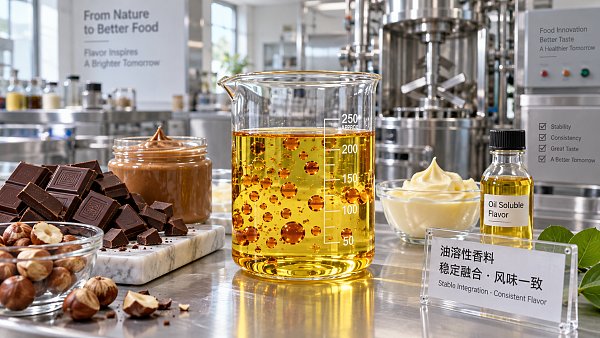
Oil soluble aroma ingredients help address this issue when the product has a meaningful lipid phase or relies on an oil-based flavor carrier. Their main value is not simply that they dissolve in oil. A well-matched oil-soluble ingredient can distribute more predictably, reduce local over-concentration, protect certain volatile notes during processing, and release aroma more consistently during storage and consumption. Those benefits depend on the full formulation and process, not on solubility alone.
Consistency starts with phase matching
Aroma compounds vary widely in polarity, volatility, and affinity for fats, proteins, water, sugars, and packaging materials. An ingredient described as oil soluble has a stronger tendency to dissolve in a lipid carrier than in water. In a fat-based application, that tendency can be useful because the aroma is more likely to stay associated with the phase that carries it through mixing, filling, storage, and eating.
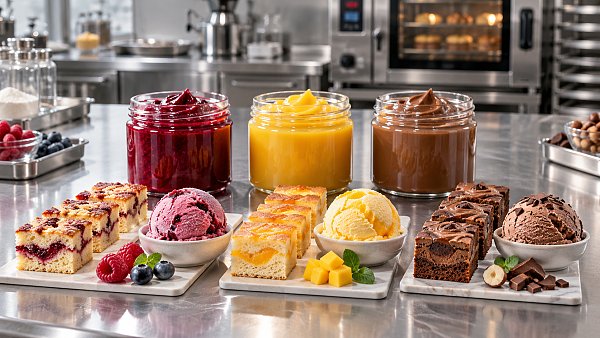
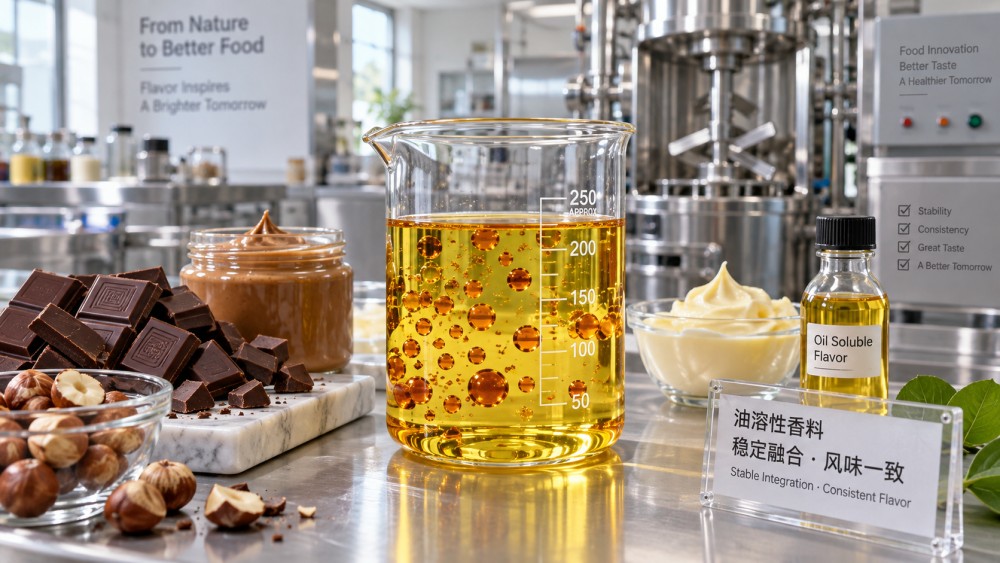
This is especially relevant in products such as chocolate compounds, fillings, nut spreads, bakery fats, ice cream mixes, dairy systems, seasoning oils, sauces, and fried snacks. These products do not all behave the same way, but each can contain a lipid phase that influences how flavor moves and is perceived.
When an oil-compatible aroma ingredient is added to an oil phase, it can be diluted before entering the main batch. This creates a more uniform starting point than introducing a concentrated flavor directly into a complex mixture. Better initial distribution does not guarantee identical sensory results, but it removes a common source of batch variation: isolated flavor-rich zones caused by incomplete incorporation.
The opposite mistake is also common. An oil-soluble flavor is sometimes treated as suitable for every product containing a little fat. In a predominantly water-based beverage, a sauce with only a small oil fraction, or an unstable emulsion, the aroma may separate, form droplets, cling to processing equipment, or produce an uneven top note. The relevant question is not “Does this product contain oil?” It is “Which phase controls flavor distribution and release in the finished product?”
Why distribution changes sensory perception
Flavor consistency is a sensory outcome, but it is driven by physical behavior. A flavor can have the correct odor profile on a blotter and still perform poorly after it enters a food matrix. In an oil-rich environment, lipid-soluble compounds may be held in the fat phase and released more gradually. This can make the flavor seem fuller or more persistent, particularly for creamy, roasted, buttery, nutty, spice, citrus peel, or confectionery profiles that are intended to sit within a rich product base.
That same retention can be a limitation. A highly volatile fresh note may seem muted if it partitions too strongly into fat. A citrus, mint, green, or fruit top note may need a balance of components with different affinities rather than a fully oil-soluble system. The desired sensory effect matters: a flavor designed for immediate aroma impact requires a different partitioning strategy from one intended to build body and linger through consumption.
Oil soluble aroma ingredients can also reduce sensory variation caused by uneven evaporation. In an oil carrier, certain volatile compounds are less exposed to the surrounding air than they would be in a more open aqueous system. This can help retain profile balance during controlled processing and storage. It does not make an aroma immune to heat, oxygen, light, or headspace loss. It simply changes the environment around the aroma compound and may slow the pathways by which the profile drifts.
Oil solubility is not the same as finished-product stability
A flavor ingredient can dissolve clearly in a chosen carrier and still create instability after the carrier enters the full formulation. This distinction matters in technical selection.
For example, a flavor may be completely compatible with vegetable oil but become problematic when added to an emulsion containing water, proteins, hydrocolloids, salt, or particulate ingredients. Changes in temperature, shear, pH, or emulsifier balance can alter droplet size and phase distribution. The aroma may then migrate between phases, separate at the surface, or become trapped in a way that changes flavor delivery.
Oxidative stability also deserves separate evaluation. Oil carriers and lipid-rich foods can oxidize, especially where oxygen exposure, heat, light, trace metals, or unsaturated fats are present. Oxidation products can introduce off-notes or interact with delicate aroma materials. A flavor that remains chemically intact may still be less recognizable if the surrounding fat develops a competing odor. The flavor review should therefore include the carrier and product fat system, not only the aroma composition.
Packaging is another overlooked variable. Some aroma molecules can migrate into polymer packaging, seals, liners, or closures. This can lower aroma intensity over time or alter the relative balance of notes. A technically credible assessment includes the intended package, expected headspace, storage orientation, and likely temperature exposure in distribution.
Processing conditions can preserve or undo the benefit
Oil-based flavor addition is usually most reliable when the ingredient is first dispersed into a compatible portion of the fat phase and then incorporated under controlled mixing. Adding a small volume of concentrated aroma to a large vessel without adequate pre-blending raises the risk of localized intensity differences, even if the ingredient is theoretically soluble.
Order of addition matters because different processing stages expose the aroma to different stresses. High heat, prolonged holding, vacuum treatment, aggressive aeration, and open transfer can reduce volatile aroma content. In some systems, the flavor is added after the highest-temperature step to preserve top notes. In others, it must be introduced earlier to achieve full distribution or allow the flavor to integrate with the matrix. There is no universal addition point; it should follow the product’s temperature profile and mixing sequence.
Choose the carrier for the food system, not for a label claim
The carrier in an oil-based flavor affects viscosity, dispersion, oxidation behavior, sensory contribution, declaration requirements, and compatibility with the finished food. A technically suitable carrier should remain stable under the product’s process conditions and should not create a noticeable off-note, haze, waxy mouthfeel, or undesirable change in texture at the use level.
Neutral oils, medium-chain lipid carriers, and other permitted flavor carriers can behave differently in a given matrix. A low-viscosity carrier may simplify dosing but migrate more readily in a multipart system. A more viscous carrier may support handling in some applications but slow blending or behave differently at lower temperatures. Selection should begin with the target food, its processing route, and its storage conditions, then move to ingredient form.
Natural extracts require additional attention. Their aroma may be oil soluble while other extract components are not fully compatible with the carrier or product matrix. Trace waxes, pigments, nonvolatile fractions, or source-to-source variation can affect clarity, sediment, flavor tone, and batch reproducibility. A clear specification for sensory profile, appearance, carrier system, and acceptable variation is more useful than relying on a broad ingredient name.
What should be reviewed before approving an ingredient
A robust review combines documentation, bench work, pilot-scale observation, and sensory comparison. Relying only on a supplier sample or a single freshly prepared batch leaves important risks untested.
- Solubility and dilution behavior: Confirm that the ingredient stays uniform at the intended dosage in the actual oil phase, including at the lowest expected storage temperature.
- Matrix compatibility: Check for separation, haze, surface oil, sediment, emulsion changes, or interaction with proteins and hydrocolloids after processing.
- Sensory profile across time: Compare initial aroma with samples held under realistic storage conditions. Evaluate not only intensity, but the balance between top, middle, and base notes.
- Heat and processing tolerance: Examine the flavor after the relevant thermal step, hold period, and filling process rather than judging the unprocessed blend.
- Batch-to-batch control: Define the sensory and physical attributes that must remain consistent, including carrier identity, appearance, odor character, and concentration range.
- Packaging interaction: Assess the filled package, not just the bulk product, because aroma retention can change after contact with closures and films.
- Documentation readiness: Review composition information, allergen and origin statements where relevant, storage conditions, handling guidance, and applicable food-use documentation for the intended market.
Common selection errors
The first error is treating “oil soluble” as a performance claim. It describes affinity for a phase, not a promise of better flavor in every formulation. A water-based drink, clear beverage, or low-fat sauce may need a water-dispersible, emulsified, or otherwise tailored flavor system instead.
The second is comparing flavors only at equal addition rates. Two aroma ingredients can require different use levels because their concentration, carrier, release pattern, and sensory strength differ. A fair comparison uses the intended finished-product sensory target, with controlled dosing and the same processing history.
The third is approving a flavor from a warm fresh sample. Some fat systems change structure at lower temperatures, and some aroma notes fade or shift only after time in the package. Testing should include the temperatures the product will encounter during storage and use.
The fourth is separating formulation decisions from procurement decisions. A lower-cost ingredient can create more production adjustment, sensory correction, or batch rejection if its carrier, odor profile, or documentation is inconsistent. Ingredient value is better assessed through fit with the process and product specification than through unit price alone.
When oil-soluble systems are the right choice
They are often a strong option where the product has a stable, significant oil phase and the desired profile benefits from integration with fat. Confectionery, bakery fillings, lipid-based seasonings, creamy dairy-style products, nut-based foods, and rich sauces are common examples. They can also be useful in emulsions when the aroma is intentionally designed to reside primarily in the dispersed or continuous oil phase and the emulsion system supports that distribution.
They are less suitable when the product must remain optically clear, when rapid aroma release into a water phase is the central objective, or when the available oil phase is too limited or unstable to carry the flavor uniformly. In these cases, a different flavor format may provide more predictable results.
For product teams comparing aroma materials, the practical sequence is simple: define where the flavor should reside, map the processing stresses it will face, test it in the finished matrix and package, then set specifications around the sensory result that matters. Resources such as FCAS can support that evaluation by connecting flavor ingredients with formulation compatibility, processing behavior, storage considerations, and supplier documentation rather than treating aroma materials as interchangeable catalog items.
Facing technical bottlenecks in manufacturing or looking for more efficient industrial solutions? Leave your details below and let the engineering experts at FCAS solve them for you.
We respect your privacy. Your information is strictly confidential.
Related News
 Maillard Reaction Savory FlavorsHow Does an Ethyl Maltol Factory Control Product Quality?How does an ethyl maltol factory ensure consistent quality? Explore testing, contamination controls, traceability, and key questions to ask suppliers.MORE+
 Maillard Reaction Savory FlavorsHow Spray Dried Flavors Retain Flavor in Dry Food MixesDiscover how Spray Dried Flavors preserve aroma in dry food mixes, and learn how formulation, storage and packaging influence flavor quality.MORE+
 Maillard Reaction Savory FlavorsHow High Purity Ethyl Maltol Enhances Flavor in FoodDiscover how high purity ethyl maltol enhances sweet, fruity and caramel notes, and explore practical tips for food formulation and sourcing.MORE+
 Maillard Reaction Savory FlavorsHow to Choose Spray Dried Flavors for Better Powder StabilityChoose Spray Dried Flavors with confidence. Compare carriers, moisture behavior, particle properties, and packaging to improve powder stability and flavor retention.MORE+
 Maillard Reaction Savory FlavorsHow Do Savory Flavor Paste Prices Affect Your Cost per Serving?Compare flavor pastes price by validated dose, landed cost, and usable recovery—not price per kilogram alone. Discover how to lower cost per serving without compromising flavor.MORE+
 Maillard Reaction Savory FlavorsWhat Should You Check Before Choosing a Flavor Paste Exporter?Choosing a flavor pastes exporter? Discover how to verify food safety, compliance, product performance, and landed costs to avoid costly mistakes and secure reliable supply.MORE+
 Maillard Reaction Savory FlavorsWhat to Consider When Developing Flavor Bases for Food ApplicationsCan flavor bases be customized for specific food applications? Explore sensory targets, processing stability, compliance, and cost-effective development strategies.MORE+
 Maillard Reaction Savory FlavorsHow Oil Soluble Aroma Ingredients Improve Flavor ConsistencyOil soluble aroma ingredients improve flavor consistency in fat-based foods by enhancing distribution, stability, and controlled aroma release. Discover practical selection tips.MORE+
 Maillard Reaction Savory FlavorsWhat to Check Before Choosing Flavor Bases Wholesale for BeveragesFlavor bases wholesale guide for beverage buyers: evaluate taste, stability, documentation, dosage costs, and supplier reliability before scaling production.MORE+
 Maillard Reaction Savory FlavorsHow to Assess a Flavor Bases Supplier List for Reliable SourcingGlobal Fine Chemicals & Agrochemical Intelligence Network flavor bases supplier list: assess specs, samples, supply risk, and true cost to source with confidence.MORE+
 Maillard Reaction Savory FlavorsHow Ethyl Maltol Purity Testing Supports Flavor Safety ComplianceEthyl Maltol purity testing strengthens flavor safety compliance through identity checks, impurity profiling, supplier verification, and audit-ready documentation.MORE+
 Maillard Reaction Savory FlavorsHow to Evaluate an Ethyl Maltol Supplier for Reliable Flavor QualityChoose an ethyl maltol supplier with confidence. Learn how to assess sensory consistency, purity, documentation, compliance, and supply reliability for dependable flavor quality.MORE+
 Maillard Reaction Savory FlavorsHow Aroma Ingredients for Baked Goods Shape Fresh-Baked AppealAroma ingredients for baked goods help create authentic fresh-baked appeal. Explore heat stability, sensory balance, sourcing, and formulation tips for better bakery products.MORE+
 Maillard Reaction Savory FlavorsHow to Select Liquid Flavorings for Consistent Beverage ProfilesLiquid Flavorings guide for consistent beverage profiles—compare stability, dosage, carriers, processing performance, and supplier reliability for better product results.MORE+
 Maillard Reaction Savory FlavorsHow Flavoring Preparations for Confectionery Stay Stable in ProductionFlavoring preparations for confectionery: learn how to protect aroma, ensure even dispersion, control heat exposure, and achieve consistent production quality.MORE+
 Maillard Reaction Savory FlavorsHow Powder Flavors Improve Consistency in Snack SeasoningPowder flavors for snack seasoning improve blend uniformity, adhesion, aroma release, and shelf-life stability. Learn how to control key process variables.MORE+
 Maillard Reaction Savory FlavorsHow Natural Flavor Bases Create Consistent Savory Food ProfilesNatural flavor bases help create consistent savory food profiles. Learn how sensory testing, processing control, and storage practices protect flavor quality.MORE+
 Maillard Reaction Savory FlavorsHow High Color Oleoresins Improve Consistency in Savory Food FormulationsHigh color oleoresins improve savory food consistency through precise dosing, stable dispersion, and heat-aware processing. Discover practical formulation controls.MORE+
 Maillard Reaction Savory FlavorsWhy Do Food Flavorings Change Taste During Long-Term Storage?Why do food flavorings change taste after prolonged storage? Discover how oxidation, heat, packaging, and ingredient interactions affect flavor stability.MORE+
 Maillard Reaction Savory FlavorsEthyl Maltol in Food Formulations for Balanced Sweet Aroma ProfilesEthyl Maltol helps food formulators create balanced sweet aroma profiles. Explore dosage control, sensory performance, quality assurance, and compliance insights.MORE+
 Maillard Reaction Savory FlavorsHow Concentrated Flavor Pastes Solve Batch-to-Batch Flavor VariationConcentrated flavor pastes help manufacturers reduce batch-to-batch variation with precise dosing, reliable dispersion, and stronger sensory consistency.MORE+
 Maillard Reaction Savory FlavorsHow Reaction Flavors Create Richer Taste in Baked and Savory FoodsReaction Flavors bring roasted, toasted, and savory depth to bakery, snacks, sauces, and plant-based foods. Learn how to select profiles that perform after processing.MORE+
 Maillard Reaction Savory FlavorsCan Flavor Bases Withstand High-Temperature Baking Without Losing Flavor?Can flavor bases withstand high temperature baking? Discover how heat, moisture, encapsulation, and formula design affect flavor retention in baked goods.MORE+
 Maillard Reaction Savory FlavorsWhat Determines Flavoring Preparations Bulk Price in 2026Flavoring preparations bulk price in 2026 depends on formula, dosage, logistics, compliance, and supplier reliability. Learn how to compare total cost and reduce sourcing risk.MORE+
 Maillard Reaction Savory FlavorsWhy Food Grade Flavor Pastes Help Build Stable Savory ProfilesFood grade flavor pastes help manufacturers build stable savory profiles with better dispersion, heat retention, and dosing control—ideal for sauces, snacks, meats, and ready meals.MORE+
 Maillard Reaction Savory FlavorsHow Microencapsulated Flavors for Chewing Gum Extend TasteMicroencapsulated flavors for chewing gum help extend taste by improving flavor retention, controlling release, and supporting longer-lasting sensory performance from processing to chew.MORE+
 Maillard Reaction Savory FlavorsWhy Spray Dried Flavors Fit Modern Beverage Premix DevelopmentSpray dried flavors for beverage premixes help brands improve stability, dosing, and dry blending efficiency. See why they fit faster launches and scalable modern premix production.MORE+
 Maillard Reaction Savory FlavorsFlavor Bases for Sauces, Snacks, and Seasonings: How to Match Base Notes to Product FormatFlavor Bases guide for sauces, snacks, and seasonings—learn how to match base notes to each format for better stability, flavor release, and product performance.MORE+