
How High Color Oleoresins Improve Consistency in Savory Food Formulations
Uniform color in savory foods begins with a controlled pigment system, not with visual matching at the end of a production run. High color oleoresins offer concentrated color in a liquid or semi-liquid carrier, allowing small additions to deliver a defined visual effect in sauces, dry seasonings, snacks, processed meats, and prepared foods. Their main formulation value is the ability to reduce variation caused by uneven powder dispersion, raw-material color drift, and inconsistent dosing.
That consistency is conditional. A high-strength oleoresin can produce stable, repeatable color only when its declared color value, carrier phase, addition point, mixing energy, and thermal exposure are aligned with the finished product. A darker or more concentrated material is not automatically easier to control. At very low use levels, a small weighing error or incomplete pre-dispersion can become more visible than it would with a lower-strength colorant.
Color strength needs a usable specification
High color oleoresins are commonly evaluated through a color-value specification associated with the relevant pigment fraction, such as paprika-derived carotenoids or other oil-soluble natural coloring components. This value indicates concentration, but it does not by itself predict the shade seen in food. Two materials with similar color strength can differ in hue, red-to-yellow balance, opacity, aroma carryover, viscosity, and performance after heating.
A useful incoming-material specification therefore links color value with practical controls: visual appearance in the supplied carrier, odor profile where relevant, moisture or volatile content, viscosity range, carrier identity, and a defined test method. Comparing supplier values without confirming the analytical basis creates avoidable confusion. Results may vary when color is measured in a different solvent, at a different dilution, or against a different reference method.
For production control, a retained reference sample is often more informative than a numerical color value alone. A defined dilution of the oleoresin in the intended oil phase, examined alongside retained approved lots, exposes hue movement that may be obscured by a single strength result. The same comparison should be repeated in the food matrix where the color will actually be viewed.
Dispersion determines whether concentration becomes consistency
Most high color oleoresins are designed for oil-containing systems or for incorporation through an emulsified phase. In an oil-based seasoning slurry, fat-containing sauce, or fried snack coating, the pigment can be distributed through the liquid fat phase before it reaches the bulk product. This route is usually more reliable than adding a dense, highly colored oleoresin directly into a large finished batch.
Direct addition can leave localized streaks, dark particles, or a product that appears correct at first but separates during holding. These outcomes are often attributed to poor color quality even though the underlying issue is poor phase transfer. An oleoresin placed into an aqueous base without adequate emulsification can remain as dispersed droplets. When those droplets rise, coalesce, or attach to other ingredients, color becomes uneven across the batch and from container to container.
Pre-dilution improves dosing accuracy and helps establish dispersion before the material encounters the full formulation. The diluent must be compatible with the declared carrier and with the product's oil phase. Using a diluent that is technically miscible but absent from the final formula can alter viscosity, flavor delivery, or label considerations. The dilution ratio should remain fixed once the target shade has been approved; changing it during routine production changes the relationship between pump volume, operator handling, and delivered pigment.
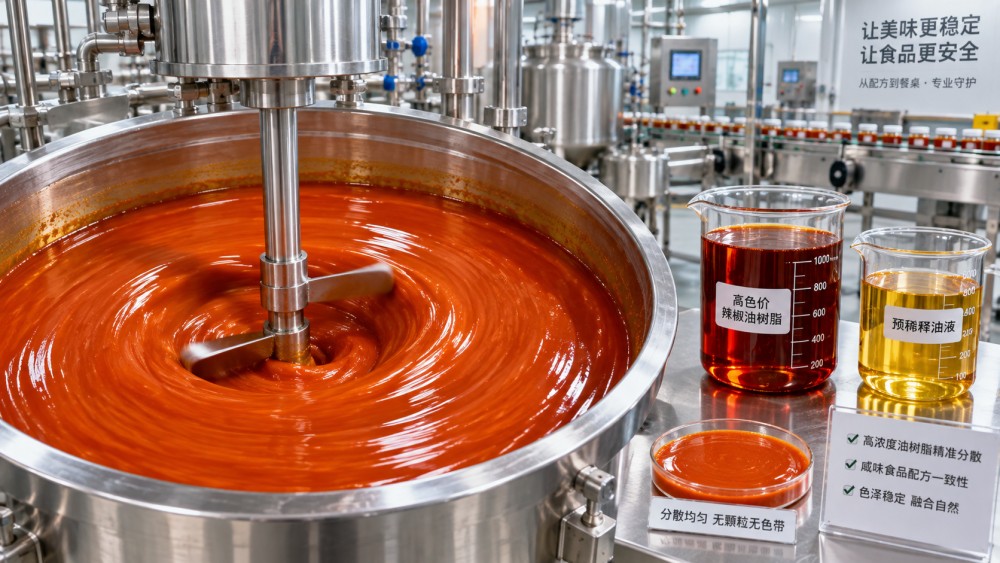
Mixing should be assessed at the scale and geometry used for manufacture. A laboratory rotor-stator mixer may create a uniform dispersion rapidly, while a large vessel with a low-speed sweep agitator may not reproduce that result. Conversely, excessive shear can introduce air into a viscous emulsion, changing light scattering and making a sample appear paler until deaeration. Sampling immediately after mixing can therefore give a different color reading from a sample taken after the batch has rested.
Oil phase, emulsifier system, and matrix opacity
In an emulsion, color behavior is influenced by droplet size and by where the pigment resides. When an oil-soluble oleoresin remains dissolved in small, stable oil droplets, color is distributed more uniformly. If emulsifier selection or process order produces unstable droplets, the visible shade can shift during storage even when the total pigment content remains unchanged.
Opacity adds another layer. A clear oil-based glaze reveals the intrinsic hue of the oleoresin more directly than an opaque sauce containing starch, protein, or finely dispersed solids. In the latter, light scattering can mute brightness or shift the perceived shade. Salt level, pH, and particulate ingredients may also alter the matrix appearance without chemically changing the pigment. A batch that appears too light after seasoning addition may reflect increased opacity rather than underdosing.
This distinction matters during corrective action. Adding more oleoresin to compensate for a matrix that has become more opaque can overshoot the intended pigment level. Once the product is heated, settled, or viewed under different lighting, the correction may become obvious as an overly red or dark result. Color should be judged after the formula reaches its representative state, including hydration, cooking, cooling, and holding where those stages are part of normal manufacture.
Heat stability is a process question, not a single material claim
Oleoresins are often selected because their pigments are more manageable in processing than raw spice powders. Concentration reduces the amount of non-color plant material introduced into the formula, which can improve texture control and lower the chance of visible specks. Still, thermal stability depends on time, temperature, oxygen exposure, product moisture, and the composition of the surrounding phase.
Dry snack systems and surface-seasoned products present different exposure patterns from retorted sauces or cooked meat emulsions. In a fried or baked application, the color may experience short, intense heat followed by oxygen exposure on the product surface. In a sauce, heating may be less severe at any moment but sustained for longer, then followed by hot filling and shelf storage. A color that holds well through one heating profile cannot be assumed to retain the same shade through the other.
Adding the oleoresin early can improve bulk distribution, but it extends residence time at elevated temperature. Adding it late reduces heat exposure, yet may demand stronger mixing to avoid streaking. The correct addition point is established by testing the real sequence, rather than by treating late addition as a universal solution. In some thick systems, an early oil-phase addition is necessary to ensure full dispersion before viscosity rises. In others, a protected post-cook addition produces better color retention.
Oxidation is another source of drift. Open kettles, high headspace, repeated reheating, and prolonged exposure to air can diminish certain natural pigment systems or move the shade away from the approved reference. Antioxidant systems, if already appropriate for the formula, can influence stability, but they should be assessed as part of the total product rather than treated as a correction for poor handling. Light exposure in transparent packaging may further reveal color loss that was not apparent in factory samples.
Application differences that change the evaluation method
Dry applications require particular caution. An oleoresin does not behave like a free-flowing powdered spice when added to a seasoning blend. It is commonly introduced through an oil carrier, a slurry, or an adsorbed intermediate. If the liquid is placed onto a portion of the dry blend without adequate distribution, that portion can become a concentrated color source. Later blending may spread the material partially while preserving localized intensity differences that appear on finished snacks.
In meat and protein systems, visual changes may come from both pigment performance and cooking chemistry. Surface browning, protein denaturation, fat rendering, and moisture loss change how the same color dose is perceived. A redder raw batter does not necessarily yield a redder cooked product. Product evaluation should therefore use the appearance that consumers will see, not only the pre-cook mixture.
Control points that prevent avoidable batch variation
The dose should be expressed in a way that production can reproduce. A formula based only on a mass addition of oleoresin assumes the supplied material has identical strength from lot to lot. Where material strength is permitted to vary within a specification, the dosing instruction should state how the addition is normalized to the approved color basis. This avoids a situation where every batch follows the same recipe weight but develops a different shade because incoming potency has shifted within its accepted range.
Scale accuracy matters more as color strength rises. A small manual addition may represent a meaningful portion of the target pigment dose. Premixed solutions, controlled metering, or a larger standardized intermediate batch can reduce this sensitivity. The best method is the one that keeps the added quantity within the resolution and repeatability of the available equipment while preserving stable dispersion.
- Control the addition sequence. Record whether the oleoresin enters the oil phase, an emulsion premix, a seasoning slurry, or the bulk vessel. A sequence change can alter distribution even when all ingredients and weights remain unchanged.
- Define sampling locations. Samples taken only from the top of a vessel can miss settling, creaming, or dead-zone effects. A meaningful review includes locations and times that reflect the filling process.
- Use a common viewing condition. Differences in lighting, sample depth, gloss, and background can create apparent color variation. Visual approval and instrumental color readings are most useful when their sample presentation is standardized.
- Track process interruptions. A hold before filling, a change in agitator speed, or an extended hot hold may explain a color deviation that does not appear in the ingredient record.
Reading color deviations correctly
A weak final shade has several possible causes: lower pigment strength, under-addition, incomplete dispersion, higher product opacity, heat loss, or a change in surface oil distribution. These causes require different responses. Before changing dosage, compare the actual batch with an approved reference at the same temperature, sample thickness, and lighting. Review the premix appearance, addition record, mixing time, and process timeline. That short investigation is often enough to separate a material-strength issue from a process issue.
Similarly, a darker product is not always overcolored. Reduced moisture, lower sauce pickup, increased coating solids, or a glossier surface can intensify perceived color without any increase in pigment. When a snack coating looks darker, examining coating pickup and surface oil can be more revealing than immediately lowering the oleoresin dose. Correcting the wrong variable can create alternating light and dark batches as the process returns to normal.
High color oleoresins support reliable savory-food appearance when they are treated as part of a controlled phase system. The most dependable formulations connect incoming color strength with a fixed dilution method, defined addition point, representative thermal test, and final-product evaluation. That approach turns a concentrated ingredient into a repeatable visual standard rather than a late-stage adjustment tool.
Related News
 Antioxidants & Natural PreservativesWhat Quality Checks Matter When Sourcing Butylparaben for Personal CareButylparaben for personal care sourcing guide: compare assay, impurities, physical performance, documentation, traceability, and supplier quality to reduce formulation risk.MORE+
 Nano-microcapsule FormulationsHow Encapsulated Flavors Protect Taste During Processing and StorageEncapsulated Flavors protect taste from heat, oxygen, moisture, and storage loss. Explore smarter release, carrier selection, and processing strategies.MORE+
 Chelated Trace Element FertilizersHow Greenhouse Fertigation Systems Reduce Water and Fertilizer WasteGreenhouse fertigation systems reduce water and fertilizer waste with precise dosing, uniform irrigation, drainage monitoring, and smarter crop-zone control. Learn practical strategies.MORE+
 Supercritical CO2 Essential OilsHow Natural Essential Oil Blends Improve Consistent Product FragranceNatural essential oil blends help brands achieve consistent, appealing fragrance across batches. Explore smart blend design, stability testing, and product compatibility strategies.MORE+
 Non-ionic Surfactants & DefoamersHow to Choose Non Ionic Low Foaming Surfactants for CIP CleaningNon ionic low foaming surfactants for CIP cleaning: learn how to balance wetting, foam control, compatibility, and rinseability for reliable cleaning performance.MORE+
 Nano-microcapsule FormulationsHow Food Grade Cyclodextrin Complexes Protect Sensitive FlavorsFood grade cyclodextrin inclusion complexes help protect sensitive flavors from oxidation, evaporation, and processing loss while supporting controlled release and consistent sensory quality.MORE+
 Polymer-Coated Water Soluble NPKHow Fertilizer Coating Polymers Improve NPK Granule ReleaseFertilizer coating polymers for NPK granules improve controlled nutrient release, reduce loss risks, and enhance product consistency. Discover key selection and process insights.MORE+
 Chelated Trace Element FertilizersWhat Diammonium Phosphate Means for Crop Nutrition PlanningDiammonium Phosphate: learn how DAP supports early phosphorus access, nitrogen budgeting, smart placement, and balanced crop nutrition planning.MORE+
 Maillard Reaction Savory FlavorsHow to Assess a Flavor Bases Supplier List for Reliable SourcingGlobal Fine Chemicals & Agrochemical Intelligence Network flavor bases supplier list: assess specs, samples, supply risk, and true cost to source with confidence.MORE+
 Hydrocolloids & EmulsifiersHow Konjac Gum Powder Improves Texture in Low-Calorie FoodsKonjac gum powder improves body, stability, and mouthfeel in low-calorie foods. Discover practical tips for smoother sauces, beverages, and reduced-fat formulations.MORE+
 Supercritical CO2 Essential OilsWhat to Check Before Choosing a Botanical Essential Oils ManufacturerChoose a botanical essential oils manufacturer with confidence. Explore key checks for purity, traceability, compliance, batch consistency, and reliable supply.MORE+
 Microencapsulated FragrancesHow Fragrance Carriers for Detergents Improve Scent PerformanceFragrance carriers for detergents improve stability, fabric deposition, and long-lasting scent. Explore practical solutions for better wash-to-wear fragrance performance.MORE+
 Antioxidants & Natural PreservativesWhen Propyl Gallate Antioxidant Is the Right Choice for Oil StabilityPropyl gallate antioxidant: learn when it is the right choice for oil stability, shelf-life protection, processing compatibility, and smarter formulation decisions.MORE+
 Antioxidants & Natural PreservativesHow Potassium Sorbate Extends Shelf Life in Food and Beverage ProductsPotassium Sorbate helps food and beverage brands control yeast and mold spoilage. Explore pH, dosage, processing, and packaging strategies for reliable shelf life.MORE+
 Antioxidants & Natural PreservativesHow to Source Bulk Herbal Extracts With Reliable Quality ControlBulk herbal extracts sourcing guide: compare suppliers, verify traceability, review CoAs, and build reliable quality controls for safer, consistent purchasing.MORE+
 Antioxidants & Natural PreservativesWhat to Check Before Sourcing Butylparaben for Personal Care FormulasButylparaben for personal care sourcing guide: check market eligibility, purity, supplier controls, formula compatibility, packaging, and total risk before buying.MORE+
 Targeted Bio-pesticides & APIsChoosing Microbial Fungicides for Foliar Diseases in Integrated Crop ProgramsMicrobial fungicides for foliar diseases: learn how to match biology, formulation, tank compatibility, and timing for stronger integrated crop protection.MORE+
 Targeted Bio-pesticides & APIsHow Microbial Insecticides Control Caterpillars With Lower Crop Residue RiskMicrobial insecticides for caterpillars help protect crops with targeted early-larval control and lower residue-management pressure. Learn timing, coverage, compliance, and scouting essentials.MORE+
 Microencapsulated FragrancesHow to Add Encapsulated Laundry Fragrances Without Weakening Wash ResultsEncapsulated laundry fragrances: learn how to boost long-lasting scent while protecting cleaning power, stability, foam control, and fabric care.MORE+
 Supercritical CO2 Essential OilsHow Aroma Ingredients Shape Lasting and Skin-Safe Personal Care ProductsAroma ingredients for personal care: discover how to achieve lasting scent, formulation stability, skin safety, and confident product performance.MORE+
 Targeted Bio-pesticides & APIsInsecticides Explained Through Labels, Active Ingredients, and SafetyInsecticides explained through labels, active ingredients, formulations, and safety. Learn how to compare products, manage risk, and make informed crop protection decisions.MORE+
 Heavy-duty Industrial DegreasersHow to Select Parts Wash Cleaners for Automotive ComponentsParts wash cleaners for automotive components: learn how to match chemistry, materials, rinsing, safety, and waste controls for reliable cleaning results.MORE+
 Chelated Trace Element FertilizersHow Precision Fertigation Systems Improve Water and Nutrient ControlPrecision fertigation systems improve water and nutrient control with accurate dosing, uniform irrigation, smart monitoring, and reduced waste. Discover how to optimize crop performance.MORE+
 Hydrocolloids & EmulsifiersHow Bulk Price Factors Affect Hydrocolloid Stabilizer Blend SourcingHydrocolloid stabilizer blends bulk price: compare dosage efficiency, quality consistency, logistics, and documentation to reduce total sourcing costs.MORE+
 Zero-Calorie Sweeteners & AcidulantsHow to Choose a Natural Sweeteners Supplier for Clean-Label ProductsNatural sweeteners supplier selection guide for clean-label products: compare formulation fit, traceability, documentation, and supply reliability.MORE+
 Non-ionic Surfactants & DefoamersWhat Cationic Surfactants Do and Where They Are UsedCationic Surfactants deliver antimicrobial action, conditioning, antistatic control, and surface treatment benefits. Explore key uses, compatibility, and safe selection tips.MORE+
 Targeted Bio-pesticides & APIsHow to Evaluate Pesticide Suspension Concentrates for Field StabilityPesticide Suspension Concentrates: learn how to evaluate field stability, redispersibility, dilution, tank-mix compatibility, and spray safety for reliable performance.MORE+
 Hydrocolloids & EmulsifiersHow Hydrocolloid Systems for Meat Products Improve Texture and YieldHydrocolloid systems for meat products improve yield, texture, water retention, and slicing quality. Explore practical formulation strategies for stable, high-performing meat products.MORE+
 Microencapsulated FragrancesHow Laundry Fragrances for Liquid Detergents Improve Scent LongevityLaundry fragrances for liquid detergents: discover how fragrance design, deposition, and encapsulation create lasting fabric freshness and stronger product appeal.MORE+
 Nano-microcapsule FormulationsChoosing Fragrance Preparations That Perform Well in Personal WashFragrance preparations for personal wash: learn how to select options that protect clarity, stability, foam, scent performance, and packaging compatibility.MORE+
 Controlled-Release ThermodynamicsModified Cyclodextrins Explained for Controlled Fragrance ReleaseModified cyclodextrins enable controlled fragrance release, odor control, and volatile-note protection. Explore how they optimize performance in detergents, fabric care, and more.MORE+
 Microencapsulated FragrancesHow Fragrance Delivery Systems Improve Fabric Softener LongevityFragrance delivery systems for fabric softeners improve scent longevity through smart protection, reliable deposition, and controlled release for lasting freshness.MORE+
 Supercritical CO2 Essential OilsHow to Evaluate a Natural Cardamom Oil Supplier for Reliable SupplyNatural cardamom oil supplier evaluation guide: verify botanical origin, purity, batch consistency, documentation, packaging, and delivery reliability for confident sourcing.MORE+
 Maillard Reaction Savory FlavorsHow Ethyl Maltol Purity Testing Supports Flavor Safety ComplianceEthyl Maltol purity testing strengthens flavor safety compliance through identity checks, impurity profiling, supplier verification, and audit-ready documentation.MORE+
 Microencapsulated FragrancesEssential Oil Extracts Compared for Fragrance and Wellness UsesEssential Oil Extracts compared for fragrance and wellness: explore scent profiles, extraction methods, stability, safety, and sourcing insights for smarter formulation choices.MORE+
 Zero-Calorie Sweeteners & AcidulantsWhat Drives Zero Calorie Sweeteners Bulk Price in 2026Zero calorie sweeteners bulk price in 2026: compare specifications, dosage, quality, freight, and supply risk to make smarter sourcing decisions.MORE+
 EPA FIFRA & FDA GRAS RegsSynthetic Food Preservatives Rules That Support Safer FormulasSynthetic Food Preservatives: learn the rules for safer formulas, compliant use levels, validated shelf life, labeling, and reliable microbial control.MORE+
 Micelle Fluidics & ChelationHow Anionic Industrial Dispersants Improve Coating StabilityAnionic industrial dispersants improve coating stability, pigment wetting, viscosity control, gloss, and storage performance. Learn how to select and test the right solution.MORE+
 Supercritical CO2 Essential OilsHow to Choose Eucalyptus Oil Grades for Clean, Consistent ProductsChoose the right Eucalyptus Oil grade with confidence. Compare cineole content, purity, origin, processing, documentation, and application fit for consistent products.MORE+
 Micelle Fluidics & ChelationWhat Are Cationic Surfactants and Where Are They Commonly Used?Cationic Surfactants deliver powerful surface affinity for disinfection, fabric softening, hair conditioning, antistatic control, and industrial treatments. Explore key uses and selection factors.MORE+







































