
How Aroma Ingredients for Baked Goods Shape Fresh-Baked Appeal
Aroma ingredients for baked goods play a critical role in creating the warm, recognizable sensory appeal consumers associate with fresh bread, cakes, cookies, and pastries.
Beyond delivering a desirable flavor profile, these ingredients must withstand baking temperatures, interact reliably with fats and sugars, and maintain consistency throughout shelf life.
This guide examines formulation performance, sourcing priorities, sensory risks, and compliance factors that help food manufacturers select suitable aroma solutions for bakery applications.
Why Fresh-Baked Aroma Matters More Than a Pleasant Smell
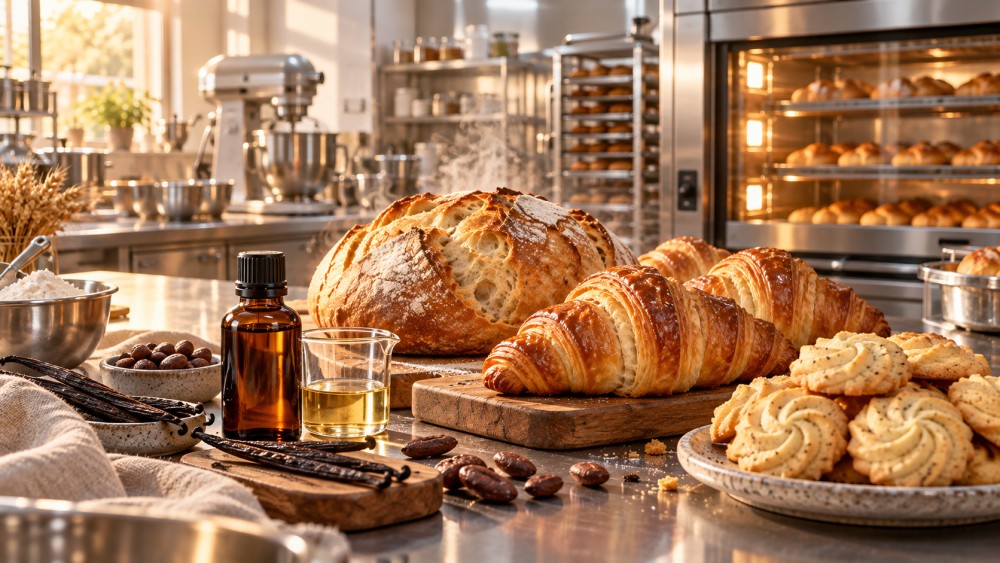
For bakery buyers and product developers, aroma is not a decorative finishing detail. It strongly influences perceived freshness, product quality, indulgence, and willingness to purchase again.
Consumers often evaluate baked products before tasting them. The aroma released from a package, display case, toaster, or oven creates an immediate expectation of flavor and texture.
A warm buttery note may suggest richness, while roasted cereal notes can support an artisanal bread position. Vanilla, caramel, cocoa, and spice notes reinforce familiar product cues.
Fresh-baked appeal is especially important when a product is manufactured centrally, transported over distance, and sold several days after production rather than directly from the oven.
In these situations, aroma ingredients for baked goods can help compensate for sensory losses caused by cooling, storage, packaging barriers, moisture migration, and distribution time.
The commercial objective is not simply making the formula smell stronger. It is creating an aroma profile that feels authentic, balanced, stable, and appropriate for the bakery category.
Information researchers should therefore compare aroma systems by application performance and sensory outcome, rather than selecting materials based only on a familiar flavor name or unit price.
Start With the Actual Bakery Application
The first selection question is straightforward: what product must the aroma support? Bread, cookies, cakes, laminated pastries, fillings, and dry mixes present very different processing conditions.
Yeast-raised breads often require cereal, toasted crust, malt, dairy, or fermentation-associated notes. Their sensory target is usually subtle, integrated, and closely connected to grain character.
Cookies can tolerate stronger vanilla, butter, brown sugar, nut, cocoa, or caramel profiles because lower moisture and surface browning produce intense aroma during baking.
Cakes commonly need a cleaner and softer aroma profile. Vanilla, dairy, citrus, fruit, chocolate, or cream notes must remain recognizable within sugar, egg, oil, and flour systems.
Pastries frequently rely on butter, cream, vanilla, almond, fruit, or roasted notes. However, high-fat doughs can retain certain aroma compounds and change perceived intensity over time.
Dry bakery mixes require another level of evaluation. The aroma must survive powder blending, storage, consumer preparation, and baking without becoming uneven or prematurely volatilized.
Aroma selection should reflect the final eating experience, not only the raw batter smell. A promising pre-bake note may weaken, distort, or disappear after thermal processing.
Understand What Happens During Baking
Baking exposes aroma compounds to heat, water loss, steam movement, fats, proteins, sugars, and chemical reactions. These conditions determine which notes remain noticeable after production.
Highly volatile compounds can generate an attractive oven aroma but may be lost before the finished product reaches a retail shelf or consumer kitchen.
Other compounds are more thermally stable but can appear flat, heavy, or overly sweet if they are not supported by brighter top notes.
Maillard reactions between amino acids and reducing sugars naturally generate toasted, nutty, roasted, and crust-like notes. Added aroma ingredients should complement rather than imitate these reactions poorly.
Fat content also matters. Lipophilic aroma molecules can dissolve into butter, margarine, shortening, or oil, changing both release speed and perceived aroma intensity.
Water activity influences aroma release as well. A dry cookie, moist cake, and frozen dough may carry the same flavor system differently because their structures release volatile compounds differently.
Suppliers should provide application-specific heat stability information, but manufacturers should still validate performance in their own ovens, batch sizes, bake times, and packaging conditions.
Choose the Right Aroma Format for the Manufacturing Process
Aroma ingredients for baked goods are supplied in liquid, powder, encapsulated, emulsified, oil-soluble, and water-dispersible formats. The right format depends on process handling and formulation compatibility.
Liquid flavors are widely used because they disperse efficiently in batters, doughs, creams, and syrups. They can be easy to dose accurately in automated production systems.
However, liquid systems may require careful attention to carrier selection. Alcohol, propylene glycol, triacetin, vegetable oil, and other carriers can affect labeling, processing, or texture.
Powder flavors are often useful for dry mixes, powdered fillings, premixes, and low-moisture products. They can simplify handling but must remain free-flowing during storage.
Encapsulated aroma systems can protect sensitive compounds from heat, oxidation, and early release. They may also improve shelf-life performance or create aroma release during eating.
Emulsified systems may be appropriate when oil-based aroma materials must disperse consistently in water-containing batters. Their stability depends on emulsifier choice, particle size, and processing conditions.
Procurement teams should ask whether the selected format needs special mixing order, temperature limits, shear control, dust management, or storage conditions before approving a supplier.
Evaluate Aroma Performance Beyond the First Sample
A supplier sample can smell impressive in a bottle, yet perform poorly in production. Evaluation should focus on the finished baked product under realistic manufacturing conditions.
A structured trial should compare aroma intensity before baking, immediately after baking, after cooling, after packaging, and near the planned end of shelf life.
Sensory panels should assess more than strength. They should examine authenticity, balance, off-notes, product fit, after-aroma, and whether the profile remains pleasant after repeated consumption.
For packaged products, test aroma when the package is opened. Headspace aroma can be critical because consumers may associate the first release with freshness.
It is also useful to compare products after reheating or toasting. Some bakery items are consumed warm, and their aroma profile may change substantially at serving temperature.
Testing should include realistic production variation, including different flour lots, fat sources, egg content, oven zones, moisture levels, and cooling times where relevant.
Aroma suppliers with bakery experience can support trial design, but final decisions should rely on documented internal results rather than informal impressions from isolated bench samples.
Build a Balanced Profile Instead of Chasing Intensity
Many bakery formulations fail because the aroma is too obvious. An intense buttery, vanilla, or caramel note can make a product seem artificial rather than freshly baked.
A convincing profile usually includes several sensory layers. Top notes create immediate recognition, middle notes provide the expected character, and base notes add warmth and persistence.
For example, a vanilla cake profile may combine creamy sweetness, gentle dairy warmth, and subtle baked sugar notes rather than relying on a single vanilla ingredient.
Likewise, a bread aroma may need toasted cereal, mild fermentation, crust character, and restrained sweetness. Excessive dairy or caramel notes can undermine a natural bread identity.
Product positioning should guide intensity decisions. Value products may favor a clear, familiar profile, while premium bakery products often benefit from more nuanced and less obvious aroma design.
Regional preferences also matter. Consumer expectations for butter, vanilla, spice, fruit, and roast notes differ by market, age group, bakery tradition, and consumption occasion.
When comparing suppliers, request sensory descriptors and recommended use levels, but assess whether those recommendations align with the target market rather than treating them as universal standards.
Manage Ingredient Interactions and Formulation Risks
Aroma ingredients do not work independently. Their final expression can be changed by sweeteners, salt, cocoa, dairy powders, emulsifiers, preservatives, acids, colors, and processing aids.
High sugar systems can suppress delicate aromatic detail while emphasizing caramelized or sweet notes. Strong cocoa ingredients may mask lighter vanilla, fruit, or cream profiles.
Oxidized fats can create stale, cardboard-like, or rancid off-notes that no aroma system can fully hide. Fat quality and antioxidant strategy remain important sensory controls.
Some bakery preservatives or acidic ingredients may interact with specific flavor compounds. Product developers should confirm stability within the expected pH range and storage environment.
Packaging materials can absorb certain volatile compounds, particularly in long-life products. This may reduce aroma impact or change the balance between top and base notes.
Migration from printing inks, adhesives, or packaging components can also create undesirable odors. Aroma development should be coordinated with packaging qualification, not treated as a separate activity.
Manufacturers should investigate off-notes systematically. The source may be an aroma ingredient, but it may also involve raw materials, oxidation, microbial spoilage, packaging, or cleaning residues.
Source Aroma Ingredients With Documentation in Mind
For business buyers, consistent sensory performance is only one part of supplier assessment. Documentation quality, regulatory support, traceability, and change control are equally important.
A supplier should clearly identify the flavor category, physical form, recommended dosage, storage conditions, shelf life, allergen status, and relevant food-contact or food-use documentation.
Buyers may also need certificates of analysis, specification sheets, safety data, origin information, halal or kosher status, non-GMO statements, and contaminant-related declarations.
Natural, natural-identical, and artificial flavor terminology can carry different commercial and regulatory implications depending on the destination market. Label claims require market-specific review.
Global manufacturers should check whether materials meet applicable requirements in the United States, European Union, United Kingdom, China, Southeast Asia, or other intended markets.
Supplier change notifications are particularly important for aroma systems. Adjustments to raw materials, carriers, manufacturing sites, or composition may alter sensory performance or labeling obligations.
A reliable supplier relationship includes technical responsiveness. When a bakery formula changes, the supplier should be able to explain compatibility concerns and recommend workable alternatives promptly.
Compare Cost Through Finished Product Value
The lowest aroma price per kilogram rarely represents the lowest cost in use. Dosage, batch consistency, sensory impact, waste reduction, and reformulation needs all affect total value.
A more concentrated aroma may have a higher purchase price but require lower use levels. It may also reduce storage space, handling time, and formulation variability.
Conversely, a low-cost flavor requiring high dosage can increase formula cost, complicate labeling, or create excessive carrier contribution in sensitive bakery systems.
Assess cost using the finished-product formula: calculate cost per batch, cost per unit, required dosage range, expected shelf-life retention, and risk of rejected production.
Consider the commercial consequence of inconsistent aroma. A product that fails to deliver its expected fresh-baked character can lose repeat purchases even when technical specifications are met.
For new product development, small pilot trials are usually more economical than relying solely on supplier claims. Early sensory validation prevents expensive changes after market launch.
Information researchers can add value by creating a comparison matrix that combines sensory performance, technical fit, documentation readiness, supply reliability, and total applied cost.
A Practical Selection Framework for Bakery Teams
Begin by defining the desired consumer impression in plain language. Specify whether the target should feel buttery, crusty, warm, creamy, fruity, toasted, indulgent, or traditionally baked.
Next, document the product conditions: formula composition, mixing order, baking temperature, bake duration, cooling method, package type, target shelf life, and serving method.
Shortlist aroma ingredients for baked goods based on format compatibility, dosage practicality, heat stability, regional compliance, supplier documentation, and availability in required commercial volumes.
Run controlled trials using a reference product and at least one alternative. Evaluate samples blind when possible, using predetermined sensory criteria and clear acceptance thresholds.
Confirm the preferred option after shelf-life testing, not only after a freshly baked assessment. This step is essential for packaged bakery products and export-oriented supply chains.
Before commercialization, agree on specifications, change-control procedures, lead times, packaging sizes, storage requirements, and technical contacts for quality or production issues.
This process turns aroma selection into a disciplined business decision. It helps teams avoid choosing an attractive sample that cannot deliver stable performance at production scale.
Conclusion
Aroma ingredients for baked goods shape far more than fragrance. They influence perceived freshness, flavor expectation, product differentiation, and the consumer's first judgment at every purchase occasion.
The most suitable solution matches the bakery format, process temperature, fat and moisture system, intended shelf life, package design, market positioning, and regulatory requirements.
For researchers and procurement teams, the strongest evaluation combines technical documentation with finished-product testing. Aroma value should be measured by reliable fresh-baked appeal, not by bottle impressions alone.







































