
How to Qualify a Pesticide Formulation Intermediates Supplier
A pesticide formulation intermediate should be qualified against the formulation it will enter, the process it will undergo, and the documentation needed to release the finished product. A material can meet a broad commercial description and still create unacceptable variation in an emulsifiable concentrate, suspension concentrate, water-dispersible granule, seed treatment, or microencapsulated system. The qualification decision therefore needs evidence that the supplied material is chemically identified, consistently manufactured, controlled at meaningful limits, safely handled, and traceable through receipt and use.
Start by defining the intermediate in functional terms rather than relying on its trade description. A solvent, dispersant, wetting agent, emulsifier, carrier, preservative, stabilizer, or processing aid may have different critical properties even when the nominal chemical name is similar. For example, two surfactant grades with comparable active content can differ in water content, cloud point, free alcohol content, salt level, color, odor, or hydrophilic-lipophilic balance. Those differences may alter emulsion behavior, foam, viscosity development, cold-storage stability, or compatibility with the active ingredient.
Set the qualification specification before reviewing the supplier
The internal material specification should distinguish between values that define identity, values that affect formulation performance, and values that indicate process control. Purity alone is rarely enough. For a liquid intermediate, relevant controls may include assay, moisture, acidity or alkalinity, density, refractive index, color, insoluble matter, flash point, and impurity profile. For a solid, particle-size distribution, bulk density, moisture, residue on sieve, flow behavior, and contamination by foreign particles may determine whether it can be dispersed, milled, granulated, or packed reliably.
Limits should reflect the actual formulation window. A broad supplier range may be suitable for one application and too wide for another. If a dispersant is used near the minimum concentration needed to hold active particles in suspension, a small shift in molecular-weight distribution or active matter can cause sedimentation after storage. If a solvent is close to a solubility threshold for an active ingredient, water content and aromatic composition can change crystallization behavior. Acceptance limits need to be tied to observed process sensitivity, not copied uncritically from a supplier certificate.
Critical attributes are best separated into release tests and periodic characterization. Release tests are practical controls applied to every lot, such as appearance, assay, water content, pH, density, or particle size. Periodic characterization examines attributes that may not be tested on every receipt but can reveal material drift: trace impurities, residual monomers, chromatographic fingerprints, elemental contaminants, or microbial burden where a biologically derived intermediate is involved. This distinction avoids both under-testing and an impractical incoming-control program.
Confirm identity, origin, and batch traceability
A supplier qualification file should establish the legal and technical identity of the material. The product name, chemical identity, grade, relevant composition range, and intended function must agree across the specification, technical data sheet, safety documentation, certificate of analysis, label, and purchase description. Inconsistent naming is not merely an administrative defect. It can conceal a grade substitution, a changed feedstock, or a material supplied from a different production route.
Traceability must connect the received container to a supplier batch, manufacturing date or production period, release status, and supporting test record. Where the intermediate is blended or repacked, the traceability path should identify the original manufacturing batch as well as the blending or repacking operation. A certificate that lists only a sales lot without a defensible connection to production records offers limited value during a deviation investigation.
Raw-material origin matters most when it changes the impurity profile or hazard profile. Natural extracts, fermentation-derived materials, recycled solvents, fatty alcohol derivatives, and multi-component surfactant systems often have broader compositional variation than a single, highly defined chemical. Qualification should establish whether the source and manufacturing route are controlled and whether a meaningful change to either requires advance notification. A supplier that cannot describe its change-notification practice leaves the formulation site exposed to unannounced shifts in performance.
Read the certificate of analysis as process evidence
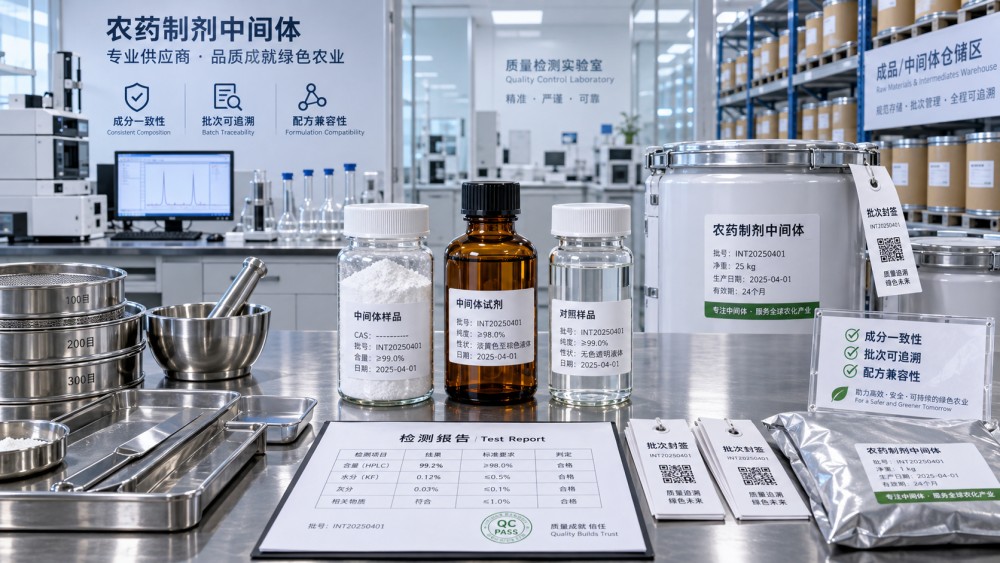
A certificate of analysis should be assessed for more than the presence of passing numbers. Compare several certificates from separate batches where available. Repeated values at exactly the same result, especially for measurements that normally show small analytical variation, may indicate transcription, specification targeting, or a report generated from limited testing. That observation does not prove nonconformance, but it warrants clarification of the testing method, sampling basis, and reporting practice.
Method references should be sufficiently specific to understand what was measured. “Internal method” may be acceptable when the method principle, revision control, units, and acceptance criteria are available for review. A moisture result obtained by a method that responds differently to bound and free water should not be treated as interchangeable with another moisture method. Likewise, particle-size results require the measurement technique and dispersion conditions. Laser diffraction, wet sieving, and sedimentation methods can produce different distributions for the same powder.
Pay attention to units, test temperatures, and basis of reporting. Density at one temperature cannot be compared directly with a value at another. Active content expressed on an as-is basis differs from a dry basis. A result reported as “less than” may be useful for a controlled trace impurity, but it is not a measured value for trend analysis. These details become important when investigating a batch that performs differently despite appearing compliant on paper.
Test the material in the formulation, not only in the laboratory vial
Incoming analysis confirms whether a lot meets defined limits; it does not prove formulation fitness. Qualification samples should be evaluated in a representative formulation using the intended active ingredient, concentration range, mixing order, water quality, processing temperature, and packaging contact conditions. A small bench batch is useful, but it should be designed to expose the known stress points of the product rather than simply demonstrate that components can be combined.
For suspension concentrates, examine wetting during addition, milling response, particle-size stability, viscosity profile, sedimentation, redispersibility, and behavior after temperature cycling. A dispersant may give an acceptable initial particle-size result yet lose effectiveness after a heat hold, allowing a compact sediment to form. For emulsifiable concentrates, inspect clarity, active ingredient solubility, low-temperature precipitation, dilution behavior in waters of relevant hardness, and emulsion persistence. Apparent clarity at room temperature does not confirm storage stability.
Water-dispersible granules and wettable powders need a different lens. Moisture pickup, caking tendency, dispersibility, wetting time, suspension behavior, dust generation, and compatibility with the carrier are often more informative than a simple assay result. For seed-treatment systems, film formation, viscosity recovery, adhesion, abrasion resistance, colorant interaction, and drying behavior can expose deficiencies in a binder or rheology modifier. The correct qualification test is the one that represents the failure mode most likely to disrupt the finished formulation.
Use retained samples to distinguish material drift from process variation
Retain approved samples from qualification batches and selected routine receipts under controlled conditions. When a finished formulation deviates, comparative testing against a retained intermediate can separate a supplier-related shift from changes in water quality, mixing energy, active ingredient condition, equipment cleanliness, or storage history. Without reference material, investigations often become speculative and lead to unnecessary rejection or repeated reformulation work.
Retained-sample comparisons should be planned carefully. Aged material may itself change, particularly if it is hygroscopic, oxidation-sensitive, volatile, or prone to phase separation. Storage conditions, container closure, headspace, and sample quantity should therefore be recorded. A comparison is meaningful only when the retained sample remains representative of its original released condition.
Evaluate manufacturing control and change discipline
Document review should be followed, where appropriate, by a technical assessment of the manufacturing and release process. The objective is not to inspect every operational detail; it is to understand whether critical quality attributes are controlled at the point where they can be influenced. Questions should cover incoming raw-material verification, equipment cleaning, segregation of incompatible materials, batch identification, sampling practice, laboratory controls, deviation handling, and disposition of off-specification material.
Particular attention is needed where cross-contamination could affect a pesticide formulation. Residues of other surfactants, solvents, actives, dyes, metals, or cleaning agents can be significant even at low levels when they change emulsion stability, odor, appearance, or toxicological assessment. Shared equipment is not automatically unacceptable, but the supplier should be able to explain cleaning validation or a justified cleaning approach, line scheduling, and how carryover risk is assessed.
Change control is a decisive part of long-term qualification. Changes to manufacturing site, synthesis route, catalyst, solvent source, raw-material supplier, purification method, packaging, test method, or specification limits can alter behavior without changing the material name. The supply agreement should define which changes require notification before implementation and what supporting information is needed. A revised certificate alone is not an adequate notification when a change could affect formulation performance or regulatory documentation.
Inspect packaging, transport, and storage as part of material quality
Many intermediate failures originate after release from the supplier. The package must protect against the material’s actual vulnerabilities: moisture ingress, oxygen exposure, light, heat, static accumulation, leakage, container interaction, or contamination from reused closures. A hygroscopic powder in a damaged fiber drum can pass its original certificate yet form lumps that no longer disperse. A solvent-sensitive emulsifier stored in excessive heat can separate or develop color, while a container lining may extract or adsorb components from certain formulations.
Receipt inspection should verify container integrity, label legibility, lot consistency, seal condition, net quantity, transport damage, and storage instructions. A material that arrives with a different package configuration should not be accepted automatically, even where the product name and batch number match. Packaging changes can affect shelf life, handling safety, discharge behavior, and contamination control.
Quarantine status should remain visible until identity and required release testing are complete. Sampling needs an approach that protects both sample integrity and personnel. Volatile liquids, sensitizing materials, corrosive components, and dusty powders call for different sampling controls. Open sampling in an unsuitable area can create exposure, contaminate the material, and invalidate the sample as evidence of the delivered batch.
Address safety and regulatory documentation without treating it as a paper exercise
Safety documentation must align with the material actually supplied, including concentration ranges, physical form, hazard communication, storage conditions, and transport classification where applicable. Conflicts between the safety data and the certificate of analysis deserve investigation. For example, a solvent-containing intermediate described as low volatility while its stated composition suggests otherwise may indicate an outdated document or a grade mismatch.
Qualification should also establish whether the supplier can provide composition, impurity, and traceability information at the level needed for the intended product registration, hazard assessment, or customer documentation. The needed depth varies by formulation and market, but the important point is timing: unresolved data gaps discovered after pilot batches, label preparation, or product release can delay work that was otherwise technically complete.
Do not confuse a document set with sustained control. A well-presented technical package supports qualification only when batch records, analytical results, packaging practices, and change management remain consistent with it. Ongoing approval should be maintained through receipt trending, periodic review of deviations, confirmation of document revisions, and re-evaluation when formulation performance or supplier operations change materially.
A qualified pesticide formulation intermediates supplier is one whose material remains identifiable, reproducible, compatible, and controllable across routine deliveries. The evidence should be strong enough to explain why a lot was accepted, how a deviation would be investigated, and what event would trigger renewed technical assessment.
Related News
 Antioxidants & Natural PreservativesWhat Quality Checks Matter When Sourcing Butylparaben for Personal CareButylparaben for personal care sourcing guide: compare assay, impurities, physical performance, documentation, traceability, and supplier quality to reduce formulation risk.MORE+
 Nano-microcapsule FormulationsHow Encapsulated Flavors Protect Taste During Processing and StorageEncapsulated Flavors protect taste from heat, oxygen, moisture, and storage loss. Explore smarter release, carrier selection, and processing strategies.MORE+
 Chelated Trace Element FertilizersHow Greenhouse Fertigation Systems Reduce Water and Fertilizer WasteGreenhouse fertigation systems reduce water and fertilizer waste with precise dosing, uniform irrigation, drainage monitoring, and smarter crop-zone control. Learn practical strategies.MORE+
 Supercritical CO2 Essential OilsHow Natural Essential Oil Blends Improve Consistent Product FragranceNatural essential oil blends help brands achieve consistent, appealing fragrance across batches. Explore smart blend design, stability testing, and product compatibility strategies.MORE+
 Non-ionic Surfactants & DefoamersHow to Choose Non Ionic Low Foaming Surfactants for CIP CleaningNon ionic low foaming surfactants for CIP cleaning: learn how to balance wetting, foam control, compatibility, and rinseability for reliable cleaning performance.MORE+
 Nano-microcapsule FormulationsHow Food Grade Cyclodextrin Complexes Protect Sensitive FlavorsFood grade cyclodextrin inclusion complexes help protect sensitive flavors from oxidation, evaporation, and processing loss while supporting controlled release and consistent sensory quality.MORE+
 Polymer-Coated Water Soluble NPKHow Fertilizer Coating Polymers Improve NPK Granule ReleaseFertilizer coating polymers for NPK granules improve controlled nutrient release, reduce loss risks, and enhance product consistency. Discover key selection and process insights.MORE+
 Chelated Trace Element FertilizersWhat Diammonium Phosphate Means for Crop Nutrition PlanningDiammonium Phosphate: learn how DAP supports early phosphorus access, nitrogen budgeting, smart placement, and balanced crop nutrition planning.MORE+
 Maillard Reaction Savory FlavorsHow to Assess a Flavor Bases Supplier List for Reliable SourcingGlobal Fine Chemicals & Agrochemical Intelligence Network flavor bases supplier list: assess specs, samples, supply risk, and true cost to source with confidence.MORE+
 Hydrocolloids & EmulsifiersHow Konjac Gum Powder Improves Texture in Low-Calorie FoodsKonjac gum powder improves body, stability, and mouthfeel in low-calorie foods. Discover practical tips for smoother sauces, beverages, and reduced-fat formulations.MORE+
 Supercritical CO2 Essential OilsWhat to Check Before Choosing a Botanical Essential Oils ManufacturerChoose a botanical essential oils manufacturer with confidence. Explore key checks for purity, traceability, compliance, batch consistency, and reliable supply.MORE+
 Microencapsulated FragrancesHow Fragrance Carriers for Detergents Improve Scent PerformanceFragrance carriers for detergents improve stability, fabric deposition, and long-lasting scent. Explore practical solutions for better wash-to-wear fragrance performance.MORE+
 Antioxidants & Natural PreservativesWhen Propyl Gallate Antioxidant Is the Right Choice for Oil StabilityPropyl gallate antioxidant: learn when it is the right choice for oil stability, shelf-life protection, processing compatibility, and smarter formulation decisions.MORE+
 Antioxidants & Natural PreservativesHow Potassium Sorbate Extends Shelf Life in Food and Beverage ProductsPotassium Sorbate helps food and beverage brands control yeast and mold spoilage. Explore pH, dosage, processing, and packaging strategies for reliable shelf life.MORE+
 Antioxidants & Natural PreservativesHow to Source Bulk Herbal Extracts With Reliable Quality ControlBulk herbal extracts sourcing guide: compare suppliers, verify traceability, review CoAs, and build reliable quality controls for safer, consistent purchasing.MORE+
 Antioxidants & Natural PreservativesWhat to Check Before Sourcing Butylparaben for Personal Care FormulasButylparaben for personal care sourcing guide: check market eligibility, purity, supplier controls, formula compatibility, packaging, and total risk before buying.MORE+
 Targeted Bio-pesticides & APIsChoosing Microbial Fungicides for Foliar Diseases in Integrated Crop ProgramsMicrobial fungicides for foliar diseases: learn how to match biology, formulation, tank compatibility, and timing for stronger integrated crop protection.MORE+
 Targeted Bio-pesticides & APIsHow Microbial Insecticides Control Caterpillars With Lower Crop Residue RiskMicrobial insecticides for caterpillars help protect crops with targeted early-larval control and lower residue-management pressure. Learn timing, coverage, compliance, and scouting essentials.MORE+
 Microencapsulated FragrancesHow to Add Encapsulated Laundry Fragrances Without Weakening Wash ResultsEncapsulated laundry fragrances: learn how to boost long-lasting scent while protecting cleaning power, stability, foam control, and fabric care.MORE+
 Supercritical CO2 Essential OilsHow Aroma Ingredients Shape Lasting and Skin-Safe Personal Care ProductsAroma ingredients for personal care: discover how to achieve lasting scent, formulation stability, skin safety, and confident product performance.MORE+
 Targeted Bio-pesticides & APIsInsecticides Explained Through Labels, Active Ingredients, and SafetyInsecticides explained through labels, active ingredients, formulations, and safety. Learn how to compare products, manage risk, and make informed crop protection decisions.MORE+
 Heavy-duty Industrial DegreasersHow to Select Parts Wash Cleaners for Automotive ComponentsParts wash cleaners for automotive components: learn how to match chemistry, materials, rinsing, safety, and waste controls for reliable cleaning results.MORE+
 Chelated Trace Element FertilizersHow Precision Fertigation Systems Improve Water and Nutrient ControlPrecision fertigation systems improve water and nutrient control with accurate dosing, uniform irrigation, smart monitoring, and reduced waste. Discover how to optimize crop performance.MORE+
 Hydrocolloids & EmulsifiersHow Bulk Price Factors Affect Hydrocolloid Stabilizer Blend SourcingHydrocolloid stabilizer blends bulk price: compare dosage efficiency, quality consistency, logistics, and documentation to reduce total sourcing costs.MORE+
 Zero-Calorie Sweeteners & AcidulantsHow to Choose a Natural Sweeteners Supplier for Clean-Label ProductsNatural sweeteners supplier selection guide for clean-label products: compare formulation fit, traceability, documentation, and supply reliability.MORE+
 Non-ionic Surfactants & DefoamersWhat Cationic Surfactants Do and Where They Are UsedCationic Surfactants deliver antimicrobial action, conditioning, antistatic control, and surface treatment benefits. Explore key uses, compatibility, and safe selection tips.MORE+
 Targeted Bio-pesticides & APIsHow to Evaluate Pesticide Suspension Concentrates for Field StabilityPesticide Suspension Concentrates: learn how to evaluate field stability, redispersibility, dilution, tank-mix compatibility, and spray safety for reliable performance.MORE+
 Hydrocolloids & EmulsifiersHow Hydrocolloid Systems for Meat Products Improve Texture and YieldHydrocolloid systems for meat products improve yield, texture, water retention, and slicing quality. Explore practical formulation strategies for stable, high-performing meat products.MORE+
 Microencapsulated FragrancesHow Laundry Fragrances for Liquid Detergents Improve Scent LongevityLaundry fragrances for liquid detergents: discover how fragrance design, deposition, and encapsulation create lasting fabric freshness and stronger product appeal.MORE+
 Nano-microcapsule FormulationsChoosing Fragrance Preparations That Perform Well in Personal WashFragrance preparations for personal wash: learn how to select options that protect clarity, stability, foam, scent performance, and packaging compatibility.MORE+
 Controlled-Release ThermodynamicsModified Cyclodextrins Explained for Controlled Fragrance ReleaseModified cyclodextrins enable controlled fragrance release, odor control, and volatile-note protection. Explore how they optimize performance in detergents, fabric care, and more.MORE+
 Microencapsulated FragrancesHow Fragrance Delivery Systems Improve Fabric Softener LongevityFragrance delivery systems for fabric softeners improve scent longevity through smart protection, reliable deposition, and controlled release for lasting freshness.MORE+
 Supercritical CO2 Essential OilsHow to Evaluate a Natural Cardamom Oil Supplier for Reliable SupplyNatural cardamom oil supplier evaluation guide: verify botanical origin, purity, batch consistency, documentation, packaging, and delivery reliability for confident sourcing.MORE+
 Maillard Reaction Savory FlavorsHow Ethyl Maltol Purity Testing Supports Flavor Safety ComplianceEthyl Maltol purity testing strengthens flavor safety compliance through identity checks, impurity profiling, supplier verification, and audit-ready documentation.MORE+
 Microencapsulated FragrancesEssential Oil Extracts Compared for Fragrance and Wellness UsesEssential Oil Extracts compared for fragrance and wellness: explore scent profiles, extraction methods, stability, safety, and sourcing insights for smarter formulation choices.MORE+
 Zero-Calorie Sweeteners & AcidulantsWhat Drives Zero Calorie Sweeteners Bulk Price in 2026Zero calorie sweeteners bulk price in 2026: compare specifications, dosage, quality, freight, and supply risk to make smarter sourcing decisions.MORE+
 EPA FIFRA & FDA GRAS RegsSynthetic Food Preservatives Rules That Support Safer FormulasSynthetic Food Preservatives: learn the rules for safer formulas, compliant use levels, validated shelf life, labeling, and reliable microbial control.MORE+
 Micelle Fluidics & ChelationHow Anionic Industrial Dispersants Improve Coating StabilityAnionic industrial dispersants improve coating stability, pigment wetting, viscosity control, gloss, and storage performance. Learn how to select and test the right solution.MORE+
 Supercritical CO2 Essential OilsHow to Choose Eucalyptus Oil Grades for Clean, Consistent ProductsChoose the right Eucalyptus Oil grade with confidence. Compare cineole content, purity, origin, processing, documentation, and application fit for consistent products.MORE+
 Micelle Fluidics & ChelationWhat Are Cationic Surfactants and Where Are They Commonly Used?Cationic Surfactants deliver powerful surface affinity for disinfection, fabric softening, hair conditioning, antistatic control, and industrial treatments. Explore key uses and selection factors.MORE+







































