
How Organic Botanical Insecticides Can Improve Integrated Pest Management
Organic botanical insecticides can improve integrated pest management (IPM) when they are used as targeted tools within a broader crop protection program. Their value comes from combining plant-derived chemistry with monitoring, cultural practices, biological control, and carefully timed applications. Used without field observation or with the expectation of instant eradication, they can produce uneven control, unnecessary repeat sprays, and avoidable pressure on beneficial organisms.
Botanical products are made from plant extracts, oils, or purified compounds with insecticidal, repellent, antifeedant, or growth-regulating activity. Common examples include neem-derived materials containing azadirachtin, pyrethrins obtained from chrysanthemum flowers, and selected essential-oil components. The active substance, concentration, extraction method, stabilizer system, and formulation type all influence how the product behaves on foliage and against a particular pest.
Where Botanical Insecticides Fit in an IPM Program
IPM begins with prevention and observation. Crop rotation, removal of infested plant material, weed management, resistant varieties, irrigation control, sanitation, insect exclusion, and conservation of natural enemies can reduce the pest population before a spray is considered. Botanical insecticides then serve as an intervention when monitoring shows that pest activity is increasing or crop injury is approaching an unacceptable level.
This position is important because many botanical insecticides work best against specific life stages or under specific exposure conditions. A neem-based product may interfere with feeding and molting, so it is generally more useful against active immature stages than against a population that has already reached maturity and caused extensive damage. Pyrethrins can provide rapid knockdown on exposed insects, but their performance depends heavily on contact and coverage. Volatile botanical compounds may act on pests on the plant surface, while offering limited residual activity after exposure to sunlight, heat, or rainfall.
The treatment decision should therefore connect four observations: the pest species, its life stage, the location of the population, and the rate at which crop damage is developing. Finding a few insects does not automatically justify treatment. Conversely, a low visible count can still require action when the pest is concealed, rapidly reproducing, transmitting a plant disease, or attacking a sensitive crop stage.
Why Monitoring Changes the Result
Scouting converts a botanical insecticide from a general-purpose spray into a precision measure. Inspection should cover the upper and lower leaf surfaces, growing points, flowers, stems, fruit, and nearby weeds. Sticky cards, sweep samples, direct counts, and records of feeding damage can reveal whether the population is stable, increasing, or moving into the crop from surrounding areas.
Weather records add useful context. Warm conditions may accelerate insect development, whereas rain can wash residues from leaves or prevent an application from drying properly. High humidity can support some pests and diseases at the same time, creating a need to distinguish insect injury from fungal damage, nutrient stress, or spray phytotoxicity. A curled leaf, stippled surface, or distorted shoot does not identify the cause by itself.
Thresholds should reflect crop value, growth stage, pest behavior, and the presence of beneficial insects. A flowering crop with active pollinators requires a different decision from a vegetative crop with a concealed aphid colony. Treatment timing should also account for the interval before harvest and for the need to avoid spraying when bees or other sensitive organisms are actively foraging.
Match the Mode of Action to the Pest
Botanical insecticides are often grouped together because they originate from plants, yet their field behavior can be very different. The following distinctions are more useful than the word “natural” alone.
A treatment that appears ineffective may have been selected for the wrong reason. For example, a feeding inhibitor should not be judged only by the number of insects visible immediately after spraying. The relevant observation may be reduced feeding, fewer new larvae, or a decline in fresh damage over the following period. A contact material, by contrast, requires adequate deposition on the insect and should be assessed through direct mortality and population counts.
Formulation Determines Field Performance
The plant source does not fully describe a commercial product. Botanical actives can be supplied as emulsifiable concentrates, soluble concentrates, suspension systems, oil dispersions, wettable powders, or microencapsulated formulations. Each format changes mixing behavior, leaf coverage, storage stability, residue persistence, and equipment requirements.
Oil-based formulations may improve spreading on waxy leaves, but excessive concentration, high temperature, drought stress, or combination with incompatible products can increase the risk of leaf burn. Water-dispersible powders need sufficient agitation and adequate wetting to prevent sedimentation. Emulsifiable concentrates should form a stable mixture in the spray tank; separation, curdling, excessive foam, or floating oil indicates that the combination needs to be investigated before field use.
Water quality can also affect consistency. Hard water, extreme pH, suspended solids, and high alkalinity may reduce formulation stability or accelerate degradation of sensitive active compounds. A jar test using the actual water source, product sequence, and intended tank partners can expose incompatibility before a full tank is prepared. The mixture should be observed after agitation and again after standing for a practical period. A stable appearance does not prove biological compatibility, so small-area crop testing remains appropriate when a new combination is introduced.
Labels and technical specifications should be read for the product as formulated rather than inferred from the plant extract name. Relevant information includes active ingredient concentration, target pests, approved crops, application interval, re-entry requirements, harvest restrictions, mixing directions, storage conditions, and compatibility notes. “Botanical” and “organic” are not universal regulatory categories; the accepted status of a formulation depends on the applicable production system and jurisdiction.
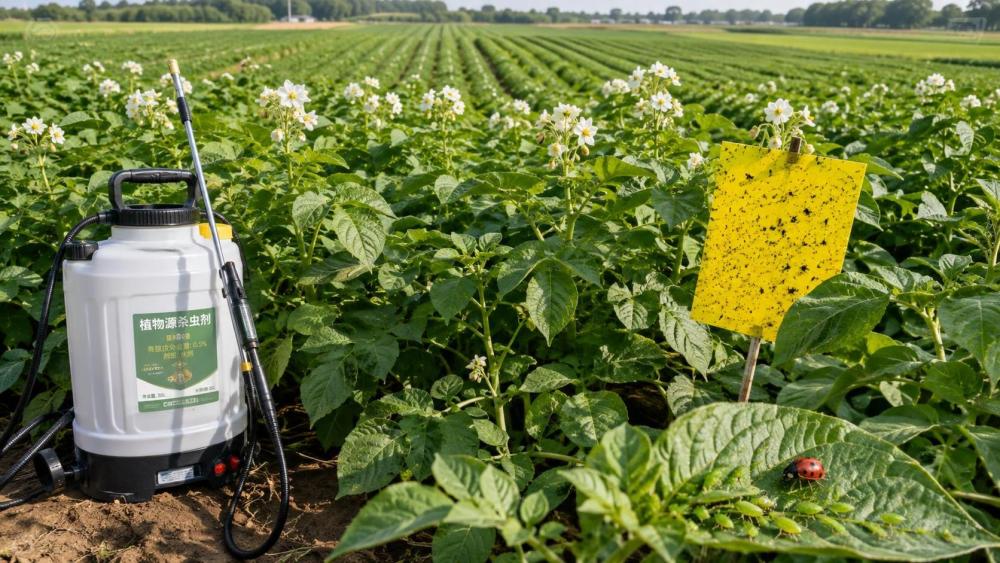
Application Technique Matters More Than Spray Volume Alone
Coverage is the practical connection between the formulation and the insect. Aphids beneath leaves, whiteflies on lower foliage, mites in protected leaf areas, and caterpillars inside curled growth are not equally accessible. Nozzle selection, droplet distribution, spray pressure, water volume, travel speed, canopy density, and air movement all affect whether the active material reaches the target.
Increasing volume does not automatically correct poor deposition. A dense canopy may need improved penetration and directed coverage, while a tender crop may require a gentler approach to limit mechanical and chemical stress. Spraying during strong wind creates drift and uneven deposition. Applying to wet foliage can dilute the deposit or prolong drying. Very hot conditions can increase evaporation and phytotoxicity, particularly with concentrated oils or volatile compounds.
Applications should be scheduled around pest activity and crop protection constraints. Early morning or evening may reduce exposure to foraging pollinators, but the selected period must still allow the foliage to dry and must not create a prolonged wetness problem. Rainfastness varies by formulation and cannot be assumed from the active ingredient alone. A rainfall event shortly after treatment may justify reassessing coverage rather than automatically repeating the application.
Protect Biological Control and Resistance Management
IPM gains are weakened when every insect is treated as a target. Predatory mites, lady beetles, lacewings, parasitic wasps, ground beetles, pollinators, and decomposer organisms may be contributing to suppression. Botanical products can have lower persistence than some conventional materials, yet lower persistence does not mean zero impact. Direct contact, residues on flowers, repeated exposure, and tank mixtures may still affect non-target organisms.
Selective timing and localized treatment can reduce this pressure. Treating an infested block, plant row, or canopy zone is preferable to routine whole-field application when the pest distribution is uneven. Flowering areas and known nesting or refuge sites deserve particular care. Where biological control agents have been released, compatibility should be confirmed from product-specific information rather than assumed from the botanical origin.
Resistance management also requires discipline. A short residual period may lead to repeated applications, especially when scouting is infrequent. Repeating the same mode of action through successive pest generations can select for survivors even when the product is plant-derived. Alternating distinct modes of action, removing heavily infested plant material, improving coverage, and treating the correct life stage reduce the chance that poor performance will be mistaken for product failure.
Diagnosing Poor Control Before Repeating the Spray
When pest numbers remain high, the immediate response should be diagnosis. Several different problems can produce the same field impression:
- The target was misidentified, and the product was chosen for an insect with a different feeding habit or life cycle.
- The population was protected inside leaves, fruit, soil, webbing, or dense plant growth, leaving little direct contact.
- The application was made after the most susceptible life stage had passed.
- Rain, intense sunlight, rapid evaporation, or poor leaf retention reduced the active deposit.
- The formulation separated in the tank, settled in the equipment, or was applied with insufficient agitation.
- New insects migrated into the treated area after the original population had been suppressed.
- Leaf injury or disease symptoms were interpreted as continuing insect feeding.
Field notes should connect the treatment to observable conditions: pest stage, weather at application, canopy location, mixing order, nozzle setup, coverage, and the timing of the follow-up inspection. This record makes it easier to distinguish a chemistry problem from a scouting or application problem. Repeating the same spray without resolving the cause can increase crop stress and non-target exposure while leaving the original gap untouched.
Integrating Botanical Products with Other Controls
Botanical insecticides are most useful when each intervention has a defined role. Sanitation can remove breeding sites, exclusion materials can limit incoming pests, and irrigation management can reduce conditions that favor certain outbreaks. Biological control can suppress populations between applications, while selective botanical treatments address localized increases that exceed the acceptable damage level.
Compatibility must be considered in both directions. An oil or solvent system can damage tender foliage when combined with another product or applied under heat stress. A broad-spectrum contact material may reduce natural enemies that were intended to provide continuing suppression. Mixing with microbial pesticides, foliar nutrients, or adjuvants may change drying, adhesion, pH, or organism viability. Separate applications are sometimes more reliable than a crowded tank mix, particularly when the interaction has not been tested on the crop.
A sound IPM program therefore treats botanical insecticides as part of a decision sequence: observe the pest, identify the vulnerable stage, select a formulation that can reach it, apply under suitable crop and weather conditions, then assess both pest response and non-target effects. This approach preserves the practical advantages of plant-derived chemistry while keeping crop safety, application quality, and long-term pest suppression aligned.
Related News
 Antioxidants & Natural PreservativesWhat Quality Checks Matter When Sourcing Butylparaben for Personal CareButylparaben for personal care sourcing guide: compare assay, impurities, physical performance, documentation, traceability, and supplier quality to reduce formulation risk.MORE+
 Nano-microcapsule FormulationsHow Encapsulated Flavors Protect Taste During Processing and StorageEncapsulated Flavors protect taste from heat, oxygen, moisture, and storage loss. Explore smarter release, carrier selection, and processing strategies.MORE+
 Chelated Trace Element FertilizersHow Greenhouse Fertigation Systems Reduce Water and Fertilizer WasteGreenhouse fertigation systems reduce water and fertilizer waste with precise dosing, uniform irrigation, drainage monitoring, and smarter crop-zone control. Learn practical strategies.MORE+
 Supercritical CO2 Essential OilsHow Natural Essential Oil Blends Improve Consistent Product FragranceNatural essential oil blends help brands achieve consistent, appealing fragrance across batches. Explore smart blend design, stability testing, and product compatibility strategies.MORE+
 Non-ionic Surfactants & DefoamersHow to Choose Non Ionic Low Foaming Surfactants for CIP CleaningNon ionic low foaming surfactants for CIP cleaning: learn how to balance wetting, foam control, compatibility, and rinseability for reliable cleaning performance.MORE+
 Nano-microcapsule FormulationsHow Food Grade Cyclodextrin Complexes Protect Sensitive FlavorsFood grade cyclodextrin inclusion complexes help protect sensitive flavors from oxidation, evaporation, and processing loss while supporting controlled release and consistent sensory quality.MORE+
 Polymer-Coated Water Soluble NPKHow Fertilizer Coating Polymers Improve NPK Granule ReleaseFertilizer coating polymers for NPK granules improve controlled nutrient release, reduce loss risks, and enhance product consistency. Discover key selection and process insights.MORE+
 Chelated Trace Element FertilizersWhat Diammonium Phosphate Means for Crop Nutrition PlanningDiammonium Phosphate: learn how DAP supports early phosphorus access, nitrogen budgeting, smart placement, and balanced crop nutrition planning.MORE+
 Maillard Reaction Savory FlavorsHow to Assess a Flavor Bases Supplier List for Reliable SourcingGlobal Fine Chemicals & Agrochemical Intelligence Network flavor bases supplier list: assess specs, samples, supply risk, and true cost to source with confidence.MORE+
 Hydrocolloids & EmulsifiersHow Konjac Gum Powder Improves Texture in Low-Calorie FoodsKonjac gum powder improves body, stability, and mouthfeel in low-calorie foods. Discover practical tips for smoother sauces, beverages, and reduced-fat formulations.MORE+
 Supercritical CO2 Essential OilsWhat to Check Before Choosing a Botanical Essential Oils ManufacturerChoose a botanical essential oils manufacturer with confidence. Explore key checks for purity, traceability, compliance, batch consistency, and reliable supply.MORE+
 Microencapsulated FragrancesHow Fragrance Carriers for Detergents Improve Scent PerformanceFragrance carriers for detergents improve stability, fabric deposition, and long-lasting scent. Explore practical solutions for better wash-to-wear fragrance performance.MORE+
 Antioxidants & Natural PreservativesWhen Propyl Gallate Antioxidant Is the Right Choice for Oil StabilityPropyl gallate antioxidant: learn when it is the right choice for oil stability, shelf-life protection, processing compatibility, and smarter formulation decisions.MORE+
 Antioxidants & Natural PreservativesHow Potassium Sorbate Extends Shelf Life in Food and Beverage ProductsPotassium Sorbate helps food and beverage brands control yeast and mold spoilage. Explore pH, dosage, processing, and packaging strategies for reliable shelf life.MORE+
 Antioxidants & Natural PreservativesHow to Source Bulk Herbal Extracts With Reliable Quality ControlBulk herbal extracts sourcing guide: compare suppliers, verify traceability, review CoAs, and build reliable quality controls for safer, consistent purchasing.MORE+
 Antioxidants & Natural PreservativesWhat to Check Before Sourcing Butylparaben for Personal Care FormulasButylparaben for personal care sourcing guide: check market eligibility, purity, supplier controls, formula compatibility, packaging, and total risk before buying.MORE+
 Targeted Bio-pesticides & APIsChoosing Microbial Fungicides for Foliar Diseases in Integrated Crop ProgramsMicrobial fungicides for foliar diseases: learn how to match biology, formulation, tank compatibility, and timing for stronger integrated crop protection.MORE+
 Targeted Bio-pesticides & APIsHow Microbial Insecticides Control Caterpillars With Lower Crop Residue RiskMicrobial insecticides for caterpillars help protect crops with targeted early-larval control and lower residue-management pressure. Learn timing, coverage, compliance, and scouting essentials.MORE+
 Microencapsulated FragrancesHow to Add Encapsulated Laundry Fragrances Without Weakening Wash ResultsEncapsulated laundry fragrances: learn how to boost long-lasting scent while protecting cleaning power, stability, foam control, and fabric care.MORE+
 Supercritical CO2 Essential OilsHow Aroma Ingredients Shape Lasting and Skin-Safe Personal Care ProductsAroma ingredients for personal care: discover how to achieve lasting scent, formulation stability, skin safety, and confident product performance.MORE+
 Targeted Bio-pesticides & APIsInsecticides Explained Through Labels, Active Ingredients, and SafetyInsecticides explained through labels, active ingredients, formulations, and safety. Learn how to compare products, manage risk, and make informed crop protection decisions.MORE+
 Heavy-duty Industrial DegreasersHow to Select Parts Wash Cleaners for Automotive ComponentsParts wash cleaners for automotive components: learn how to match chemistry, materials, rinsing, safety, and waste controls for reliable cleaning results.MORE+
 Chelated Trace Element FertilizersHow Precision Fertigation Systems Improve Water and Nutrient ControlPrecision fertigation systems improve water and nutrient control with accurate dosing, uniform irrigation, smart monitoring, and reduced waste. Discover how to optimize crop performance.MORE+
 Hydrocolloids & EmulsifiersHow Bulk Price Factors Affect Hydrocolloid Stabilizer Blend SourcingHydrocolloid stabilizer blends bulk price: compare dosage efficiency, quality consistency, logistics, and documentation to reduce total sourcing costs.MORE+
 Zero-Calorie Sweeteners & AcidulantsHow to Choose a Natural Sweeteners Supplier for Clean-Label ProductsNatural sweeteners supplier selection guide for clean-label products: compare formulation fit, traceability, documentation, and supply reliability.MORE+
 Non-ionic Surfactants & DefoamersWhat Cationic Surfactants Do and Where They Are UsedCationic Surfactants deliver antimicrobial action, conditioning, antistatic control, and surface treatment benefits. Explore key uses, compatibility, and safe selection tips.MORE+
 Targeted Bio-pesticides & APIsHow to Evaluate Pesticide Suspension Concentrates for Field StabilityPesticide Suspension Concentrates: learn how to evaluate field stability, redispersibility, dilution, tank-mix compatibility, and spray safety for reliable performance.MORE+
 Hydrocolloids & EmulsifiersHow Hydrocolloid Systems for Meat Products Improve Texture and YieldHydrocolloid systems for meat products improve yield, texture, water retention, and slicing quality. Explore practical formulation strategies for stable, high-performing meat products.MORE+
 Microencapsulated FragrancesHow Laundry Fragrances for Liquid Detergents Improve Scent LongevityLaundry fragrances for liquid detergents: discover how fragrance design, deposition, and encapsulation create lasting fabric freshness and stronger product appeal.MORE+
 Nano-microcapsule FormulationsChoosing Fragrance Preparations That Perform Well in Personal WashFragrance preparations for personal wash: learn how to select options that protect clarity, stability, foam, scent performance, and packaging compatibility.MORE+
 Controlled-Release ThermodynamicsModified Cyclodextrins Explained for Controlled Fragrance ReleaseModified cyclodextrins enable controlled fragrance release, odor control, and volatile-note protection. Explore how they optimize performance in detergents, fabric care, and more.MORE+
 Microencapsulated FragrancesHow Fragrance Delivery Systems Improve Fabric Softener LongevityFragrance delivery systems for fabric softeners improve scent longevity through smart protection, reliable deposition, and controlled release for lasting freshness.MORE+
 Supercritical CO2 Essential OilsHow to Evaluate a Natural Cardamom Oil Supplier for Reliable SupplyNatural cardamom oil supplier evaluation guide: verify botanical origin, purity, batch consistency, documentation, packaging, and delivery reliability for confident sourcing.MORE+
 Maillard Reaction Savory FlavorsHow Ethyl Maltol Purity Testing Supports Flavor Safety ComplianceEthyl Maltol purity testing strengthens flavor safety compliance through identity checks, impurity profiling, supplier verification, and audit-ready documentation.MORE+
 Microencapsulated FragrancesEssential Oil Extracts Compared for Fragrance and Wellness UsesEssential Oil Extracts compared for fragrance and wellness: explore scent profiles, extraction methods, stability, safety, and sourcing insights for smarter formulation choices.MORE+
 Zero-Calorie Sweeteners & AcidulantsWhat Drives Zero Calorie Sweeteners Bulk Price in 2026Zero calorie sweeteners bulk price in 2026: compare specifications, dosage, quality, freight, and supply risk to make smarter sourcing decisions.MORE+
 EPA FIFRA & FDA GRAS RegsSynthetic Food Preservatives Rules That Support Safer FormulasSynthetic Food Preservatives: learn the rules for safer formulas, compliant use levels, validated shelf life, labeling, and reliable microbial control.MORE+
 Micelle Fluidics & ChelationHow Anionic Industrial Dispersants Improve Coating StabilityAnionic industrial dispersants improve coating stability, pigment wetting, viscosity control, gloss, and storage performance. Learn how to select and test the right solution.MORE+
 Supercritical CO2 Essential OilsHow to Choose Eucalyptus Oil Grades for Clean, Consistent ProductsChoose the right Eucalyptus Oil grade with confidence. Compare cineole content, purity, origin, processing, documentation, and application fit for consistent products.MORE+
 Micelle Fluidics & ChelationWhat Are Cationic Surfactants and Where Are They Commonly Used?Cationic Surfactants deliver powerful surface affinity for disinfection, fabric softening, hair conditioning, antistatic control, and industrial treatments. Explore key uses and selection factors.MORE+







































