How to Use Food Grade Cyclodextrin Inclusion Complexes in Beverages
A beverage can look promising on the bench and still disappoint after dilution, heat treatment, or a few weeks in storage. An oil-soluble flavor separates, a botanical extract leaves an unwelcome aftertaste, or a citrus top note fades before the product reaches the consumer. Food grade cyclodextrin inclusion complexes offer a potential way to manage selected ingredients, but they are not universal solubilizers or substitutes for sound beverage formulation.
For technical evaluators, the useful question is not simply whether cyclodextrin can bind an ingredient. It is whether that interaction survives manufacturing, delivers the intended sensory profile, and remains acceptable throughout shelf life. A practical assessment starts with the target molecule and ends with the finished drink—not with the appearance of a clear supplier sample.
Decide what the complex needs to accomplish
Cyclodextrins are cyclic carbohydrates with a relatively hydrophobic internal cavity and a hydrophilic exterior. A compatible guest molecule, or part of it, can associate with the cavity through noncovalent interactions. In water, free guest, free cyclodextrin, and complexed material exist in a dynamic equilibrium.
That equilibrium explains both the opportunity and the limitation. Complexation may increase the apparent aqueous solubility of a poorly soluble compound, reduce its exposure to oxygen or light, or change how readily it reaches taste and aroma receptors. Dilution, temperature changes, and competing ingredients can also shift the balance and release the guest.
Before selecting a material, define one primary objective:
- Ingredient delivery: keep a selected hydrophobic compound dispersed or dissolved at the intended beverage concentration.
- Flavor retention: reduce losses of a volatile component during handling or storage without suppressing desirable aroma.
- Off-note management: reduce the availability of a specific bitter or otherwise undesirable compound.
- Handling improvement: introduce a liquid or oxidation-sensitive ingredient through a more manageable powder intermediate.
These objectives can conflict. Stronger association may improve retention while weakening the aroma consumers expect when opening the bottle. Likewise, adding enough cyclodextrin to reduce bitterness may alter the wider flavor balance. Set measurable acceptance criteria before trials begin.
Choose a permitted cyclodextrin, not just a convenient cavity size
Alpha-, beta-, and gamma-cyclodextrin contain six, seven, and eight glucose units respectively. Their different cavity dimensions influence guest compatibility, but molecular size alone does not predict performance. Guest geometry, polarity, binding strength, and the solubility of the resulting complex all matter.
Regulatory review belongs at this stage. “Food grade” does not mean that every cyclodextrin is permitted in every beverage category, country, or concentration. Confirm the exact substance identity, applicable authorization or legal basis, permitted technological purpose, specifications, use conditions, and labeling requirements in each destination market. Review the guest ingredient and any carriers or processing aids as well.
Do not transfer suitability from pharmaceutical or laboratory literature to food applications. Modified cyclodextrins used in those settings are not automatically acceptable food ingredients. Supplier documentation should establish identity and traceability rather than rely on a broad food-grade statement.
Evaluate the complex separately from the powder
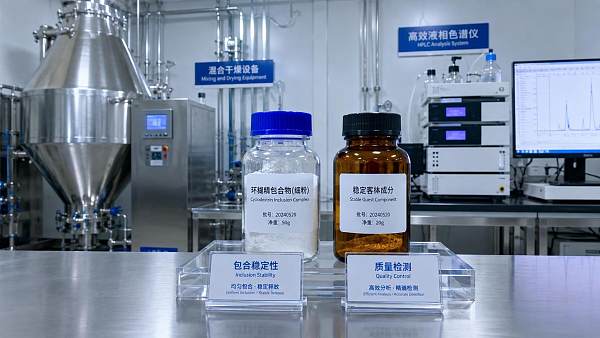
A dry powder containing cyclodextrin and a flavor is not necessarily a well-characterized inclusion complex. It may contain substantial free guest, surface-associated oil, or additional encapsulating materials. Those distinctions affect dispersion, oxidation, sensory release, and purchasing value.
Request the total guest content, cyclodextrin content, moisture, other formulation components, and recommended reconstitution conditions. Ask how the supplier distinguishes included guest from unbound material and how batch consistency is controlled. Analytical evidence should match the claim: measuring total flavor loading alone does not establish inclusion efficiency.
For development work, phase-solubility studies can help identify whether cyclodextrin increases apparent guest solubility under defined conditions. Complementary techniques such as NMR, thermal analysis, or diffraction may support characterization, depending on the system. No single powder measurement replaces performance testing in the actual beverage.
Also clarify what the reported loading means. A percentage expressed on a dry basis cannot be used interchangeably with an as-supplied value. A supplier’s “encapsulation efficiency” may use a different calculation from another supplier’s figure.
Two practical routes for incorporating food grade cyclodextrin inclusion complexes
Use a preformed complex when consistency is the priority
A qualified preformed complex can simplify dosing and reduce the need to handle a volatile or poorly water-soluble guest directly. Establish a reconstitution procedure using the supplier’s guidance, then test it against plant conditions.
Typically, the powder is introduced gradually into an adequately agitated water phase. A separate premix may make wetting easier, but its concentration must remain below practical solubility limits. Heating should be justified by data: warmer water may aid dissolution while also increasing aroma loss or changing association behavior.
Inspect the premix after cooling and after the intended holding period. A stock that looks clear while warm may crystallize or release guest later. Record mixing time, temperature, order of addition, and the time between preparation and use.
Form the complex in-house when flexibility justifies the work
In-situ preparation generally involves bringing the guest into contact with dissolved cyclodextrin under controlled mixing, temperature, and equilibration conditions. It offers flexibility but adds development variables. Hydrophobic guests may disperse poorly, and rapid mixing does not prove that an adequate proportion has complexed.
Establish a reproducible preparation method before integrating it into production. Any use of processing solvents requires a suitable food-use basis, control of residues where relevant, and validation of removal. For many beverage teams, purchasing a characterized complex is more practical than developing complexation and drying operations internally.
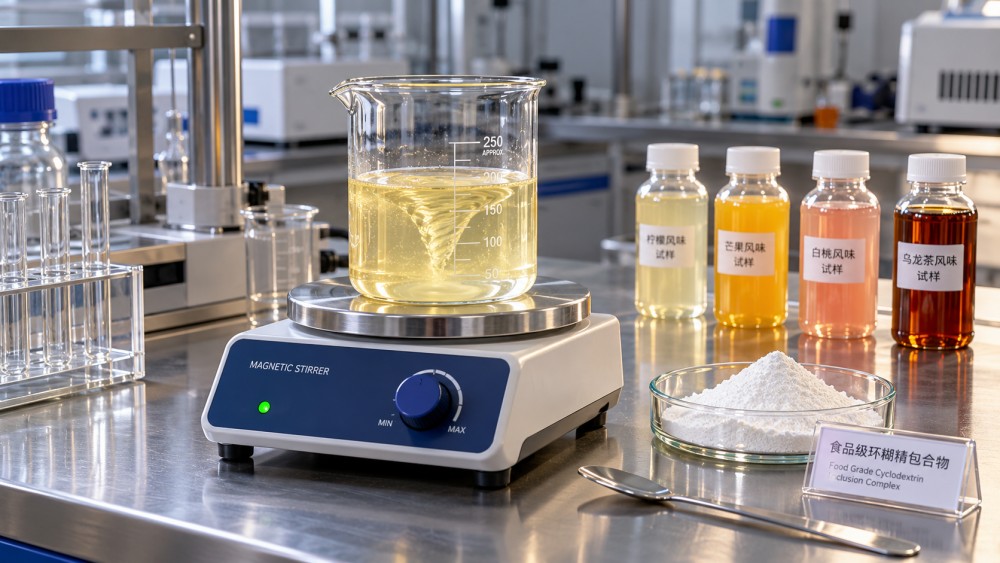
A useful process map follows the ingredient through premixing, beverage blending, thermal treatment, cooling, filling, and storage. Sample at these transitions to identify where haze, guest loss, or sensory changes first appear. This is more informative than comparing only the initial and final bottles.
Calculate dosage from guest delivery, then test the equilibrium
Start with the required concentration of the guest ingredient—not with a generic cyclodextrin addition rate. For a preformed powder, calculate the amount needed from its verified as-supplied loading:
Complex powder required = target guest concentration ÷ guest mass fraction in the powder.
For example, a hypothetical powder containing 10% guest by mass would require 200 mg/L to deliver 20 mg/L of that guest. This is a mass-balance illustration, not a recommended beverage dosage. The remaining powder components must also be included in formulation and regulatory calculations.
For in-house complexation, calculate host-to-guest ratios on a molar basis. Do not assume that all systems follow a 1:1 stoichiometry or that a nominal 1:1 mixture produces complete inclusion. Excess host may improve apparent solubility in some systems, but can increase cost and change interactions with other ingredients.
Run a small dose-response series around the intended guest level and several technically justified host-to-guest ratios. Include a beverage blank, an uncomplexed-guest control, and, where useful, a cyclodextrin-only control. Keep other carriers consistent so that apparent improvements are not actually caused by a different solvent or emulsifier.
Evaluate both concentrate and ready-to-drink conditions. Dilution changes equilibrium, and a stable syrup does not guarantee a stable drink. The reverse can also occur: an overly concentrated premix may fail even though the final beverage concentration is workable.
Challenge the system under real beverage conditions
The surrounding formulation can change performance as much as the chosen cyclodextrin. Flavor mixtures contain multiple potential guests; proteins, lipids, and other components can alter partitioning or physical stability. Preservative availability may also change when a compatible preservative associates with cyclodextrin. Total preservative concentration alone may therefore be insufficient to demonstrate antimicrobial performance.
Use the actual pH, soluble-solids level, mineral profile, and processing conditions. Where heat treatment is required, compare samples before and after the relevant time–temperature exposure. Adding a complex after heating is not an acceptable shortcut unless the addition is part of a validated hygienic or aseptic process.
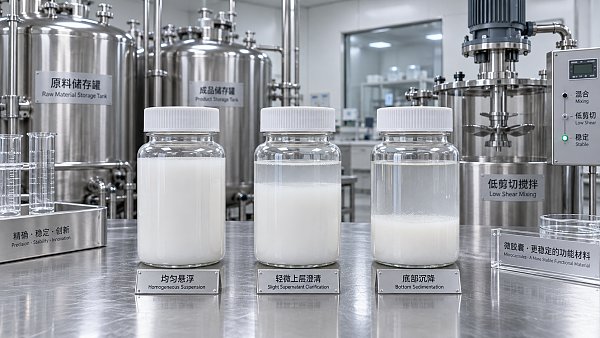
For carbonated drinks, assess the filled product at its intended carbonation level. For clear beverages, measure turbidity rather than relying solely on visual inspection. In cloudy drinks, monitor sediment and oil separation even if initial haze conceals early instability.
Real-time storage in the intended packaging should anchor shelf-life conclusions. Accelerated testing can expose weaknesses, but elevated temperature may change binding and degradation mechanisms, making direct shelf-life extrapolation unreliable.
Read failures as formulation evidence
Haze after dilution may indicate guest release, precipitation, or incompatibility with another ingredient. Check the uncomplexed control, compare guest recovery, and investigate the effect of dilution rather than simply adding more host.
A weaker flavor despite good chemical retention suggests that availability, not total content, is limiting sensory performance. Adjusting the complexed fraction or blending free and complexed flavor may be worth testing, provided physical stability remains acceptable.
Crystals during cold storage warrant investigation of host solubility, complex solubility, and premix concentration. More mixing will not correct an equilibrium solubility problem.
No measurable shelf-life improvement may mean the main degradation pathway is not sufficiently affected by inclusion. Oxygen control, light protection, packaging selection, or a different delivery technology may offer a better solution.
Make the approval decision on the finished drink
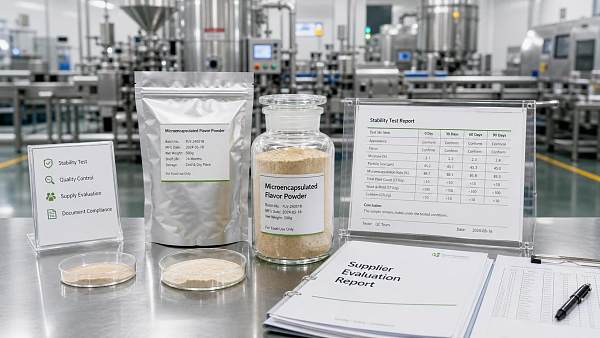
A defensible technical recommendation combines regulatory suitability, characterized ingredient composition, reproducible processing, acceptable sensory performance, and storage data. Procurement should compare cost per unit of delivered guest—not simply powder price—and confirm specifications, storage conditions, packaging protection, batch traceability, and change-notification arrangements.
Food grade cyclodextrin inclusion complexes are most useful when they solve a defined molecular-delivery problem without creating a larger formulation problem elsewhere. Approve the system when the intended beverage demonstrates that balance across processing and shelf life. If it does not, treat the result as a reason to reconsider the delivery strategy, not as a reason to keep increasing the dose.
Facing technical bottlenecks in manufacturing or looking for more efficient industrial solutions? Leave your details below and let the engineering experts at FCAS solve them for you.
We respect your privacy. Your information is strictly confidential.
Related News
 Nano-microcapsule FormulationsIndexBox Releases 2026–2035 Global Controlled-Release Pesticide Formulation OutlookControlled-release pesticide formulations could grow 5.8% annually through 2035, according to IndexBox. Explore the forecast, key drivers and implications for buyers.MORE+
 Nano-microcapsule FormulationsWhat Affects the Cost of Microencapsulated Flavors Wholesale?Microencapsulated flavors wholesale pricing depends on formulation, processing, volume and quality. Learn how to compare suppliers and lower your cost in use.MORE+
 Nano-microcapsule FormulationsHow to Use Microcapsule Slurries for Household ProductsDiscover how to use microcapsule slurries for household products, from compatibility and gentle mixing to stability testing and fragrance performance.MORE+
 Nano-microcapsule FormulationsHow to Choose a Capsule Suspension Pesticides SupplierChoose a capsule suspension pesticides supplier with confidence. Compare formulation quality, regulatory documentation, delivery reliability and total costs.MORE+
 Nano-microcapsule FormulationsHow to Choose Seed Coating Agents for Better Seed CoverageChoose Seed Coating Agents with confidence. Learn how to assess coverage, dust-off, compatibility, drying, and germination for reliable results.MORE+
 Nano-microcapsule FormulationsHow Flavor Encapsulates for Bakery Fillings Retain FlavorDiscover how flavor encapsulates for bakery fillings protect aroma, support shelf-life stability, and help you choose the right carrier for your formulation.MORE+
 Nano-microcapsule FormulationsHow Can You Prevent Microcapsule Slurries From Settling in Storage?Keep Microcapsule Slurries stable in storage. Discover how temperature control, gentle agitation, and uniformity checks help reduce settling and protect capsule integrity.MORE+
 Nano-microcapsule FormulationsHow Do Microencapsulated Flavors Improve Snack Seasoning Stability?Explore how microencapsulated flavors for snack seasonings help preserve aroma and slow flavor loss. Learn to select and test systems for lasting freshness and better snack performance.MORE+
 Nano-microcapsule FormulationsHow to Use Food Grade Cyclodextrin Inclusion Complexes in BeveragesExplore food grade cyclodextrin inclusion complexes for beverages. Learn how to select, dose, and test them for flavor retention, stability, and smarter formulation decisions.MORE+
 Nano-microcapsule FormulationsHow Can High Solids Microcapsule Slurries Stay Stable in Storage?Keep high solids microcapsule slurries stable in storage. Learn how to control settling, protect capsule integrity, and optimize mixing for reliable pumping and consistent dosing.MORE+
 Nano-microcapsule FormulationsHow Spray Drying Wall Materials Affect Stability and EncapsulationSpray drying wall materials determine powder stability, encapsulation efficiency, moisture resistance, and release. Learn how to select the right matrix for reliable performance.MORE+
 Nano-microcapsule FormulationsHow Encapsulated Flavors Protect Taste During Processing and StorageEncapsulated Flavors protect taste from heat, oxygen, moisture, and storage loss. Explore smarter release, carrier selection, and processing strategies.MORE+
 Nano-microcapsule FormulationsHow Food Grade Cyclodextrin Complexes Protect Sensitive FlavorsFood grade cyclodextrin inclusion complexes help protect sensitive flavors from oxidation, evaporation, and processing loss while supporting controlled release and consistent sensory quality.MORE+
 Nano-microcapsule FormulationsChoosing Fragrance Preparations That Perform Well in Personal WashFragrance preparations for personal wash: learn how to select options that protect clarity, stability, foam, scent performance, and packaging compatibility.MORE+
 Nano-microcapsule FormulationsHow to Select Spray Drying Wall Materials for Better StabilitySpray drying wall materials: learn how to select the right matrix for improved stability, moisture resistance, encapsulation, release performance, and cost-efficient scale-up.MORE+
 Nano-microcapsule FormulationsFood Grade Cyclodextrin Inclusion Complexes for Stable Flavor DeliveryFood grade cyclodextrin inclusion complexes help protect volatile flavors, improve handling, and support controlled release for reliable food formulation performance.MORE+
 Nano-microcapsule FormulationsHow Oxidation Resistant Flavor Encapsulation Protects Taste StabilityOxidation resistant flavor encapsulation protects aroma, freshness, and taste stability. Discover how smart barriers, release control, and packaging improve shelf life.MORE+
 Nano-microcapsule FormulationsWhat to Verify When Choosing a Cyclodextrin Inclusion Complexes ManufacturerChoose a cyclodextrin inclusion complexes manufacturer with confidence: verify complexation evidence, loading, stability, process control, and batch consistency.MORE+
 Nano-microcapsule FormulationsWhat to Look for in a Reliable Flavor Encapsulates ManufacturerFlavor encapsulates manufacturer selection starts with application fit. Learn how to compare stability, release, documentation, and supply reliability before you buy.MORE+
 Nano-microcapsule FormulationsHow Pesticide Formulation Intermediates Improve Suspoemulsion StabilityPesticide formulation intermediates for suspoemulsion can make or break product stability. Learn how dispersants, emulsifiers, and co-stabilizers reduce separation, caking, and storage failure.MORE+