How to Choose Seed Coating Agents for Better Seed Coverage
Choose seed coating agents by testing the complete treatment on the intended seed and application equipment, not by comparing film appearance alone. A suitable agent should spread across the seed surface, hold the treatment in place through handling, dry within the available process window, and maintain acceptable germination and planting performance. The best-looking coating is not necessarily the one that meets all four requirements.
A technical evaluation often starts when a treated batch shows bare patches, uneven color, or excessive dust after transfer. The cause may lie in the coating agent, but it can also be the slurry, seed surface, application rate, mixing, or drying conditions. Comparing candidates under controlled conditions helps separate these effects before a formulation is selected.
Define coverage before comparing agents
Coverage can mean several different things: a continuous visible film, even distribution of a colorant, or consistent deposition of an active ingredient. These outcomes are related but not interchangeable. A pigment may make a seed look uniformly treated while an active ingredient remains unevenly distributed within the slurry or between seeds.
Set the evaluation endpoint around the function of the treatment. For a cosmetic film, visible bare areas and color consistency may be useful screening measures. For a crop protection treatment, also assess deposition and retention of the relevant ingredient using an appropriate analytical method. A visual inspection alone cannot establish dose uniformity.
Record the crop and seed lot, seed size distribution, surface condition, target treatment rate, application equipment, and intended storage period. Include the complete formulation and order of addition. Without these details, a coverage comparison may reflect differences in the process rather than differences between coating agents.
Match the coating system to the seed surface
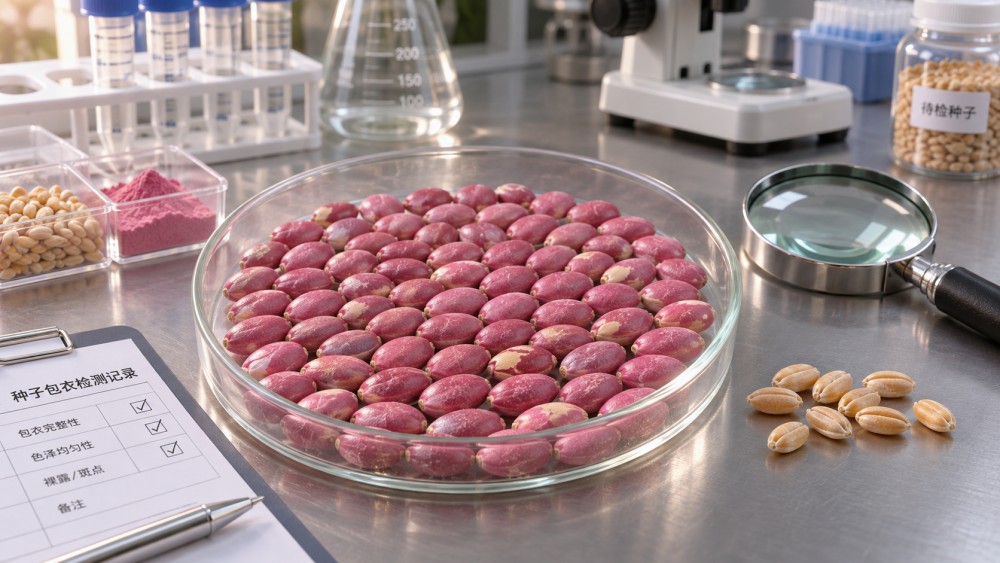
Seed shape and surface texture influence how readily a liquid film spreads and where it accumulates. A smooth seed may appear covered quickly but still need a film with sufficient adhesion to resist abrasion. A rough or irregular surface can trap formulation in recesses while leaving raised areas thinly coated. Examine both under consistent lighting and magnification rather than relying only on the appearance of a bulk sample.
Seed condition matters as much as species. Dust, broken seed coats, chaff, and variation between lots can alter wetting and consume part of the applied treatment. Before changing the agent, check whether the incoming seed is clean and representative of commercial production. A candidate that works only on a carefully cleaned laboratory sample may not be robust enough for the intended operation.
Coating agents are commonly selected for film formation, adhesion, flexibility, and compatibility with other treatment components. Their behavior depends on the specific formulation, not just the polymer family named on a specification sheet. Ask suppliers for the recommended use range and application method, then verify performance at the intended slurry rate. A higher binder level may improve retention, but it can also increase tack, drying demand, or bridging between seeds.
Check formulation compatibility before coverage trials
Test the coating agent with every component that will be applied together, including actives, pigments, biological materials, and any wetting or dispersing additives. A stable agent on its own can behave differently in a mixed slurry. Changes in pH, electrolyte content, solids loading, or addition order may cause thickening, separation, flocculation, or sediment that is difficult to redisperse.
- Prepare the proposed slurry in the intended addition order, using representative water and treatment concentrations.
- Observe initial wetting, viscosity, foam, and any visible particles or phase separation. Record how easily settled material can be redispersed.
- Repeat observations over the expected holding period and after representative agitation. Avoid assuming that a mixture stable immediately after preparation will remain suitable throughout a shift.
- Apply the slurry through a representative nozzle or delivery system where practical. Check for changes in flow, spray pattern, buildup, and blockage.
For biological seed treatments, confirm the compatibility of the agent and other ingredients with the organism and the intended drying and storage conditions. A uniform film is not evidence that a microbial product remains viable. Use a suitable viability assay and follow the biological product’s handling instructions.
Compare coverage and retention under the same conditions
Screen candidates at a controlled treatment rate rather than adjusting each one until it looks acceptable. Use the same seed lot, batch size, equipment settings, mixing time, drying conditions, and sampling points. Include the current formulation or an untreated control where it helps interpret the result. Replicate trials where practical, and document deviations that could affect the comparison.
Look beyond the average appearance
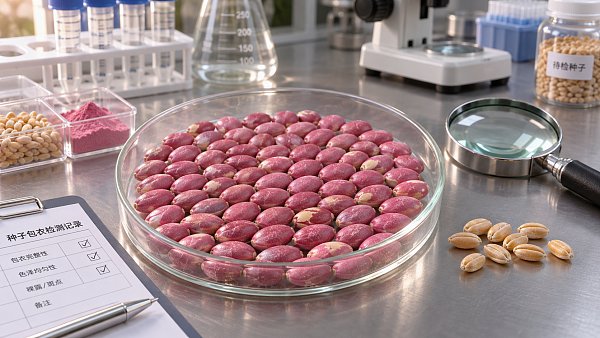
Inspect samples taken across the treated batch, not just from the surface of the collection container. Note bare patches, clumps, color variation, and buildup in grooves or around damaged areas. A consistent image-capture setup can help compare visible coverage, but lighting, seed orientation, and colorant concentration must be controlled. Image analysis is a screening tool; validate what its coverage metric actually represents.
Where dose distribution matters, sample and analyze the treatment ingredient using a method suited to the material and the required decision. Define the sampling unit and acceptance criteria in advance. A bulk assay can show average loading while masking seed-to-seed variation, so consider whether individual-seed or smaller sub-sample measurements are needed.
Test the film after handling
Measure dust-off or abrasion resistance using a defined method that reflects the intended handling route. Compare samples after equivalent drying and conditioning, then subject them to consistent mechanical stress. Record the collection method and result alongside the test conditions; results from different equipment or methods should not be treated as directly interchangeable.
Dust mass is useful, but it does not always describe the composition of the material lost. Where relevant, analyze collected dust for the treatment ingredient. Also inspect equipment and packaging-contact surfaces for deposits: low visible dust in one test does not establish retention through every transfer, storage, and planting operation.
Keep drying, flowability, and seed safety in the decision
Coverage achieved on a wet seed is only an intermediate result. If the film remains tacky at the end of the process, treated seeds may stick together, pick up debris, or build up on equipment. Excessive drying, temperature, or residence time may create a different problem by stressing the seed or damaging sensitive treatment components.
For each candidate, observe the time and conditions needed to reach a usable, non-tacky state. Check flow through representative conveying and metering equipment after drying and after relevant storage conditioning. An agent that requires a longer drying step than the production line can provide is a weak candidate, even if its bench-scale film is attractive.
Run germination and, where appropriate, seed vigor tests on the complete treatment—not just on seed coated with the binder alone. Compare against an appropriate untreated control and the existing treatment where available. Include testing after the intended storage period and under representative conditions, since an immediate result may not reveal later deterioration. Use recognized methods appropriate to the crop and market, and agree acceptance limits before ranking candidates.
Pay attention to moisture introduced by the total slurry. The agent, water, other liquid components, and drying process all contribute to the final seed condition. Avoid attributing a germination change to the polymer alone until application rate, moisture, temperature, active ingredients, and seed-lot quality have been investigated.
Use symptoms to narrow the next trial
Change one meaningful factor at a time during troubleshooting, while keeping a record of interactions that may require a later combined trial. For example, reducing the liquid rate might improve drying but worsen distribution; increasing binder might reduce dust while making the batch harder to handle. The next test should identify which trade-off is responsible rather than simply producing another visual sample.
Move from a promising sample to a production decision
Shortlist agents that meet predefined coverage, retention, seed-quality, and process criteria. Then repeat the comparison at a scale that represents the intended operation. Equipment loading, spray distribution, residence time, and drying behavior can change with scale, so preserve samples from different points in the run and examine startup as well as steady operation.
Review supplier documentation against the proposed formulation and destination markets. Relevant information may include composition and handling details, batch specifications, storage requirements, recommended use ranges, and applicable restrictions for treated seed. Confirm that the complete treatment and its intended use meet local requirements; an acceptable coating ingredient does not by itself establish compliance for the finished treatment.
Before approval, agree on practical batch acceptance measures. These might include incoming agent viscosity or solids specifications, slurry stability, application rate, visual distribution, dust-off, and germination results, as appropriate to the process. A replacement agent should be requalified when formulation, seed type, equipment, or treatment components change materially, because the original coverage result belongs to the tested system—not to the coating agent in isolation.
Facing technical bottlenecks in manufacturing or looking for more efficient industrial solutions? Leave your details below and let the engineering experts at FCAS solve them for you.
We respect your privacy. Your information is strictly confidential.
Related News
 Nano-microcapsule FormulationsWhat Affects the Cost of Microencapsulated Flavors Wholesale?Microencapsulated flavors wholesale pricing depends on formulation, processing, volume and quality. Learn how to compare suppliers and lower your cost in use.MORE+
 Nano-microcapsule FormulationsHow to Use Microcapsule Slurries for Household ProductsDiscover how to use microcapsule slurries for household products, from compatibility and gentle mixing to stability testing and fragrance performance.MORE+
 Nano-microcapsule FormulationsHow to Choose a Capsule Suspension Pesticides SupplierChoose a capsule suspension pesticides supplier with confidence. Compare formulation quality, regulatory documentation, delivery reliability and total costs.MORE+
 Nano-microcapsule FormulationsHow to Choose Seed Coating Agents for Better Seed CoverageChoose Seed Coating Agents with confidence. Learn how to assess coverage, dust-off, compatibility, drying, and germination for reliable results.MORE+
 Nano-microcapsule FormulationsHow Flavor Encapsulates for Bakery Fillings Retain FlavorDiscover how flavor encapsulates for bakery fillings protect aroma, support shelf-life stability, and help you choose the right carrier for your formulation.MORE+
 Nano-microcapsule FormulationsHow Can You Prevent Microcapsule Slurries From Settling in Storage?Keep Microcapsule Slurries stable in storage. Discover how temperature control, gentle agitation, and uniformity checks help reduce settling and protect capsule integrity.MORE+
 Nano-microcapsule FormulationsHow Do Microencapsulated Flavors Improve Snack Seasoning Stability?Explore how microencapsulated flavors for snack seasonings help preserve aroma and slow flavor loss. Learn to select and test systems for lasting freshness and better snack performance.MORE+
 Nano-microcapsule FormulationsHow to Use Food Grade Cyclodextrin Inclusion Complexes in BeveragesExplore food grade cyclodextrin inclusion complexes for beverages. Learn how to select, dose, and test them for flavor retention, stability, and smarter formulation decisions.MORE+
 Nano-microcapsule FormulationsHow Can High Solids Microcapsule Slurries Stay Stable in Storage?Keep high solids microcapsule slurries stable in storage. Learn how to control settling, protect capsule integrity, and optimize mixing for reliable pumping and consistent dosing.MORE+
 Nano-microcapsule FormulationsHow Spray Drying Wall Materials Affect Stability and EncapsulationSpray drying wall materials determine powder stability, encapsulation efficiency, moisture resistance, and release. Learn how to select the right matrix for reliable performance.MORE+
 Nano-microcapsule FormulationsHow Encapsulated Flavors Protect Taste During Processing and StorageEncapsulated Flavors protect taste from heat, oxygen, moisture, and storage loss. Explore smarter release, carrier selection, and processing strategies.MORE+
 Nano-microcapsule FormulationsHow Food Grade Cyclodextrin Complexes Protect Sensitive FlavorsFood grade cyclodextrin inclusion complexes help protect sensitive flavors from oxidation, evaporation, and processing loss while supporting controlled release and consistent sensory quality.MORE+
 Nano-microcapsule FormulationsChoosing Fragrance Preparations That Perform Well in Personal WashFragrance preparations for personal wash: learn how to select options that protect clarity, stability, foam, scent performance, and packaging compatibility.MORE+
 Nano-microcapsule FormulationsHow to Select Spray Drying Wall Materials for Better StabilitySpray drying wall materials: learn how to select the right matrix for improved stability, moisture resistance, encapsulation, release performance, and cost-efficient scale-up.MORE+
 Nano-microcapsule FormulationsFood Grade Cyclodextrin Inclusion Complexes for Stable Flavor DeliveryFood grade cyclodextrin inclusion complexes help protect volatile flavors, improve handling, and support controlled release for reliable food formulation performance.MORE+
 Nano-microcapsule FormulationsHow Oxidation Resistant Flavor Encapsulation Protects Taste StabilityOxidation resistant flavor encapsulation protects aroma, freshness, and taste stability. Discover how smart barriers, release control, and packaging improve shelf life.MORE+
 Nano-microcapsule FormulationsWhat to Verify When Choosing a Cyclodextrin Inclusion Complexes ManufacturerChoose a cyclodextrin inclusion complexes manufacturer with confidence: verify complexation evidence, loading, stability, process control, and batch consistency.MORE+
 Nano-microcapsule FormulationsWhat to Look for in a Reliable Flavor Encapsulates ManufacturerFlavor encapsulates manufacturer selection starts with application fit. Learn how to compare stability, release, documentation, and supply reliability before you buy.MORE+
 Nano-microcapsule FormulationsHow Pesticide Formulation Intermediates Improve Suspoemulsion StabilityPesticide formulation intermediates for suspoemulsion can make or break product stability. Learn how dispersants, emulsifiers, and co-stabilizers reduce separation, caking, and storage failure.MORE+