How Spray Drying Wall Materials Affect Stability and Encapsulation
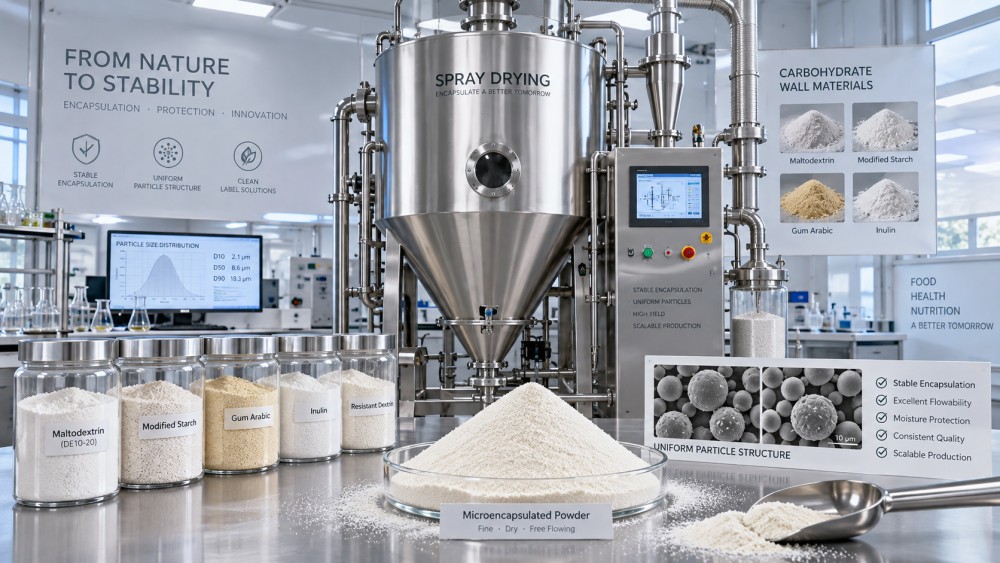
Wall materials determine whether a spray-dried powder remains free-flowing, retains its active content, and performs as intended after reconstitution or use. The same core ingredient can show sharply different stability when dried with maltodextrin, gum arabic, modified starch, protein, carbohydrate syrup solids, or a blended matrix. The difference is not explained by solubility alone. A wall system changes droplet structure during atomization, film formation in the drying chamber, oxygen and moisture transfer after drying, and the physical state of the final powder.
Encapsulation is therefore best assessed as a combined outcome: how much core is retained, how much remains exposed at the particle surface, how the material responds to humidity and temperature, and whether release occurs at the required point of use. A powder with high initial retention can still fail in storage if its wall phase becomes sticky, cracks during handling, or permits rapid diffusion of oxygen into an oxidation-sensitive core.
Film formation sets the first stability limit
Spray drying converts liquid feed droplets into particles within seconds. As water evaporates, dissolved or dispersed wall materials concentrate near the droplet surface and form a solid or semi-solid shell. This sequence is decisive because the wall must establish a coherent film before volatile, reactive, or mobile core material escapes.
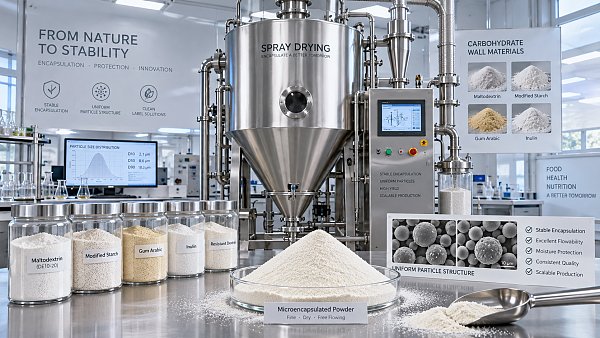
Materials with good film-forming behavior tend to reduce surface oil, surface aroma, and exposed active content. Gum arabic is often selected for emulsified flavor and fragrance systems because it can stabilize droplets before drying and form a protective carbohydrate matrix afterward. Modified starches may provide similar emulsion support, although performance depends on their substitution pattern, molecular structure, and compatibility with the oil phase. Proteins can adsorb efficiently at oil-water interfaces, but their behavior is more sensitive to pH, ionic strength, heat exposure, and interactions with other feed components.
A wall material that produces a stable emulsion but forms a weak dry film can give misleading early results. The feed may atomize well and the initial powder may appear acceptable, while storage reveals oil migration, aroma loss, caking, or oxidation. Conversely, a material with an excellent dry barrier may be unsuitable if it cannot stabilize the feed or creates viscosity too high for consistent atomization.
The wall-to-core ratio affects this balance, but increasing wall solids is not a universal remedy. More wall material can improve shell continuity and lower surface exposure, yet it also increases feed viscosity, changes droplet size, and may reduce payload to an impractical level. A useful formulation target is not simply the highest encapsulation efficiency; it is the lowest exposed core content compatible with acceptable processability and intended release.
Glass transition governs stickiness, collapse, and storage tolerance
Many carbohydrate-based wall materials form amorphous solids after spray drying. Their physical behavior is closely tied to glass-transition temperature, often described as Tg. Below the glass transition, the matrix is relatively rigid and diffusion is limited. Above it, the matrix becomes more rubbery, molecular mobility increases, and the particle is more likely to deform, agglomerate, or release encapsulated compounds.
Water is a powerful plasticizer. A powder that is stable at low moisture content can lose its rigidity after absorbing moisture from humid air, even when its measured water content still appears modest. This is why two powders with similar residual moisture can behave differently during warehousing or after repeated opening of a package. Their moisture sorption profiles and glass-transition responses may be very different.
Low-molecular-weight sugars and some syrup solids can be effective drying aids or contribute desirable dissolution characteristics, but they often require careful humidity control because they may lower the glass transition of the matrix. Maltodextrin generally provides a higher-molecular-weight carbohydrate structure, although its dextrose equivalent, molecular weight distribution, and residual low-mass fraction materially affect hygroscopicity and stickiness. Referring to “maltodextrin” without its grade is therefore insufficient for formulation comparison.
Blending wall materials is frequently used to manage this issue. A higher-Tg carbohydrate can provide body and improve powder handling, while an emulsifying polymer, protein, or modified starch supports droplet stabilization and core retention. The blend should be evaluated as a new matrix rather than as the arithmetic average of its components. Interactions can alter viscosity, drying behavior, and moisture response in ways that are not visible from individual material data sheets.
Barrier performance is not the same as encapsulation efficiency
Encapsulation efficiency is commonly interpreted as the fraction of core retained within particles rather than located at the surface. It is valuable, but it does not fully predict shelf stability. Surface oil measurements, solvent extraction methods, active assay, headspace analysis, and oxidation markers each answer different questions. A low surface-oil result does not prove that oxygen transmission through the matrix will remain low during storage. Likewise, a high retained active assay does not establish that the material will resist volatilization after packaging is opened.
Barrier performance depends on the route of degradation. Oxygen-sensitive oils, unsaturated fragrance components, carotenoids, and some botanical extracts require control of oxygen diffusion and, where relevant, light exposure. Hygroscopic salts, organic acids, enzymes, microbial preparations, and water-reactive actives place greater emphasis on moisture uptake and matrix integrity. A volatile aroma compound can be retained during drying but slowly diffuse through an otherwise intact wall if the molecular affinity for the matrix is weak.
For fragrance encapsulates, the most favorable wall material is often the one that combines emulsion stability with sufficiently low aroma diffusion, not necessarily the one that provides the hardest particle. For a water-soluble agrochemical powder, fast disintegration may be desired after dilution, while the same degree of rapid hydration would be undesirable during humid storage. The required barrier is therefore time- and environment-specific.
Compatibility can override nominal material advantages
Wall materials interact with acids, salts, solvents, surfactants, oxidants, enzymes, metal ions, and active ingredients. These interactions can change feed viscosity, emulsion droplet size, drying yield, and chemical stability. A material selected for oxygen protection may perform poorly when a co-solvent softens the matrix. A protein-based wall can lose solubility or aggregation stability near its isoelectric range. Ionic components can compress electrostatic stabilization in a feed emulsion and increase droplet coalescence before the material reaches the atomizer.
Surfactants require particular attention. In flavor, fragrance, crop protection, and specialty chemical feeds, an emulsifier may be essential for dispersing the core. Excessive surfactant, however, can increase mobility at the particle surface, weaken shell cohesion, or alter reconstitution behavior. The apparent benefit of a more stable liquid emulsion can be offset by higher surface core after drying if the interfacial system changes during water removal.
pH adjustment is another source of false confidence. A feed can remain visually uniform after pH correction while an active or wall polymer has already entered a less stable chemical or colloidal state. Short residence time in a spray dryer does not eliminate this concern, because the feed tank, recirculation loop, and atomization zone expose the formulation to shear, oxygen, and local concentration changes before drying occurs.
In hygroscopic mineral or fertilizer-related compositions, the challenge is often less about trapping a volatile core and more about preventing moisture-driven particle bridging. A conventional carbohydrate wall may dissolve too readily at the surface under humid conditions. Alternative matrices or protective post-treatment can be considered, but they must not compromise intended solubility, nutrient release, or compatibility with the final application medium.
Particle architecture changes release behavior
Spray-dried particles are not always uniform solid spheres. Depending on the wall material and drying conditions, they may develop a dense shell, porous structure, hollow interior, collapsed surface, or fractured morphology. These structural features influence how rapidly water enters the particle and how the core is released.
A dense, continuous wall generally slows diffusion and protects volatile compounds, but may delay dissolution. A porous particle can disperse quickly yet expose more internal surface to oxygen and moisture. Hollow particles often have low bulk density, which can be advantageous for some powder formats, but their thin walls may be vulnerable to breakage during pneumatic conveying, blending, or repeated package handling.
Particle size should not be interpreted only as a flowability measure. Large droplets may dry less completely, retain more internal moisture, or produce more porous particles. Very fine particles can have higher surface area, leading to faster moisture uptake and a greater fraction of exposed core. Drying air conditions, feed solids, nozzle or rotary atomizer settings, and wall-material rheology all influence this architecture together. A wall material comparison is meaningful only when the process conditions are sufficiently aligned to prevent particle size from becoming the hidden variable.
Material classes have different strengths and limitations
Carbohydrate carriers such as maltodextrins and glucose syrups are widely used because they are accessible, water-soluble, and capable of forming dry matrices. Their limitation is often modest emulsification capacity and sensitivity to moisture-related softening, especially in formulations with a low glass transition. They commonly benefit from combination with an emulsifying wall component when the core is hydrophobic.
Gum arabic offers strong emulsion stabilization and is often well suited to volatile oils. Its performance is influenced by source variation, solution properties, and feed solids. It can also impose practical limits where high solids loading or cost-sensitive formulations are required.
Modified starches can provide effective emulsification and film formation, with performance shaped by the specific modification and molecular characteristics. Treating all modified starches as interchangeable leads to avoidable reformulation work. Their behavior in the presence of alcohols, salts, high oil loading, or aggressive surfactants should be demonstrated in the intended feed.
Protein-based systems can deliver strong interfacial films and useful protection in selected formulations. They require closer control of pH, thermal history, mineral content, and possible interactions with reactive flavor compounds, polyphenols, or aldehydes. Protein-carbohydrate blends may improve stability, but the drying profile must be managed to avoid excessive browning or loss of solubility where reactive components are present.
More hydrophobic polymers, lipids, or composite wall systems can improve moisture resistance and extend release. They are less suitable where rapid dissolution is required and may demand a different dispersion strategy. Their value should be judged against the actual use environment, such as aqueous dilution, heat exposure, abrasion, or controlled fragrance release from a consumer product.
Testing should follow the expected failure route
A single accelerated storage test rarely resolves wall-material selection. High temperature can reveal oxidation or volatile loss, while high humidity exposes glass-transition and caking risks. These are related but distinct failure modes. An aggressive thermal condition may also create chemical degradation that would not be the dominant issue in normal storage, so results need interpretation rather than simple ranking.
Useful comparisons start with a controlled feed: aligned core concentration, solids content, homogenization energy, and atomization conditions. Then measure the variables that connect directly to the intended function. For an oil encapsulate, this often includes emulsion droplet distribution, powder moisture, water activity, surface oil, retained volatile profile, oxidation response, flow, and reconstitution. For a water-sensitive active, sorption behavior, caking tendency, assay stability, and package-headspace moisture become more relevant.
- Compare feed viscosity at the temperature actually used before atomization; a room-temperature value can conceal a processing difference.
- Inspect powders after sieving or conveying, because mechanical damage can expose core material without changing the average particle-size result substantially.
- Use storage conditions that reflect the likely packaging barrier and distribution climate, rather than treating an unprotected open-container test as the only reference.
- Evaluate reconstitution as a sequence: surface wetting, sinking or flotation, breakup of agglomerates, and final dispersion. Fast wetting does not guarantee complete dissolution.
Packaging completes the wall-material system. A highly protective matrix cannot compensate indefinitely for a package that permits moisture uptake or oxygen ingress, while a robust package can mask weaknesses during early trials. The relevant question is whether the combined powder and package maintain the required performance over the intended storage interval, including handling after opening.
Wall-material selection becomes more reliable when the formulation is viewed as a linked system of feed colloid, drying behavior, particle structure, storage environment, and release requirement. That approach prevents a familiar error: choosing a carrier from a favorable single property, then discovering late in development that the finished powder fails through a different mechanism.
Facing technical bottlenecks in manufacturing or looking for more efficient industrial solutions? Leave your details below and let the engineering experts at FCAS solve them for you.
We respect your privacy. Your information is strictly confidential.
Related News
 Nano-microcapsule FormulationsIndexBox Releases 2026–2035 Global Controlled-Release Pesticide Formulation OutlookControlled-release pesticide formulations could grow 5.8% annually through 2035, according to IndexBox. Explore the forecast, key drivers and implications for buyers.MORE+
 Nano-microcapsule FormulationsWhat Affects the Cost of Microencapsulated Flavors Wholesale?Microencapsulated flavors wholesale pricing depends on formulation, processing, volume and quality. Learn how to compare suppliers and lower your cost in use.MORE+
 Nano-microcapsule FormulationsHow to Use Microcapsule Slurries for Household ProductsDiscover how to use microcapsule slurries for household products, from compatibility and gentle mixing to stability testing and fragrance performance.MORE+
 Nano-microcapsule FormulationsHow to Choose a Capsule Suspension Pesticides SupplierChoose a capsule suspension pesticides supplier with confidence. Compare formulation quality, regulatory documentation, delivery reliability and total costs.MORE+
 Nano-microcapsule FormulationsHow to Choose Seed Coating Agents for Better Seed CoverageChoose Seed Coating Agents with confidence. Learn how to assess coverage, dust-off, compatibility, drying, and germination for reliable results.MORE+
 Nano-microcapsule FormulationsHow Flavor Encapsulates for Bakery Fillings Retain FlavorDiscover how flavor encapsulates for bakery fillings protect aroma, support shelf-life stability, and help you choose the right carrier for your formulation.MORE+
 Nano-microcapsule FormulationsHow Can You Prevent Microcapsule Slurries From Settling in Storage?Keep Microcapsule Slurries stable in storage. Discover how temperature control, gentle agitation, and uniformity checks help reduce settling and protect capsule integrity.MORE+
 Nano-microcapsule FormulationsHow Do Microencapsulated Flavors Improve Snack Seasoning Stability?Explore how microencapsulated flavors for snack seasonings help preserve aroma and slow flavor loss. Learn to select and test systems for lasting freshness and better snack performance.MORE+
 Nano-microcapsule FormulationsHow to Use Food Grade Cyclodextrin Inclusion Complexes in BeveragesExplore food grade cyclodextrin inclusion complexes for beverages. Learn how to select, dose, and test them for flavor retention, stability, and smarter formulation decisions.MORE+
 Nano-microcapsule FormulationsHow Can High Solids Microcapsule Slurries Stay Stable in Storage?Keep high solids microcapsule slurries stable in storage. Learn how to control settling, protect capsule integrity, and optimize mixing for reliable pumping and consistent dosing.MORE+
 Nano-microcapsule FormulationsHow Spray Drying Wall Materials Affect Stability and EncapsulationSpray drying wall materials determine powder stability, encapsulation efficiency, moisture resistance, and release. Learn how to select the right matrix for reliable performance.MORE+
 Nano-microcapsule FormulationsHow Encapsulated Flavors Protect Taste During Processing and StorageEncapsulated Flavors protect taste from heat, oxygen, moisture, and storage loss. Explore smarter release, carrier selection, and processing strategies.MORE+
 Nano-microcapsule FormulationsHow Food Grade Cyclodextrin Complexes Protect Sensitive FlavorsFood grade cyclodextrin inclusion complexes help protect sensitive flavors from oxidation, evaporation, and processing loss while supporting controlled release and consistent sensory quality.MORE+
 Nano-microcapsule FormulationsChoosing Fragrance Preparations That Perform Well in Personal WashFragrance preparations for personal wash: learn how to select options that protect clarity, stability, foam, scent performance, and packaging compatibility.MORE+
 Nano-microcapsule FormulationsHow to Select Spray Drying Wall Materials for Better StabilitySpray drying wall materials: learn how to select the right matrix for improved stability, moisture resistance, encapsulation, release performance, and cost-efficient scale-up.MORE+
 Nano-microcapsule FormulationsFood Grade Cyclodextrin Inclusion Complexes for Stable Flavor DeliveryFood grade cyclodextrin inclusion complexes help protect volatile flavors, improve handling, and support controlled release for reliable food formulation performance.MORE+
 Nano-microcapsule FormulationsHow Oxidation Resistant Flavor Encapsulation Protects Taste StabilityOxidation resistant flavor encapsulation protects aroma, freshness, and taste stability. Discover how smart barriers, release control, and packaging improve shelf life.MORE+
 Nano-microcapsule FormulationsWhat to Verify When Choosing a Cyclodextrin Inclusion Complexes ManufacturerChoose a cyclodextrin inclusion complexes manufacturer with confidence: verify complexation evidence, loading, stability, process control, and batch consistency.MORE+
 Nano-microcapsule FormulationsWhat to Look for in a Reliable Flavor Encapsulates ManufacturerFlavor encapsulates manufacturer selection starts with application fit. Learn how to compare stability, release, documentation, and supply reliability before you buy.MORE+
 Nano-microcapsule FormulationsHow Pesticide Formulation Intermediates Improve Suspoemulsion StabilityPesticide formulation intermediates for suspoemulsion can make or break product stability. Learn how dispersants, emulsifiers, and co-stabilizers reduce separation, caking, and storage failure.MORE+