How Flavor Encapsulates for Bakery Fillings Retain Flavor
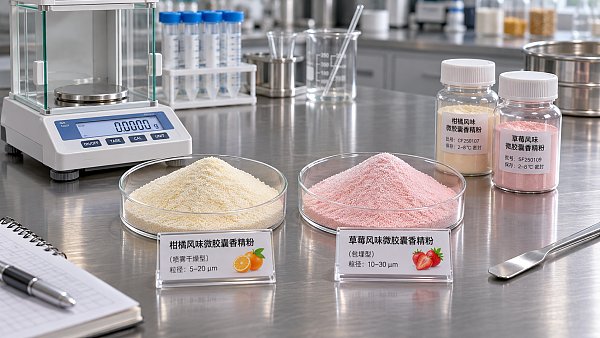
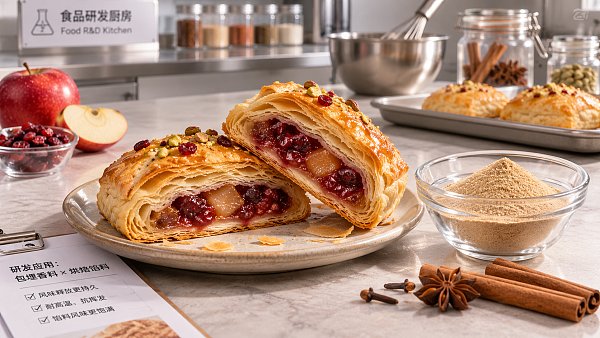
Flavor encapsulates for bakery fillings can reduce aroma loss by holding volatile flavor compounds within a protective carrier until they are released during processing, storage, or eating. Their effectiveness, however, depends on more than how well they tolerate oven heat. A flavor that survives baking may still fade in a moist filling, interact with fat, or release too slowly to deliver the intended taste.
The most useful starting point is to define where flavor is being lost. For a filling baked inside a pastry, the challenge may be heat exposure and steam. For a cream added after baking, oxygen, moisture, and refrigerated storage may matter more. The right encapsulated flavor is the one that performs in the finished product through its intended shelf life, not simply the one with the strongest aroma before mixing.
What encapsulation protects, and what it cannot prevent
Many desirable flavor compounds are volatile: they can move into the air during mixing, heating, and storage. Some are also sensitive to oxygen or react with other ingredients. Encapsulation disperses or traps these compounds in a food-grade carrier, reducing their direct exposure to conditions that can cause loss or change.
The carrier is not necessarily a sealed shell. Depending on the process, the flavor may be distributed throughout a solid matrix, held in a coating, or incorporated into an emulsion that is subsequently dried. Protection depends on how completely the flavor is retained, how permeable the carrier is, and what happens when that carrier encounters the filling.
Encapsulation also changes the way flavor becomes available. Water can dissolve or soften certain matrices; heat, mechanical action, and contact with other ingredients can alter the rate of release. The objective is not to lock in every aroma compound indefinitely. A useful system retains enough flavor through manufacturing and storage while releasing it at the point where the consumer can perceive it.
There are limits. A carrier cannot make every flavor compound chemically stable under every condition. It will not correct an unsuitable filling pH, poor packaging, or a formulation that develops off-notes for unrelated reasons. Encapsulation should be evaluated as part of the whole formulation rather than treated as a substitute for controlling the process.
Start with the filling’s journey through production
The timing of filling addition determines the stresses an encapsulated flavor must withstand. Map the journey from ingredient addition to consumption before comparing samples.
Fillings baked inside the product
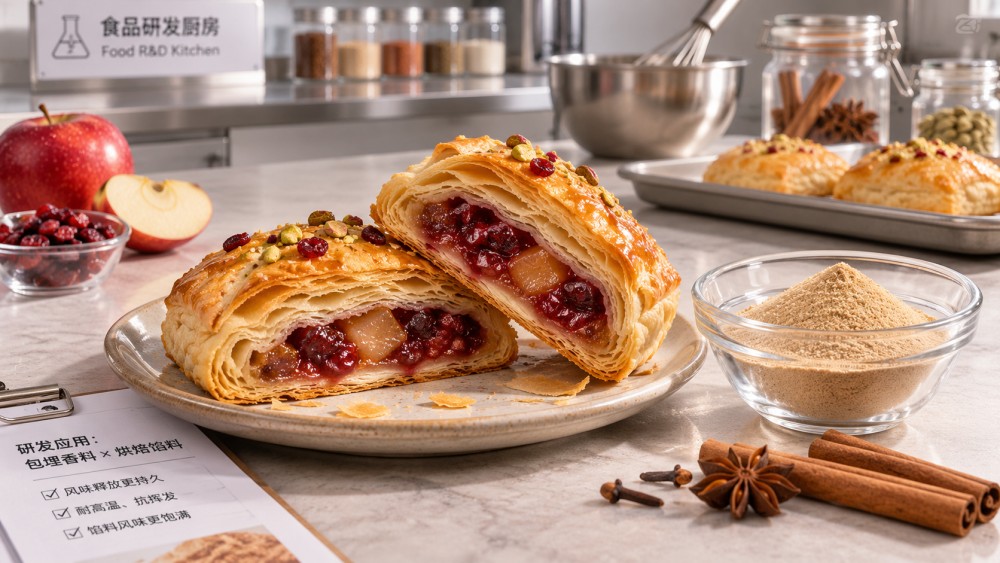
Fruit preparations, custards, and other fillings deposited before baking face heating in the oven, but the relevant exposure is the filling’s own temperature profile, not the oven set point alone. Product size, dough thickness, filling placement, moisture content, and bake time influence how quickly the center heats and how long it stays hot.
Steam and moisture movement can also carry aroma away. A carrier that delays flavor release until the filling warms may be helpful, but a water-soluble matrix can begin releasing its contents during mixing or holding before the tray reaches the oven. A long holding period between preparation and baking can therefore change the result even when the baking conditions are unchanged.
For these products, compare flavor at several points: after filling preparation, immediately after baking and cooling, and during storage. A pleasant aroma from the oven is not necessarily evidence of good retention; some of that aroma may be flavor leaving the product.
Fillings added after baking
Post-bake creams, ganaches, and fruit fillings avoid the main oven exposure, so maximum heat protection may be less valuable than stability during mixing, storage, and distribution. In a refrigerated cream, for example, the carrier must work in a moist environment and release flavor at the temperature at which the product is eaten.
A highly protective system may produce a muted initial flavor if release is too slow. Conversely, a rapidly dissolving flavor can provide an immediate impact but offer less separation from moisture and oxygen during shelf life. A standard liquid or powdered flavor may be sufficient where processing is gentle and the finished product is consumed quickly. Encapsulation is most useful when it addresses a loss mechanism that the existing formulation cannot manage adequately.
How carrier choice changes performance
Carrier descriptions are useful starting points, but they are not performance guarantees. Ingredients, manufacturing method, particle structure, and flavor composition all influence how a system behaves.
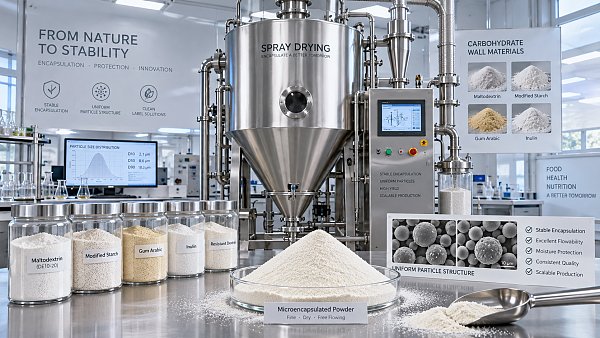
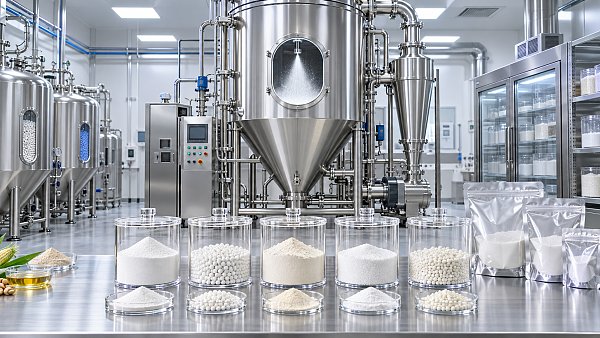
Spray drying is a common way to produce powdered encapsulated flavors, while other approaches use different matrix formation or coating processes. The process name alone does not establish baking performance. Two powders made using the same method can differ in carrier composition, particle size, surface flavor, and release behavior.
Surface flavor deserves attention because flavor present on the outside of a particle may deliver a strong aroma when a container is opened but have less protection during handling and storage. Ask suppliers how their specifications address flavor loading and retention, and assess samples in the finished application rather than by smelling the powder alone.
Moisture, pH, and fat can change the result
Moisture and water activity: A dry powder may be stable in its original packaging but behave differently once incorporated into a filling. Water can penetrate or dissolve some carriers, allowing flavor to move into the surrounding mixture. Water activity describes how available water is in a product and can help interpret stability, but it does not by itself predict release: carrier solubility, ingredient interactions, and storage temperature also matter.
Moisture migration within the finished bakery item adds another variable. A filling may exchange moisture with the surrounding cake or pastry, changing texture and potentially changing how the flavor is released. Test the complete product, not only the filling stored in a separate container.
Filling pH: Acidic fruit fillings can affect flavor stability and the behavior of some carrier materials. A carrier that disperses well in a neutral cream may behave differently in an acidic fruit preparation. The flavor compounds themselves may also change under acidic conditions, so a carrier should be screened with the actual fruit base, acidity system, and planned processing conditions.
Fat and emulsifiers: Oil-soluble aroma compounds may distribute into the fat phase rather than remain available in the aqueous phase. This can affect perceived intensity and the timing of release. Emulsifiers and other surface-active ingredients can also change how flavors are dispersed. In a fat-rich filling, compare the encapsulate with the existing flavor system at equivalent finished-product dosage, then assess both initial impact and flavor persistence.
These variables interact. Changing the fat content to improve texture, for example, can alter flavor perception even if the encapsulated flavor and its dose remain unchanged. Reformulation should trigger a fresh application check rather than an assumption that the previous flavor level will still work.
Design a trial that identifies the cause of flavor loss
A useful trial compares the encapsulated candidate with the current flavor system under the same conditions. It should also separate processing loss from storage loss. A practical sequence is:
- Define the target profile. Specify the desired character and intensity in the finished product, including any notes that should not become dominant.
- Record the process. Document ingredient addition order, mixing, holding, filling temperature, baking or cooling, packaging, and storage conditions. Measure the filling temperature during processing where practical.
- Set a meaningful comparison. Prepare a control using the current flavor and one or more encapsulated candidates. Compare at supplier-recommended starting levels, then adjust dosage as needed; equal powder weight does not necessarily mean equal flavor content.
- Sample at relevant stages. Assess the filling after preparation, the product after processing and cooling, and packaged samples at selected points across the intended shelf life.
- Evaluate the whole product. Check aroma, taste, aftertaste, texture, appearance, and dispersion. Serve samples consistently, because temperature and handling affect perception.
- Investigate unexpected results. If flavor is lost before baking, examine mixing and holding. If it is acceptable after cooling but fades in storage, examine packaging, oxygen exposure, moisture changes, and flavor stability.
A structured sensory assessment can reveal changes that a single overall intensity score misses. A fruit flavor may retain sweetness-associated notes while losing its fresh top notes, for instance. Where analytical capability is available, measurement of selected aroma compounds can complement sensory evaluation, but it should not replace tasting: measured retention does not always translate directly into the intended flavor experience.
Include normal production variation when moving beyond the initial screen. A candidate that works in a small batch may behave differently when mixing time, holding time, shear, or filling throughput changes. Check for practical issues such as dusting, clumping, incomplete dispersion, or a gritty texture before approving it for scale-up.
What to request from a supplier
Give the supplier a concise application brief: filling type, target flavor, addition point, relevant temperatures and holding times, pH, fat and moisture characteristics, packaging, storage conditions, and intended shelf life. Also identify the markets where the finished product will be sold and any labeling, allergen, dietary, or customer specifications that affect ingredient selection.
Request the ingredient composition and specifications needed for evaluation, recommended dosage and addition method, storage and handling guidance, and information on the intended release behavior. Ask whether the sample is designed for pre-bake or post-bake use and what conditions informed that recommendation. Food-use suitability and labeling depend on the complete ingredient composition and the destination market, not on the term “encapsulated” alone.
For the final decision, compare the flavor delivered at the required quality throughout shelf life, the dose needed to achieve it, and its effect on production. A more expensive encapsulate may be justified if it preserves a flavor profile that cannot otherwise survive the process. If it offers no meaningful improvement in the finished product, a simpler flavor system may be the better choice.
Facing technical bottlenecks in manufacturing or looking for more efficient industrial solutions? Leave your details below and let the engineering experts at FCAS solve them for you.
We respect your privacy. Your information is strictly confidential.
Related News
 Nano-microcapsule FormulationsWhat Affects the Cost of Microencapsulated Flavors Wholesale?Microencapsulated flavors wholesale pricing depends on formulation, processing, volume and quality. Learn how to compare suppliers and lower your cost in use.MORE+
 Nano-microcapsule FormulationsHow to Use Microcapsule Slurries for Household ProductsDiscover how to use microcapsule slurries for household products, from compatibility and gentle mixing to stability testing and fragrance performance.MORE+
 Nano-microcapsule FormulationsHow to Choose a Capsule Suspension Pesticides SupplierChoose a capsule suspension pesticides supplier with confidence. Compare formulation quality, regulatory documentation, delivery reliability and total costs.MORE+
 Nano-microcapsule FormulationsHow to Choose Seed Coating Agents for Better Seed CoverageChoose Seed Coating Agents with confidence. Learn how to assess coverage, dust-off, compatibility, drying, and germination for reliable results.MORE+
 Nano-microcapsule FormulationsHow Flavor Encapsulates for Bakery Fillings Retain FlavorDiscover how flavor encapsulates for bakery fillings protect aroma, support shelf-life stability, and help you choose the right carrier for your formulation.MORE+
 Nano-microcapsule FormulationsHow Can You Prevent Microcapsule Slurries From Settling in Storage?Keep Microcapsule Slurries stable in storage. Discover how temperature control, gentle agitation, and uniformity checks help reduce settling and protect capsule integrity.MORE+
 Nano-microcapsule FormulationsHow Do Microencapsulated Flavors Improve Snack Seasoning Stability?Explore how microencapsulated flavors for snack seasonings help preserve aroma and slow flavor loss. Learn to select and test systems for lasting freshness and better snack performance.MORE+
 Nano-microcapsule FormulationsHow to Use Food Grade Cyclodextrin Inclusion Complexes in BeveragesExplore food grade cyclodextrin inclusion complexes for beverages. Learn how to select, dose, and test them for flavor retention, stability, and smarter formulation decisions.MORE+
 Nano-microcapsule FormulationsHow Can High Solids Microcapsule Slurries Stay Stable in Storage?Keep high solids microcapsule slurries stable in storage. Learn how to control settling, protect capsule integrity, and optimize mixing for reliable pumping and consistent dosing.MORE+
 Nano-microcapsule FormulationsHow Spray Drying Wall Materials Affect Stability and EncapsulationSpray drying wall materials determine powder stability, encapsulation efficiency, moisture resistance, and release. Learn how to select the right matrix for reliable performance.MORE+
 Nano-microcapsule FormulationsHow Encapsulated Flavors Protect Taste During Processing and StorageEncapsulated Flavors protect taste from heat, oxygen, moisture, and storage loss. Explore smarter release, carrier selection, and processing strategies.MORE+
 Nano-microcapsule FormulationsHow Food Grade Cyclodextrin Complexes Protect Sensitive FlavorsFood grade cyclodextrin inclusion complexes help protect sensitive flavors from oxidation, evaporation, and processing loss while supporting controlled release and consistent sensory quality.MORE+
 Nano-microcapsule FormulationsChoosing Fragrance Preparations That Perform Well in Personal WashFragrance preparations for personal wash: learn how to select options that protect clarity, stability, foam, scent performance, and packaging compatibility.MORE+
 Nano-microcapsule FormulationsHow to Select Spray Drying Wall Materials for Better StabilitySpray drying wall materials: learn how to select the right matrix for improved stability, moisture resistance, encapsulation, release performance, and cost-efficient scale-up.MORE+
 Nano-microcapsule FormulationsFood Grade Cyclodextrin Inclusion Complexes for Stable Flavor DeliveryFood grade cyclodextrin inclusion complexes help protect volatile flavors, improve handling, and support controlled release for reliable food formulation performance.MORE+
 Nano-microcapsule FormulationsHow Oxidation Resistant Flavor Encapsulation Protects Taste StabilityOxidation resistant flavor encapsulation protects aroma, freshness, and taste stability. Discover how smart barriers, release control, and packaging improve shelf life.MORE+
 Nano-microcapsule FormulationsWhat to Verify When Choosing a Cyclodextrin Inclusion Complexes ManufacturerChoose a cyclodextrin inclusion complexes manufacturer with confidence: verify complexation evidence, loading, stability, process control, and batch consistency.MORE+
 Nano-microcapsule FormulationsWhat to Look for in a Reliable Flavor Encapsulates ManufacturerFlavor encapsulates manufacturer selection starts with application fit. Learn how to compare stability, release, documentation, and supply reliability before you buy.MORE+
 Nano-microcapsule FormulationsHow Pesticide Formulation Intermediates Improve Suspoemulsion StabilityPesticide formulation intermediates for suspoemulsion can make or break product stability. Learn how dispersants, emulsifiers, and co-stabilizers reduce separation, caking, and storage failure.MORE+