How Can High Solids Microcapsule Slurries Stay Stable in Storage?
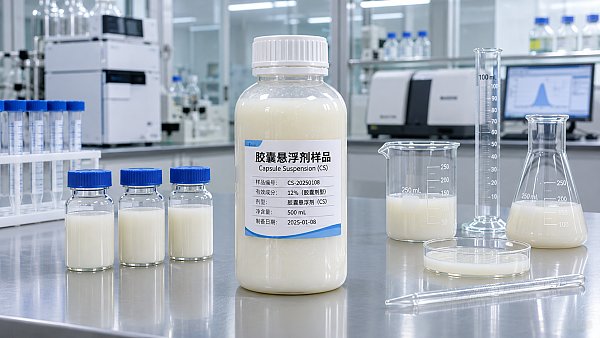
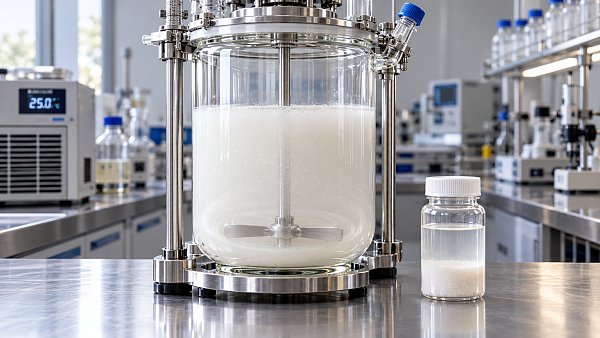
High solids microcapsule slurries stay stable when the capsule surfaces remain compatible with the liquid phase, the slurry has enough low-shear structure to limit separation, and storage and transfer stay within validated temperature and shear limits. Adding more thickener or running the agitator continuously is not a reliable substitute for that balance: either can create pumping problems or damage capsules.
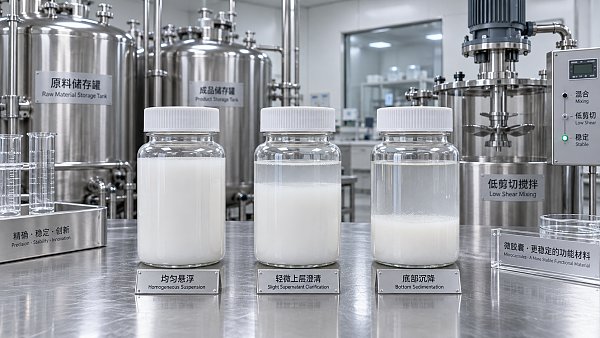
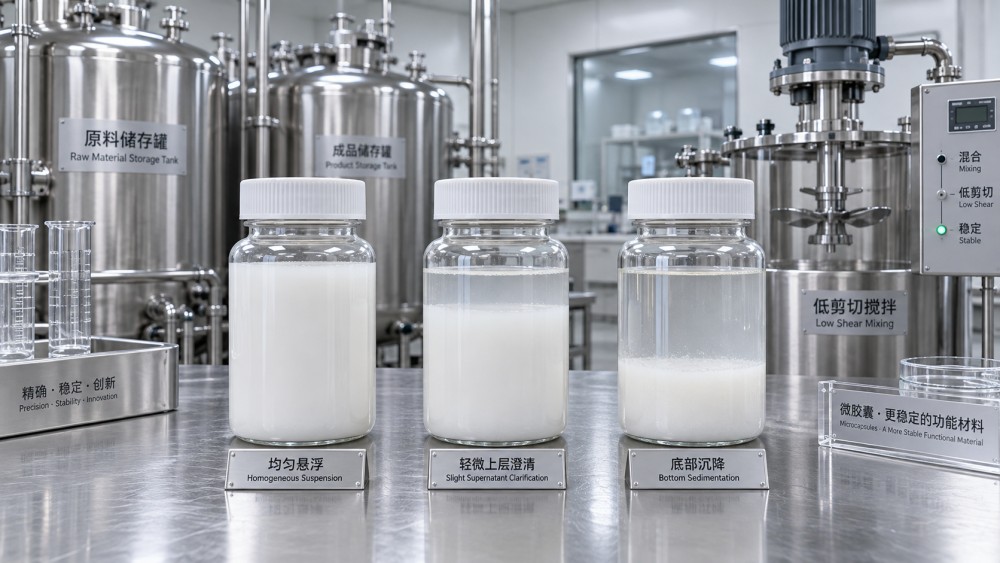
A drum may look acceptable until its first withdrawal produces thin liquid followed by a concentrated, difficult-to-pump layer. In microencapsulated agrochemicals, fragrances, and specialty formulations, this can cause inconsistent dosing, blocked strainers, or altered release performance. The first task is to distinguish reversible separation from aggregation, capsule leakage, or shell damage; these problems require different responses.
Separate a settling problem from a capsule problem
Storage stability does not always mean zero visible separation. A small separated layer may be acceptable if the product specification permits it and the slurry returns to a uniform condition under the approved mixing procedure. Conversely, a visually uniform slurry can fail because capsules have leaked or its viscosity has risen beyond the equipment’s operating range.
Before mixing a suspect container, document its condition. Record storage duration, temperature history, layer positions, visible deposits, and any changes in odor or container condition. Use the product’s sampling procedure and required protective equipment; do not open or smell a chemical container simply to investigate a suspected change.
Keep suspect material segregated until its condition is understood. A sediment that disappears under vigorous mixing is not automatically evidence of recovery: the same mixing may break capsules while making the slurry look smoother.
The formulation must support capsules without becoming unpumpable
High solids content increases interactions between capsules and leaves less continuous liquid available for movement. Small changes in capsule concentration, particle size distribution, or surface chemistry can therefore produce substantial changes in flow behavior. Solids content by weight does not tell the whole story; capsule density and effective occupied volume also matter.
Particle size and surface compatibility
Larger capsules generally separate faster than smaller ones under otherwise comparable dilute conditions, but concentrated slurries do not follow simple settling predictions reliably. Capsule crowding, flocculation, and the surrounding liquid’s structure can dominate. A broad particle size distribution may improve packing in one formulation yet introduce a coarse fraction that settles or blocks a strainer in another.
Use particle size results together with microscopy and redispersibility observations. An apparent increase in size may represent capsule clusters rather than individual capsule growth. Comparing samples before and after controlled, gentle dispersion helps the laboratory distinguish these possibilities without treating destructive dispersion as proof of stability.
Dispersants and protective colloids must be compatible with the shell surface, continuous phase, and dissolved ingredients. Changes in pH, salts, surfactants, or solvent composition can weaken surface stabilization or alter the shell. Adding a familiar dispersant to a stored batch may cause bridging, depletion flocculation, or other incompatibilities instead of correcting settling. Such additions belong in controlled formulation trials, not routine operator adjustments.
Low-shear support and working viscosity
A useful suspension often has structure at rest but becomes easier to move under shear. That can slow separation while allowing mixing, pumping, and dosing. The required balance depends on capsule size, density difference, storage duration, and equipment; there is no universal viscosity or yield-stress target for all microcapsule systems.
A single viscosity reading is insufficient. Compare measurements at defined temperatures, shear conditions, and rest times. A thixotropic slurry can become thinner during mixing and rebuild afterward, so samples tested immediately after agitation may appear different from rested samples even without deterioration.
Excessive structure can prevent an agitator from circulating the entire vessel, leaving stagnant regions while liquid near the impeller moves freely. It can also increase startup pressure and impair metering. A formulation adjustment should therefore be evaluated for both suspension stability and equipment performance, including its ability to rebuild after transfer.
Control storage conditions before changing the recipe
Temperature affects liquid viscosity, capsule-shell behavior, and payload mobility. Warm conditions can reduce suspension support and accelerate some degradation or diffusion processes. Cold conditions can increase pumping resistance; freezing may cause irreversible damage in susceptible aqueous formulations. Returning the container to room temperature does not prove that freeze damage has been reversed.
Use the supplier’s validated storage range rather than a generic temperature recommendation. Monitor conditions where the product actually sits, especially near exterior walls, heated equipment, and loading areas. Repeated temperature cycling deserves attention even when each recorded temperature appears close to the permitted range.
- Keep containers properly closed. Evaporation can raise solids concentration and viscosity, while poorly controlled opening practices can introduce contamination.
- Preserve the approved composition. Do not add water, solvent, salts, preservative, or pH adjuster unless an authorized procedure permits it.
- Use compatible packaging and contact materials. Check liners, seals, and transfer hoses against the complete formulation, not just its main ingredient.
- Manage inventory by validated shelf life. Record receipt and opening dates, and investigate material held beyond its approved period rather than automatically remixing it for use.
For susceptible aqueous products, microbial growth can change pH, produce gas, or alter rheology. Prevention requires appropriate formulation protection and hygienic handling, particularly in opened vessels. Operators should report suspected contamination; adding preservative after a change has appeared is not a validated recovery method.
Mix for circulation, not maximum speed
The objective of storage mixing is to redistribute capsules without exposing them to damaging local forces. Tank turnover matters more than a visually impressive vortex. A high-speed impeller can move the surface vigorously while leaving dense sediment below it, and the vortex may entrain air that distorts volume-based dosing.
Use the approved impeller, fill-level range, speed, and mixing sequence. Capsule tolerance depends on shell chemistry and thickness, payload, and prior exposure, so “gentle mixing” must be translated into equipment-specific settings. Rotational speed alone is not transferable between vessels: impeller diameter, tip speed, clearance, and flow pattern also affect exposure.
- Inspect before startup. Confirm temperature, fill level, container condition, and any visible separation. Follow the approved startup procedure if sediment may obstruct the agitator.
- Establish circulation at the permitted initial setting. Increase only within validated limits while watching motor load, temperature, foaming, and vessel-wide movement.
- Allow the prescribed redistribution time. Do not judge completion solely by the surface becoming uniform.
- Verify representative uniformity. Compare designated sampling locations or sequential withdrawals using the product’s acceptance criteria.
- Stop or maintain mixing as specified. Continuous agitation is appropriate only where its cumulative effect on capsule integrity has been validated.
Avoid using rotor-stator mixers, homogenizers, or ultrasound to remove lumps unless that operation has been specifically qualified for the product. These methods can turn an aggregation problem into a capsule-integrity problem.
Transfer equipment needs the same scrutiny. Pump restrictions, narrow valve openings, repeated recirculation, and unsuitable strainers can expose capsules to localized stress. Select pumps and operating conditions through product trials, and account for the total number of passes. A compatible pump does not make an unnecessarily long recirculation loop harmless.
Verify recovery before releasing stored material
When a stored slurry redistributes under its normal procedure, verify that the recovered batch still meets specification. Testing should address the problem observed, rather than relying only on appearance. For a settling complaint, spatial uniformity and redispersibility are central. For suspected leakage or rough handling, capsule integrity and free-payload measurements become more important.
A practical evaluation can include solids content, controlled-condition rheology, particle size distribution, microscopy, pH where applicable, and payload assay. Density may help track consistency but can be misleading when entrained air is present. Release behavior or application performance may also require confirmation when those properties are critical to the formulation’s function.
Compare results with an approved reference or release specification. Acceptance limits should define permitted separation, mixing conditions, and post-mixing uniformity—not simply state that the product must be “stable.” This gives operators a basis for accepting normal reversible settling without overlooking progressive deterioration.
Escalate persistent deposits, abnormal motor load, unexplained viscosity changes, suspected freezing, or evidence of leakage to the formulation or quality team. Bulk rework should follow a documented, tested procedure. Dilution may restore apparent flow while changing dose concentration, preservation, capsule interactions, and downstream performance.
Make the storage test resemble the actual handling route
A small laboratory jar can identify separation trends but cannot establish full-scale redispersibility on its own. A production vessel has different settling depth, mixing geometry, wall conditions, and withdrawal points. Storage qualification should connect laboratory observations with representative packaging and handling trials.
Assess the intended storage duration, expected temperature exposure, container orientation, and mixing before use. Where accelerated testing is used, confirm that the stress does not introduce a failure mechanism absent from normal storage. Centrifugation or elevated-temperature results are useful screening tools, not automatic substitutes for real-time stability evidence.
The handling sequence also matters. Test the slurry after storage, approved remixing, transfer, and any relevant dilution step. A concentrate may remain stable in its container but flocculate when mixed with application water or another formulation component. That is a separate compatibility question and should not be corrected by changing storage agitation.
For repeatable operation, the final storage instruction should specify the permitted temperature range, inspection frequency, mixing settings, sampling method, and conditions requiring a hold. It should also identify which changes are allowed on site. Clear limits prevent an operator from treating every thickened or separated batch with more shear when the underlying problem may be irreversible.
Facing technical bottlenecks in manufacturing or looking for more efficient industrial solutions? Leave your details below and let the engineering experts at FCAS solve them for you.
We respect your privacy. Your information is strictly confidential.
Related News
 Nano-microcapsule FormulationsWhat Affects the Cost of Microencapsulated Flavors Wholesale?Microencapsulated flavors wholesale pricing depends on formulation, processing, volume and quality. Learn how to compare suppliers and lower your cost in use.MORE+
 Nano-microcapsule FormulationsHow to Use Microcapsule Slurries for Household ProductsDiscover how to use microcapsule slurries for household products, from compatibility and gentle mixing to stability testing and fragrance performance.MORE+
 Nano-microcapsule FormulationsHow to Choose a Capsule Suspension Pesticides SupplierChoose a capsule suspension pesticides supplier with confidence. Compare formulation quality, regulatory documentation, delivery reliability and total costs.MORE+
 Nano-microcapsule FormulationsHow to Choose Seed Coating Agents for Better Seed CoverageChoose Seed Coating Agents with confidence. Learn how to assess coverage, dust-off, compatibility, drying, and germination for reliable results.MORE+
 Nano-microcapsule FormulationsHow Flavor Encapsulates for Bakery Fillings Retain FlavorDiscover how flavor encapsulates for bakery fillings protect aroma, support shelf-life stability, and help you choose the right carrier for your formulation.MORE+
 Nano-microcapsule FormulationsHow Can You Prevent Microcapsule Slurries From Settling in Storage?Keep Microcapsule Slurries stable in storage. Discover how temperature control, gentle agitation, and uniformity checks help reduce settling and protect capsule integrity.MORE+
 Nano-microcapsule FormulationsHow Do Microencapsulated Flavors Improve Snack Seasoning Stability?Explore how microencapsulated flavors for snack seasonings help preserve aroma and slow flavor loss. Learn to select and test systems for lasting freshness and better snack performance.MORE+
 Nano-microcapsule FormulationsHow to Use Food Grade Cyclodextrin Inclusion Complexes in BeveragesExplore food grade cyclodextrin inclusion complexes for beverages. Learn how to select, dose, and test them for flavor retention, stability, and smarter formulation decisions.MORE+
 Nano-microcapsule FormulationsHow Can High Solids Microcapsule Slurries Stay Stable in Storage?Keep high solids microcapsule slurries stable in storage. Learn how to control settling, protect capsule integrity, and optimize mixing for reliable pumping and consistent dosing.MORE+
 Nano-microcapsule FormulationsHow Spray Drying Wall Materials Affect Stability and EncapsulationSpray drying wall materials determine powder stability, encapsulation efficiency, moisture resistance, and release. Learn how to select the right matrix for reliable performance.MORE+
 Nano-microcapsule FormulationsHow Encapsulated Flavors Protect Taste During Processing and StorageEncapsulated Flavors protect taste from heat, oxygen, moisture, and storage loss. Explore smarter release, carrier selection, and processing strategies.MORE+
 Nano-microcapsule FormulationsHow Food Grade Cyclodextrin Complexes Protect Sensitive FlavorsFood grade cyclodextrin inclusion complexes help protect sensitive flavors from oxidation, evaporation, and processing loss while supporting controlled release and consistent sensory quality.MORE+
 Nano-microcapsule FormulationsChoosing Fragrance Preparations That Perform Well in Personal WashFragrance preparations for personal wash: learn how to select options that protect clarity, stability, foam, scent performance, and packaging compatibility.MORE+
 Nano-microcapsule FormulationsHow to Select Spray Drying Wall Materials for Better StabilitySpray drying wall materials: learn how to select the right matrix for improved stability, moisture resistance, encapsulation, release performance, and cost-efficient scale-up.MORE+
 Nano-microcapsule FormulationsFood Grade Cyclodextrin Inclusion Complexes for Stable Flavor DeliveryFood grade cyclodextrin inclusion complexes help protect volatile flavors, improve handling, and support controlled release for reliable food formulation performance.MORE+
 Nano-microcapsule FormulationsHow Oxidation Resistant Flavor Encapsulation Protects Taste StabilityOxidation resistant flavor encapsulation protects aroma, freshness, and taste stability. Discover how smart barriers, release control, and packaging improve shelf life.MORE+
 Nano-microcapsule FormulationsWhat to Verify When Choosing a Cyclodextrin Inclusion Complexes ManufacturerChoose a cyclodextrin inclusion complexes manufacturer with confidence: verify complexation evidence, loading, stability, process control, and batch consistency.MORE+
 Nano-microcapsule FormulationsWhat to Look for in a Reliable Flavor Encapsulates ManufacturerFlavor encapsulates manufacturer selection starts with application fit. Learn how to compare stability, release, documentation, and supply reliability before you buy.MORE+
 Nano-microcapsule FormulationsHow Pesticide Formulation Intermediates Improve Suspoemulsion StabilityPesticide formulation intermediates for suspoemulsion can make or break product stability. Learn how dispersants, emulsifiers, and co-stabilizers reduce separation, caking, and storage failure.MORE+