
How to Assess Quality Risks at a Pesticide Formulation Intermediates Factory
A pesticide formulation can fail long before it reaches a spray tank. A suspension may settle too quickly, an emulsifiable concentrate may separate after transport, or an otherwise sound active ingredient may become difficult to disperse because an intermediate carries the wrong moisture level, particle profile, or trace contaminant. For technical evaluators, these are not minor production issues. They are supplier-qualification risks with consequences for field performance, registration support, customer complaints, and supply continuity.
Assessing a pesticide formulation intermediates factory therefore requires more than checking a certificate of analysis against a purchase specification. The evaluation should reveal whether the factory can repeatedly deliver an intermediate that behaves as expected in a real formulation system—not merely in one retained sample. The most useful assessment combines document review, plant observation, targeted sampling, and a practical understanding of the downstream formulation process.
Begin with the function of the intermediate, not the supplier’s brochure
The term “formulation intermediate” can cover solvents, dispersants, emulsifiers, wetting agents, carriers, stabilizers, mineral fillers, surfactant blends, polymeric additives, encapsulation materials, and premixes used in suspension concentrates, emulsifiable concentrates, water-dispersible granules, soluble liquids, and other crop-protection products. Their risk profile depends on what they must do.
A dispersant used in a high-load suspension concentrate is sensitive to molecular-weight consistency, salt content, and compatibility with the active ingredient. A solvent for an EC formulation may require tight control of water, acidity, aromatic composition, flash point, and odor. A carrier for granules may create problems through dust, variable bulk density, or adsorption behavior. Treating all intermediates as generic chemical inputs is a common and costly mistake.
Before the audit, define the intermediate’s critical-to-quality attributes in downstream language. Rather than asking only, “Is the viscosity within range?”, ask: “What viscosity variation can be tolerated before milling, pumping, emulsification, or storage stability is affected?” This changes the review from a routine factory visit into a decision-oriented risk assessment.
Map the path from incoming material to released batch
Quality risks often enter quietly at transition points: an incoming raw material is accepted based on a supplier document, a blend tank is not fully cleaned between campaigns, a sample is taken from the top of a drum, or a released lot is stored in heat long enough for its behavior to drift. A process map makes these weak points visible.
Ask the factory to walk through one recent production batch from purchase order to dispatch. The route should include supplier approval, receiving inspection, quarantine status, warehousing, weighing, reaction or blending, in-process controls, filtration, filling, finished-goods testing, release, retain sample management, and shipping. Compare the written procedure with what operators actually do on the shop floor.
A credible operation can explain why each control exists. If a factory says it tests moisture, for example, it should also be able to explain whether the result affects hydrolysis risk, emulsifier performance, active ingredient compatibility, or packaging integrity. If staff cannot connect a test to product function, the control may be historical rather than meaningful.
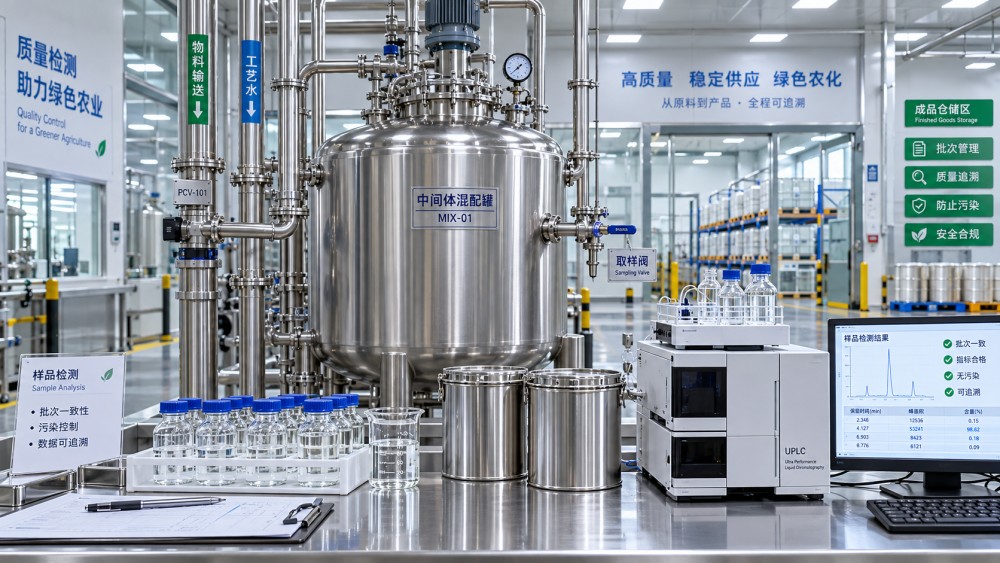
Raw-material control: where batch variability usually begins
A finished intermediate is only as predictable as the materials used to make it. This is particularly important when a supplier relies on multiple sources for fatty alcohol ethoxylates, aromatic solvents, mineral components, polymers, technical-grade acids, or natural-origin materials. Inputs that appear equivalent on a basic COA may differ in isomer distribution, color, odor, unsaturation, ash, residual monomer, particle shape, or trace metals.
During assessment, look for evidence that approved raw materials are controlled by more than a name and a nominal assay. Useful questions include:
- Are alternate suppliers qualified through comparative production or formulation testing?
- Does receiving inspection verify identity, not just review the supplier’s COA?
- Are raw materials sampled using a defined plan for drums, bags, tanks, or bulk deliveries?
- How are off-specification or suspicious materials physically segregated?
- Can the factory trace a finished batch back to every major raw-material lot?
Pay particular attention to “minor” components. A low-dose defoamer, preservative, pH adjuster, or antioxidant can have an outsized effect on shelf life and formulation appearance. In pesticide applications, a small change in an emulsifier blend may also alter dilution behavior, phytotoxicity potential, or compatibility with tank-mix partners.
Process consistency is more revealing than a single passing result
Many factories can manufacture an acceptable batch under close attention. The more important question is whether their system prevents ordinary variation from turning into a quality event. This is where production discipline matters: calibrated weighing systems, defined charging order, controlled mixing energy, temperature limits, reaction endpoint criteria, filtration controls, and validated hold times.
For a blending operation, examine how it manages homogeneity. Large tanks can develop concentration gradients when viscosity is high, recirculation is inadequate, or sampling occurs too soon after addition. For powdered intermediates, inspect dust collection, sieving, metal control, blending time, and the potential for particle segregation during transfer. For reaction-derived materials, assess the control of temperature excursions, residual reactants, catalyst removal, and impurity formation.
Trend data are particularly valuable. Request several consecutive batch records or a longer batch history for the same grade. A specification may be broad enough that every lot passes, while a gradual drift in color, viscosity, acid value, particle size, or active content signals weakening process control. A factory that tracks trends and investigates shifts before they become failures is generally lower risk than one that only reacts to out-of-specification results.
Contamination control should match pesticide-industry realities
Cross-contamination is not limited to pharmaceutical-style facilities. At a pesticide formulation intermediates factory, it can arise from shared tanks, hoses, pumps, filters, filling heads, sampling tools, reworked materials, dusty transfer areas, or poorly controlled packaging returns. The consequences may include unexpected odor, discoloration, unstable emulsions, insoluble residues, analytical interference, or the presence of substances that complicate regulatory and residue-related assessments.
The audit should distinguish between reasonable shared-equipment use and uncontrolled sharing. Dedicated equipment may not be necessary for every product, but cleaning procedures must be technically justified. Inspect whether cleaning is documented, whether the selected solvent or wash medium can remove the prior material, and whether verification reflects the actual risk. A visual check alone is rarely enough for strongly colored, high-viscosity, potent, or difficult-to-rinse materials.
Also review the factory’s approach to rework. Rework can be legitimate when it is defined, traceable, compatible with the original batch, and controlled within set limits. It becomes a serious risk when unidentified leftovers are casually returned to a process or when multiple batches are combined without a clear quality rationale.
Do the laboratory methods answer the questions that matter?
An internal laboratory does not need to perform every advanced analysis, but it must be capable of reliably testing the properties that govern release and use. A COA showing only appearance, assay, and density may be inadequate for a surfactant blend where cloud point, water content, pH, foaming behavior, or active-matter distribution affect formulation performance.
Evaluate the analytical system on three levels. First, confirm that test methods are suitable for the material and specification. Second, check whether instruments are calibrated, maintained, and used by trained analysts. Third, determine whether the factory can investigate abnormal results rather than simply repeat a test until a passing value appears.
Where a supplier outsources specialized testing, verify the external laboratory’s role, turnaround time, reporting format, and treatment of atypical findings. Outsourcing is not inherently negative; the risk lies in releasing material before critical results are known or in failing to understand what the external result means for the formulation.
Batch traceability must work under pressure
Traceability is easy to describe and harder to prove. Ask a simple practical question: if a downstream formulation batch shows an unexpected separation after shipment, how quickly could the factory identify the exact intermediate lot, all associated raw materials, production conditions, quality records, retain sample, and customers who received related lots?
Strong traceability connects lot numbers across receiving, production, packaging, quality release, and shipment. It also covers repacking, partial deliveries, relabeling, and returned goods. Gaps often appear in these less formal activities, especially when a site handles both bulk and small-pack orders.
Retain samples deserve closer attention than they usually receive. They should represent the released lot, be stored under conditions that preserve their meaning, and be available for comparison if a claim occurs months later. For materials vulnerable to oxidation, moisture pickup, settling, or temperature change, a poorly stored retain sample may provide little evidence during an investigation.
Storage and packaging can undo careful manufacturing
Some formulation intermediates are chemically stable but physically sensitive. Others slowly change when exposed to air, heat, light, moisture, or unsuitable packaging. Warehouses should therefore be assessed as part of the quality system, not merely as a logistics area.
Check temperature monitoring, segregation of incompatible materials, container closure practices, first-expired-first-out controls, pest and dust management, and the condition of drums, IBCs, bags, and labels. For liquid materials, inspect whether containers are protected from water ingress and whether there is a procedure for mixing or homogenizing products that may settle during storage. For powders, look for damaged liners, caking, excessive fines, and evidence that bags are stacked beyond safe limits.
Packaging compatibility is especially relevant for solvent-containing products, corrosive materials, and surfactant-rich blends. A technically compliant product can become nonconforming if its container softens, leaks, absorbs moisture, or contributes extractables during extended storage.
Read deviations and complaints as evidence of factory culture
The most informative documents are not always the polished SOPs. Request examples of deviations, customer complaints, corrective and preventive actions, and change controls. The goal is not to find a factory with no problems; such a record may simply indicate weak reporting. The goal is to see whether problems are investigated with discipline.
A useful investigation identifies the immediate cause, contributing factors, affected lots, product impact, corrective action, and effectiveness check. Weak reports often stop at operator retraining without addressing equipment design, unclear specifications, unsuitable sampling, or inadequate supplier controls. Repeated complaints about settling, color, packaging leaks, or batch-to-batch variation should be treated as a pattern, even if each individual case was closed.
Turn observations into a supplier decision
Not every gap should lead to rejection. Technical evaluators should separate critical risks from manageable development work. A missing calibration record for a noncritical device does not carry the same weight as uncontrolled raw-material substitution, absent traceability, unexplained analytical variability, or inadequate contamination control for shared equipment.
For a promising supplier, qualification may include a conditional approval plan: define the required corrective actions, request updated procedures and objective evidence, obtain pilot lots, and test those lots in the intended pesticide formulation under realistic storage and dilution conditions. This is often more informative than relying on a single laboratory sample.
FCAS supports this kind of decision-making by organizing the technical and commercial context behind fine chemicals and agrochemical materials. For a pesticide formulation intermediates factory, the central question is not whether the site can produce a compliant drum today. It is whether its controls, people, records, and operating habits can protect the consistency that your formulation—and ultimately the grower using it—depends on.
Related News
 Antioxidants & Natural PreservativesWhat Quality Checks Matter When Sourcing Butylparaben for Personal CareButylparaben for personal care sourcing guide: compare assay, impurities, physical performance, documentation, traceability, and supplier quality to reduce formulation risk.MORE+
 Nano-microcapsule FormulationsHow Encapsulated Flavors Protect Taste During Processing and StorageEncapsulated Flavors protect taste from heat, oxygen, moisture, and storage loss. Explore smarter release, carrier selection, and processing strategies.MORE+
 Chelated Trace Element FertilizersHow Greenhouse Fertigation Systems Reduce Water and Fertilizer WasteGreenhouse fertigation systems reduce water and fertilizer waste with precise dosing, uniform irrigation, drainage monitoring, and smarter crop-zone control. Learn practical strategies.MORE+
 Supercritical CO2 Essential OilsHow Natural Essential Oil Blends Improve Consistent Product FragranceNatural essential oil blends help brands achieve consistent, appealing fragrance across batches. Explore smart blend design, stability testing, and product compatibility strategies.MORE+
 Non-ionic Surfactants & DefoamersHow to Choose Non Ionic Low Foaming Surfactants for CIP CleaningNon ionic low foaming surfactants for CIP cleaning: learn how to balance wetting, foam control, compatibility, and rinseability for reliable cleaning performance.MORE+
 Nano-microcapsule FormulationsHow Food Grade Cyclodextrin Complexes Protect Sensitive FlavorsFood grade cyclodextrin inclusion complexes help protect sensitive flavors from oxidation, evaporation, and processing loss while supporting controlled release and consistent sensory quality.MORE+
 Polymer-Coated Water Soluble NPKHow Fertilizer Coating Polymers Improve NPK Granule ReleaseFertilizer coating polymers for NPK granules improve controlled nutrient release, reduce loss risks, and enhance product consistency. Discover key selection and process insights.MORE+
 Chelated Trace Element FertilizersWhat Diammonium Phosphate Means for Crop Nutrition PlanningDiammonium Phosphate: learn how DAP supports early phosphorus access, nitrogen budgeting, smart placement, and balanced crop nutrition planning.MORE+
 Maillard Reaction Savory FlavorsHow to Assess a Flavor Bases Supplier List for Reliable SourcingGlobal Fine Chemicals & Agrochemical Intelligence Network flavor bases supplier list: assess specs, samples, supply risk, and true cost to source with confidence.MORE+
 Hydrocolloids & EmulsifiersHow Konjac Gum Powder Improves Texture in Low-Calorie FoodsKonjac gum powder improves body, stability, and mouthfeel in low-calorie foods. Discover practical tips for smoother sauces, beverages, and reduced-fat formulations.MORE+
 Supercritical CO2 Essential OilsWhat to Check Before Choosing a Botanical Essential Oils ManufacturerChoose a botanical essential oils manufacturer with confidence. Explore key checks for purity, traceability, compliance, batch consistency, and reliable supply.MORE+
 Microencapsulated FragrancesHow Fragrance Carriers for Detergents Improve Scent PerformanceFragrance carriers for detergents improve stability, fabric deposition, and long-lasting scent. Explore practical solutions for better wash-to-wear fragrance performance.MORE+
 Antioxidants & Natural PreservativesWhen Propyl Gallate Antioxidant Is the Right Choice for Oil StabilityPropyl gallate antioxidant: learn when it is the right choice for oil stability, shelf-life protection, processing compatibility, and smarter formulation decisions.MORE+
 Antioxidants & Natural PreservativesHow Potassium Sorbate Extends Shelf Life in Food and Beverage ProductsPotassium Sorbate helps food and beverage brands control yeast and mold spoilage. Explore pH, dosage, processing, and packaging strategies for reliable shelf life.MORE+
 Antioxidants & Natural PreservativesHow to Source Bulk Herbal Extracts With Reliable Quality ControlBulk herbal extracts sourcing guide: compare suppliers, verify traceability, review CoAs, and build reliable quality controls for safer, consistent purchasing.MORE+
 Antioxidants & Natural PreservativesWhat to Check Before Sourcing Butylparaben for Personal Care FormulasButylparaben for personal care sourcing guide: check market eligibility, purity, supplier controls, formula compatibility, packaging, and total risk before buying.MORE+
 Targeted Bio-pesticides & APIsChoosing Microbial Fungicides for Foliar Diseases in Integrated Crop ProgramsMicrobial fungicides for foliar diseases: learn how to match biology, formulation, tank compatibility, and timing for stronger integrated crop protection.MORE+
 Targeted Bio-pesticides & APIsHow Microbial Insecticides Control Caterpillars With Lower Crop Residue RiskMicrobial insecticides for caterpillars help protect crops with targeted early-larval control and lower residue-management pressure. Learn timing, coverage, compliance, and scouting essentials.MORE+
 Microencapsulated FragrancesHow to Add Encapsulated Laundry Fragrances Without Weakening Wash ResultsEncapsulated laundry fragrances: learn how to boost long-lasting scent while protecting cleaning power, stability, foam control, and fabric care.MORE+
 Supercritical CO2 Essential OilsHow Aroma Ingredients Shape Lasting and Skin-Safe Personal Care ProductsAroma ingredients for personal care: discover how to achieve lasting scent, formulation stability, skin safety, and confident product performance.MORE+
 Targeted Bio-pesticides & APIsInsecticides Explained Through Labels, Active Ingredients, and SafetyInsecticides explained through labels, active ingredients, formulations, and safety. Learn how to compare products, manage risk, and make informed crop protection decisions.MORE+
 Heavy-duty Industrial DegreasersHow to Select Parts Wash Cleaners for Automotive ComponentsParts wash cleaners for automotive components: learn how to match chemistry, materials, rinsing, safety, and waste controls for reliable cleaning results.MORE+
 Chelated Trace Element FertilizersHow Precision Fertigation Systems Improve Water and Nutrient ControlPrecision fertigation systems improve water and nutrient control with accurate dosing, uniform irrigation, smart monitoring, and reduced waste. Discover how to optimize crop performance.MORE+
 Hydrocolloids & EmulsifiersHow Bulk Price Factors Affect Hydrocolloid Stabilizer Blend SourcingHydrocolloid stabilizer blends bulk price: compare dosage efficiency, quality consistency, logistics, and documentation to reduce total sourcing costs.MORE+
 Zero-Calorie Sweeteners & AcidulantsHow to Choose a Natural Sweeteners Supplier for Clean-Label ProductsNatural sweeteners supplier selection guide for clean-label products: compare formulation fit, traceability, documentation, and supply reliability.MORE+
 Non-ionic Surfactants & DefoamersWhat Cationic Surfactants Do and Where They Are UsedCationic Surfactants deliver antimicrobial action, conditioning, antistatic control, and surface treatment benefits. Explore key uses, compatibility, and safe selection tips.MORE+
 Targeted Bio-pesticides & APIsHow to Evaluate Pesticide Suspension Concentrates for Field StabilityPesticide Suspension Concentrates: learn how to evaluate field stability, redispersibility, dilution, tank-mix compatibility, and spray safety for reliable performance.MORE+
 Hydrocolloids & EmulsifiersHow Hydrocolloid Systems for Meat Products Improve Texture and YieldHydrocolloid systems for meat products improve yield, texture, water retention, and slicing quality. Explore practical formulation strategies for stable, high-performing meat products.MORE+
 Microencapsulated FragrancesHow Laundry Fragrances for Liquid Detergents Improve Scent LongevityLaundry fragrances for liquid detergents: discover how fragrance design, deposition, and encapsulation create lasting fabric freshness and stronger product appeal.MORE+
 Nano-microcapsule FormulationsChoosing Fragrance Preparations That Perform Well in Personal WashFragrance preparations for personal wash: learn how to select options that protect clarity, stability, foam, scent performance, and packaging compatibility.MORE+
 Controlled-Release ThermodynamicsModified Cyclodextrins Explained for Controlled Fragrance ReleaseModified cyclodextrins enable controlled fragrance release, odor control, and volatile-note protection. Explore how they optimize performance in detergents, fabric care, and more.MORE+
 Microencapsulated FragrancesHow Fragrance Delivery Systems Improve Fabric Softener LongevityFragrance delivery systems for fabric softeners improve scent longevity through smart protection, reliable deposition, and controlled release for lasting freshness.MORE+
 Supercritical CO2 Essential OilsHow to Evaluate a Natural Cardamom Oil Supplier for Reliable SupplyNatural cardamom oil supplier evaluation guide: verify botanical origin, purity, batch consistency, documentation, packaging, and delivery reliability for confident sourcing.MORE+
 Maillard Reaction Savory FlavorsHow Ethyl Maltol Purity Testing Supports Flavor Safety ComplianceEthyl Maltol purity testing strengthens flavor safety compliance through identity checks, impurity profiling, supplier verification, and audit-ready documentation.MORE+
 Microencapsulated FragrancesEssential Oil Extracts Compared for Fragrance and Wellness UsesEssential Oil Extracts compared for fragrance and wellness: explore scent profiles, extraction methods, stability, safety, and sourcing insights for smarter formulation choices.MORE+
 Zero-Calorie Sweeteners & AcidulantsWhat Drives Zero Calorie Sweeteners Bulk Price in 2026Zero calorie sweeteners bulk price in 2026: compare specifications, dosage, quality, freight, and supply risk to make smarter sourcing decisions.MORE+
 EPA FIFRA & FDA GRAS RegsSynthetic Food Preservatives Rules That Support Safer FormulasSynthetic Food Preservatives: learn the rules for safer formulas, compliant use levels, validated shelf life, labeling, and reliable microbial control.MORE+
 Micelle Fluidics & ChelationHow Anionic Industrial Dispersants Improve Coating StabilityAnionic industrial dispersants improve coating stability, pigment wetting, viscosity control, gloss, and storage performance. Learn how to select and test the right solution.MORE+
 Supercritical CO2 Essential OilsHow to Choose Eucalyptus Oil Grades for Clean, Consistent ProductsChoose the right Eucalyptus Oil grade with confidence. Compare cineole content, purity, origin, processing, documentation, and application fit for consistent products.MORE+
 Micelle Fluidics & ChelationWhat Are Cationic Surfactants and Where Are They Commonly Used?Cationic Surfactants deliver powerful surface affinity for disinfection, fabric softening, hair conditioning, antistatic control, and industrial treatments. Explore key uses and selection factors.MORE+







































