
What Determines Fertigation Systems Price and Long-Term Operating Cost
What Determines Fertigation Systems Price and Long-Term Operating Cost
The quoted fertigation systems price is rarely the number that determines whether a project is economical. It is simply the visible starting point. Two systems may appear similar on a supplier quotation—both inject fertilizer into drip irrigation lines, both include pumps and basic controls—yet create very different costs over several growing seasons.
For procurement teams, the harder question is not “Which system costs less to buy?” It is “Which system can deliver the required nutrient program, under our water conditions and labor model, without creating recurring maintenance, incompatibility, or downtime costs?” That distinction matters especially where water-soluble fertilizers, liquid nutrients, chelated micronutrients, humic substances, or biological inputs are part of the crop program. A low-capital installation can become expensive if filters plug repeatedly, injection rates drift, or operators cannot manage the controls consistently.
A useful comparison therefore separates initial equipment expenditure from the cost of operating the whole nutrient-delivery process. It also treats the fertilizer product and the irrigation equipment as one connected system. This is an area where chemical compatibility, water quality, field hydraulics, and supplier support matter just as much as the pump itself.
Why Price Quotes for Similar Systems Can Differ So Much
The largest pricing variable is usually capacity. A compact unit serving a limited irrigation block is fundamentally different from a centralized installation designed to feed several zones, multiple crops, or large daily water volumes. Capacity is not only about tank size. It affects pump selection, pipe diameters, manifold design, filtration duty, control hardware, electrical requirements, and the margin available when irrigation demand peaks.
Buyers should ask suppliers to define capacity in operating terms: expected flow range, working pressure, number of irrigation zones, injection rate range, and the fertilizer recipes the system must handle. “Suitable for X hectares” is often too vague. The same area can have sharply different needs depending on crop density, irrigation duration, slope, block layout, water source, and whether fertilizer is applied continuously or in concentrated dosing windows.
The injection method also changes the capital cost. Venturi injectors are comparatively simple and may suit smaller or less automated applications, but they rely on a pressure differential and can affect hydraulic efficiency. Dosing pumps generally give more controllable injection, particularly where recipe accuracy and multiple nutrient channels matter. Proportional injection systems, EC/pH-controlled units, and multi-channel automation add cost because they add measurement, logic, calibration requirements, and more components that need service.
That added complexity is not automatically a problem. In a greenhouse, high-value horticulture setting, or operation running several nutrient formulations, control can reduce operator dependence and improve repeatability. In a simpler field application with limited labor capacity for maintenance, a more robust and less elaborate system may be the better purchase. The right specification is the one that fits the actual operating discipline available on site.
The Components That Should Never Be Treated as Optional
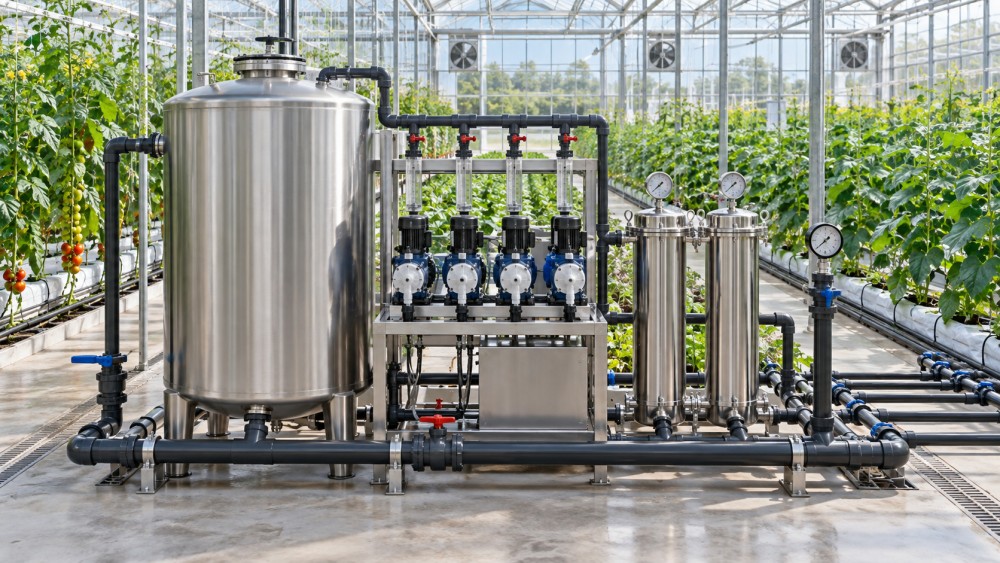
A quote that focuses heavily on the fertilizer tank and injection pump can hide the parts that protect the system from failure. Filtration is the obvious example. Water from reservoirs, canals, wells, or mixed sources may carry sand, organic matter, suspended solids, scale-forming minerals, or biological growth. Fertilizer solutions can add their own sediment risk when products are not fully dissolved or when incompatible materials are mixed.
The filtration package needs to match the water analysis and the emitter requirements, not just a standard bill of materials. Screen, disc, media, and hydrocyclone arrangements serve different purposes. A system designed around clear municipal-quality water should not be assumed suitable for a source with high sediment load. Retrofitting undersized or inappropriate filtration later is possible, but it is disruptive and often costs more than specifying it correctly at the beginning.
Backflow prevention, non-return valves, pressure gauges, flow measurement, pressure regulation, flushing points, and chemical-resistant fittings deserve the same attention. These items are not glamorous, so they are easy to downgrade during price negotiations. Yet they determine whether a dosing error is noticed early, whether irrigation uniformity can be monitored, and whether fertilizer solution can move where it should not.
Materials of construction also affect long-term cost. Procurement should confirm compatibility with the planned nutrient products, cleaning chemicals, local water chemistry, and outdoor exposure. A system may handle a standard soluble NPK solution well while having different durability with acidic products, concentrated micronutrients, or solutions containing materials that settle. Request a written statement of compatible fertilizers and any concentration or temperature limits rather than relying on a general claim that the equipment is “chemical resistant.”
Fertilizer Formulation Can Change the Economics of the Equipment
A fertigation system is not a neutral pipe network through which every fertilizer behaves the same way. Product selection influences dissolution time, tank cleaning, filter loading, injector wear, precipitation risk, and emitter blockage. This is where purchasing fertilizer and purchasing equipment as separate decisions can create avoidable trouble.
Water-soluble grades are generally intended for injection, but “water-soluble” does not eliminate the need to check solubility under site conditions. Water temperature, hardness, bicarbonate content, mixing sequence, and concentration all matter. Calcium-containing products, phosphates, sulfates, and some micronutrient materials can create precipitation risks when combined inappropriately. A procurement specification should identify the expected fertilizer portfolio and ask the equipment provider how those products will be dissolved, filtered, injected, and flushed.
Liquid fertilizers may reduce handling and dissolution labor, but they can introduce different considerations: storage stability, viscosity, crystallization at low temperature, corrosion potential, packaging logistics, and transport cost. Dry soluble materials may offer sourcing flexibility, yet require disciplined mixing and adequate tank agitation. There is no universal lower-cost choice. The better route depends on local supply availability, operator time, storage conditions, and the nutrient program itself.
FCAS follows fertilizer technologies and formulation factors across water-soluble fertilizers, liquid nutrients, controlled-release products, micronutrient blends, humic substances, seaweed extracts, and amino-acid-based inputs. For buyers, the practical lesson is straightforward: do not assess nutrient cost per tonne alone. Assess whether the formulation is technically suitable for the delivery method, stable in storage, compatible with other inputs, and supported by clear handling documentation.
Installation Conditions Often Decide the Real Capital Requirement
Equipment price can be only one portion of the installed cost. Civil work, electrical supply, pump-house modifications, pipework, drainage, water storage, communications, commissioning, and local labor can materially change the budget. A supplier may offer a competitive skid-mounted unit, while the site still requires a substantial amount of work before that unit can operate reliably.
Before requesting final bids, prepare a site data pack. It should include water-source information, water test results where available, existing pump curves, pressure and flow records, irrigation layout, elevation changes, available power, target application windows, and proposed fertilizer products. It is also useful to state whether the project is a new installation, an expansion, or a retrofit to an existing drip network. Retrofitting is particularly sensitive because old lines, unknown pressure losses, and undersized filters can limit the benefit of new injection equipment.
Recurring Costs: Where the Budget Drifts After Commissioning
Long-term operating cost usually comes from five areas: energy, labor, maintenance, consumables, and nutrient losses caused by poor control. Energy is influenced by pumping head, pressure losses through filters and injectors, operating hours, and whether the irrigation schedule forces the system to run during costly power periods. A design that looks efficient on paper can still consume more energy if filters are left dirty, valves malfunction, or pressure is not monitored.
Labor is often underestimated. Manual systems require staff to prepare stock solutions, check levels, open and close valves, verify injection, flush lines, and respond to blockages. Automation can reduce routine intervention, but it does not eliminate the need for calibration and inspection. Sensors that are never checked do not create precision; they merely create a false sense of control.
Maintenance should be budgeted as a planned activity, not as an emergency expense. Filters need cleaning or backflushing. Pumps, seals, injectors, meters, and valves have service requirements. Tanks must be inspected for sediment and residues. At the end of a cycle, lines may need flushing according to the nutrient products used and local operating practice. Ask for a preventive-maintenance schedule, a recommended spare-parts list, and clear instructions on winterization or seasonal shutdown where relevant.
The most difficult cost to measure is nutrient inefficiency. Over-injection, non-uniform distribution, leakage, precipitation, or poorly timed applications can waste product without producing an obvious equipment failure. This is why flow and pressure monitoring, as well as practical record keeping, are worth considering. The goal is not excessive data collection. It is being able to identify whether water and nutrients were delivered as intended.
How to Compare Suppliers Without Reducing the Decision to a Single Quote
A fair procurement comparison uses a common technical schedule. Ask each bidder to price the same operating basis and to separate equipment, installation, commissioning, training, warranty, software or communication services where applicable, initial spares, and exclusions. Otherwise, the lowest quote may simply omit necessary work.
The following questions tend to reveal whether a proposal has been engineered for the project rather than assembled from standard components:
- What water-quality assumptions were used for the filtration design?
- Which fertilizer materials and concentration limits has the supplier assumed?
- What is the usable flow and pressure range, not only the nominal rating?
- How are injection accuracy, flow, pressure, and alarms checked in normal operation?
- Which parts are expected to require routine replacement, and how quickly can they be sourced?
- Who is responsible for commissioning, operator training, and troubleshooting after handover?
Documentation is part of the deliverable. Procurement teams should request piping and instrumentation information appropriate to the project, operating manuals, maintenance instructions, electrical requirements, compatible-chemical guidance, parts lists, and warranty terms. For systems connected to agricultural input storage, local safety, water-protection, and electrical requirements may also affect the final design. Those obligations should be checked locally rather than assumed from an overseas equipment catalog.
A Better Way to Frame Fertigation System Value
The most useful way to evaluate fertigation systems price is to calculate a project-specific total cost of ownership. Include the installed system, expected energy use, labor time, maintenance parts, cleaning and filtration needs, training, and the commercial impact of downtime. Then compare that figure against the operational reliability needed for the crop and irrigation model.
A basic unit can be the sensible choice when the water is stable, the nutrient program is simple, and trained operators are available. A more automated package can justify its added cost when dosing complexity, labor constraints, traceability needs, or crop value make repeatability more important. Neither choice is inherently superior.
The costly mistake is buying an injection system before defining what must pass through it, what the water will do to it, and who will keep it running. In fertilizer technology, as in many specialty chemical applications, performance comes from the fit between formulation, equipment, operating conditions, and documentation—not from the lowest equipment price on a spreadsheet.
Related News
 Antioxidants & Natural PreservativesWhat Quality Checks Matter When Sourcing Butylparaben for Personal CareButylparaben for personal care sourcing guide: compare assay, impurities, physical performance, documentation, traceability, and supplier quality to reduce formulation risk.MORE+
 Nano-microcapsule FormulationsHow Encapsulated Flavors Protect Taste During Processing and StorageEncapsulated Flavors protect taste from heat, oxygen, moisture, and storage loss. Explore smarter release, carrier selection, and processing strategies.MORE+
 Chelated Trace Element FertilizersHow Greenhouse Fertigation Systems Reduce Water and Fertilizer WasteGreenhouse fertigation systems reduce water and fertilizer waste with precise dosing, uniform irrigation, drainage monitoring, and smarter crop-zone control. Learn practical strategies.MORE+
 Supercritical CO2 Essential OilsHow Natural Essential Oil Blends Improve Consistent Product FragranceNatural essential oil blends help brands achieve consistent, appealing fragrance across batches. Explore smart blend design, stability testing, and product compatibility strategies.MORE+
 Non-ionic Surfactants & DefoamersHow to Choose Non Ionic Low Foaming Surfactants for CIP CleaningNon ionic low foaming surfactants for CIP cleaning: learn how to balance wetting, foam control, compatibility, and rinseability for reliable cleaning performance.MORE+
 Nano-microcapsule FormulationsHow Food Grade Cyclodextrin Complexes Protect Sensitive FlavorsFood grade cyclodextrin inclusion complexes help protect sensitive flavors from oxidation, evaporation, and processing loss while supporting controlled release and consistent sensory quality.MORE+
 Polymer-Coated Water Soluble NPKHow Fertilizer Coating Polymers Improve NPK Granule ReleaseFertilizer coating polymers for NPK granules improve controlled nutrient release, reduce loss risks, and enhance product consistency. Discover key selection and process insights.MORE+
 Chelated Trace Element FertilizersWhat Diammonium Phosphate Means for Crop Nutrition PlanningDiammonium Phosphate: learn how DAP supports early phosphorus access, nitrogen budgeting, smart placement, and balanced crop nutrition planning.MORE+
 Maillard Reaction Savory FlavorsHow to Assess a Flavor Bases Supplier List for Reliable SourcingGlobal Fine Chemicals & Agrochemical Intelligence Network flavor bases supplier list: assess specs, samples, supply risk, and true cost to source with confidence.MORE+
 Hydrocolloids & EmulsifiersHow Konjac Gum Powder Improves Texture in Low-Calorie FoodsKonjac gum powder improves body, stability, and mouthfeel in low-calorie foods. Discover practical tips for smoother sauces, beverages, and reduced-fat formulations.MORE+
 Supercritical CO2 Essential OilsWhat to Check Before Choosing a Botanical Essential Oils ManufacturerChoose a botanical essential oils manufacturer with confidence. Explore key checks for purity, traceability, compliance, batch consistency, and reliable supply.MORE+
 Microencapsulated FragrancesHow Fragrance Carriers for Detergents Improve Scent PerformanceFragrance carriers for detergents improve stability, fabric deposition, and long-lasting scent. Explore practical solutions for better wash-to-wear fragrance performance.MORE+
 Antioxidants & Natural PreservativesWhen Propyl Gallate Antioxidant Is the Right Choice for Oil StabilityPropyl gallate antioxidant: learn when it is the right choice for oil stability, shelf-life protection, processing compatibility, and smarter formulation decisions.MORE+
 Antioxidants & Natural PreservativesHow Potassium Sorbate Extends Shelf Life in Food and Beverage ProductsPotassium Sorbate helps food and beverage brands control yeast and mold spoilage. Explore pH, dosage, processing, and packaging strategies for reliable shelf life.MORE+
 Antioxidants & Natural PreservativesHow to Source Bulk Herbal Extracts With Reliable Quality ControlBulk herbal extracts sourcing guide: compare suppliers, verify traceability, review CoAs, and build reliable quality controls for safer, consistent purchasing.MORE+
 Antioxidants & Natural PreservativesWhat to Check Before Sourcing Butylparaben for Personal Care FormulasButylparaben for personal care sourcing guide: check market eligibility, purity, supplier controls, formula compatibility, packaging, and total risk before buying.MORE+
 Targeted Bio-pesticides & APIsChoosing Microbial Fungicides for Foliar Diseases in Integrated Crop ProgramsMicrobial fungicides for foliar diseases: learn how to match biology, formulation, tank compatibility, and timing for stronger integrated crop protection.MORE+
 Targeted Bio-pesticides & APIsHow Microbial Insecticides Control Caterpillars With Lower Crop Residue RiskMicrobial insecticides for caterpillars help protect crops with targeted early-larval control and lower residue-management pressure. Learn timing, coverage, compliance, and scouting essentials.MORE+
 Microencapsulated FragrancesHow to Add Encapsulated Laundry Fragrances Without Weakening Wash ResultsEncapsulated laundry fragrances: learn how to boost long-lasting scent while protecting cleaning power, stability, foam control, and fabric care.MORE+
 Supercritical CO2 Essential OilsHow Aroma Ingredients Shape Lasting and Skin-Safe Personal Care ProductsAroma ingredients for personal care: discover how to achieve lasting scent, formulation stability, skin safety, and confident product performance.MORE+
 Targeted Bio-pesticides & APIsInsecticides Explained Through Labels, Active Ingredients, and SafetyInsecticides explained through labels, active ingredients, formulations, and safety. Learn how to compare products, manage risk, and make informed crop protection decisions.MORE+
 Heavy-duty Industrial DegreasersHow to Select Parts Wash Cleaners for Automotive ComponentsParts wash cleaners for automotive components: learn how to match chemistry, materials, rinsing, safety, and waste controls for reliable cleaning results.MORE+
 Chelated Trace Element FertilizersHow Precision Fertigation Systems Improve Water and Nutrient ControlPrecision fertigation systems improve water and nutrient control with accurate dosing, uniform irrigation, smart monitoring, and reduced waste. Discover how to optimize crop performance.MORE+
 Hydrocolloids & EmulsifiersHow Bulk Price Factors Affect Hydrocolloid Stabilizer Blend SourcingHydrocolloid stabilizer blends bulk price: compare dosage efficiency, quality consistency, logistics, and documentation to reduce total sourcing costs.MORE+
 Zero-Calorie Sweeteners & AcidulantsHow to Choose a Natural Sweeteners Supplier for Clean-Label ProductsNatural sweeteners supplier selection guide for clean-label products: compare formulation fit, traceability, documentation, and supply reliability.MORE+
 Non-ionic Surfactants & DefoamersWhat Cationic Surfactants Do and Where They Are UsedCationic Surfactants deliver antimicrobial action, conditioning, antistatic control, and surface treatment benefits. Explore key uses, compatibility, and safe selection tips.MORE+
 Targeted Bio-pesticides & APIsHow to Evaluate Pesticide Suspension Concentrates for Field StabilityPesticide Suspension Concentrates: learn how to evaluate field stability, redispersibility, dilution, tank-mix compatibility, and spray safety for reliable performance.MORE+
 Hydrocolloids & EmulsifiersHow Hydrocolloid Systems for Meat Products Improve Texture and YieldHydrocolloid systems for meat products improve yield, texture, water retention, and slicing quality. Explore practical formulation strategies for stable, high-performing meat products.MORE+
 Microencapsulated FragrancesHow Laundry Fragrances for Liquid Detergents Improve Scent LongevityLaundry fragrances for liquid detergents: discover how fragrance design, deposition, and encapsulation create lasting fabric freshness and stronger product appeal.MORE+
 Nano-microcapsule FormulationsChoosing Fragrance Preparations That Perform Well in Personal WashFragrance preparations for personal wash: learn how to select options that protect clarity, stability, foam, scent performance, and packaging compatibility.MORE+
 Controlled-Release ThermodynamicsModified Cyclodextrins Explained for Controlled Fragrance ReleaseModified cyclodextrins enable controlled fragrance release, odor control, and volatile-note protection. Explore how they optimize performance in detergents, fabric care, and more.MORE+
 Microencapsulated FragrancesHow Fragrance Delivery Systems Improve Fabric Softener LongevityFragrance delivery systems for fabric softeners improve scent longevity through smart protection, reliable deposition, and controlled release for lasting freshness.MORE+
 Supercritical CO2 Essential OilsHow to Evaluate a Natural Cardamom Oil Supplier for Reliable SupplyNatural cardamom oil supplier evaluation guide: verify botanical origin, purity, batch consistency, documentation, packaging, and delivery reliability for confident sourcing.MORE+
 Maillard Reaction Savory FlavorsHow Ethyl Maltol Purity Testing Supports Flavor Safety ComplianceEthyl Maltol purity testing strengthens flavor safety compliance through identity checks, impurity profiling, supplier verification, and audit-ready documentation.MORE+
 Microencapsulated FragrancesEssential Oil Extracts Compared for Fragrance and Wellness UsesEssential Oil Extracts compared for fragrance and wellness: explore scent profiles, extraction methods, stability, safety, and sourcing insights for smarter formulation choices.MORE+
 Zero-Calorie Sweeteners & AcidulantsWhat Drives Zero Calorie Sweeteners Bulk Price in 2026Zero calorie sweeteners bulk price in 2026: compare specifications, dosage, quality, freight, and supply risk to make smarter sourcing decisions.MORE+
 EPA FIFRA & FDA GRAS RegsSynthetic Food Preservatives Rules That Support Safer FormulasSynthetic Food Preservatives: learn the rules for safer formulas, compliant use levels, validated shelf life, labeling, and reliable microbial control.MORE+
 Micelle Fluidics & ChelationHow Anionic Industrial Dispersants Improve Coating StabilityAnionic industrial dispersants improve coating stability, pigment wetting, viscosity control, gloss, and storage performance. Learn how to select and test the right solution.MORE+
 Supercritical CO2 Essential OilsHow to Choose Eucalyptus Oil Grades for Clean, Consistent ProductsChoose the right Eucalyptus Oil grade with confidence. Compare cineole content, purity, origin, processing, documentation, and application fit for consistent products.MORE+
 Micelle Fluidics & ChelationWhat Are Cationic Surfactants and Where Are They Commonly Used?Cationic Surfactants deliver powerful surface affinity for disinfection, fabric softening, hair conditioning, antistatic control, and industrial treatments. Explore key uses and selection factors.MORE+







































