How to Compare Fully Soluble NPK Fertilizer Grades Before Buying
Two bags of fully soluble NPK fertilizer can display the same grade and still behave differently in a fertigation system. Nitrogen forms, raw material sources, unwanted salts, and dissolution characteristics can all affect whether a product suits your water, crop program, and equipment.
A useful comparison starts with three questions: does the grade supply the nutrient balance you need, will it remain usable under your mixing conditions, and can the supplier deliver consistent batches? Price becomes meaningful after those requirements are met. A cheaper tonne may require more supplementary fertilizer, more tank cleaning, or a different application schedule.
Read the guaranteed analysis before comparing grades
The three numbers on an NPK label normally express nitrogen, phosphate as P₂O₅, and potash as K₂O, by mass. They do not represent three elemental nutrient percentages. Keep this reporting basis consistent when comparing labels, laboratory reports, and crop nutrition recommendations.
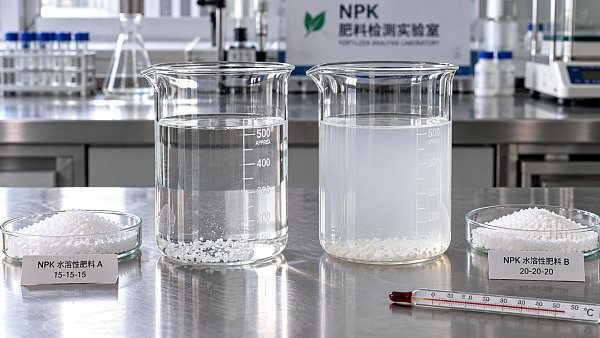
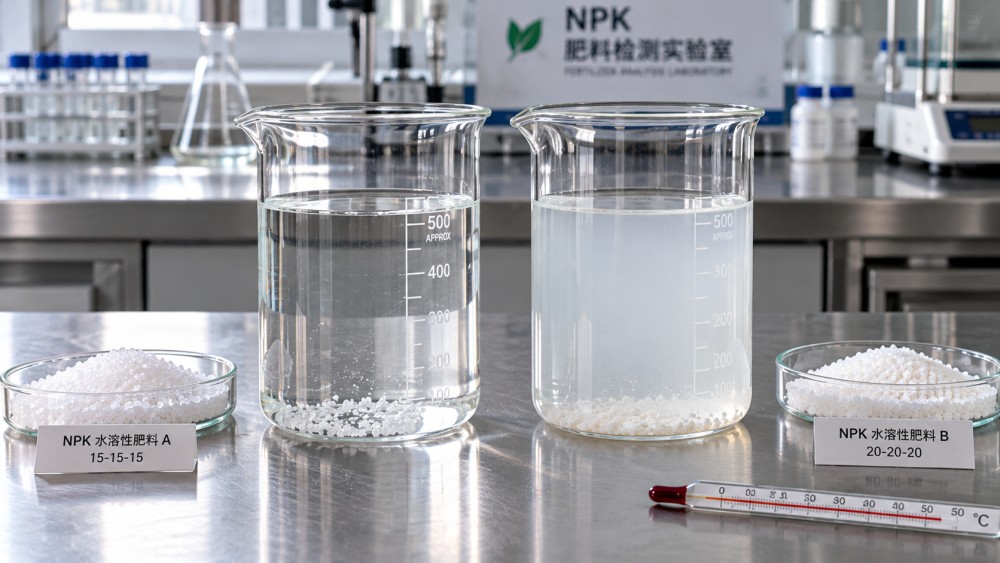
Also distinguish a nutrient ratio from a fertilizer grade. For example, 15-15-15 and 20-20-20 have the same ratio, but different nutrient concentrations. Equal weights do not supply equal quantities of nutrients. Neither grade is automatically more suitable: the relevant question is how much product is needed to deliver the required nutrient program.
Check whether the declared phosphorus and potassium values refer to water-soluble content or another reporting category. A total nutrient declaration alone does not establish suitability for fertigation. The specification should clearly identify the water-soluble fractions relevant to the intended application.
Use the following comparison sheet to expose differences that a headline NPK grade can hide.
Choose the nutrient balance around the complete feeding program
A balanced grade is convenient, but convenience does not establish nutritional suitability. Start with the target nutrient supply, then account for contributions from irrigation water and other fertilizers. This matters especially where separate calcium, magnesium, or nitrogen products already form part of the program.
A high-phosphorus grade may be appropriate when additional phosphorus is justified. It becomes less attractive when meeting the nitrogen requirement would repeatedly add phosphorus beyond the planned supply. Similarly, a potassium-rich grade can suit periods of greater potassium demand, but the crop still needs an appropriate balance of nitrogen, calcium, magnesium, and other nutrients.
For illustration, delivering 30 kilograms of nitrogen requires 150 kilograms of a 20-20-20 grade, compared with 200 kilograms of a 15-15-15 grade. Both quantities also deliver 30 kilograms each of declared P₂O₅ and K₂O. That comparison is useful only if those accompanying nutrients are wanted.
When grades have different ratios, compare complete fertilizer programs. A product with an attractive cost per kilogram of nitrogen may become expensive once the required potassium supplement is included. A slightly more expensive blend may simplify dosing if its nutrient balance closely matches the intended recipe.
Nitrogen forms and salt sources can change the shortlist
Total nitrogen does not explain how that nitrogen is supplied. Nitrate, ammonium, and urea behave differently in the root zone. Their suitability depends on the crop, growing medium, temperature, and management program.
In soil, urea nitrogen generally undergoes conversion before much of it becomes available in mineral forms. Hydroponic and substrate systems require closer control of nitrogen forms because they provide different buffering and biological conditions. A urea-rich grade should therefore be assessed against the established feeding recipe rather than treated as interchangeable with a predominantly nitrate-based product.
Nitrogen form also influences root-zone pH behavior. Ammonium uptake generally tends to acidify the root environment, while nitrate uptake tends to have the opposite effect. The final response depends on the whole nutrient solution and the growing system. A solution pH printed on a data sheet does not describe all of these effects.
For potassium, ask about the source and the finished product’s chloride specification. Potassium chloride contributes chloride; potassium sulfate and potassium nitrate contribute different accompanying nutrients. Chloride is a plant nutrient, but excessive supply can be problematic for sensitive crops or where irrigation water already carries a substantial salt load.
Sodium also deserves a defined limit where water quality or salt accumulation is a concern. Terms such as “premium” or “low salt” are too broad for comparing offers. Use measurable specifications linked to the conditions in which the fertilizer will operate.
Test “fully soluble” at your actual stock concentration
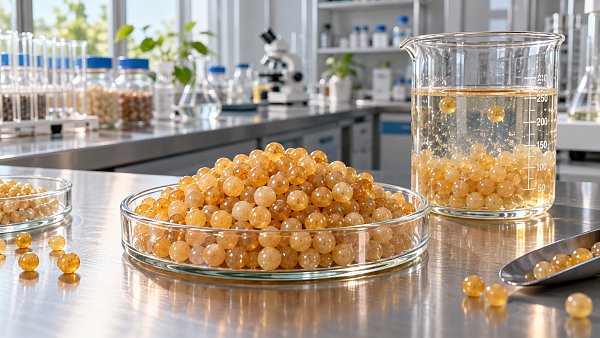
A product that dissolves in a dilute laboratory solution may behave differently in a concentrated stock tank. Solubility depends on temperature, concentration, water chemistry, and the other materials present. A solubility figure without its test conditions provides limited purchasing value.
Distinguish three properties: how much material can dissolve, how quickly it dissolves, and how much insoluble residue remains. Slow dissolution may require additional mixing time. Persistent residue can increase filter loading. A solution that initially clears but later forms crystals presents a different handling problem.
Ask the supplier to state the test temperature, fertilizer-to-water ratio, mixing procedure, and residue measurement method. Compare competing products under equivalent conditions. “Clear solution” is a useful observation, but it is less informative than a defined test with an agreed acceptance limit.
Run a sample assessment using the intended irrigation water and stock concentration. Include the lowest temperature reasonably expected during preparation or storage, because cooling can trigger crystallization in concentrated solutions.
- Prepare the fertilizer using the intended mixing sequence and available agitation.
- Record dissolution time, visible particles, and deposits remaining after mixing.
- Hold the solution for a period representative of normal tank use and inspect it again.
- Assess the diluted feed solution and any mixtures with other intended inputs.
Keep records of sample identity, water source, temperature, and concentration. Without those details, an apparent difference between suppliers may actually come from different test conditions.
Check irrigation water and tank compatibility together
A fully water-soluble fertilizer can still produce precipitates after mixing. Dissolution describes the original product entering solution; compatibility describes what happens when its dissolved components encounter the water and other inputs.
Water hardness and alkalinity are especially relevant. Calcium and magnesium can react with phosphate under certain conditions, while bicarbonate alkalinity influences pH management and precipitation risk. Water pH alone is insufficient: two water sources with similar pH can require different treatment because their alkalinity differs.
Use a water analysis that covers electrical conductivity, alkalinity or bicarbonate, calcium, magnesium, sodium, and chloride. These results help establish whether the fertilizer adds to an existing limitation or fits comfortably within the feeding program.
Concentrated calcium fertilizers are commonly kept separate from phosphate- and sulfate-containing concentrates to reduce precipitation risk. An NPK blend containing phosphate may therefore need a separate stock tank from calcium nitrate. Compatibility after dilution does not establish compatibility in concentrated storage.
A jar test can reveal immediate cloudiness, deposits, or other visible incompatibility. It cannot guarantee trouble-free operation through every irrigation cycle. Follow the sample assessment with a limited system trial that includes normal dilution, filtration, and operating temperatures.
Compare electrical conductivity at the same product concentration and temperature. EC helps assess the ionic salt load, but it is not a direct measure of nutritional quality. Non-ionic components such as urea contribute differently to conductivity, so a lower reading does not automatically indicate a better grade.
Look beyond “with micronutrients” on the label
A trace-element package is useful only if its composition matches the feeding program. Request individual declarations for iron, manganese, zinc, copper, boron, and molybdenum where included. A single combined micronutrient percentage leaves too much unexplained.
Where metals are described as chelated, identify the chelating agent and the proportion supplied in that form. Chelates differ in stability across solution conditions, particularly pH. The word “chelated” alone does not establish that iron will remain available in a particular irrigation solution or root environment.
Extra micronutrients are not automatically beneficial. If a separate trace-element mix is already used, an enriched NPK grade can duplicate supply and complicate dosing. Conversely, a blend with a suitable package may reduce preparation steps where its nutrient ratios fit the complete recipe.
Turn supplier claims into purchasing specifications
A technical data sheet describes the product’s intended characteristics. A batch-specific certificate of analysis records results for a particular lot. Request both, and distinguish guaranteed limits from typical values. A typical figure provides context but is not necessarily an acceptance criterion.
The purchasing specification should cover nutrient guarantees, nitrogen forms, relevant impurity limits, insoluble residue, and the agreed test methods. Where dissolution speed matters operationally, define a repeatable assessment rather than relying on “fast dissolving” as a description.
Ask which characteristics are tested on every batch and which are checked periodically. Also establish lot traceability, the procedure for handling nonconforming material, and how changes in raw materials or formulation are communicated. These arrangements make performance more predictable across repeat deliveries.
Packaging belongs in the evaluation because moisture exposure can cause caking and make accurate dosing harder. Assess the moisture barrier, seal quality, bag size, pallet protection, and storage instructions against local handling conditions. A successful sample trial has limited value if commercial deliveries arrive damp or damaged.
For an initial order, use agreed sample criteria followed by a limited operational trial. Record mixing performance, filter deposits, and dosing behavior before expanding the purchase volume.
Compare the cost of the usable nutrient program
Once unsuitable grades have been excluded, compare delivered cost on a consistent basis. Include freight, handling, supplementary nutrients, mixing labor, and relevant filtration or cleaning requirements. Count only costs that are supported by the proposed operating method or trial results.
For a single nutrient, divide delivered product cost by the mass of that nutrient supplied. For an NPK feeding program, calculate the combined cost of reaching all required nutrient targets. Simply dividing price by the sum of N, P₂O₅, and K₂O percentages can reward nutrients the crop does not need.
The strongest shortlist combines a suitable nutrient balance, acceptable behavior in the intended water, and documented batch consistency. Put those conditions into the purchase specification before negotiating the final price. That gives each offer a common basis and makes the eventual buying decision easier to defend.
Facing technical bottlenecks in manufacturing or looking for more efficient industrial solutions? Leave your details below and let the engineering experts at FCAS solve them for you.
We respect your privacy. Your information is strictly confidential.
Related News
 Polymer-Coated Water Soluble NPKHow to Use Calcium Nitrate Fertilizer in Drip IrrigationCalcium Nitrate Fertilizer in drip irrigation: learn how to calculate doses, mix stock solutions, prevent clogged emitters, and support healthy crops.MORE+
 Polymer-Coated Water Soluble NPK2026 Fertilizer Price Swings Shape 2027 Planting Decisions2026 fertilizer price swings are shaping 2027 planting decisions. Explore nutrient cost pressures and practical strategies for planning purchases.MORE+
 Polymer-Coated Water Soluble NPKRecord Fertilizer Prices Could Shape 2027 US Corn and Soybean Planting DecisionsRecord fertilizer prices could influence 2027 US corn and soybean planting decisions. Explore the potential impact on farm budgets and acreage.MORE+
 Polymer-Coated Water Soluble NPKUSDA Announces $1.34 Billion Investment to Expand Domestic Fertilizer SupplyUSDA’s $1.34 billion fertilizer investment targets eight domestic projects. Discover what the plans could mean for suppliers, buyers and future sourcing.MORE+
 Polymer-Coated Water Soluble NPKHow to Choose a Potassium Sulfate Fertilizer SupplierChoose a potassium sulfate fertilizer supplier with confidence. Compare product quality, delivered costs, reliability, and contract terms before you buy.MORE+
 Polymer-Coated Water Soluble NPKIndonesian Farmers' Association Warns of Prolonged Fertilizer ShortagesIndonesia fertilizer shortages could persist as high prices and supply disruptions strain farmers. Explore the risks for agriculture and the regional market.MORE+
 Polymer-Coated Water Soluble NPKEU Fertilizer Prices Remain High Amid Gas Costs and Supply DisruptionsEU fertilizer prices remain high amid gas costs and supply disruptions. Explore the impact on farmers, suppliers and purchasing decisions.MORE+
 Polymer-Coated Water Soluble NPKUS Commerce Department Recommends Keeping Duties on Moroccan Phosphate FertilizersUS Commerce Department recommends keeping duties on Moroccan phosphate fertilizers. Explore the findings and what comes next for exporters and US buyers.MORE+
 Polymer-Coated Water Soluble NPKWhen to Apply Sulfate of Potash Fertilizer to Chloride-Sensitive CropsSulfate of potash fertilizer timing can make all the difference. Discover when and how to apply it to chloride-sensitive crops for efficient nutrient delivery.MORE+
 Polymer-Coated Water Soluble NPKUS Commerce Department Says Ending Moroccan Fertilizer Duty Would Harm IndustryMoroccan fertilizer duty removal could harm the US industry, the Commerce Department says. Explore what the finding means ahead of the ITC vote.MORE+
 Polymer-Coated Water Soluble NPKGlobal Fertilizer Prices May Fall as Demand Weakens and Stocks Remain HighGlobal fertilizer prices may fall as weak demand and high stocks reshape the market. Explore what this could mean for purchasing and inventory planning.MORE+
 Polymer-Coated Water Soluble NPKWhen to Apply Potassium Sulfate Fertilizer for PotatoesLearn when to apply potassium sulfate fertilizer for potatoes, from pre-planting to tuber growth, and build a soil-test-based plan for your crop.MORE+
 Polymer-Coated Water Soluble NPKHow to Evaluate a Controlled Release Fertilizer Systems SupplierChoosing a controlled release fertilizer systems supplier? Compare release performance, quality, supply reliability, and total costs with this practical guide.MORE+
 Polymer-Coated Water Soluble NPKHow to Choose Potassium Chloride Fertilizer for Bulk BlendingChoose potassium chloride fertilizer for bulk blending with confidence. Learn how particle size, durability, and moisture affect blend quality—and compare suppliers beyond price.MORE+
 Polymer-Coated Water Soluble NPKUSDA Pushes Domestic Fertilizer Capacity as Analysts Expect Further Price DeclinesUSDA fertilizer policies and expanded domestic production could push prices lower. Explore what shifting supply expectations mean for farm input costs and buying decisions.MORE+
 Polymer-Coated Water Soluble NPKHow to Choose Fertilizer Coating Resins for Controlled ReleaseChoose fertilizer coating resins for controlled release with confidence. Compare release profiles, processing needs, durability, and total costs in this practical selection guide.MORE+
 Polymer-Coated Water Soluble NPKShould You Use Potassium Chloride or Coated NPK as Basal Fertilizer?Compare potassium chloride fertilizer for basal application with coated NPK. Discover how soil needs, chloride sensitivity, nutrient timing, and costs guide your best choice.MORE+
 Polymer-Coated Water Soluble NPKUSDA Selects Eight Fertilizer Projects for $573M Under FIELDS ProgramUSDA selects eight fertilizer projects for $573M under the FIELDS Program. Explore plans to add over 1 million tons of U.S. capacity and the potential impact on supply chains.MORE+
 Polymer-Coated Water Soluble NPKWhen Is Potassium Chloride Fertilizer with 60% K2O Right for Crops?Is potassium chloride fertilizer 60 k2o right for your crops? Discover how soil tests, chloride tolerance, and application timing guide smarter fertilizer choices.MORE+
 Polymer-Coated Water Soluble NPKAlgeria Directs Producers to Stop Urea Exports to FranceAlgeria reportedly halts urea exports to France, raising supply concerns for fertilizer buyers. Explore potential price risks and practical steps to protect procurement plans.MORE+
 Polymer-Coated Water Soluble NPKGlobal Fertilizer Uncertainty Complicates Buying for U.S. Corn and Soybean GrowersGlobal fertilizer uncertainty challenges U.S. corn and soybean growers. Explore supply risks, cost pressures and practical buying checks to make more informed purchasing decisions.MORE+
 Polymer-Coated Water Soluble NPKWhen Are Polymer-Coated Granular NPK Fertilizers Worth the Cost?Granular NPK Fertilizers: Are polymer coatings worth the premium? Compare release timing, application savings, and break-even costs to make a smarter fertilizer investment.MORE+
 Polymer-Coated Water Soluble NPKUAN32, UAN28 and Anhydrous Ammonia Lead US Fertilizer Gains in October 2026, Week 2UAN32, UAN28 and anhydrous ammonia lead US fertilizer price gains in October 2026, Week 2. Explore reported trends and key procurement checks before revising quotes, budgets or orders.MORE+
 Polymer-Coated Water Soluble NPKHow to Compare Fully Soluble NPK Fertilizer Grades Before BuyingCompare fully soluble npk fertilizer grades by nutrient balance, solubility, water compatibility, and batch quality. Learn what to check before buying to avoid costly mistakes.MORE+
 Polymer-Coated Water Soluble NPKChina’s Phosphate Fertilizer Export Collapse Squeezes Global SupplyChina’s phosphate fertilizer export collapse tightens global supply. Explore procurement risks, sulfur shortages and practical steps to verify suppliers and protect delivery plans.MORE+
 Polymer-Coated Water Soluble NPKHow Does High Potassium Sulfate Fertilizer Fit Into NPK Blends?See how high potassium sulfate fertilizer fits into NPK blends. Learn to balance potassium and sulfur, control chloride, and select the right grade for reliable performance.MORE+
 Polymer-Coated Water Soluble NPKHow Should You Apply Water Soluble NPK Fertilizers to Greenhouse Crops?Apply npk water soluble fertilizers for greenhouse crops with confidence. Learn precise dosing, fertigation, and EC/pH monitoring techniques to support healthy growth and avoid salt stress.MORE+
 Polymer-Coated Water Soluble NPKHow Fertilizer Coating Polymers Improve NPK Granule ReleaseFertilizer coating polymers for NPK granules improve controlled nutrient release, reduce loss risks, and enhance product consistency. Discover key selection and process insights.MORE+
 Polymer-Coated Water Soluble NPKHow Fully Soluble NPK Fertilizer Improves Precision FertigationFully soluble NPK fertilizer improves precision fertigation with clean injection, uniform nutrient delivery, flexible crop-stage feeding, and lower clogging risk. Learn practical system-management tips.MORE+
 Polymer-Coated Water Soluble NPKHow Potassium Chloride Fertilizer 60 K2O Supports Crop YieldPotassium chloride fertilizer 60 K2O supports crop yield with efficient potassium nutrition. Explore benefits, chloride considerations, application tips, and smarter fertilizer selection.MORE+
 Polymer-Coated Water Soluble NPKWhat Determines Fertigation Systems Price and Long-Term Operating CostFertigation systems price depends on capacity, automation, filtration, water quality, and fertilizer compatibility. Explore total ownership costs and compare suppliers smarter.MORE+
 Polymer-Coated Water Soluble NPKHow Drip Irrigation Fertilizers Improve Nutrient EfficiencyDrip Irrigation Fertilizers improve nutrient efficiency with precise root-zone feeding, smarter timing, and reduced waste. Discover practical fertigation strategies.MORE+
 Polymer-Coated Water Soluble NPKHow to Choose Resin Coated NPK Fertilizers for Efficient Nutrient ReleaseResin Coated NPK Fertilizers: learn how to match release duration, nutrient profiles, granule quality, and supplier reliability to your crop programme for better efficiency and lower costs.MORE+
 Polymer-Coated Water Soluble NPKWhich Specialty Fertilizers Best Support High-Value Crop Production?Specialty Fertilizers for high-value crops: compare controlled-release, water-soluble, micronutrient, and biostimulant options for precision, quality, and reliable results.MORE+
 Polymer-Coated Water Soluble NPKWhat Fertilizer Coatings Mean for Nutrient Efficiency and Cost ControlFertilizer Coatings improve nutrient timing, cut loss risk, and support cost control. Discover how coated fertilizers can boost efficiency and strengthen field performance.MORE+