
How Potassium Chloride Fertilizer 60 K2O Supports Crop Yield
Potassium chloride fertilizer 60 K2O can support crop yield when the crop needs a substantial potassium supply and chloride is compatible with the crop, soil, irrigation, and intended market. Its value is straightforward: it delivers a concentrated, readily dissolving source of potassium at a practical cost for broad-acre and field nutrition programs. Its limitation is equally important: the same product also supplies chloride, which is not suitable for every crop or every production system.
A good fertilizer decision therefore starts with more than the K2O number on the bag. The useful question is: does this potassium source fit the crop's nutrient demand, the existing soil potassium level, the salinity risk, and the quality requirements of the harvested product? When the answer is yes, potassium chloride can be a reliable foundation for potassium management. When the answer is no, another potassium source may protect crop quality or reduce avoidable soil stress.
What “60 K2O” means in practical crop nutrition
Potassium chloride, also called muriate of potash or MOP, is commonly sold with a nutrient declaration expressed as K2O equivalent. The “60 K2O” designation means the material is a high-analysis potassium fertilizer, rather than a fertilizer containing literal potassium oxide. Plants take up potassium as the potassium ion after the fertilizer dissolves in soil water.
This distinction matters because fertilizer labels and nutrient plans often calculate potassium requirements in K2O units, while plant physiology is discussed in terms of elemental potassium. A procurement team comparing materials should use the same nutrient basis for every option. Comparing bag weights alone can be misleading: a lower-analysis product may require more material, more storage space, more handling, and a different logistics plan to deliver an equivalent potassium amount.
Potassium is not mainly used to build plant tissue in the way nitrogen supports leafy growth. Instead, it regulates water movement in plant cells, activates many enzyme systems, helps maintain stomatal function, and supports the movement of sugars from leaves to developing grain, fruit, tubers, or roots. These roles explain why potassium supply can affect both yield formation and crop quality.
How potassium chloride fertilizer 60 K2O contributes to yield
A crop with inadequate potassium may still emerge and appear generally healthy early in the season. Yield losses often become clearer when plants face a period of moisture stress, rapid reproductive growth, heavy fruit load, or disease pressure. Potassium chloride fertilizer 60 K2O helps prevent that nutritional constraint when applied at a rate and timing that match soil supply and crop removal.
Its yield contribution usually comes through several connected processes:
- More effective water use: Potassium helps plants regulate the opening and closing of stomata. This supports balanced water use and can help crops tolerate short periods of water stress better than potassium-deficient plants.
- Stronger carbohydrate movement: In grain, tuber, root, and fruit crops, potassium supports the transfer of sugars and other photosynthates to harvestable plant parts. The benefit is most meaningful when the crop has enough light, water, and other nutrients to produce those carbohydrates in the first place.
- Better reproductive development: Adequate potassium can help sustain crop demand during flowering, grain filling, bulking, or fruit sizing. It does not replace sound nitrogen management, but poor potassium availability can limit the return from nitrogen already applied.
- Improved stand resilience: Potassium nutrition is associated with stronger plant structure and more balanced growth. In some systems, this can reduce the severity of stress-related problems that otherwise lower harvestable yield.
These effects do not mean that adding more potassium always raises yield. If soil potassium is already sufficient, the crop may show little response. If water supply is inadequate, roots are restricted, soil compaction is severe, or nitrogen and phosphorus are limiting, potassium alone cannot correct the production constraint. A nutrient source should be part of a crop nutrition plan, not a substitute for one.
Where this potassium source usually fits well
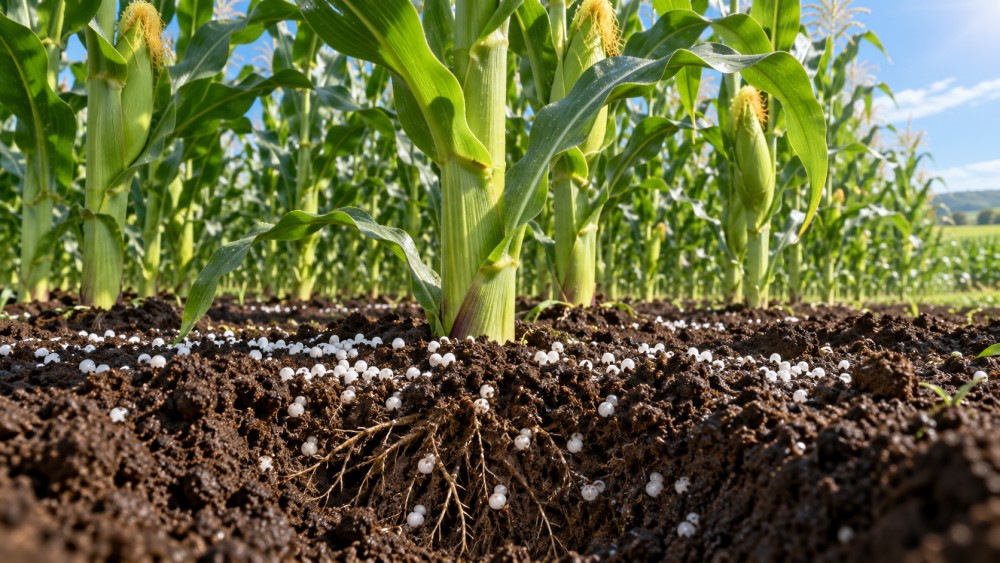
Potassium chloride is often a practical choice for crops with substantial potassium demand that do not have a strong sensitivity to chloride. It is widely considered for field crops, forage production, many cereal systems, and other situations where the priority is efficient potassium replacement rather than a low-chloride quality program.
It is particularly useful when soil testing indicates a genuine potassium deficit or when a cropping sequence removes significant potassium over time. High-yielding crops can remove meaningful amounts of potassium in harvested material, while residues left in the field may return some potassium to the soil. The nutrient budget should distinguish between these two situations. A crop harvested for grain is not nutritionally identical to the same crop harvested as silage or forage, because much more potassium may leave the field with whole-plant removal.
Granular potassium chloride can also work well in pre-plant and early-season programs where there is enough soil moisture to dissolve and distribute the nutrient through the root zone. In many field situations, it is applied in a blend with other granular fertilizers. That approach can simplify handling, but blend quality matters. Similar granule size, low dust, stable particle strength, and uniform nutrient distribution affect whether each area of the field receives the intended potassium rate.
Chloride is the deciding factor, not a minor label detail
Potassium chloride delivers two agronomic components: potassium and chloride. Chloride is an essential plant nutrient in small amounts, and some crops can use it without difficulty. The problem is not that chloride is automatically harmful. The problem is that chloride loading can be a poor fit where crop sensitivity, soil salinity, irrigation water quality, or product-quality targets create a narrow margin for error.
This is why potassium chloride fertilizer 60 K2O should not be selected solely because it is the least expensive source per unit of declared potassium. A lower purchase price can lose its advantage if the chosen crop needs a low-chloride nutrition program or if the field already has salt-related constraints.
Potatoes, tobacco, grapes, some fruit crops, and certain vegetable systems are often evaluated more carefully for chloride exposure, especially where product quality is central to the sale. That does not produce a universal ban on MOP for every field growing these crops. Soil texture, rainfall or irrigation pattern, timing, total chloride inputs, cultivar behavior, and buyer specifications can all change the decision. The practical lesson is to treat crop sensitivity as a planning condition, not an afterthought.
Application placement affects whether the crop can use the nutrient
Potassium is positively charged in soil solution and can be held by clay minerals and organic matter. In many soils, it does not move as freely as nitrate nitrogen. A surface application may be effective over time, particularly with rainfall, irrigation, active roots, and suitable soil conditions, but it may be slower to reach a deeper developing root system in dry conditions.
For this reason, placement should reflect the production system. Pre-plant incorporation can place potassium closer to the anticipated root zone. Broadcast applications may suit established fields and broad-acre operations where incorporation is not practical. Band placement can improve access in some row-crop systems, but the fertilizer concentration near seed and young roots must be managed carefully. Potassium chloride has a salt effect, so placing too much material too close to seed can reduce germination or slow early root growth.
In-season potassium correction also needs realistic expectations. A late application cannot always reverse an earlier shortage, particularly once yield potential has been set. Where potassium demand peaks later, building soil supply before planting and maintaining an application program that matches crop uptake are usually more reliable than waiting for visible deficiency symptoms.
Fertigation is a separate use case. Do not assume that every granular MOP product is appropriate for injection simply because potassium chloride is soluble. A fertigation program requires a grade suited to dissolving and filtration, compatible water chemistry, clean mixing procedures, and an irrigation schedule that distributes nutrients through the wetted root zone. In drip systems, a fertilizer's physical quality and impurity profile can matter as much as its nutrient analysis.
Use soil testing to avoid both under-application and routine over-application
Potassium decisions are strongest when based on soil test results, crop removal expectations, field history, and the yield level that the field can realistically support. A single farm may contain zones with very different potassium availability because of soil texture, previous manure use, erosion, residue management, or historic fertilizer placement. Applying one uniform rate everywhere can leave some zones short while spending unnecessarily in others.
Soil testing should be interpreted in the context of the local calibration method and crop recommendation system. The purpose is not simply to classify a field as “low” or “high.” It is to determine whether fertilizer potassium is likely to produce an economic and agronomic response, whether the soil needs gradual build-up, or whether maintenance replacement is the more appropriate strategy.
Leaf or tissue analysis can be useful in high-value crops and intensive production systems, but it should complement rather than replace soil information. Tissue results show what the plant has accessed at a particular stage; soil testing helps explain the supply conditions and supports planning before nutrient stress appears.
Common purchasing and handling mistakes
The most frequent error is treating all potash products as interchangeable. Potassium chloride, potassium sulfate, potassium nitrate, and specialty potassium formulations each have different accompanying nutrients, salt characteristics, physical forms, and application roles. The right comparison is not only cost per tonne. It is cost per usable nutrient within the crop system, including the value of sulfur or nitrogen where relevant, chloride exposure, application method, and handling requirements.
Buyers should also review the physical specification. Granule size distribution affects blending and spreading consistency. Excess fines can create dust, segregation in blends, and uneven field placement. Moisture protection matters because fertilizer can cake during storage if packaging is damaged or storage conditions are poor. For importers, distributors, and formulation operations, documentation, batch consistency, packaging strength, and transport conditions deserve the same attention as the declared K2O analysis.
Storage should keep the product dry, contained, and separated from materials that could contaminate it. Once a bag or bulk stock is exposed to moisture, material flow and application uniformity may suffer even when the nutrient content itself has not changed.
A practical selection sequence
Before specifying potassium chloride fertilizer 60 K2O, work through the decision in this order:
- Identify the crop's potassium requirement and the crop stage where supply matters most.
- Review soil potassium status, texture, drainage, compaction, and existing salinity concerns.
- Assess chloride tolerance in relation to crop quality targets, irrigation water, and other chloride sources.
- Choose placement and timing that bring potassium into the active root zone without concentrating salt near seed.
- Compare supplier specifications beyond nutrient analysis: granule quality, moisture condition, blend compatibility, packaging, and documentation.
For fertilizer sourcing and technical planning, platforms such as FCAS help organize the comparison between conventional potash, water-soluble materials, controlled-release products, and crop-specific nutrient programs. The useful outcome is not a generic preference for one fertilizer type, but a clearer match between nutrient source, field conditions, application equipment, and commercial crop requirements.
When another potassium source is the better solution
Potassium chloride is a strong option when potassium efficiency and broad compatibility are the priority. It becomes less attractive when chloride is a known quality risk, when soil or irrigation conditions already create salt stress, or when the crop nutrition plan also needs sulfur or nitrogen from the potassium source. In those cases, potassium sulfate, potassium nitrate, or a specialty low-chloride formulation may justify their different cost and handling profile.
The most effective choice is rarely the product with the highest analysis alone. It is the source that supplies enough available potassium, reaches the crop at the right time, and does not introduce a chloride or salinity constraint that limits the yield and quality the potassium program was meant to support.
Related News
 Antioxidants & Natural PreservativesWhat Quality Checks Matter When Sourcing Butylparaben for Personal CareButylparaben for personal care sourcing guide: compare assay, impurities, physical performance, documentation, traceability, and supplier quality to reduce formulation risk.MORE+
 Nano-microcapsule FormulationsHow Encapsulated Flavors Protect Taste During Processing and StorageEncapsulated Flavors protect taste from heat, oxygen, moisture, and storage loss. Explore smarter release, carrier selection, and processing strategies.MORE+
 Chelated Trace Element FertilizersHow Greenhouse Fertigation Systems Reduce Water and Fertilizer WasteGreenhouse fertigation systems reduce water and fertilizer waste with precise dosing, uniform irrigation, drainage monitoring, and smarter crop-zone control. Learn practical strategies.MORE+
 Supercritical CO2 Essential OilsHow Natural Essential Oil Blends Improve Consistent Product FragranceNatural essential oil blends help brands achieve consistent, appealing fragrance across batches. Explore smart blend design, stability testing, and product compatibility strategies.MORE+
 Non-ionic Surfactants & DefoamersHow to Choose Non Ionic Low Foaming Surfactants for CIP CleaningNon ionic low foaming surfactants for CIP cleaning: learn how to balance wetting, foam control, compatibility, and rinseability for reliable cleaning performance.MORE+
 Nano-microcapsule FormulationsHow Food Grade Cyclodextrin Complexes Protect Sensitive FlavorsFood grade cyclodextrin inclusion complexes help protect sensitive flavors from oxidation, evaporation, and processing loss while supporting controlled release and consistent sensory quality.MORE+
 Polymer-Coated Water Soluble NPKHow Fertilizer Coating Polymers Improve NPK Granule ReleaseFertilizer coating polymers for NPK granules improve controlled nutrient release, reduce loss risks, and enhance product consistency. Discover key selection and process insights.MORE+
 Chelated Trace Element FertilizersWhat Diammonium Phosphate Means for Crop Nutrition PlanningDiammonium Phosphate: learn how DAP supports early phosphorus access, nitrogen budgeting, smart placement, and balanced crop nutrition planning.MORE+
 Maillard Reaction Savory FlavorsHow to Assess a Flavor Bases Supplier List for Reliable SourcingGlobal Fine Chemicals & Agrochemical Intelligence Network flavor bases supplier list: assess specs, samples, supply risk, and true cost to source with confidence.MORE+
 Hydrocolloids & EmulsifiersHow Konjac Gum Powder Improves Texture in Low-Calorie FoodsKonjac gum powder improves body, stability, and mouthfeel in low-calorie foods. Discover practical tips for smoother sauces, beverages, and reduced-fat formulations.MORE+
 Supercritical CO2 Essential OilsWhat to Check Before Choosing a Botanical Essential Oils ManufacturerChoose a botanical essential oils manufacturer with confidence. Explore key checks for purity, traceability, compliance, batch consistency, and reliable supply.MORE+
 Microencapsulated FragrancesHow Fragrance Carriers for Detergents Improve Scent PerformanceFragrance carriers for detergents improve stability, fabric deposition, and long-lasting scent. Explore practical solutions for better wash-to-wear fragrance performance.MORE+
 Antioxidants & Natural PreservativesWhen Propyl Gallate Antioxidant Is the Right Choice for Oil StabilityPropyl gallate antioxidant: learn when it is the right choice for oil stability, shelf-life protection, processing compatibility, and smarter formulation decisions.MORE+
 Antioxidants & Natural PreservativesHow Potassium Sorbate Extends Shelf Life in Food and Beverage ProductsPotassium Sorbate helps food and beverage brands control yeast and mold spoilage. Explore pH, dosage, processing, and packaging strategies for reliable shelf life.MORE+
 Antioxidants & Natural PreservativesHow to Source Bulk Herbal Extracts With Reliable Quality ControlBulk herbal extracts sourcing guide: compare suppliers, verify traceability, review CoAs, and build reliable quality controls for safer, consistent purchasing.MORE+
 Antioxidants & Natural PreservativesWhat to Check Before Sourcing Butylparaben for Personal Care FormulasButylparaben for personal care sourcing guide: check market eligibility, purity, supplier controls, formula compatibility, packaging, and total risk before buying.MORE+
 Targeted Bio-pesticides & APIsChoosing Microbial Fungicides for Foliar Diseases in Integrated Crop ProgramsMicrobial fungicides for foliar diseases: learn how to match biology, formulation, tank compatibility, and timing for stronger integrated crop protection.MORE+
 Targeted Bio-pesticides & APIsHow Microbial Insecticides Control Caterpillars With Lower Crop Residue RiskMicrobial insecticides for caterpillars help protect crops with targeted early-larval control and lower residue-management pressure. Learn timing, coverage, compliance, and scouting essentials.MORE+
 Microencapsulated FragrancesHow to Add Encapsulated Laundry Fragrances Without Weakening Wash ResultsEncapsulated laundry fragrances: learn how to boost long-lasting scent while protecting cleaning power, stability, foam control, and fabric care.MORE+
 Supercritical CO2 Essential OilsHow Aroma Ingredients Shape Lasting and Skin-Safe Personal Care ProductsAroma ingredients for personal care: discover how to achieve lasting scent, formulation stability, skin safety, and confident product performance.MORE+
 Targeted Bio-pesticides & APIsInsecticides Explained Through Labels, Active Ingredients, and SafetyInsecticides explained through labels, active ingredients, formulations, and safety. Learn how to compare products, manage risk, and make informed crop protection decisions.MORE+
 Heavy-duty Industrial DegreasersHow to Select Parts Wash Cleaners for Automotive ComponentsParts wash cleaners for automotive components: learn how to match chemistry, materials, rinsing, safety, and waste controls for reliable cleaning results.MORE+
 Chelated Trace Element FertilizersHow Precision Fertigation Systems Improve Water and Nutrient ControlPrecision fertigation systems improve water and nutrient control with accurate dosing, uniform irrigation, smart monitoring, and reduced waste. Discover how to optimize crop performance.MORE+
 Hydrocolloids & EmulsifiersHow Bulk Price Factors Affect Hydrocolloid Stabilizer Blend SourcingHydrocolloid stabilizer blends bulk price: compare dosage efficiency, quality consistency, logistics, and documentation to reduce total sourcing costs.MORE+
 Zero-Calorie Sweeteners & AcidulantsHow to Choose a Natural Sweeteners Supplier for Clean-Label ProductsNatural sweeteners supplier selection guide for clean-label products: compare formulation fit, traceability, documentation, and supply reliability.MORE+
 Non-ionic Surfactants & DefoamersWhat Cationic Surfactants Do and Where They Are UsedCationic Surfactants deliver antimicrobial action, conditioning, antistatic control, and surface treatment benefits. Explore key uses, compatibility, and safe selection tips.MORE+
 Targeted Bio-pesticides & APIsHow to Evaluate Pesticide Suspension Concentrates for Field StabilityPesticide Suspension Concentrates: learn how to evaluate field stability, redispersibility, dilution, tank-mix compatibility, and spray safety for reliable performance.MORE+
 Hydrocolloids & EmulsifiersHow Hydrocolloid Systems for Meat Products Improve Texture and YieldHydrocolloid systems for meat products improve yield, texture, water retention, and slicing quality. Explore practical formulation strategies for stable, high-performing meat products.MORE+
 Microencapsulated FragrancesHow Laundry Fragrances for Liquid Detergents Improve Scent LongevityLaundry fragrances for liquid detergents: discover how fragrance design, deposition, and encapsulation create lasting fabric freshness and stronger product appeal.MORE+
 Nano-microcapsule FormulationsChoosing Fragrance Preparations That Perform Well in Personal WashFragrance preparations for personal wash: learn how to select options that protect clarity, stability, foam, scent performance, and packaging compatibility.MORE+
 Controlled-Release ThermodynamicsModified Cyclodextrins Explained for Controlled Fragrance ReleaseModified cyclodextrins enable controlled fragrance release, odor control, and volatile-note protection. Explore how they optimize performance in detergents, fabric care, and more.MORE+
 Microencapsulated FragrancesHow Fragrance Delivery Systems Improve Fabric Softener LongevityFragrance delivery systems for fabric softeners improve scent longevity through smart protection, reliable deposition, and controlled release for lasting freshness.MORE+
 Supercritical CO2 Essential OilsHow to Evaluate a Natural Cardamom Oil Supplier for Reliable SupplyNatural cardamom oil supplier evaluation guide: verify botanical origin, purity, batch consistency, documentation, packaging, and delivery reliability for confident sourcing.MORE+
 Maillard Reaction Savory FlavorsHow Ethyl Maltol Purity Testing Supports Flavor Safety ComplianceEthyl Maltol purity testing strengthens flavor safety compliance through identity checks, impurity profiling, supplier verification, and audit-ready documentation.MORE+
 Microencapsulated FragrancesEssential Oil Extracts Compared for Fragrance and Wellness UsesEssential Oil Extracts compared for fragrance and wellness: explore scent profiles, extraction methods, stability, safety, and sourcing insights for smarter formulation choices.MORE+
 Zero-Calorie Sweeteners & AcidulantsWhat Drives Zero Calorie Sweeteners Bulk Price in 2026Zero calorie sweeteners bulk price in 2026: compare specifications, dosage, quality, freight, and supply risk to make smarter sourcing decisions.MORE+
 EPA FIFRA & FDA GRAS RegsSynthetic Food Preservatives Rules That Support Safer FormulasSynthetic Food Preservatives: learn the rules for safer formulas, compliant use levels, validated shelf life, labeling, and reliable microbial control.MORE+
 Micelle Fluidics & ChelationHow Anionic Industrial Dispersants Improve Coating StabilityAnionic industrial dispersants improve coating stability, pigment wetting, viscosity control, gloss, and storage performance. Learn how to select and test the right solution.MORE+
 Supercritical CO2 Essential OilsHow to Choose Eucalyptus Oil Grades for Clean, Consistent ProductsChoose the right Eucalyptus Oil grade with confidence. Compare cineole content, purity, origin, processing, documentation, and application fit for consistent products.MORE+
 Micelle Fluidics & ChelationWhat Are Cationic Surfactants and Where Are They Commonly Used?Cationic Surfactants deliver powerful surface affinity for disinfection, fabric softening, hair conditioning, antistatic control, and industrial treatments. Explore key uses and selection factors.MORE+







































