How Fertilizer Coating Polymers Improve NPK Granule Release
Selecting fertilizer coating polymers for NPK granules is not mainly a question of choosing the toughest film or the lowest-cost resin. The coating must create a predictable pathway for water to enter the granule and for dissolved nutrients to leave it, while still surviving coating, cooling, storage, transport, bagging, and field handling. A polymer that performs well in a laboratory release test but cracks during bulk handling will not deliver controlled release in practice.
For an NPK producer, the objective is to match nutrient availability to the crop's demand curve without creating unacceptable variation between granules. A sound coating system can reduce early nutrient loss, support fewer fertilizer applications, and make product performance more consistent. It cannot compensate for an unstable core granule, poor process control, or a release target that does not fit the crop and growing environment.
How a polymer coating changes NPK nutrient release
An uncoated NPK granule begins dissolving as soon as soil moisture contacts its surface. This can be useful where fast nutrient availability is needed, but it can also produce a nutrient flush before the crop can use it efficiently. Nitrogen is particularly vulnerable to loss through leaching, volatilization, or other pathways when its release is poorly aligned with crop uptake. Phosphorus and potassium behave differently in soil, yet their delivery timing still affects early rooting, vegetative growth, fruiting, and final quality.
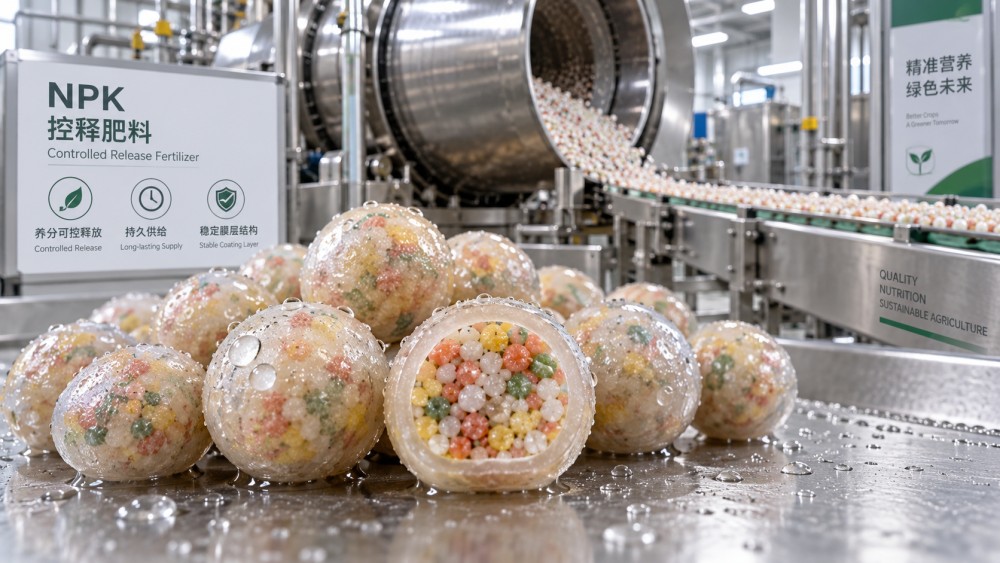
A coated granule introduces a physical barrier between the fertilizer core and soil water. Water moves through pores, microscopic imperfections, or the polymer matrix. Once water reaches the soluble salts inside, internal pressure develops as they dissolve. Nutrients then diffuse outward through the coating or are released after the shell gradually weakens, depending on coating chemistry and film structure.
This explains why release is not controlled by polymer type alone. Film thickness, continuity, flexibility, pore structure, adhesion to the core, and the condition of the coating after handling all affect the result. Soil temperature and moisture then influence the field release rate. A coating designed for a cool, moderately moist production system may behave differently in warm, frequently irrigated soil.
For this reason, controlled-release NPK development should be treated as a combined material, granulation, coating-process, and use-condition project.
The coating must work with the NPK core
NPK granules are more complex coating substrates than a single-nutrient material. Their formulation may contain ingredients with different solubilities, hygroscopic behavior, particle structures, and surface characteristics. The core can also contain trace elements, fillers, binders, or organic components that change surface energy and moisture response.
A polymer film cannot perform consistently if the granules entering the coater vary substantially in size, hardness, moisture, or surface dust. Fine particles may receive a disproportionately heavy coating. Oversized or irregular particles may develop thin spots. Dust can prevent adhesion and create weak areas that later become cracks. Excessive residual moisture can affect film formation, particularly in systems that rely on curing or solvent removal.
Before comparing coating materials, establish whether the underlying NPK granule is suitable for coating. The practical checks are straightforward:
- Is particle-size distribution narrow enough for reasonably uniform film deposition?
- Do granules have adequate crush strength and low friability after curing?
- Is surface dust controlled before the coating stage?
- Does the core retain moisture or absorb humidity during short-term storage?
- Does the fertilizer formulation contain components that may interfere with polymer adhesion or cure chemistry?
Ignoring these questions often leads to a misleading conclusion: that the polymer is defective when the real issue is inconsistent core quality.
What separates a useful coating polymer from a merely durable one
Durability is necessary, but a durable coating is not automatically a controlled-release coating. A film can be too impermeable, causing nutrient release to be later than agronomically useful. It can also be too brittle, so release becomes rapid after cracking. The preferred balance depends on the product's intended release profile and the conditions it will encounter.
Different polymer families can be formulated to provide different balances of these properties. Some systems form hydrophobic barriers that primarily slow water entry. Others use more flexible or degradable components, sometimes combined with mineral or natural-material fillers. The useful comparison is not “synthetic versus biodegradable” in isolation. It is whether the final coated granule maintains the desired release behavior through production and use.
Thickness matters, but uniformity matters more
Increasing coating weight can slow release, but it is an inefficient control lever when the application is uneven. A small number of thinly coated granules can create an early nutrient burst even if the average coating weight looks correct. Conversely, heavily coated fines can persist longer than intended. The customer experiences variability, not the average result recorded on a production sheet.
Coating uniformity depends on equipment design, spray pattern, atomization, bed movement, material temperature, and the timing of polymer addition. A formulation with suitable viscosity can still perform poorly if droplets are too large, if granule circulation is weak, or if the surface is too cool for a coherent film to form. Excessive mechanical action after coating can also damage a technically sound shell.
Project teams should therefore measure more than total polymer consumption. They need a practical link between coating level, physical integrity, and nutrient-release behavior. Cross-sectional inspection, sieve-fraction testing, handling simulations, and release testing under relevant temperature and moisture conditions can reveal variation that a bulk average conceals.
Set the release target before selecting the material
“Slow release” is not a complete product requirement. The release profile should reflect the crop cycle, application method, soil environment, irrigation pattern, and whether the coated NPK is intended as a base fertilizer, a seasonal nutrition product, or one component of a nutrient program.
A short-cycle crop may need meaningful nutrient availability early, making an excessively tight barrier counterproductive. Perennial crops, container production, turf, and certain high-labor application systems may justify a longer release window. In fertigation-based programs, a coated granular product may have a narrower role because nutrient timing is already managed through irrigation. The coating decision should follow the agronomic program rather than an assumption that longer release is inherently better.
Release testing also needs a clear purpose. It can compare candidate coatings, monitor batch consistency, or support product-development decisions, but the test condition must be relevant to the decision. Results obtained under one water exposure and temperature condition should not be treated as a universal field prediction. Temperature, moisture cycling, soil contact, and microbial activity can all change how a coated granule behaves.
Common project failures are usually interface failures
One frequent error is sourcing a coating polymer based only on product data sheets. Those documents are useful starting points, but they cannot show how the material will atomize in a specific drum, adhere to a particular NPK surface, or respond to a given cooling profile. Pilot work should examine the complete operating window, not only a single successful trial.
Another error is changing several variables at once. Altering NPK composition, granule moisture, polymer formulation, coating rate, and drum conditions in the same campaign makes it difficult to identify the cause of a release shift. A more reliable development path changes one meaningful variable at a time while maintaining a reference batch.
Teams also sometimes focus on release rate while overlooking storage and logistics. Coated granules can encounter humidity, compression in stacked bags, abrasion in bulk transfer, and temperature changes during distribution. A coating that looks intact immediately after production may fail after transport. Physical robustness should be evaluated alongside nutrient-release performance.
Finally, environmental positioning should be addressed during material selection rather than after commercialization. The coating's residual behavior, raw-material documentation, and intended market expectations can affect product acceptance and procurement discussions. This is especially relevant when a product is positioned around nutrient-use efficiency or lower environmental impact.
A practical qualification sequence
A disciplined selection process reduces the risk of approving a polymer based on incomplete evidence. It does not require an overly complex program, but it should connect material properties to production reality and field use.
- Define the agronomic release window. Identify the crop system, application timing, expected moisture conditions, and the role of the product in the fertilizer program.
- Characterize the NPK core. Review size distribution, strength, moisture, dust, surface texture, and formulation components that may affect adhesion.
- Screen coating candidates on process fit. Assess handling, viscosity, film formation, curing needs, odor, cleaning requirements, and compatibility with available equipment.
- Run controlled coating trials. Maintain a reference formulation and record coating weight, operating temperatures, spray conditions, and granule circulation behavior.
- Evaluate both release and integrity. Examine release behavior alongside abrasion resistance, shell continuity, moisture response, and storage stability.
- Confirm supply and documentation readiness. Batch consistency, packaging, transport conditions, safety information, and technical support should match the scale of the project.
Where FCAS information can support the decision
Material selection requires information from several functions: formulation, production, procurement, agronomy, quality, and commercial teams. FCAS organizes practical intelligence around controlled-release fertilizers, fertilizer formulations, specialty chemical materials, and supplier-evaluation factors. For a coating project, the most useful questions are often not limited to polymer chemistry: they include formulation compatibility, documentation quality, packaging and logistics conditions, process requirements, and the intended application environment.
The final decision should be based on a coated NPK product, not a polymer sample in isolation. When the core granule, coating system, production process, release target, and handling conditions are aligned, polymer coatings can turn a conventional NPK granule into a more predictable nutrient-delivery product. When one of those interfaces is neglected, even a technically capable coating material can produce inconsistent commercial performance.
Related News
 Supercritical CO2 Essential OilsHow Are Food Grade Essential Oil Extracts Made with CO2?Discover how food grade essential oil extracts are made with CO2, what shapes their flavor, and how to assess safety and suitability for food applications.MORE+
 Ultra-pure Semiconductor CleanersHow to Choose Electronic Cleaning Chemicals for Corrosion ProtectionElectronic cleaning chemicals corrosion protection starts with the right selection. Discover how to assess compatibility, residues, drying, and safety.MORE+
 Microencapsulated FragrancesHow Can Microencapsulation Help Essential Oil Blends Last Longer?Essential Oil Blends can retain their aroma longer with the right microencapsulation strategy. Explore carrier choices, release mechanisms, and stability testing.MORE+
 Synthesis CAPEX & Yield ROIWhat Affects the Triple Superphosphate Bulk Price?Explore what affects triple superphosphate bulk price, from raw materials and freight to quality and demand, and learn how to compare offers with confidence.MORE+
 Antioxidants & Natural PreservativesHow Do Food Preservation Ingredients Extend Shelf Life?Food Preservation Ingredients extend shelf life by slowing microbial growth and oxidation. Discover how to select and validate the right solution for your product.MORE+
 EPA FIFRA & FDA GRAS RegsEPA Issues Cancellation Order Affecting Certain Pesticide RegistrationsEPA pesticide registration cancellations may affect select products and supply chains. Learn what businesses should verify before making purchasing decisions.MORE+
 Chelated Trace Element FertilizersHow to Apply Single Superphosphate for Sulfur Deficient SoilLearn how to apply single superphosphate for sulfur deficient soil, calculate the right rate, and balance phosphorus needs for healthier crops.MORE+
 Heavy-duty Industrial DegreasersHow to Choose Parts Wash Cleaners for Spray WashersChoose parts wash cleaners for spray washers with confidence. Compare cleaning power, material compatibility, foam control, safety, and supplier support.MORE+
 Polymer-Coated Water Soluble NPKHow to Use Calcium Nitrate Fertilizer in Drip IrrigationCalcium Nitrate Fertilizer in drip irrigation: learn how to calculate doses, mix stock solutions, prevent clogged emitters, and support healthy crops.MORE+
 Micelle Fluidics & ChelationHow Venturi Fertigation Systems Control Fertilizer InjectionDiscover how venturi fertigation systems control fertilizer injection, and learn how pressure, sizing, and calibration affect dosing accuracy.MORE+
 Nano-microcapsule FormulationsHow to Choose a Capsule Suspension Pesticides SupplierChoose a capsule suspension pesticides supplier with confidence. Compare formulation quality, regulatory documentation, delivery reliability and total costs.MORE+
 Polymer-Coated Water Soluble NPK2026 Fertilizer Price Swings Shape 2027 Planting Decisions2026 fertilizer price swings are shaping 2027 planting decisions. Explore nutrient cost pressures and practical strategies for planning purchases.MORE+
 EPA FIFRA & FDA GRAS RegsEPA Reviews Glyphosate Safety, With Decision Expected in Early 2027EPA glyphosate safety review: Discover what the decision expected in early 2027 could mean for health, the environment, and businesses.MORE+
 Targeted Bio-pesticides & APIsHow Are Fungicide APIs Used in Crop Protection Products?Fungicide APIs for crop protection power disease control products. Discover how formulation, application and resistance management affect results.MORE+
 Ultra-pure Semiconductor CleanersWhat Affects the Bulk Price of Semiconductor Process Cleaners?Semiconductor process cleaners bulk price depends on purity, packaging, logistics, and more. Discover how to compare quotes and control costs.MORE+
 Microencapsulated FragrancesHow to Choose a Fragrance Capsules Manufacturer for Your ProductChoose the right fragrance capsules manufacturer with practical tips on formulation testing, quality specifications, compliance, and supply reliability.MORE+
 Targeted Bio-pesticides & APIsHow to Evaluate Quality Control at a Botanical Insecticides FactoryEvaluate a botanical insecticides factory with practical checks for sourcing, testing, batch traceability and stability. Learn how to identify quality risks before choosing a supplier.MORE+
 Herbicides & Plant Growth RegulatorsHow Do Herbicide Intermediates Affect Production Yield?Discover how Herbicide Intermediates influence production yield, from impurity control to product recovery, and learn how to evaluate suppliers with confidence.MORE+
 EPA FIFRA & FDA GRAS RegsEPA Seeks Comment on Voluntary Pesticide Registration CancellationsEPA pesticide registration cancellations are open for public comment. Discover what the proposed changes could mean for product uses, compliance and supply.MORE+
 Polymer-Coated Water Soluble NPKRecord Fertilizer Prices Could Shape 2027 US Corn and Soybean Planting DecisionsRecord fertilizer prices could influence 2027 US corn and soybean planting decisions. Explore the potential impact on farm budgets and acreage.MORE+
 Non-ionic Surfactants & DefoamersChoosing Low Residue Surfactants for Hard Surface CleaningLow residue surfactants for hard surface cleaning: discover how to compare cleaning performance, rinseability, residue testing, and total cost.MORE+
 Ultra-pure Semiconductor CleanersHow to Evaluate Low Ionic Electronic Grade Cleaners for ChipmakingDiscover how to evaluate low ionic electronic grade cleaners for chipmaking, from surface residue and material compatibility to supplier qualification.MORE+
 Zero-Calorie Sweeteners & AcidulantsHow to Use High Sweetness Sucralose in Reduced-Sugar DrinksDiscover how to use high sweetness sucralose in reduced-sugar drinks, with practical tips for balancing taste, mouthfeel, stability, and compliance.MORE+
 Herbicides & Plant Growth RegulatorsHow to Choose Crop Protection Chemicals for Effective Weed ControlChoose Crop Protection Chemicals with confidence. Discover how to match herbicides to weeds, crop stages, field conditions, and resistance risks for effective control.MORE+
 Hydrocolloids & EmulsifiersHow Do Hydrocolloid Gums Improve Texture and Stability in Foods?Discover how hydrocolloid gums improve food texture and stability, and learn how to choose the right gum for your formulation.MORE+
 Polymer-Coated Water Soluble NPKUSDA Announces $1.34 Billion Investment to Expand Domestic Fertilizer SupplyUSDA’s $1.34 billion fertilizer investment targets eight domestic projects. Discover what the plans could mean for suppliers, buyers and future sourcing.MORE+
 Non-ionic Surfactants & DefoamersEPA Adopts Human Airway Tissue Method for Surfactant Inhalation Risk AssessmentEPA surfactant inhalation risk assessment may use human airway tissue. Explore potential impacts for industrial cleaners and the details still to verify.MORE+
 Polymer-Coated Water Soluble NPKHow to Choose a Potassium Sulfate Fertilizer SupplierChoose a potassium sulfate fertilizer supplier with confidence. Compare product quality, delivered costs, reliability, and contract terms before you buy.MORE+
 Micelle Fluidics & ChelationHow to Use Cocamidopropyl Betaine for Hand Soap FormulasDiscover how to use cocamidopropyl betaine for hand soap, balance surfactants, adjust pH and viscosity, and troubleshoot common formulation issues.MORE+
 Antioxidants & Natural PreservativesWhat Drives Antioxidant Blends Bulk Price Changes?Discover what drives antioxidant blends bulk price changes, from ingredient costs to delivery terms, and learn how to compare quotes for better value.MORE+
 Non-ionic Surfactants & DefoamersWhy Do Low Foam Linear Alcohol Ethoxylates Still Cause Foam?Why do low foam linear alcohol ethoxylates still foam? Discover common causes and practical troubleshooting tips to restore consistent performance.MORE+
 Maillard Reaction Savory FlavorsHow Does an Ethyl Maltol Factory Control Product Quality?How does an ethyl maltol factory ensure consistent quality? Explore testing, contamination controls, traceability, and key questions to ask suppliers.MORE+
 Herbicides & Plant Growth RegulatorsBayer Launches First Group 12 Pre-Emergence Herbicide Convintro in the USBayer's Convintro brings a Group 12 pre-emergence herbicide option to US corn and soybean growers. Explore its potential role and key purchasing considerations.MORE+
 Herbicides & Plant Growth RegulatorsCalifornia Report Shows Continued Decline in High-Risk Pesticide UseCalifornia pesticide use reportedly declined 28% for carcinogen-classified products. Explore what this could mean for suppliers, buyers and market access.MORE+
 Controlled-Release ThermodynamicsHow to Select a Microcrystalline Cellulose Excipient for TabletsChoose the right microcrystalline cellulose excipient for tablets. Compare MCC grades, processing properties, and supplier documentation with this practical guide.MORE+
 Targeted Bio-pesticides & APIsHow Microbial Insecticides for Public Health Control MosquitoesDiscover how microbial insecticides for public health control mosquito larvae, and learn how to choose formulations and improve field results.MORE+
 Non-ionic Surfactants & DefoamersHow to Measure Foam Control Efficiency in Cleaning DefoamersMeasure cleaning defoamers foam control efficiency with practical tests, dose-response analysis, and plant trials to find the right solution for your process.MORE+
 Hydrocolloids & EmulsifiersHow to Use Hydrocolloid Stabilizer Blends for SaucesDiscover how to use hydrocolloid stabilizer blends for sauces to improve texture, prevent separation, and achieve consistent results from trial to production.MORE+
 Maillard Reaction Savory FlavorsHow Spray Dried Flavors Retain Flavor in Dry Food MixesDiscover how Spray Dried Flavors preserve aroma in dry food mixes, and learn how formulation, storage and packaging influence flavor quality.MORE+
 Micelle Fluidics & ChelationHow to Evaluate an Industrial Dispersants ManufacturerEvaluate an industrial dispersants manufacturer with confidence. Learn how to assess formulation performance, batch consistency, quality controls and supply risk.MORE+