How Does High Potassium Sulfate Fertilizer Fit Into NPK Blends?
High potassium sulfate fertilizer fits into NPK blends as a source of potassium and sulfate sulfur where chloride input needs to be controlled. It is particularly useful when a crop, growing medium, irrigation program, or finished-product specification limits the use of potassium chloride. Its suitability depends on whether the formulation can accommodate its nutrient concentration, physical properties, and behavior during application.
For technical evaluators, the first distinction is between a dry granular blend and a fertilizer intended to dissolve completely. A potassium sulfate grade that blends and spreads well may leave unacceptable residue in a fertigation system. A fine, soluble grade may dissolve effectively but segregate badly when mixed with larger fertilizer granules. Establishing the production and application route should therefore come before selecting the grade.
Start with the potassium requirement and the sulfur budget
Potassium sulfate, also called sulfate of potash or SOP, contributes no nitrogen or phosphorus. Its role in an NPK formula is to supply part or all of the potassium while adding sulfur that must be included in the nutrient balance.
Commercial grades differ, so calculations should use the supplier’s guaranteed analysis. Fertilizer potassium is commonly declared as K2O equivalent, while sulfur may be reported as elemental S or another declared basis. These figures must be converted to a consistent basis before comparing raw materials or calculating a finished formula.
For an illustrative calculation, assume a potassium sulfate grade guarantees 50% K2O and 18% S. A tonne of 12-12-24 fertilizer requires 240 kg of K2O. If SOP supplies all of that potassium, the formulation needs 480 kg of SOP, which also contributes 86.4 kg of sulfur. The finished blend would therefore contain approximately 8.6% S before accounting for sulfur from other ingredients.
That sulfur contribution can be valuable where the crop needs both nutrients. It also reduces the freedom to add ammonium sulfate or other sulfur-bearing materials without increasing sulfur beyond the intended program. Soil supply, irrigation-water composition, crop removal, and application rate determine whether the resulting balance is useful.
The same calculation exposes a formulation constraint: SOP occupies a substantial share of the batch. After allocating space to it, enough mass must remain for nitrogen and phosphate sources, any secondary nutrients, and necessary processing additives. Some high-analysis NPK targets cannot be reached with a proposed combination of raw materials, even though each ingredient appears suitable individually.
Where chloride limits allow, supplying only part of the potassium through SOP may provide a workable balance between sulfur delivery, nutrient concentration, and cost. Where chloride is tightly restricted, the formulation may require a different NPK target or a different combination of nitrogen and phosphate sources.
Replacing potassium chloride kilogram for kilogram will also change the nutrient analysis. Substitution should be calculated on equivalent potassium delivery, followed by a complete batch mass balance.
When does lower chloride justify the choice?
SOP becomes more compelling when chloride sensitivity is relevant to the crop and growing conditions, or when a buyer specifies a maximum chloride concentration. The decision should consider chloride from every ingredient and from irrigation water. Selecting SOP alone does not establish that the finished fertilizer meets a low-chloride specification.
Nor does lower chloride eliminate salinity risk. Potassium sulfate still adds dissolved salts, and excessive fertilizer concentration can damage roots or foliage. Application rate, placement, irrigation management, and background salinity remain part of the assessment. Where chloride presents no meaningful constraint and sulfur is already sufficient, SOP’s additional cost may offer limited agronomic value.
In granular NPK blends, uniformity depends on the whole particle system
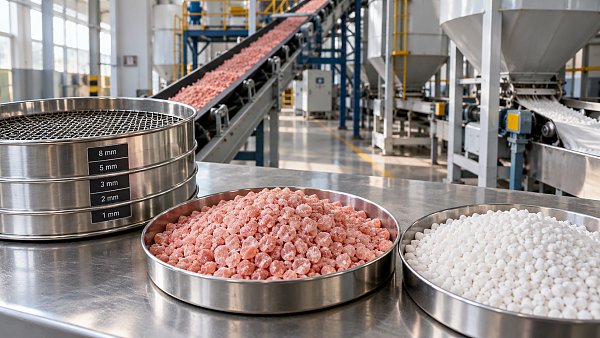
For physical bulk blending, granular SOP should be assessed alongside the actual nitrogen and phosphate materials. Matching nominal particle size is a useful starting point, but it does not establish that the blend will remain uniform through conveying, bagging, transport, and spreading.
Differences in particle-size distribution, density, shape, and surface texture can cause segregation. Fine material may migrate through spaces between larger particles, while handling and vibration can redistribute components within a bag or bulk load. A blend that meets its average laboratory analysis can still deliver uneven nutrient proportions across individual application passes.
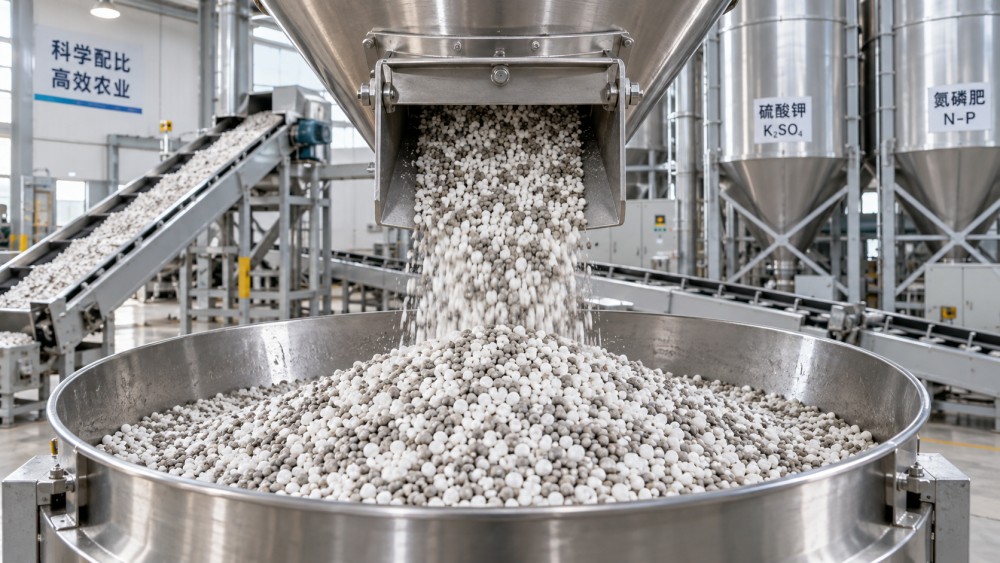
A practical evaluation should examine the following properties together:
- Particle-size distribution: Compare the full distributions of all major ingredients, including fines and oversized particles.
- Granule strength and abrasion: Determine whether handling generates dust or changes the size distribution before application.
- Density and shape: Assess their influence on segregation, hopper discharge, and spreader behavior.
- Moisture and surface condition: Check whether the materials remain free flowing under the expected storage conditions.
Acceptance limits should reflect the equipment and delivery chain. A blend produced close to the point of use faces different demands from one transported in bulk, transferred several times, and stored before spreading. Representative samples taken after handling provide better evidence of application consistency than samples taken only at the mixer outlet.
Caking also requires a blend-level assessment. Individually acceptable fertilizers can form a mixture that absorbs moisture more readily or develops stronger bridges between particles. The result depends on the complete composition, humidity, temperature cycling, storage pressure, and packaging. Potassium sulfate’s behavior by itself cannot predict the storage stability of an NPK mixture.
For blends containing urea, ammonium phosphates, or ammonium sulfate, evaluate the intended proportions under relevant storage conditions. Look for loss of flow, lump formation, increased fines, and changes in discharge behavior. An anticaking treatment may help, but it cannot compensate for uncontrolled moisture or severe physical mismatch.
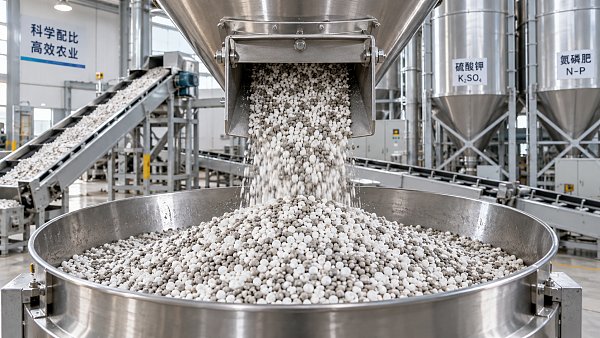
Manufacturing compound granules introduces a different set of requirements. SOP must perform within the granulation process, including wetting, agglomeration, drying, and recycle. A grade suitable for bulk blending is not automatically suitable for incorporation into every compound-fertilizer process. Pilot production should establish granule strength, nutrient distribution, and process stability before scale-up.
Water-soluble NPK formulas need a concentration and compatibility check
In a water-soluble formulation, potassium sulfate offers potassium without introducing nitrogen. This can help formulate a potassium-rich product while retaining control over the nitrogen level and nitrogen forms. Its practical limitation is the concentration that can remain dissolved in the complete solution, particularly in concentrated stock tanks and at lower temperatures.
A “water-soluble” designation does not establish that a grade will dissolve at every proposed stock concentration. Dissolution rate and equilibrium solubility are separate questions. Fine particles may dissolve faster, but reducing particle size does not remove the concentration limit of the final solution.
The relevant test conditions include water temperature, mixing intensity, addition sequence, solution composition, and holding time. A clear solution immediately after preparation may crystallize after cooling or standing. Testing only the diluted irrigation solution can miss a problem that occurs in the stock tank before injection.
Other potassium- and sulfate-bearing salts can also affect the concentration that remains dissolved. A solubility figure for SOP in pure water is therefore insufficient for approving a multicomponent NPK stock. The full formulation must be evaluated at the intended concentration and minimum expected operating temperature.
Calcium is a major separation decision
Concentrated calcium-containing solutions can react with sulfate to form calcium sulfate precipitate. Phosphate introduces additional precipitation risks with calcium. Fertigation programs using calcium nitrate alongside sulfate- and phosphate-containing fertilizers therefore commonly require separate concentrated stock solutions.
The appropriate separation depends on the complete recipe and injection arrangement. Keeping incompatible materials in separate tanks addresses concentrated-stock contact, but the diluted irrigation stream still needs evaluation. Water chemistry, dilution, mixing, and residence time influence whether solids develop downstream.
Hard irrigation water deserves particular attention. Calcium, magnesium, alkalinity, and pH can affect compatibility, especially in phosphate-containing formulas. Acidification may address some water-quality problems, but it should not be assumed to make every concentrated calcium-sulfate mixture stable.
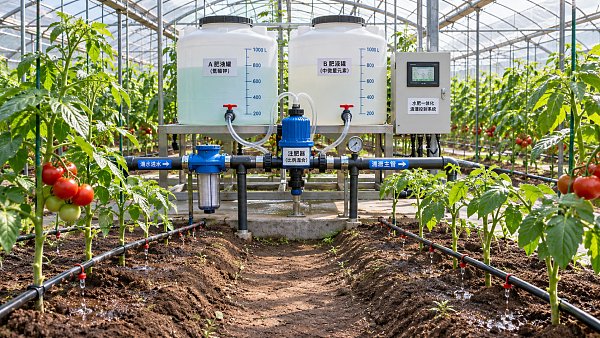
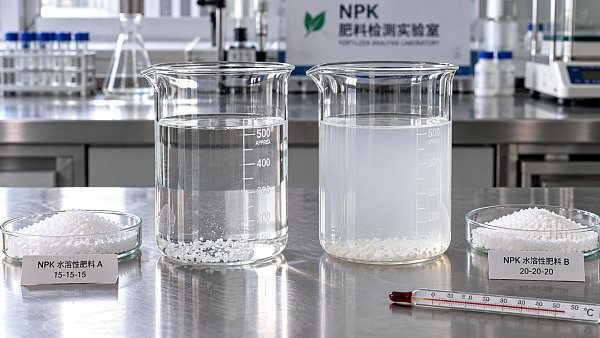
A useful bench assessment reproduces both stages of use: preparation and storage of the stock solution, followed by dilution with the actual irrigation water. Observe dissolution time, sediment, haze, crystallization after cooling, and filter residue. Where the system uses more than one stock tank, reproduce the intended dilution and mixing sequence.
Grade selection must also account for insoluble matter. Granular products may contain coatings, binders, or other components that are acceptable for soil application but unsuitable for fine filters and emitters. Specify insoluble residue and relevant impurities according to the application, and check those requirements against representative material. A high potassium assay alone does not establish fertigation suitability.
Approve the grade against the intended formulation
The most useful specification links each raw-material property to a finished-product requirement. For granular blending, that connection may be particle distribution to nutrient uniformity after transport. For water-soluble products, it may be residue and dissolution behavior to filtration performance at the intended stock concentration.
Begin by fixing the operating conditions: target NPK analysis, sulfur allowance, chloride limit, production route, application method, and expected storage or solution temperature. Without these boundaries, comparing two SOP grades can become an exercise in selecting the highest assay even when another property determines success.
The technical approval can then focus on three decisions:
- Does the nutrient balance work? Calculate the complete formula using guaranteed analyses, including sulfur and chloride contributions from all relevant materials.
- Does the grade perform in the intended route? Check handling and storage for granular blends, or dissolution, concentration limits, and precipitation for soluble formulations.
- Can production preserve that performance? Confirm that material variability, moisture control, mixing, packaging, and operating conditions remain within the limits established during evaluation.
These checks should use representative production material. A specially prepared sample may demonstrate chemical suitability without revealing the fines, moisture variation, or residue that affects routine use. Where a supplier offers several grades with similar nutrient declarations, their physical form and application specifications may matter more than a small difference in potassium content.
Cost comparison should follow the same formulation logic. Compare the cost of delivering the required potassium and usable sulfur in an acceptable finished product. If sulfur from SOP displaces another necessary ingredient, include that saving. If sulfur is already sufficient, it has no automatic additional value. Any need for greater stock dilution, extra handling, or a different production process also belongs in the comparison.
High potassium sulfate fertilizer earns its place in an NPK blend when its potassium and sulfur contributions match the nutrient program and its grade fits the delivery system. Approval should attach to a defined formula and operating range. A granular blend that remains uniform through transport, or a soluble formula that stays clear through preparation, cooling, and dilution, provides a concrete basis for proceeding to production.
Facing technical bottlenecks in manufacturing or looking for more efficient industrial solutions? Leave your details below and let the engineering experts at FCAS solve them for you.
We respect your privacy. Your information is strictly confidential.
Related News
 Polymer-Coated Water Soluble NPKHow to Use Calcium Nitrate Fertilizer in Drip IrrigationCalcium Nitrate Fertilizer in drip irrigation: learn how to calculate doses, mix stock solutions, prevent clogged emitters, and support healthy crops.MORE+
 Polymer-Coated Water Soluble NPK2026 Fertilizer Price Swings Shape 2027 Planting Decisions2026 fertilizer price swings are shaping 2027 planting decisions. Explore nutrient cost pressures and practical strategies for planning purchases.MORE+
 Polymer-Coated Water Soluble NPKRecord Fertilizer Prices Could Shape 2027 US Corn and Soybean Planting DecisionsRecord fertilizer prices could influence 2027 US corn and soybean planting decisions. Explore the potential impact on farm budgets and acreage.MORE+
 Polymer-Coated Water Soluble NPKUSDA Announces $1.34 Billion Investment to Expand Domestic Fertilizer SupplyUSDA’s $1.34 billion fertilizer investment targets eight domestic projects. Discover what the plans could mean for suppliers, buyers and future sourcing.MORE+
 Polymer-Coated Water Soluble NPKHow to Choose a Potassium Sulfate Fertilizer SupplierChoose a potassium sulfate fertilizer supplier with confidence. Compare product quality, delivered costs, reliability, and contract terms before you buy.MORE+
 Polymer-Coated Water Soluble NPKIndonesian Farmers' Association Warns of Prolonged Fertilizer ShortagesIndonesia fertilizer shortages could persist as high prices and supply disruptions strain farmers. Explore the risks for agriculture and the regional market.MORE+
 Polymer-Coated Water Soluble NPKEU Fertilizer Prices Remain High Amid Gas Costs and Supply DisruptionsEU fertilizer prices remain high amid gas costs and supply disruptions. Explore the impact on farmers, suppliers and purchasing decisions.MORE+
 Polymer-Coated Water Soluble NPKUS Commerce Department Recommends Keeping Duties on Moroccan Phosphate FertilizersUS Commerce Department recommends keeping duties on Moroccan phosphate fertilizers. Explore the findings and what comes next for exporters and US buyers.MORE+
 Polymer-Coated Water Soluble NPKWhen to Apply Sulfate of Potash Fertilizer to Chloride-Sensitive CropsSulfate of potash fertilizer timing can make all the difference. Discover when and how to apply it to chloride-sensitive crops for efficient nutrient delivery.MORE+
 Polymer-Coated Water Soluble NPKUS Commerce Department Says Ending Moroccan Fertilizer Duty Would Harm IndustryMoroccan fertilizer duty removal could harm the US industry, the Commerce Department says. Explore what the finding means ahead of the ITC vote.MORE+
 Polymer-Coated Water Soluble NPKGlobal Fertilizer Prices May Fall as Demand Weakens and Stocks Remain HighGlobal fertilizer prices may fall as weak demand and high stocks reshape the market. Explore what this could mean for purchasing and inventory planning.MORE+
 Polymer-Coated Water Soluble NPKWhen to Apply Potassium Sulfate Fertilizer for PotatoesLearn when to apply potassium sulfate fertilizer for potatoes, from pre-planting to tuber growth, and build a soil-test-based plan for your crop.MORE+
 Polymer-Coated Water Soluble NPKHow to Evaluate a Controlled Release Fertilizer Systems SupplierChoosing a controlled release fertilizer systems supplier? Compare release performance, quality, supply reliability, and total costs with this practical guide.MORE+
 Polymer-Coated Water Soluble NPKHow to Choose Potassium Chloride Fertilizer for Bulk BlendingChoose potassium chloride fertilizer for bulk blending with confidence. Learn how particle size, durability, and moisture affect blend quality—and compare suppliers beyond price.MORE+
 Polymer-Coated Water Soluble NPKUSDA Pushes Domestic Fertilizer Capacity as Analysts Expect Further Price DeclinesUSDA fertilizer policies and expanded domestic production could push prices lower. Explore what shifting supply expectations mean for farm input costs and buying decisions.MORE+
 Polymer-Coated Water Soluble NPKHow to Choose Fertilizer Coating Resins for Controlled ReleaseChoose fertilizer coating resins for controlled release with confidence. Compare release profiles, processing needs, durability, and total costs in this practical selection guide.MORE+
 Polymer-Coated Water Soluble NPKShould You Use Potassium Chloride or Coated NPK as Basal Fertilizer?Compare potassium chloride fertilizer for basal application with coated NPK. Discover how soil needs, chloride sensitivity, nutrient timing, and costs guide your best choice.MORE+
 Polymer-Coated Water Soluble NPKUSDA Selects Eight Fertilizer Projects for $573M Under FIELDS ProgramUSDA selects eight fertilizer projects for $573M under the FIELDS Program. Explore plans to add over 1 million tons of U.S. capacity and the potential impact on supply chains.MORE+
 Polymer-Coated Water Soluble NPKWhen Is Potassium Chloride Fertilizer with 60% K2O Right for Crops?Is potassium chloride fertilizer 60 k2o right for your crops? Discover how soil tests, chloride tolerance, and application timing guide smarter fertilizer choices.MORE+
 Polymer-Coated Water Soluble NPKAlgeria Directs Producers to Stop Urea Exports to FranceAlgeria reportedly halts urea exports to France, raising supply concerns for fertilizer buyers. Explore potential price risks and practical steps to protect procurement plans.MORE+
 Polymer-Coated Water Soluble NPKGlobal Fertilizer Uncertainty Complicates Buying for U.S. Corn and Soybean GrowersGlobal fertilizer uncertainty challenges U.S. corn and soybean growers. Explore supply risks, cost pressures and practical buying checks to make more informed purchasing decisions.MORE+
 Polymer-Coated Water Soluble NPKWhen Are Polymer-Coated Granular NPK Fertilizers Worth the Cost?Granular NPK Fertilizers: Are polymer coatings worth the premium? Compare release timing, application savings, and break-even costs to make a smarter fertilizer investment.MORE+
 Polymer-Coated Water Soluble NPKUAN32, UAN28 and Anhydrous Ammonia Lead US Fertilizer Gains in October 2026, Week 2UAN32, UAN28 and anhydrous ammonia lead US fertilizer price gains in October 2026, Week 2. Explore reported trends and key procurement checks before revising quotes, budgets or orders.MORE+
 Polymer-Coated Water Soluble NPKHow to Compare Fully Soluble NPK Fertilizer Grades Before BuyingCompare fully soluble npk fertilizer grades by nutrient balance, solubility, water compatibility, and batch quality. Learn what to check before buying to avoid costly mistakes.MORE+
 Polymer-Coated Water Soluble NPKChina’s Phosphate Fertilizer Export Collapse Squeezes Global SupplyChina’s phosphate fertilizer export collapse tightens global supply. Explore procurement risks, sulfur shortages and practical steps to verify suppliers and protect delivery plans.MORE+
 Polymer-Coated Water Soluble NPKHow Does High Potassium Sulfate Fertilizer Fit Into NPK Blends?See how high potassium sulfate fertilizer fits into NPK blends. Learn to balance potassium and sulfur, control chloride, and select the right grade for reliable performance.MORE+
 Polymer-Coated Water Soluble NPKHow Should You Apply Water Soluble NPK Fertilizers to Greenhouse Crops?Apply npk water soluble fertilizers for greenhouse crops with confidence. Learn precise dosing, fertigation, and EC/pH monitoring techniques to support healthy growth and avoid salt stress.MORE+
 Polymer-Coated Water Soluble NPKHow Fertilizer Coating Polymers Improve NPK Granule ReleaseFertilizer coating polymers for NPK granules improve controlled nutrient release, reduce loss risks, and enhance product consistency. Discover key selection and process insights.MORE+
 Polymer-Coated Water Soluble NPKHow Fully Soluble NPK Fertilizer Improves Precision FertigationFully soluble NPK fertilizer improves precision fertigation with clean injection, uniform nutrient delivery, flexible crop-stage feeding, and lower clogging risk. Learn practical system-management tips.MORE+
 Polymer-Coated Water Soluble NPKHow Potassium Chloride Fertilizer 60 K2O Supports Crop YieldPotassium chloride fertilizer 60 K2O supports crop yield with efficient potassium nutrition. Explore benefits, chloride considerations, application tips, and smarter fertilizer selection.MORE+
 Polymer-Coated Water Soluble NPKWhat Determines Fertigation Systems Price and Long-Term Operating CostFertigation systems price depends on capacity, automation, filtration, water quality, and fertilizer compatibility. Explore total ownership costs and compare suppliers smarter.MORE+
 Polymer-Coated Water Soluble NPKHow Drip Irrigation Fertilizers Improve Nutrient EfficiencyDrip Irrigation Fertilizers improve nutrient efficiency with precise root-zone feeding, smarter timing, and reduced waste. Discover practical fertigation strategies.MORE+
 Polymer-Coated Water Soluble NPKHow to Choose Resin Coated NPK Fertilizers for Efficient Nutrient ReleaseResin Coated NPK Fertilizers: learn how to match release duration, nutrient profiles, granule quality, and supplier reliability to your crop programme for better efficiency and lower costs.MORE+
 Polymer-Coated Water Soluble NPKWhich Specialty Fertilizers Best Support High-Value Crop Production?Specialty Fertilizers for high-value crops: compare controlled-release, water-soluble, micronutrient, and biostimulant options for precision, quality, and reliable results.MORE+
 Polymer-Coated Water Soluble NPKWhat Fertilizer Coatings Mean for Nutrient Efficiency and Cost ControlFertilizer Coatings improve nutrient timing, cut loss risk, and support cost control. Discover how coated fertilizers can boost efficiency and strengthen field performance.MORE+